A Local-First Agent for Private and Cost-Effective Knowledge Work
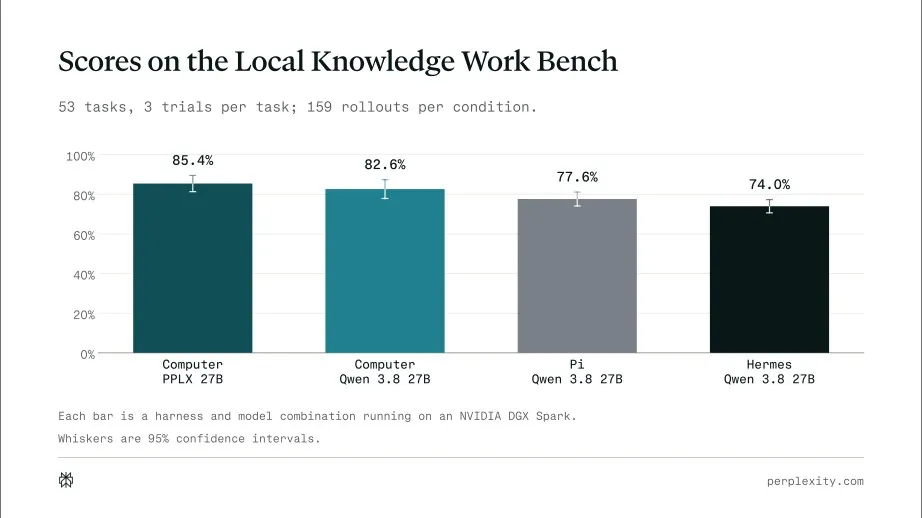
Perplexity details Portable Computer, a local-first agent whose model, harness, conversation and trajectory live on-device by default, with web search, connectors and cloud advisor escalation only on user-approved demand. A lean local harness (on-demand skills, CLI connectors, self-verification, sandboxed execution) is co-designed around Qwen 3.8 27B, then post-trained into PPLX 27B. On the 53-task Local Knowledge Work Bench, Computer scores 82.6% vs Hermes 74.0% and Pi 77.6%, rising to 85.4% with PPLX 27B; it also leads BrowseComp (66.7%) and ParseBench-100 (65.1%) with the least time and tokens, while advisor escalation recovers ~3/5 of the Terminal Bench 2.1 frontier gap at ~2/3 of frontier cost.
Perplexity Portable Computer is a local-first agent.
The entire stack runs locally by default. The model, harness, conversation, and trajectory all live on the user's machine. Work that needs the outside world, such as web search, connectors, or escalation to a stronger advisor model on the cloud, is invoked only when necessary and always gated by the user. Sensitive data therefore never leaves the device without permission, and local models carry no inference fee: the system is private and cost-effective by construction.
An effective local-first agent requires the model and harness to be designed together. General-purpose harnesses assume a frontier model that can absorb long contexts, navigate a broad tool surface, and plan over long horizons. Local models are less reliable under those demands. Rather than asking a small model to manage a harness built for a large one, Perplexity shaped the two around each other: a harness tailored to the model's capability profile, and a model post-trained to use that harness effectively.
Introduction
Agentic capabilities have advanced rapidly in recent months across a wide range of knowledge-work tasks. While these advances bring large gains in productivity and efficiency, they also pose two challenges.
Token consumption is rising quickly, and with it overall spend. When intelligence is accessed through the APIs of closed-source models running on remote clusters, private information and intellectual property leave the user's device with every request. As agents scale across individual workflows and entire organizations, token expenditure and data movement become increasingly difficult to govern.
At the same time, open-source models have improved at an even faster rate. Progress is most visible in very small and efficient models such as NVIDIA Nemotron 3.5 Lightning (30B total parameters), Qwen 3.6 (35B), and Qwen 3.8 (27B). These small models punch above their weight and are now capable of complex agentic workflows. Local-inference hardware is advancing in parallel: systems such as the NVIDIA DGX Spark can now run these models locally. Together, these trends make fully on-device operation practical while allowing users to opt into external capabilities when needed, such as web search, connectors, or cloud-model escalation.
This local-first approach enables significant cost savings, since local inference avoids per-token API fees. It also naturally resolves the privacy and intellectual-property concerns: private tokens never need to be transmitted to remote clusters and remain safely within the boundary of the local device.
In June, Perplexity introduced the first hybrid local-server inference orchestrator that decides what work should run on-device and what work should go to agents in the cloud. This article explains how they built such a local-first agent, including the harness and the models co-optimized for one another.
The post gives an overview of the key design choices, and evaluates Computer — the Perplexity local harness — against popular open-source general-purpose harnesses (Hermes and Pi) across three public benchmarks and an internal Local Knowledge Work Bench. On that benchmark, with the Qwen 3.8 27B model running on an NVIDIA DGX Spark, Computer achieves the highest score: 82.6% versus 77.6% for Pi and 74.0% for Hermes. PPLX 27B, a model post-trained on top of Qwen 3.8 27B, raises the score further to 85.4%.
Design the harness around the local model
Although compact on-device models are already quite capable, they still trail larger frontier models in performance. A carefully designed harness is needed to steer these models effectively and to address their limitations.
Popular open-source harnesses such as Pi and Hermes have proven to be general: they work well with a wide variety of models across sizes and classes. But they are not optimized for the capabilities of on-device models. The local harness was designed specifically for this setting, around a few key principles.
Context efficiency
The main focus in designing the harness was to make the best use of the model's context.
Although on-device models such as Qwen 3.8 27B offer context windows of 260K tokens, the team found empirically that they begin to struggle beyond 100K tokens. They therefore keep the core harness succinct: a minimal system prompt and a small set of core tools.
All other capabilities are modularized into on-demand skills that load and unload throughout the trajectory. These skills are designed for common knowledge-work tasks: research, data science, data visualization, document creation, software engineering, and more.
The harness also supports context compaction, summarizing stale context when a trajectory grows long so the model stays within its effective window.
Connectors as command-line tools
Day-to-day knowledge work often requires connectors such as Gmail, GitHub, Outlook, and Google Calendar. These are usually exposed to a harness as MCP servers, whose large tool definitions consume a substantial share of the context. Instead, Perplexity converted the most-used MCPs into compact, easy-to-use command-line tools, supplemented with custom skills that make far better use of the limited effective context.
Self-verification
Performance also improves when the agent verifies its own work. Verification adds extra steps, but it greatly improves final results and substantially narrows the gap to frontier models. It can be triggered by the model itself or by a set of hooks that monitor the health of the trajectory and request self-verification when something goes wrong.
Sandboxed execution
The harness executes tools in an OS-level sandbox on the user's device. The boundary restricts processes, filesystem paths, and network access according to policy. This limits the blast radius of an erroneous command. If the sandbox is unavailable, the harness disables itself before any tool calls rather than degrading to unsandboxed execution.
This differs from open-source harnesses such as Pi and Hermes, which run commands directly with the user's permissions by default. In Computer, isolation is always on, requires no configuration, and tools cannot run without it.
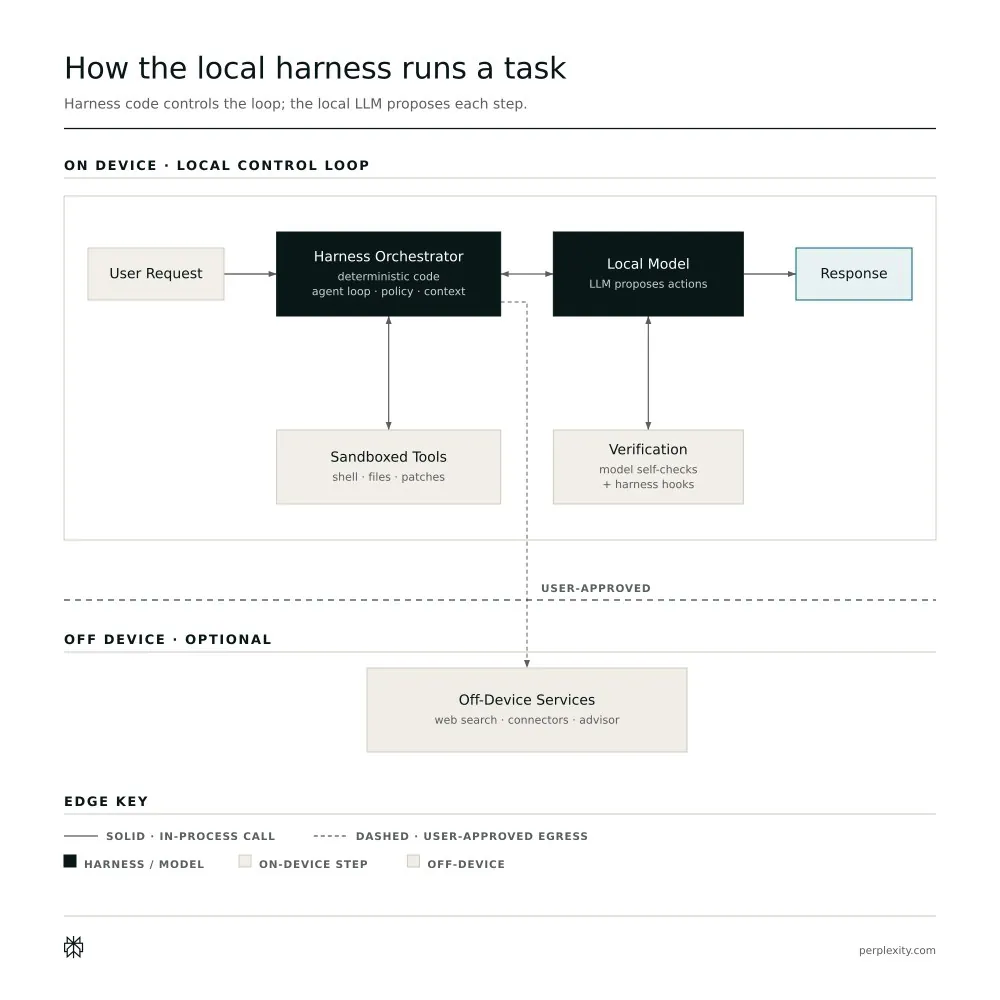
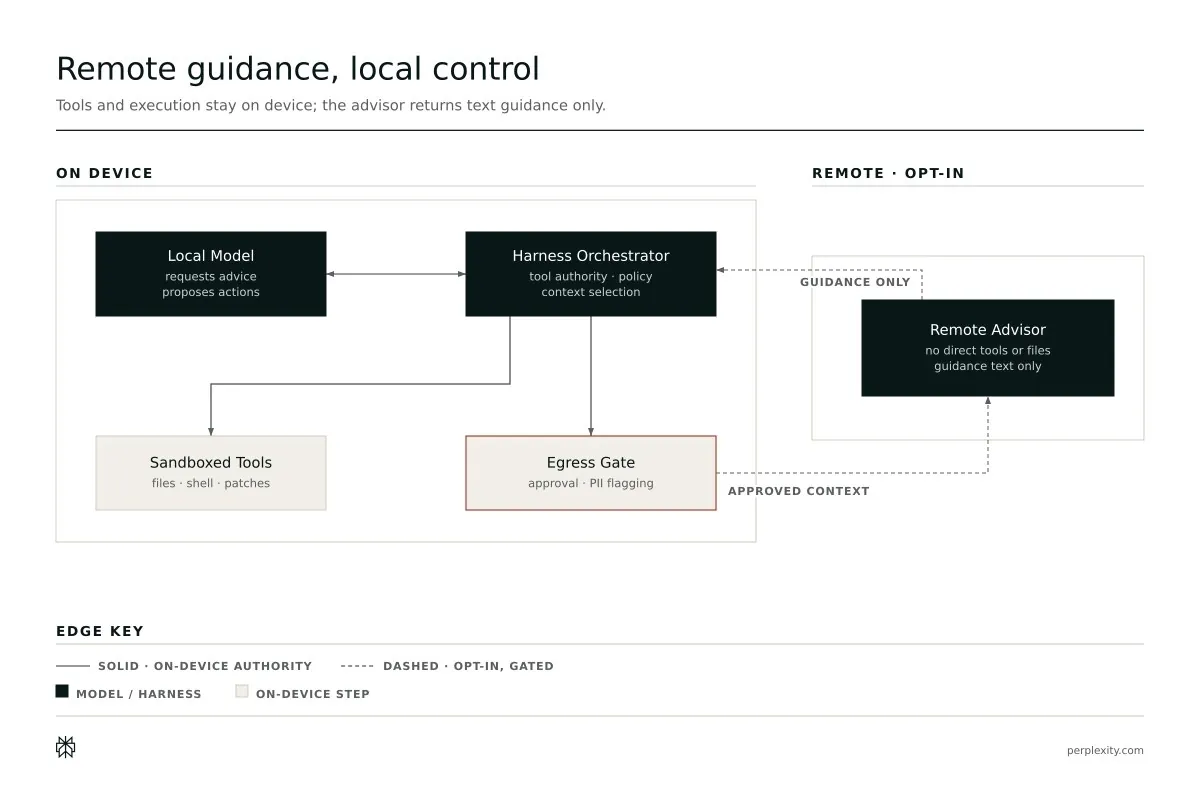
The diagram above shows how these principles fit together in the execution loop. The orchestrator is deterministic harness code, not an LLM: it maintains the loop, assembles context, and enforces policy. The local model proposes the next action; the orchestrator executes approved tool calls in the sandbox and returns their results to the model. Web search, connectors, and advisor calls cross the device boundary only when enabled and approved.
A local harness makes more of the same model
Using the same on-device base model, the local harness was compared with general-purpose alternatives on web research and multimodal document understanding. All harnesses use the Qwen 3.8 27B model with medium reasoning, running on an NVIDIA DGX Spark. This comparison isolates the capabilities contributed by the harness itself, before any model post-training.
The focus is on these two capabilities because knowledge work often combines private documents on the user's device with public information from the web to produce a grounded artifact. Web search requires connectivity, but model inference and private-document processing remain local. Local files serve as the authoritative source, public sources add context, and users can disable web search entirely for fully offline work.
Web research
The local harness was built alongside Perplexity's search engine, which has achieved top rankings in independent evaluations. The harness accesses it through the Search as Code interface.
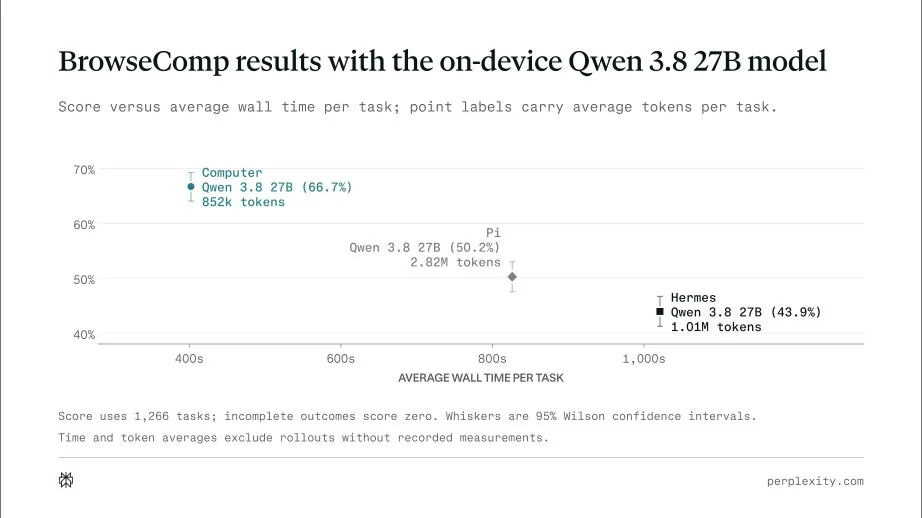
Research quality was evaluated on 1,266 BrowseComp tasks. Computer uses Perplexity's search infrastructure along with the local harness, while Pi and Hermes rely on Brave, their recommended search provider. Computer reaches 66.7% accuracy, compared with 50.2% for Pi and 43.9% for Hermes.
Computer also has the lowest mean recorded wall time and token use: 402.1 seconds and 852k tokens per task, compared with 1,020.9 seconds and 1.01 million tokens for Hermes, and 826.0 seconds and 2.82 million tokens for Pi. Computer therefore uses 61% less wall time and 16% fewer tokens than Hermes, and 51% less wall time and 70% fewer tokens than Pi.
On-device multimodal document understanding
Many documents carry information visually and are difficult to parse as plain text: PDFs, scanned pages, screenshots, charts, and presentations. These workflows depend on OCR and image understanding, and benefit most from a natively multimodal model.
The harness passes document pages and images directly to the model, which understands them and combines visual evidence with the extracted text. Processing these files on device keeps sensitive documents and their extracted content private.
Multimodal document understanding was evaluated on ParseBench-100, a 100-task subset of the ParseBench benchmark, with 20 tasks each for charts, layout, tables, text content, and formatting.
Computer reaches a mean score of 65.1%, compared with 34.6% for Hermes and 13.9% for Pi. It also completes tasks with the least time and the fewest tokens: on average 60.6 seconds and 20.1k tokens per task, compared with 108.3 seconds and 32.1k tokens for Hermes, and 410.5 seconds and 829.1k tokens for Pi. Computer leads in all five document categories, with its largest advantage on charts. Layout remains difficult for all three harnesses.
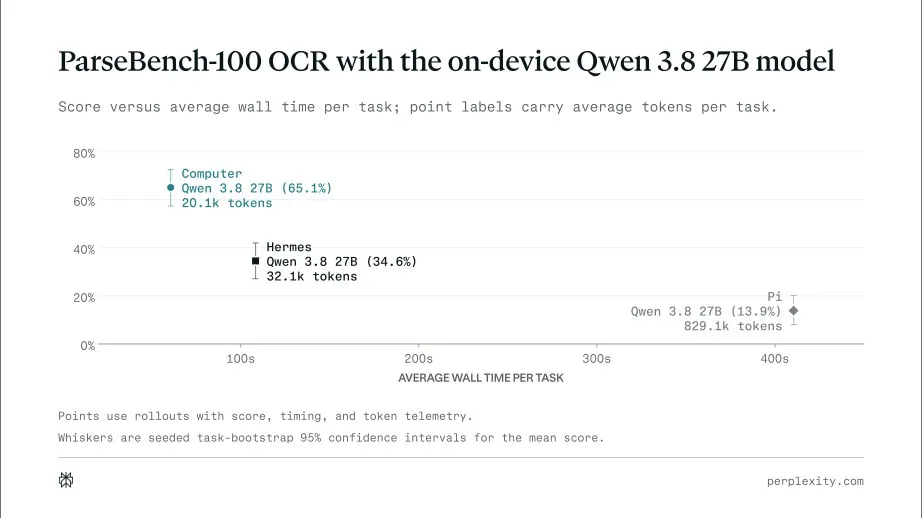
Table 1. ParseBench-100 mean score by document category for the Computer, Hermes, and Pi harnesses with the on-device Qwen 3.8 27B model. Computer leads in all five categories.
| Harness | Chart | Layout | Table | Text content | Formatting |
|---|---|---|---|---|---|
| Computer | 76.5% | 16.2% | 72.7% | 87.9% | 72.4% |
| Hermes | 29.3% | 2.9% | 44.1% | 61.5% | 35.2% |
| Pi | 2.5% | 0.1% | 11.0% | 29.7% | 26.1% |
Narrowing the frontier gap with advisor escalation
Even with a carefully designed harness, the hardest tasks still exceed the capabilities of a compact on-device model. For such tasks, the harness exposes an advisor tool: the local model can consult a stronger frontier model when it needs help with planning, resolving ambiguity, recovering from repeated failures, or verifying the final result.
The local model decides when to request advice, while the harness orchestrator retains tool authority and controls what context is sent. Escalation is optional. The user decides whether to enable it and whether to approve each advisor call manually or automatically.
Before an advisor call, the harness selects the relevant context, applies a PII classifier to flag sensitive information, and shows the user what would leave the device. The advisor receives only the approved context and returns text guidance; it has no direct access to the device's files, tools, or conversations. This improves both cost and privacy, and the team plans to explore this direction further in future work.
This approach was tested on challenging software engineering tasks, which demand strong reasoning and are where a local model most often falls short. The evaluation uses Terminal Bench 2.1, a popular 89-task benchmark for coding agents.
Two questions are in play: how much of the gap to a frontier model can advisor escalation close, and at what cost. Fully local models cost virtually nothing to run, since inference happens on the user's hardware. Once the model starts calling the advisor, however, it begins to incur API costs.
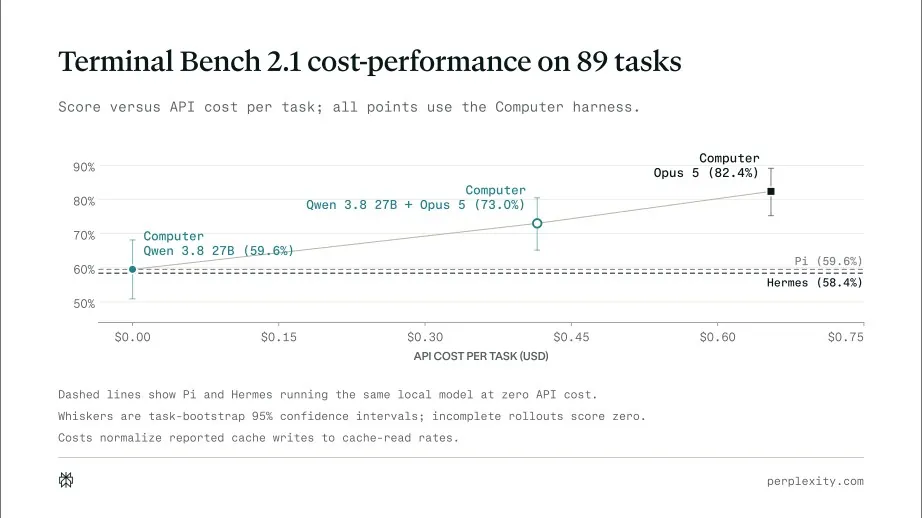
As the baseline for frontier performance, the evaluation uses Claude Opus 5 operating in the local harness; the local model is Qwen 3.8 27B. Finally, the two are paired: Qwen 3.8 27B executes the task and escalates to a Claude Opus 5 advisor when it needs help. Advisor escalation was not evaluated with Pi or Hermes because neither provides an equivalent advisor tool; adding one would require modifying their tool surface and orchestration logic, so the result would no longer represent the off-the-shelf harness.
Advisor escalation raises Computer's score from 59.6% to 73.0%, a gain of 13.5 percentage points, at an estimated API cost of $0.415 per rollout. Running Claude Opus 5 alone reaches 82.4% at $0.65 per rollout. Escalation thus recovers roughly three-fifths of the gap to the frontier at about two-thirds of the frontier's cost, and the user decides when that trade is worth making.
Post-training for the harness and knowledge work
So far, the local model was kept unchanged to isolate what the harness contributes. With the harness design in place, the biggest remaining gains come from adapting the model itself. Perplexity Computer usage data shows what people actually do for knowledge work, which is used to synthesize training data. The local model is post-trained inside the Computer harness, guided by the real distribution of tasks that users perform.
Concretely, the team identifies a diverse set of use cases that exercise different model capabilities, tools, and connectors. From these use cases they synthesize realistic reinforcement learning environments and define challenging but verifiable tasks: each task consists of an instruction, an environment, and a verifier that scores the final result, where the environment is a Docker container in which the harness operates. Importantly, because the tasks are synthetic, they contain no real documents or user information.
These environments are used for two-stage training: rejection fine-tuning followed by reinforcement learning. In the first stage, the model is rolled out against each task multiple times, the best trajectories are selected by verifier score, and the model is trained on them with supervised learning. This stage initializes the model for the specific harness and task distribution. In the second stage, reinforcement learning further fine-tunes the model, making it more robust.
A subset of tasks is held out from training and used for final evaluation; this held-out set is called the Local Knowledge Work Bench: 53 tasks spanning seven categories of day-to-day knowledge work, from deep research to document creation. Perplexity will soon publish a technical report describing the model training in detail, and plans to open-source this evaluation benchmark.
Qwen 3.8 27B was post-trained with this approach, producing a model called PPLX 27B, and evaluated on the Local Knowledge Work Bench. With the base Qwen 3.8 27B model, Computer achieves the highest score (82.6%, compared with 77.6% for Pi and 74.0% for Hermes) and uses the fewest tokens (520k, versus 681k for Pi and 634k for Hermes). Pi completes tasks fastest at 176 seconds per task, compared with 218 seconds for Computer and 292 seconds for Hermes. PPLX 27B lifts Computer's score to 85.4%, at the cost of more tokens (678k versus 520k). Its estimated wall time is 250 seconds.
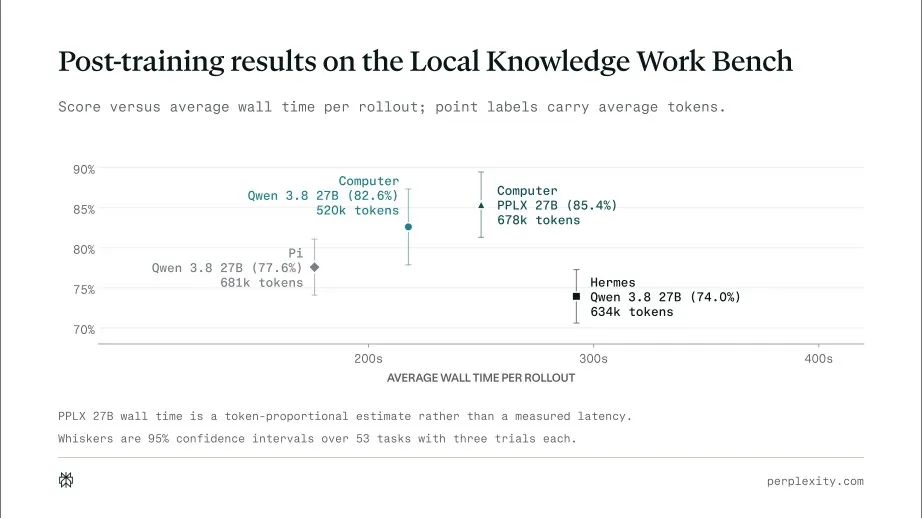
Table 2. Local Knowledge Work Bench task categories.
| Category | Tasks | Share | Description |
|---|---|---|---|
| Deep research | 20 | 37.7% | Answer complex questions requiring multi-hop web research, public datasets, statistics, and source verification. |
| Data, finance, and procurement | 9 | 17.0% | Clean datasets, reconcile records, audit expenses, analyze investments, evaluate suppliers, and calculate financial metrics. |
| Documents, presentations, and design | 7 | 13.2% | Produce polished PDFs, invoices, onboarding materials, event collateral, and business presentations. |
| Engineering, IT, and incidents | 5 | 9.4% | Investigate incidents, analyze logs, write recovery plans, assess release readiness, and synthesize technical documentation. |
| Contracts, evidence, and compliance | 5 | 9.4% | Review contracts, screen evidence, investigate recalls, redact sensitive documents, and verify compliance requirements. |
| Dashboards, software, and visualization | 4 | 7.5% | Build interactive dashboards, educational microsites, charts, and project visualizations. |
| People, projects, and meetings | 3 | 5.7% | Screen résumés, consolidate meeting decisions, and maintain project action trackers. |
| Total | 53 | 100% |
Conclusion
The research shows that a strong open-source model, with capable local hardware and a harness built for them, can handle real knowledge work at near-zero inference cost without requiring sensitive data to leave the device.
Across the various benchmarks, Computer matched or exceeded Hermes and Pi in accuracy while running Qwen 3.8 27B on an NVIDIA DGX Spark. Among the three benchmarks that report latency and token use, Computer was fastest on BrowseComp and ParseBench-100 and used the fewest tokens on all three; Pi was fastest on the Local Knowledge Work Bench.
The gains came from deliberate choices: a succinct local harness with skills that load on demand, connectors converted into compact CLI tools instead of MCP servers, and sandboxed execution for security.
The results also show where compact models have room for improvement. For example, on the challenging coding tasks of Terminal Bench 2.1, the local model trails the frontier model across all three harnesses. Advisor escalation narrows but does not fully close the gap; continued improvements in model capabilities and local hardware are still needed to push performance further.
The purpose of building the harness and model for local constraints is to give users explicit control over what information leaves their machines. There are also cost benefits to the user. These are part of a broader shift in which increasingly capable agents move from remote infrastructure to individual and local devices. Advances in chips, models, and devices will continually expand the range and quality of knowledge work that Portable Computer handles locally.
Source: Perplexity Engineering — "A Local-First Agent for Private and Cost-Effective Knowledge Work" (Perplexity Blog, 2026-08-25)