
OPEN SOURCE DEEP DIVE
Content Studio: An Open-Source Design Agent
LangChain’s Content Studio turns Slack requests into code-rendered stills, decks, charts, and films using isolated sandboxes, reusable design skills, async helpers, and deterministic brand gates.
LangChain’s newly open-sourced design-agent is not another prompt-to-image toy. Inside the company it is called Content Studio, and its objective is to turn design production into an inspectable workflow. A colleague describes the deliverable in a Slack thread. The agent then works in an isolated Linux sandbox, reads the brand pack, writes pages and animation timelines, invokes rendering tools, looks at its own output, runs deterministic checks, and returns finished files.
The important shift is not that a model has suddenly acquired taste. LangChain moved design judgment into the environment around the model. The model supplies concepts and code. The renderer turns code into artifacts. The sandbox preserves a project across turns. Slack provides a multiplayer interface. Background helpers let a production run for hours without blocking the conversation. The company calls this combination a media-production harness, and the public repository exposes a runnable version of it.
The problem is repeated design work, not a missing image generator
The original need was concrete. LangChain runs product launches, webinars, blog posts, and events. Every initiative needs headers, diagrams, decks, videos, and ad creatives. Repetitive requests consumed the design team’s time and crowded out work that required more judgment. Content Studio therefore does not begin with the claim that an agent should replace a designer. It begins by giving product managers, engineers, and founders a way to execute clearly scoped production work within the company’s existing standards.
The public release can produce stills, ad sets in multiple sizes, decks, charts, diagrams, thumbnails, storyboards, and motion graphics. Slack is the primary experience, but it is not the only surface. The same agent assembly can run through Managed Deep Agents, a self-hosted HTTP API, a command-line interface, or LangSmith Studio. Those surfaces share the creative logic and differ only in where the sandbox comes from, how files are delivered, how the lead is awakened, and where state is persisted.
That distinction separates two questions that are often mixed together. Can the model write HTML, chart specifications, and animation timelines? And can a team repeat the work reliably while confirming that type, contrast, logos, dimensions, and output contracts do not drift? The first question improves as foundation models improve. The second is the product engineering problem the team owns.
What happens to one request
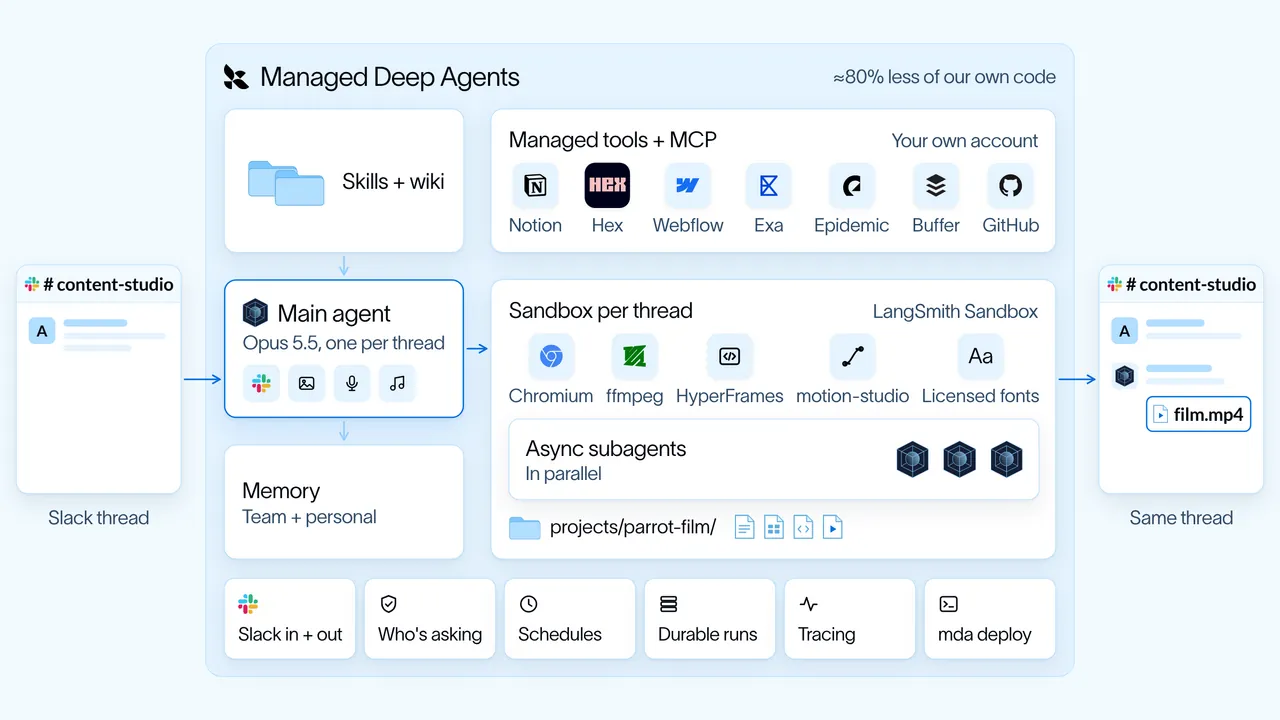
A user mentions the agent in a Slack thread and attaches a brief, source material, or an existing file. The managed runtime moves those attachments into the thread’s sandbox. Before the turn starts, it stages the skills’ scripts, gates, brand pack, and fonts into a workspace. The lead reads a short always-on instruction set and a list of skills, routes the request through the media-production skill, and creates a project folder with a brief and a plan.
A single card may be finished in the current turn: write the page, render it, inspect it, pass the gates, and deliver it. A film or a long deck is different. The lead explores directions, divides the production into pieces, and hands those pieces to background helpers. It then ends its turn so people can continue the conversation. Helpers work against the same project files. The runtime wakes the lead when a helper finishes, fails, or stalls. Finals return through a host-side delivery tool and are recorded in a ledger so the same file is not sent twice.
Two trust boundaries are central to this sequence. Model output, user files, Slack messages, canvas content, and web pages are data, not higher-priority instructions. Credentials stay outside the sandbox. Host tools may hold keys to fetch assets, generate images, synthesize voice, inspect traces, or upload final files, but the model-generated code that runs inside the sandbox does not receive those keys.
One assembly, several runtime profiles
The least glamorous architectural decision may be the most important. Managed Deep Agents, the self-hosted API, Slack, and the CLI do not maintain separate copies of the agent. They use one shared assembly of models, tools, middleware, subagents, memory policies, and instructions. A runtime profile supplies only the parts that genuinely differ: sandbox access, file delivery, wake-ups, and durable state.
| Runtime | Sandbox and state | Delivery and background work | Best fit |
|---|---|---|---|
| Managed Deep Agents | LangSmith sandbox per thread; managed memory, schedules, and tracing | Native Slack integration, one-time runtime schedules, host tools | Teams that want the complete team workflow without operating the infrastructure |
| Self-hosted service | Docker containers for sandboxes; Postgres for checkpoints, ledgers, transcripts, and observations | HTTP API, optional Slack app, in-process waker, maintenance loop | Organizations that need infrastructure control and can operate a dedicated Docker host |
| CLI | Local sandbox and workspace; the process stays available for background work | Prints tool steps and writes final files to the local output directory | Development, evaluation, and one-off production |
| LangSmith Studio | Managed deployment and runtime state | Files can be inspected through the run trace | Debugging and single-turn requests, not jobs that need background wake-ups |
This pattern prevents a familiar kind of drift. A skill fixed in Slack does not become a different behavior when the same agent is called through the API. It also makes the repository easier to evaluate. A developer can run the keyless demo with a scripted model, observe the sandbox and gate sequence, and only then connect a real model provider.
Every thread gets a designer’s computer
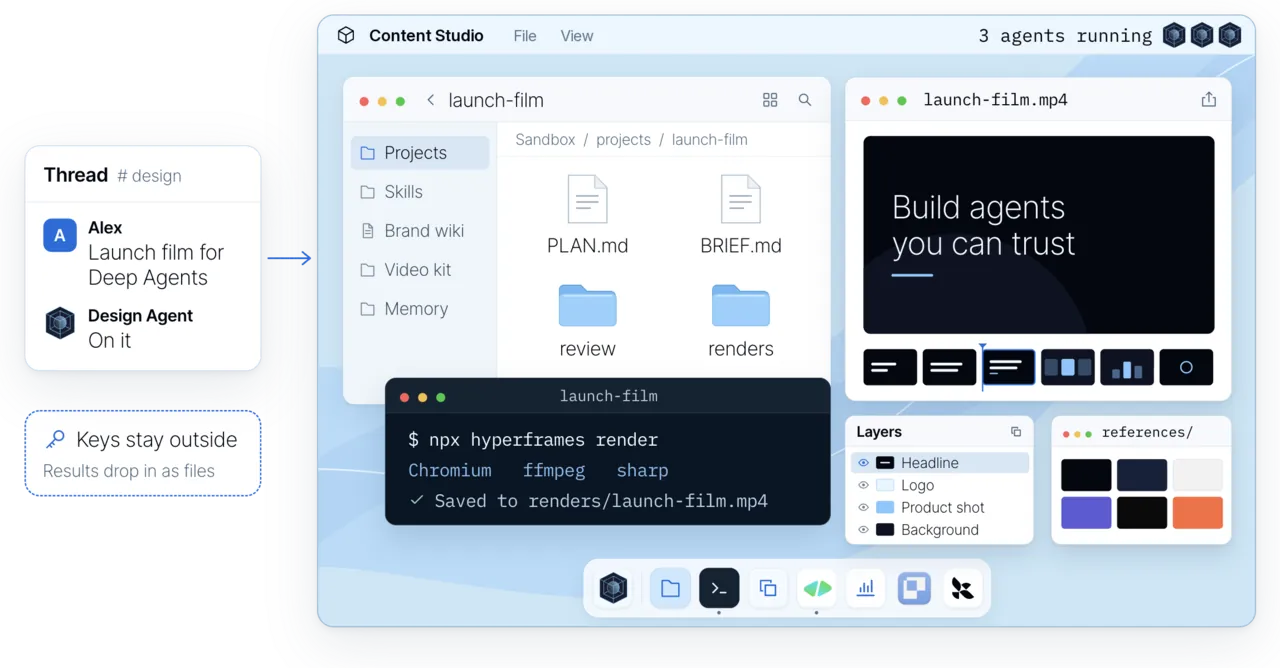
An image-generation endpoint usually treats each request as a transaction: submit a prompt, receive an image, end the state. Design work is iterative. Someone asks to move a title, bring the protagonist in two seconds earlier, preserve the previous palette, or change only one chart series. Without a persistent workspace, every edit risks becoming a fresh generation.
Content Studio gives every Slack thread its own sandbox. The documented Managed Deep Agents default is 8 vCPUs and a 16 GiB disk. Files live in a project directory and persist between turns. The image contains Chrome Headless Shell, HyperFrames, ffmpeg, sharp, ECharts, D2, open fonts, and the Node rendering toolchain. One version-pinned recipe builds the local Docker image, the LangSmith sandbox snapshot, and the CI image.
Everything the agent ships is made from code. A slide is an HTML page. A data graphic is a structured specification. A film is a web page with an animation timeline. Image editing is a sequence of reproducible file operations. If a user asks for the parrot to arrive earlier, a timing value changes and the film renders again without regenerating the artwork or copy. Audio sits on the same timeline, keeping narration, music, and effects synchronized with visual events.
The public video path uses HyperFrames, an open-source engine from HeyGen that treats a film as a web page. LangChain’s article also describes its private motion-studio canvas engine, which blends multiple moments to produce motion blur, glow, and three-dimensional logo movement. The article explicitly says the parrot film used that engine. The public repository does not contain motion-studio. A team can therefore reproduce the HyperFrames-based editing and rendering architecture, but should not claim that the public release includes the full private animation engine used for LangChain’s most polished examples.
Taste comes from context, not from asking for a premium look
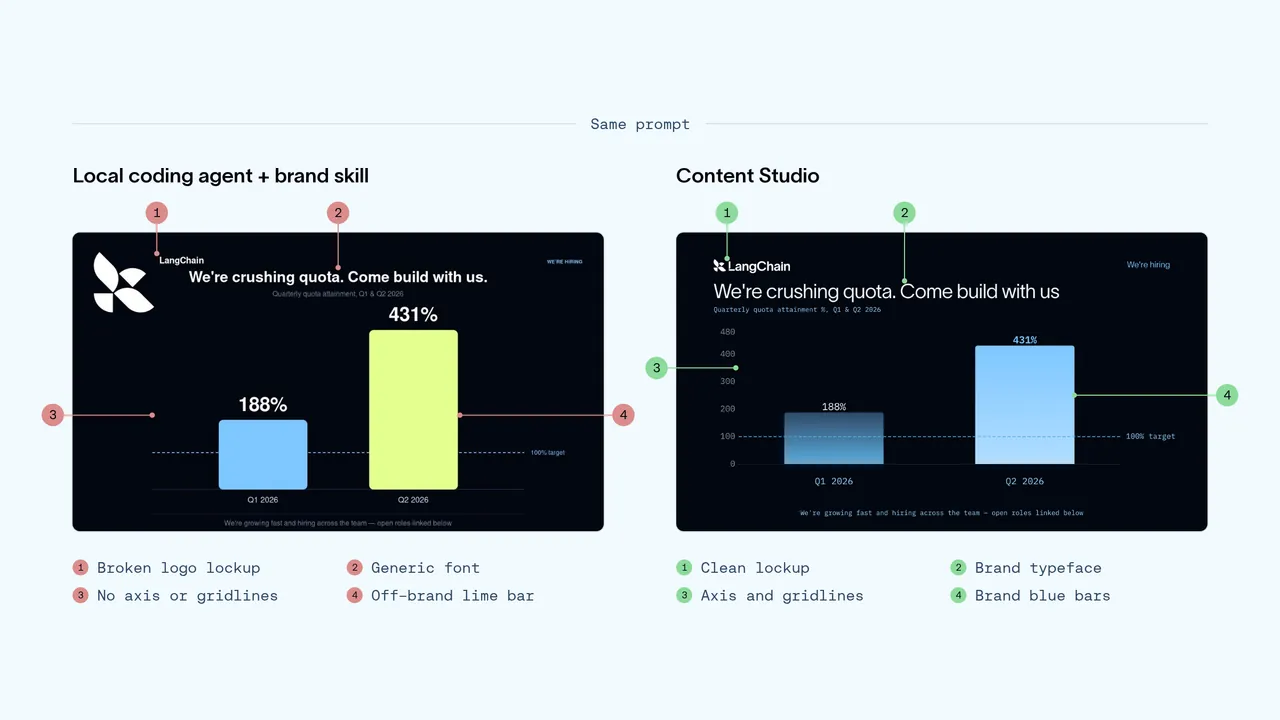
LangChain’s diagnosis is that foundation models can already execute. They can write HTML and CSS, encode chart specifications, and author animation timelines. What they lack is the organization’s point of view. Given an underspecified brief, they fill gaps with the most common patterns in their training data. The result can look polished and still resemble a hundred other pieces, or animate beautifully without making its point.
The remedy is not a larger pile of adjectives. Content Studio separates design context into four functions. Skills define how a kind of work is performed. A design wiki explains what the company considers good. A brand pack supplies facts such as tokens, typefaces, logos, voice, and graphic language. Deterministic gates handle everything a machine can count. Memory stores rules that people teach the system over time.
| Context layer | Question it answers | Where it lives | Why it must remain separate |
|---|---|---|---|
| Skills | What workflow applies, and when should another workflow be used instead? | Task-scoped skill directories plus a router | Workflows compose; copying them into every brand document creates drift |
| Design wiki | How should hierarchy, type, color, charts, platforms, and reviews work? | Text references and case studies | Shared craft knowledge should be updated once and linked from many skills |
| Brand pack | Which colors, fonts, marks, and language are actually allowed? | Structured tokens, font manifest, graphic language, voice, and logos | Brand facts must outrank model taste and incidental styles in references |
| Gates | Do dimensions, contrast, font resolution, chart math, and animation determinism pass? | Scripts and command-line checks in the sandbox | Measurable constraints should not depend on model attention or goodwill |
The public release differs from the internal deployment in one inventory detail. The article says LangChain uses 48 skills and close to 1,000 files. The repository README says 35 skills. The pinned public commit inspected for this article has 36 top-level skill entry points and 1,211 version-controlled files. The most plausible explanation is that the article describes the internal branch at publication time while the open-source branch was curated separately. This review treats 36 as the reproducible public count and does not present 48 as a property of the public checkout.
A storyboard becomes the production contract
Motion makes wrong decisions expensive. LangChain reports that a storyboard frame can render in roughly 50 milliseconds, while one second of finished film takes 8 to 40 seconds. If the visual direction is wrong, more helper work and more rendering only amplify the error. Content Studio therefore explores cheaply, then increases fidelity in stages.
The first stage is a storyboard that agrees on visual direction, copy, and shots. The second is an animatic, a rough cut timed to the real audio, which exposes pacing that stills cannot show. Production comes third, when helpers build, check, and render the approved shots. The sequence originally lived only in skill instructions. The agent sometimes skipped a review to save time. The public harness now enforces the order in code: assembly waits until every act passes review. Creative judgment remains in prompts. The order that must not be skipped remains in software.
Teams also need to compare directions spatially. Slack is useful for discussion but poor for pointing at a frame. Comments such as “move the blue block near the upper-left corner a little right” are slow and ambiguous. LangChain connects Paper as a shared design canvas. People and the agent can edit the same file, compare alternatives side by side, comment on specific frames, and preserve direct human edits. The next agent iteration reads those changes.
Paper’s agent tools were originally available only inside its desktop application, while the agent operated in a cloud sandbox. The repository bridges the two by running Paper Desktop behind a headless Linux worker with a virtual display and authenticated bridge. A local mode is also available for self-hosted use. The important lesson is larger than the integration: collaboration cannot be reduced to plain chat. A useful design agent needs to see what a person points at and read the modifications a person makes.
The lead becomes a chief of staff
A long deck or film is too large for one synchronous turn. Synchronous subagents do not solve the interaction problem either: the lead waits for them to finish while people cannot effectively steer the work. Content Studio changes the lead’s role from primary implementer to coordinator. It decomposes the job, writes helper briefs, monitors the project, and keeps the team informed.
Each helper receives a brief with its role, relevant context, file ownership, and validation expectations. The lead chooses model and reasoning effort based on task difficulty. Helpers share the project folder, but each writes only the files it owns. Progress remains on disk. A helper has a heartbeat, a durable transcript, and the ability to receive steering notes. When a new message arrives, the lead can pass it to the active helper before that helper’s next model call.
The control plane is an event spine. Every event identifies its kind, thread, source, label, human-readable sentence, and structured data. An attention policy maps each event to one of three levels. NOW wakes the lead for a completed, failed, interrupted, or stalled task, or when a person must act. NEXT carries progress notes and pipeline steps into the next turn. LOG records starts, per-frame progress, and usage without spending a model call. Unknown event kinds wake the lead so that unrecognized news is not silently lost.
| Reliability problem | Implemented response | Remaining limitation |
|---|---|---|
| Nobody notices when a background helper finishes | Events target a thread inbox; failed wakes retry after 10 seconds, 1 minute, and 5 minutes | Managed schedules still have minute-level latency |
| A process restart kills active helpers | A heartbeat is refreshed every minute; a three-minute-old record is reported as interrupted | Helpers do not restart automatically and must be resumed |
| Resumed work no longer has its history | Tool results and model replies are checkpointed and converted into a replay-safe transcript | Past the 8 MB cap, the oldest steps after the brief are dropped with a marker |
| A resumed pipeline repeats finished work | Each step is memoized by the hash of its brief, effort, schema, and label | Pipelines must be deterministic and cannot read the clock, randomness, or environment |
On Managed Deep Agents, a wake-up is implemented as a one-time runtime schedule on the same thread. The requested time must be at least a minute ahead and is rounded to the next whole minute. Events therefore reach the lead roughly 60 to 120 seconds later, before any scheduler lag. Events that land during the wait are coalesced into one notice. A thread with background work also holds a sentinel schedule 15 minutes ahead that the live process keeps postponing. If a redeploy kills the process, the sentinel fires, the lead sweeps the ledger, and the thread learns what stopped.
The API path has an important operational limitation. A thread started with an API key has no Slack channel and does not represent a verified signed-in person, so Managed Deep Agents has nowhere to schedule a background wake-up. Helpers may perform the work, but the lead is not woken to deliver it. The documentation recommends keeping API requests to jobs that finish in one turn and using Slack for films, parallel explorations, and long decks.
Deterministic gates cover what can be counted
Content Studio does not delegate every quality decision to a visual model. Before delivery, code checks brand colors, fonts, radii, copy, font fallback, canvas size, blank first frames, duration, animation determinism, chart baselines, mixed units, shares that fail to total 100 percent, diagram structure, and required output contracts. A failed gate requires a correction. A gate that cannot run must be reported as tooling failure, not treated as a pass.
The advantage is straightforward. The model may choose a composition, but it cannot quietly ship a color outside the brand pack. Gates also capture review comments that repeat. LangChain says default capitalization was a frequent review issue and is now caught automatically. More subjective questions remain with designers: whether the campaign idea is strong, whether the message lands, and whether the execution resonates. When a designer makes that call, the reasoning is written back into a skill for future drafts.
A gate is not a substitute for visual inspection. The agent renders its work and uses a vision tool to look at it. Helpers and the lead both inspect outputs before delivery. A vision model can catch hierarchy, legibility, and obvious distortion, but it should not replace an organization’s editorial standards. Deterministic checks and human judgment address different failure classes.
Two memory layers and observations that can be discarded
Without memory, every thread starts from ignorance and users repeat the same feedback. Content Studio has two learning loops. The fast loop saves a lasting preference in the same turn. On Managed Deep Agents, memory is stored as plain files in two layers: one shared by the team and one belonging to the individual. Personal preferences travel with the person, but shared standards take precedence, and work created in a company channel follows company voice.
Each layer’s always-loaded file is limited to an index of about 200 lines. An early version grew to 500,000 tokens. The index keeps every model call bounded and points to detail that can be loaded when relevant. Self-hosting is different: Postgres stores conversations and durable workflow state, but the hosted platform’s team and personal memory layers are not reproduced. That difference should be part of the deployment decision.
The slow loop starts after a job. A lightweight helper extracts up to five evidence-backed observations and associates them with the skill that was used. Later jobs read and rate those notes. Near-duplicates merge using token Jaccard similarity or a sequence ratio. Notes whose harmful votes lead by two are pruned. Once a week, a background job incorporates proven observations into skills and the wiki. The rendered notes are explicitly presented as untrusted evidence for the agent to weigh, not as policy.
This architecture confronts what LangChain calls its bitter lesson. Rules written to compensate for an older model’s weakness become baggage when the model improves. An early harness accumulated 115 reusable interface components, after which outputs repeated the same layouts and animations. A stronger model produced a larger jump when many hard-coded rules were removed and only design principles and high-level guidance remained. The durable investment is the environment: tools, context, evaluation, and ways for people to steer.
Results LangChain reports
The figures below come from LangChain’s public article and repository. They describe its internal deployment and are not independently reproduced by RobotWorld. They are useful for understanding the product thesis, not for predicting what a fork will achieve inside another organization.
| Measure | LangChain-reported result | What the number does not establish |
|---|---|---|
| Production volume | More than 3,000 assets, including over 80 decks | No public breakdown by asset type, revision count, or final adoption rate |
| Social reach | About 4.5 million views on X for posts featuring its work | Views are not the same as design quality or business conversion |
| Engagement | About 2x the likes and 3.7x the bookmarks of other posts | The control group, time window, and content mix are not fully specified |
| Adoption | Three in four requests come from outside marketing; 75% of users return weekly | Company size, deduplication, and measurement period are not public |
| Model spend | Median request around $0.50, down from around $8 in mid-September | Excludes hosting, engineering, and rendering infrastructure, and is an estimate |
| Code reduction | Internal code shrank by about 80% after moving to Managed Deep Agents | This refers primarily to orchestration code, not the design skills themselves |
The most consequential reported result is the change in who can start work. When three quarters of requests come from outside marketing, product managers, engineers, and founders no longer wait in the same design queue for every recurring asset. Designers move closer to creative direction: setting standards, reviewing alternatives, and encoding the reasoning behind feedback. That is a different claim from replacing designers. It lowers the cost of execution while concentrating judgment in a shared system.
Deployment, cost, and security
The managed path requires a LangSmith Cloud account, a key with deployment permission, a model key, and uv. Managed Deep Agents is documented as a paid public beta. The first deployment publishes a sandbox snapshot because the full computer is about 1.3 GiB, larger than a one-GiB image filesystem. Publishing builds the snapshot, runs a page/film/diagram probe, and writes the snapshot identifier back into the deployment configuration.
Self-hosting requires Docker, Compose 2.24 or newer, Postgres, and a model key. Slack is optional and can use Socket Mode or signed HTTP. Claude Opus 5.5 is the default model, but other vision-capable tool-calling models, OpenAI-compatible endpoints, and gateways are supported. Every call is metered by job, helper, and role using a dated price table. Those costs are estimates; the provider invoice remains authoritative.
The first security principle is that the sandbox holds no credentials. Host tools beside the agent perform image generation, speech and music generation, asset fetching, trace inspection, and delivery. The sandbox has default-deny network access, drops capabilities, prevents privilege escalation, and limits CPU, memory, and process count. The asset fetcher also includes server-side request forgery protection.
Self-hosting carries a risk that should not be softened. The agent starts sandbox containers through the host’s Docker socket, and access to that socket is equivalent to root on the host. The documentation recommends a dedicated machine. A deployment that cannot accept this boundary should use LangSmith sandboxes and remove the socket mount. Another privacy boundary is trace inspection: the deployed agent can read other threads in the same LangSmith project to diagnose failures. Anyone who can message the agent may therefore ask about other people’s requests, including DMs. Privacy-sensitive deployments should disable trace tools explicitly.
Budget controls are advisory rather than a hard stop. When spending reaches the configured task budget, the agent is instructed to ask before starting more work, but code does not terminate the job. Organizations still need provider limits, approval policy, and network controls. The default agent behavior is also to keep work inside its thread; publishing or sending outside that boundary must remain an explicit, separately authorized action.
What transfers, and what the repository cannot decide for you
The project is a good fit for teams with stable brand assets, a high volume of recurring content requests, and a willingness to write down review standards. The brand pack, fonts, logos, skills, and gates are all replaceable. The best first use is not a launch film. It is the social card, blog header, chart, or deck template the team already rebuilds every week. Use the system in production, identify the most common causes of rework, and then decide which rules belong in code and which knowledge belongs in the design library.
The project cannot manufacture an organization’s point of view. Without a complete brand pack, the public checkout uses a neutral sample brand. That proves the pipeline runs; it does not prove the output belongs to your company. LangChain’s internal results also depend on four months of design collaboration, a dedicated engineering effort, and managed platform capabilities. Cloning the repository and changing a few color tokens will not reproduce that system.
Three gaps between the internal and public versions are explicit. The private motion-studio animation engine is not open source. Self-hosted deployments do not reproduce the managed platform’s team and personal memory layers. Background helpers are currently in-process asyncio tasks because Managed Deep Agents does not yet provide native asynchronous subagents that share the lead’s sandbox. A restart requires heartbeat records, sweeps, and transcript recovery. The upstream documentation presents these differences as migration targets, not finished abstractions.
For the broader agent ecosystem, Content Studio is valuable as an auditable execution architecture. The always-on prompt stays small. Workflows load on demand. State lives in files and a database. Events have explicit attention priorities. Machine-checkable requirements move into deterministic gates. Human judgment returns through comments, edits, ratings, and review. It is not the only possible design agent, but it is a complete engineering decomposition of how generative models can enter a real team workflow.
A practical reproduction should begin with the keyless demo and the sandbox probes for pages, films, and diagrams. Read the shared assembly, event policy, helper ledger, and durable transcript code before changing the creative instructions. Then encode one recurring task with real brand assets and real review criteria. Judge the system first on whether it can reliably remove one repeated design failure every week. That is a more useful test than asking it to produce the largest possible launch film on day one.
SOURCE LINKS