PAPER DEEP DIVE
SparkDiffusion: Mitigating the High-Sparsity Trap — A Unified Framework for up to 265× Single-GPU Acceleration of Visual Generation
SparkDiffusion (arXiv:2609.23153) from Peking University, Tsinghua and Alibaba diagnoses the high-sparsity trap: at 97% attention sparsity, step-local training loss keeps falling while terminal video quality stagnates or degrades — the root cause is supervision, since flow-matching-style step-local losses cannot constrain terminal errors (an oracle probe shows fixing the five highest-noise steps removes most terminal error). The three-stage recipe: a short sparse warm-up (compensated sparse attention, RoLA), few-step trajectory-mixed distillation (CrossDistill: high-noise PCM consistency + low-noise DMD distribution matching, 3-step CFG-free student), and FP8 W8A8 quantization with fused kernels. It sustains 97% sparsity on long 720P generation, achieving a measured 265x end-to-end speedup on Wan2.1-T2V-14B-720P on a single RTX 5090 (220x on H100) and 1.3 s for 1.3B-480P videos, with seed-level diversity closest to the dense reference (VBench 83.15 vs 83.69). Code open-sourced.
TL;DR
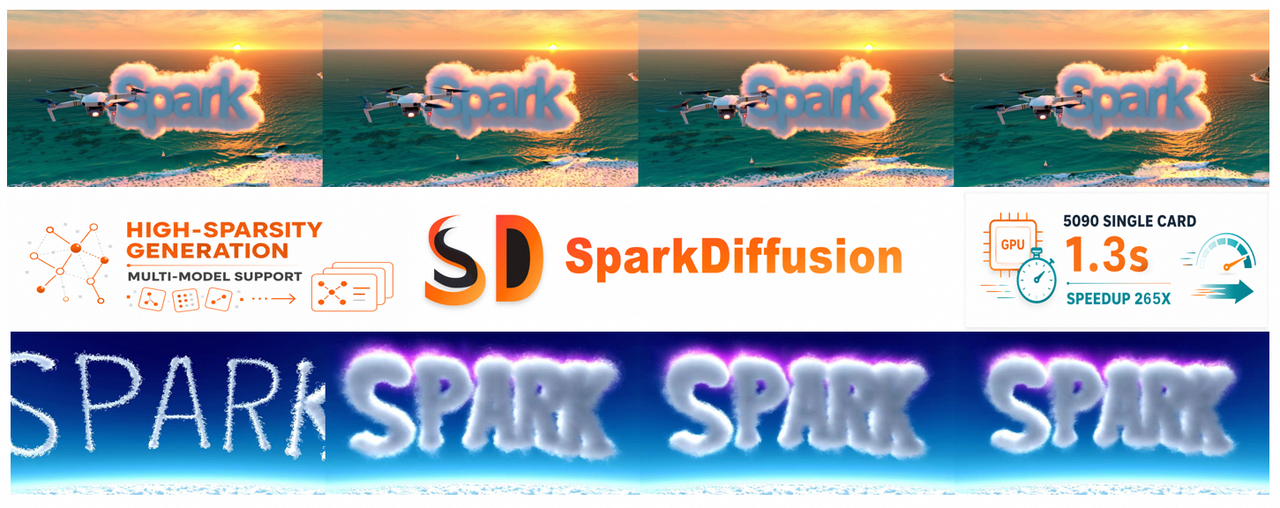
SparkDiffusion (arXiv:2609.23153), from Peking University (Melon Group), Tsinghua University, and Alibaba Group, first diagnoses the high-sparsity trap in video diffusion transformers: at 97% attention sparsity, step-local training loss keeps falling while terminal generation quality stagnates or degrades. The root cause is supervision, not representation — the dominant terminal errors originate in the high-noise structure-generation stage, which flow-matching-style step-local losses cannot see. The remedy is a staging principle: first adapt the sparse architecture into a coarse prior, then correct the terminal distribution. Instantiated as a three-stage pipeline (short sparse warm-up, few-step trajectory-mixed distillation, FP8 quantization with fused kernels), it sustains 97% attention sparsity on long-sequence 720P generation and achieves a measured 265× end-to-end speedup on Wan2.1-T2V-14B-720P over the 50-step CFG dense baseline on a single RTX 5090 (220× on H100), generating a Wan2.1-T2V-1.3B-480P video in 1.3 s (0.6 s on H100).
1. The Problem: Why Quality Degrades Faster Than Loss at Extreme Sparsity
Video diffusion transformers pay almost all their inference cost on attention over long spatiotemporal token sequences ($O(L^2)$). Sparse attention skips redundant query-key interactions, but conventional designs lose global context at very high sparsity; compensated sparse attention (a high-energy sparse branch plus a lightweight low-rank/linear compensation branch) pushes the usable limit to about 90%. The gain from going further is concrete: block-sparse computation scales roughly linearly with $1-s$, so raising sparsity from 90% to 97% cuts retained blocks from 10% to 3% — about 30% of the block-level compute. On Wan2.1-T2V-14B-720P with 3-step inference this alone reduces latency from 10.5 s to 8.0 s on H100 and 23.7 s to 18.0 s on RTX 5090, an extra 1.31-1.32× — if quality survives.
At extreme sparsity a second barrier appears: the sparse model infers fast and its step-local training loss converges, yet terminal videos show broken structure, semantic drift, mosaic textures, and temporal flicker. The authors name this regime the high-sparsity trap.
1.1 Mechanistic Diagnosis: an Oracle Probe Points to the High-Noise Segment
The paper localizes the root cause with a clean intervention: from the same initial noise, replace the sparse student's velocity with the dense teacher's velocity inside a short window of sampling steps, and compare correction effects across window positions (Wan2.1-T2V-14B-480P, 50-step sampler, 32 prompts × 4 seeds). The result is decisive: at 97% sparsity, fixing the five highest-noise steps removes most of the terminal error, while fixing the five lowest-noise steps changes almost nothing; widening the high-noise window to 28 steps recovers nearly all of it. Responsibility shifts from representation to supervision.
The formal explanation: step-local losses measure per-step error magnitudes, but the terminal sample depends on how those errors are transported and summed along the sampling trajectory. Flow matching supervises the velocity at $(x_t, t)$ against a closed-form, pointwise target — agnostic to error composition and accumulation. The paper defines a terminal-aligned signal as one whose supervision target at noise level $t$ is constructed from the sampling trajectory beyond $t$ (a later-trajectory prediction, a teacher-composed segment, or the terminal output itself), so the loss constrains how the prediction at $t$ composes into the terminal state. Consistency objectives are terminal-aligned toward their noise interval's endpoint; distribution matching toward the global terminal output; step-local losses merely build a coarse prior and cannot anchor the terminal distribution at extreme sparsity.
2. Method: a Three-Stage Pipeline
SparkDiffusion converts a pretrained dense video DiT into a fast high-sparsity generator without retraining from scratch. Each stage consumes the previous checkpoint, and the framework is agnostic to the sparse selector, compensation branch, and distillation objective — the default instantiation uses RoLA for sparsity and the CrossDistill schedule for distillation.
2.1 Compensated Sparse Attention
Dense self-attention,
$$A(Q,K,V) = \mathrm{softmax}\!\left(\frac{QK^\top}{\sqrt{d}}\right)V$$
is replaced by a two-branch mixture:
$$\tilde{A}(Q,K,V) = A_M(Q,K,V) + g_\gamma \odot C_\psi(Q,K,V)$$
where $A_M$ keeps only a fraction $1-s$ of query-key blocks and $C_\psi$ is a lightweight compensation branch. Following RoLA, the compensation branch reuses pre-attention normalized queries/keys with low-rank projections, a pointwise nonlinearity, and a rank-truncated 3D RoPE rotation:
$$\tilde{q}_i = R_r(p_i)\,\phi\!\left(P_q\, q^{\text{norm}}_i\right), \qquad \tilde{k}_j = R_r(p_j)\,\phi\!\left(P_k\, k^{\text{norm}}_j\right)$$
$$C = \sum_j \tilde{k}_j v_j^\top, \qquad O_{lr,i} = \mathrm{RMSNorm}\!\left(\tilde{q}_i^\top C\right)$$
linear in sequence length and preserving relative spatiotemporal position. A token-wise gate initialized near zero fuses the branches:
$$O_i = O_{s,i} + g_i\, r_i\, O_{lr,i}$$
with $r_i$ the RMS of the sparse output — the module starts close to pure sparsity and opens the compensation path only where needed, which is why a brief warm-up suffices.
2.2 Trajectory-Mixed Distillation
Distillation at extreme sparsity must satisfy two requirements. First, escaping the trap needs a terminal-aligned signal — consistency and distribution-matching objectives both qualify (ablations confirm). Second, the choice between them is governed by the fidelity-diversity trade-off: pure distribution matching is mode-seeking and loses seed-level diversity; pure consistency matching preserves the teacher's trajectory but never aligns the terminal distribution. SparkDiffusion adopts CrossDistill's trajectory-mixed schedule: split the trajectory at a noise crosspoint $t_{\text{cross}}$, train the high-noise segment with PCM-style consistency (preserving structure, motion, diversity) and the low-noise segment with DMD-style distribution matching (sharpening detail, correcting terminal-visible errors). The student uses 3 steps — one high-noise PCM step plus two low-noise DMD steps — mirroring the diagnosis that terminal-visible errors originate in high-noise structure generation. The Stage-1 objective remains flow matching:
$$x_t = (1-t)x_0 + t\epsilon, \qquad \mathcal{L}_{FM}(\theta) = \mathbb{E}_{x_0,\epsilon,t}\left[w(t)\left\|F_\theta(x_t,t) - (\epsilon - x_0)\right\|_2^2\right]$$
2.3 FP8 Quantization and Fused Kernels
To convert saved FLOPs into wall-clock speedup, attention linear projections and feed-forward layers are quantized to W8A8 FP8 (E4M3): weights carry static per-channel scales calibrated offline, activations are scaled dynamically per token; normalization layers, gating, and sparse mask selection stay in BF16. The per-token activation quantization path is fused into a single custom kernel so scaling and casting happen in one memory pass. Applied purely at deployment time after all training, with few-step sampling leaving no room for quantization error to accumulate — the BF16-to-FP8 quality delta stays within 0.1 VBench points.
2.4 Recipe and Benchmarking Details
Stage 1 is short because the compensation gate starts near zero — the backbone needs only a few updates to adapt to selective dropping; an ablation on Wan2.1-T2V-14B-480P shows whether one warms up (not how long) is the variable that decides distillation success: skipping warm-up collapses terminal quality, while a brief warm-up restores it. Stage 2's teacher is a frozen multi-step dense model, and the 3-step student (1 PCM + 2 DMD) follows CrossDistill's default crosspoint, loss weights, and schedule with no extra tuning — suggesting the recipe is hyperparameter-robust. For MoE backbones (Wan2.2), the high-noise and low-noise expert groups are warmed up and distilled on their own noise ranges before quantization; on RTX 5090 the latency includes swapping the two expert groups in memory while H100 holds both — part of the cross-GPU latency gap is this engineering detail, not the algorithm. Benchmarking fairness: the dense baseline uses the strongest implementation per GPU (FlashAttention-2 on 5090, FlashAttention-3 on H100, BF16); accelerated baselines run their official weights and pipelines including their own quantization; all SparkDiffusion quality numbers are measured on the fully deployed FP8 form — quality and latency come from the same deployment, with no paper-quality/product-latency mismatch. NFE accounting: dense 50 steps × CFG dual forward = NFE 100 vs 3-step CFG-free = NFE 3, so the 265× decomposes (~33× from step count and CFG removal, the rest from sparsity and quantization).
3. Results
3.1 Main Comparison: Quality and Latency Together
| Model / Method | Sparsity | VBench↑ | VBench-2.0↑ | 5090 latency(s)↓ | H100 latency(s)↓ |
|---|---|---|---|---|---|
| Wan2.1-T2V-1.3B-480P dense | 0% | 83.21 | 56.02 | 182 | 92 |
| FastWan (VSA) | 90% | 82.37 | 54.63 | 2.8 | 1.2 |
| TurboDiffusion | 90% | 82.52 | 54.61 | 2.0 | 1.0 |
| SparkDiffusion | 90% | 82.64 | 55.85 | 1.3 | 0.6 |
| Wan2.1-T2V-14B-720P dense | 0% | 83.69 | 60.20 | 4769 | 1757 |
| FastWan (VSA) | 90% | 82.72 | 58.04 | 54.1 | 20.5 |
| TurboDiffusion | 90% | 82.88 | 57.98 | 25.3 | 16.0 |
| SparkDiffusion | 90% | 83.42 | 59.36 | 23.7 | 10.5 |
| SparkDiffusion | 97% | 83.15 | 58.05 | 18.0 | 8.0 |
| Wan2.2-T2V-A14B-720P dense | 0% | 84.21 | 60.36 | 4545 | 1508 |
| SparkDiffusion (MoE) | 97% | 83.36 | 58.46 | 25.1 | 8 |
At matched 90% sparsity SparkDiffusion beats every baseline on every reported metric for Wan2.1-T2V-14B-720P, and on 1.3B-480P takes the best VBench-2.0 at the lowest latency (1.5-2.2× faster than baselines). At 97% it still slightly outperforms the strongest 90% baselines in aggregate quality while being clearly faster. The headline 265× (4769 s → 18.0 s on RTX 5090) and 220× (1757 s → 8.0 s on H100) compose three multiplicative factors: few-step distillation, attention sparsity, and FP8.
3.2 Diversity Under Few-Step Distillation
| Method | Sparsity | V-JEPA 2 cos↑ | V-JEPA 2 L2↑ | VideoMAE V2 cos↑ | VideoMAE V2 L2↑ |
|---|---|---|---|---|---|
| Full Attention (dense ref) | 0% | 0.125 | 27.15 | 0.0252 | 2.83 |
| FastWan (VSA) | 90% | 0.075 | 21.31 | 0.0117 | 2.05 |
| TurboDiffusion | 90% | 0.078 | 21.67 | 0.0125 | 2.21 |
| SparkDiffusion | 97% | 0.087 | 23.04 | 0.0142 | 2.47 |
Using two frozen video encoders (V-JEPA 2, VideoMAE V2) to measure average pairwise distances among 5 same-prompt different-seed videos (1,000 prompts, protocol of Shaul et al.), SparkDiffusion remains closest to the dense reference despite operating at 97% sparsity, while few-step baselines visibly lose seed-level variation — the mode-seeking tendency of distribution matching, and evidence for the trajectory-mixed design.
3.3 Trajectory-Level Verification on Toy Manifolds
Beyond video benchmarks, the paper measures sliced-W2 distance to the data distribution along denoising trajectories on six 2D sequence manifolds: a sparse model trained to its validation-loss plateau vs a trajectory-mixed distilled student. The distilled student's trajectory distance is markedly lower — a validation-loss plateau does not mean the trajectory hugs the data distribution everywhere, decoupling the mechanism from the benchmark. Qualitative cross-model validation covers five settings (Wan2.1 1.3B/14B T2V, I2V-14B, and Wan2.2-A14B MoE, at 480P/90% and 720P/97%), all with 3-step inference: distilled models visibly approach the dense teacher in structure, semantics, and temporal detail, while multi-step sparse models at the same sparsity show mosaic textures and drift.
Wan2.1 / Wan2.2"] --> B["Stage 1: sparse warm-up
insert compensated sparse attention
short step-local training → coarse prior"] B --> C["Stage 2: trajectory-mixed distillation
high-noise PCM consistency
low-noise DMD distribution matching
3-step student"] C --> D["Stage 3: FP8 W8A8 quantization
per-channel weights / per-token activations
fused single-pass kernel"] D --> E["Deployment: 3-step CFG-free inference
97% attention sparsity"] E --> F["Wan2.1-14B-720P
265x @RTX 5090 / 220x @H100"] E --> G["Wan2.1-1.3B-480P
1.3 s / 0.6 s end-to-end"] E --> H["Wan2.2 MoE A14B
83.36 VBench at 97% sparsity"]
4. Ablations: the Trap Is One of Supervision
| Stage-2 objective (97% sparsity, 3-step) | VBench↑ | VBench-2.0↑ |
|---|---|---|
| Full Attention (dense, 50-step) | 83.69 | 60.20 |
| PCM only (3-step) | 81.94 | 56.41 |
| DMD only (3-step) | 82.56 | 57.38 |
| CrossDistill trajectory-mixed (3-step) | 83.15 | 58.05 |
All 3-step students start from the same Stage-1 warm-up checkpoint. Both single objectives already recover most of the quality lost at 97% sparsity — corroborating that the trap is one of supervision: any terminal-aligned objective mitigates it. But the two pure objectives fail in opposite directions along the fidelity-diversity axis: PCM-only tracks the teacher trajectory but never aligns the terminal distribution (weakest scores); DMD-only aligns the terminal distribution but is mode-seeking, losing coarse structure and seed-level diversity. The trajectory-mixed objective takes the best of both. The paper also sketches extension to autoregressive video diffusion: compensated sparse attention restricted to a causal window; trajectory-mixed distillation acts on the noise axis rather than the temporal axis, composing with self-forced AR training — and since high-noise structural errors propagate across chunks, terminal alignment matters even more in AR generation.
5. Limitations and Outlook
Two layers of value. Engineering: it turns "extreme sparsity actually runs fast" into measured numbers — 97% sparsity holding quality on long 720P sequences, a single-card 265× measured end-to-end, achieved purely via post-training and deployment optimization with no retraining of the foundation model. Methodological: the diagnostic paradigm — the authors did not pile on more sparse structures; they first ran an intervention experiment (replacing student velocities with teacher velocities) to attribute error to a specific noise segment of the sampling trajectory, then shaped the training signal accordingly. When metrics plateau, run attribution experiments before changing methods — a transferable lesson for any system where training loss looks good but outputs do not.
Boundaries are equally clear: the 97% ceiling is achieved on compensated architectures like RoLA and may not transfer to pure sparse designs; FP8 gains depend on fused-kernel engineering with unassessed portability beyond NVIDIA platforms; the AR extension is a path, not an experiment; diversity metrics depend on the choice of frozen encoders. And the framework is an acceleration framework, not a quality improvement — at 97% it still trails the dense model by ~0.5 VBench / 2.1 VBench-2.0 points, a deliberate trade of quality for an order-of-magnitude latency cut. The three factors are independently switchable: distillation alone yields ~30×; latency-insensitive uses (offline data synthesis) can keep more steps for near-dense quality. Project page: sparkdiffusion.github.io; code: github.com/AlibabaResearch/SparkDiffusion.
6. Positioning
Among generation works covered on agientry, SparkDiffusion fills the inference-cost dimension: SoL-Refiner (NVIDIA) compresses the MiniMax H3 pipeline from 152.3 s to 5.64 s via one-step refinement; LTX targets native-resolution editing with overlapping tiling; Kling 4.0 upgrades model capability (4K/HDR, 15 multimodal references, native 30 s). SparkDiffusion touches none of these axes — it simply cuts per-token attention compute by 97% and stacks step distillation and 8-bit quantization on top; the factors compose, suggesting stacked order-of-magnitude gains on a single generation pipeline. For robotics, video world models and generative video branches inside robot policies (GE-Act 2.0's generative pre-training, WB-WAM's video expert) are bottlenecked at deployment rather than training; 97% sparsity plus 3-step CFG-free inference gives humanoids a workable compute budget for running a video world model as a predictor — and the authors' stated next step is pushing high-sparsity acceleration to omni-modal generative models and autoregressive world models, precisely where robot world models need it.
SOURCE LINKS