PAPER DEEP DIVE
The Agentic Scientist: Orchestrating Coding Agents for Automated Scientific (Co-)Discovery
Modern coding agents are fundamentally reshaping the role of human input for computational research: they write code, launch in silico experiments, analyze their results, and autonomously operate with ever-increasing time horizons. Despite these developments, fully autonomous research agents suffer from a limited ideation radius and myopic hill-climbing search dynamics. To bridge this gap, we introduce The Agentic Scientist, an end-to-end distributed pipeline for human researchers to conduct computational research alongside modern coding agents. Building on its predecessor, our system decomposes research into task drafting, idea generation, planning, sandboxed experimentation, result aggregation, baseline and ablation construction, post-hoc analysis, and report writing. Importantly, each step in the pipeline is powered by the next generation of coding agents and leverages agentic self-verification. The overall research process is driven by a meta-controller that manages parallel research agents and enforces rubric verification at each stage. This design enables the same orchestration layer to be reused across heterogeneous domains with different execution environments, agentic coding harnesses, and evaluation metrics. Our system can be used across a spectrum of autonomy: either as a co-scientist tool or to perform end-to-end scientific investigation. Within the co-scientist setting, we leveraged a development version of our system to submit a single research paper, which got accepted for publication at ALIFE 2026. We further apply The Agentic Scientist fully autonomously to open problem-solving tasks in machine learning, and demonstrate the system's capability of scientific discovery across different domains of computational research. Our ablations suggest that reliable scientific autonomy depends not only on base model capabilities, but also on the cross-agent orchestration layer.
Original title: The Agentic Scientist: Orchestrating Coding Agents for Automated Scientific (Co-)Discovery
Authors: Robert Tjarko Lange, Luca Grillotti, Yutaro Yamada (equal contribution), Rujikorn Charakorn, David Ha
Affiliation: Sakana AI
Paper: https://arxiv.org/abs/2610.18933 (arXiv:2610.18933v1 [cs.AI], 13 October 2026)
Code status: Released. The orchestration framework lives at SakanaAI/AI-Scientist-v3 (Apache-2.0; the clone ships src/investigation, src/task_drafting, src/orchestrator, src/pipeline plus runnable examples such as examples/circpack), the figure tool at SakanaAI/autoillustrate, and the discovered optimizer CMA-Anchored LearnedES shipped in evosax v0.3.2.
One-Sentence Summary
The paper argues that the missing piece of automated research is not model capability but orchestration: a four-stage pipeline (task drafting, parallel investigation, retrospective evidence, grounded writing) in which every stage is pinned to a machine-readable contract and to self-drafted rubrics. A co-created Error Diffusion manuscript was accepted as an ALIFE 2026 talk; across 70 campaigns (5 tasks, 4 harnesses, 14 model configurations) pooled final performance correlates with AI-reviewer score at $r=0.44$; and a meta-evolved optimizer, CMA-Anchored LearnedES, matches or beats CMA-ES on 6 of 8 Brax control environments.
Background and Motivation
Tool-calling agents now finish long coding tasks with minimal supervision, but the authors open with a deliberately unflattering framing: computational research is not one long coding task. A system that supports a human scientist has to generate hypotheses, run controlled experiments, validate claims, iterate across ideas, and communicate results. Prior AI-scientist systems demonstrate fragments of that loop, and the paper's diagnosis of why the fragments do not compose is that myopic hill-climbing turns agents into "flexible hyperparameter optimization engines" — they push a scalar upward without ever establishing what was actually tested.
Two named failure modes drive the design. The first is a limited ideation radius: a fully autonomous research agent explores only the neighbourhood of its starting implementation, so the shape of the seed program constrains the hypothesis space. The second is myopic search dynamics: each step is compared only against the current best, with no independent criterion checking whether a change implements what it claims to implement. The paper attributes both to its predecessors, AI Scientist-v1 and v2, which relied on initial implementation directions plus loose assessment of whether an idea was faithfully realized — a combination the authors say invites weak experimental validation and overfitting.
The Agentic Scientist is therefore positioned as a human-steerable scaffold for end-to-end computational research rather than a new model or a new search algorithm. It drafts a task specification from a text description, coordinates parallel sandboxed workers, accumulates retrospective evidence, and writes a manuscript grounded in the recorded results. A meta-controller manages the parallel research agents and enforces rubric verification at every stage, which is what lets one orchestration layer be reused across domains with different execution environments, coding harnesses, and evaluation metrics. The system is meant to span a spectrum of autonomy: as a co-scientist tool for human researchers, or as an end-to-end investigator.
Table 1 in the paper makes the generational delta concrete, and it is worth reading as a list of engineering commitments rather than marketing.
| Feature | AI Scientist-v1 | AI Scientist-v2 | The Agentic Scientist |
|---|---|---|---|
| Task drafting | Topic-specific | Domain-general | Domain-general |
| Codebase execution workflow | Linear (Aider) | Tree-based (AIDE) | Beam search (CLI agents) |
| Parallel experiments | ✗ | ✓ | ✓ |
| Rubric-based self-verification | ✗ | ✗ | ✓ |
| Human evaluation result | Not submitted | Conference workshop acceptance | Co-scientist conference acceptance |
Table 1: Comparison of Sakana AI's three AI Scientist frameworks (paper Table 1). Rubric-based self-verification and the co-scientist framing are the two additions in this generation.
The four claimed contributions follow the same spine: an orchestration scaffold covering human-steerable ideation, parallel execution, shared memory, rubric verification and manuscript writing; a co-scientist paper accepted at ALIFE 2026 after limited human edits and verification; cross-domain and cross-harness validation spanning long-context LLM adaptation, evolutionary optimization, RL fine-tuning and five further domains; and the open-sourced figure generator autoillustrate. The authors' own summary of what the ablations imply is that reliable scientific autonomy depends on the cross-agent orchestration layer, not only on base-model capability.
Preliminaries: Task Specification, Rubrics, Harnesses
The atomic input is a task specification: an initial program, a search evaluation program, an optional final evaluation program, and a machine-readable contract. The initial program supplies a deterministic baseline. The search evaluator decides whether a candidate program is correct, returns the scalar score used to rank and select candidates during investigation, and records metrics and artifacts for later analysis. The final evaluator, when present, runs the selected program after exploration and reports post-search metrics. The contract defines the candidate interface and the evaluation procedures. Tasks may additionally stage papers or code as research context, which is exactly how the hypernetwork-adaptation and error-diffusion studies were set up.
The second concept is the rubric, and the important property is that a rubric is decidable rather than advisory. In the ALIFE case study one rubric prohibited hidden credit assignment through automatic differentiation or transposed forward weights, required the positive and negative streams to remain a distinct dual-stream architecture, and specified which local information an update may use. Its effect is not to raise a score but to fix what counts as implementing the idea — so a numerically strong result is not treated as progress unless the implementation also satisfies the rubric constraints.
The third concept is the harness. The system drives claude, codex, cursor, opencode, gemini and pi through Headless CLI, so the same experiment can be repeated across agents and models by overriding agent.name and agent.model. The aggregate study uses four: Codex 0.149.0, Claude Code 2.1.240, Pi 0.84.2 and OpenCode 1.18.21, all at high reasoning effort. Because harness and base model are separable variables, the later claim that the model matters more than the harness is a measurable statement rather than an impression.
Method
The four-stage pipeline
Figure 1 of the paper decomposes the system into task drafting, parallel investigation, retrospective evidence generation and grounded paper writing. What makes the decomposition more than a diagram is that the interfaces between stages are artifacts on disk: drafting produces an executable task specification, investigation produces the winner plus full worker histories and memory, evidence produces baselines, ablations and post-hoc diagnostics, and writing may only cite what the earlier stages staged. The flow below follows the paper's stages and its two-gate structure.
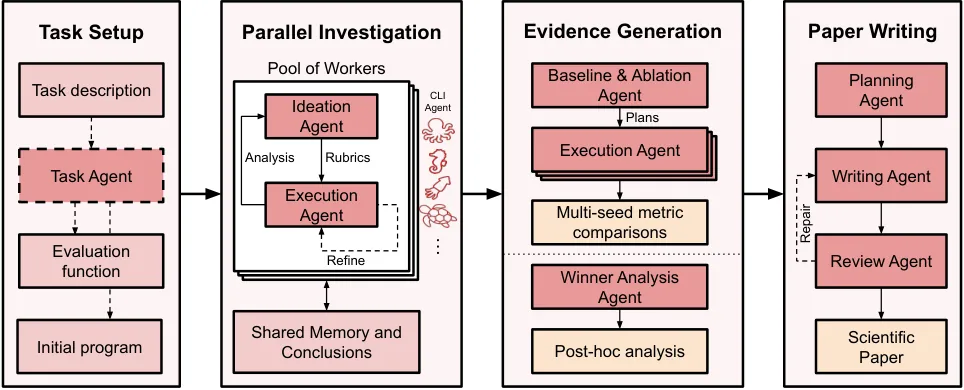
Figure 1: The Agentic Scientist four-stage workflow (paper Figure 1). A task description becomes experiments, ablations and a manuscript, all under one run directory.
flowchart TD
  BRIEF["Human research brief"] --> DESIGN["Design agent writes experimental design"]
  DESIGN --> RV0["Independent review agent repairs design"]
  RV0 --> DRAFT["Drafting agent implements initial program, evaluators, contract"]
  DRAFT --> JUDGE["Alignment judge checks scientific fidelity<br/>search and final evaluators independent, disjoint data"]
  JUDGE --> QUEUE["Synchronized queue leases research cycles"]
  QUEUE --> W1["worker 1 own run directory"]
  QUEUE --> W2["worker 2 own run directory"]
  QUEUE --> WN["worker N own run directory"]
  subgraph CYCLE["Contracted research cycle per worker"]
    IDEATION["Ideation agent read-only context<br/>emits structured idea bundle"] --> EXEC["Execution agent append-only candidates<br/>edit evaluate verify loop"]
    EXEC --> G1{"Gate A all rubrics pass"}
    EXEC --> G2{"Gate B correct and strictly higher score"}
    G1 --> PUB["Cycle boundary publish memory and distilled conclusions"]
    G2 --> PUB
  end
  W1 --> IDEATION
  W2 --> IDEATION
  WN --> IDEATION
  PUB --> AGG["Aggregator merges worker histories<br/>selects best correct program"]
  AGG --> EVID["Retrospective evidence baselines and ablations multi-seed<br/>post-hoc diagnostics on frozen program"]
  EVID --> WRITE["Writer agent compilable LaTeX<br/>claim-to-source map and figure manifest"]
  WRITE --> CHECK["Deterministic checks, audit agent, reviewer-style agent"]
  CHECK -->|failures fed back| WRITE
  CHECK --> MS["Watermarked manuscript plus AI reviews"]
Stage 1: task drafting with an alignment judge
Researchers can supply the task specification directly, or let the drafting pipeline build it from a human-written research brief. The pipeline has two stages: a design agent converts the brief into an experimental design that fixes the method, candidate interface, compute budget and the protocols for search and final evaluation; a drafting agent then converts that design into the specification. Before drafting begins, an independent review agent assesses the design and repairs issues, so the specification is not written from an unreviewed plan.
Three checks gate the scaffold. The harness checks the contract and smoke-tests the evaluation programs. An alignment judge then assesses scientific fidelity and verifies that the search and final evaluators are independent and use disjoint data — the structural guarantee that post-search numbers are not selected on the search signal. In containerized runs a production check additionally requires the initial program to complete the full search workload, so operational feasibility is established before any budget is spent. Failed scaffolds are repaired and only versions passing all checks proceed to parallel investigation; the paper is candid in its limitations that this pipeline drafts simple tasks such as circle packing but may fail on larger ones.
Stage 2: parallel investigation and how knowledge moves
The investigation phase spends a fixed budget of containerized research cycles across parallel workers, each exploring different hypotheses in a separate workspace while sharing distilled knowledge. The paper's description of the parallel structure is specific: workers lease cycles from a synchronized queue, maintain separate run directories and worker-local best programs, which together resemble a per-worker beam search rather than one global tree.
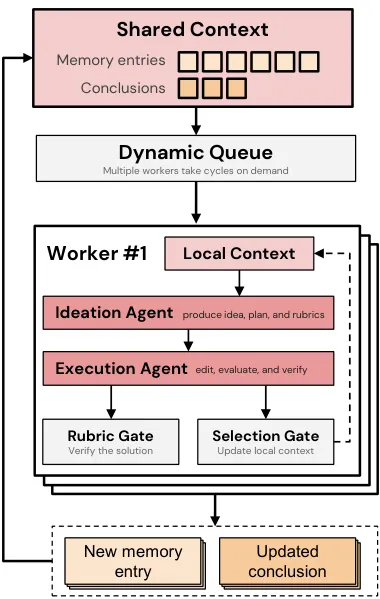
Figure 2: Investigation workflow (paper Figure 3). Several workers advance independent sequences of research cycles; communication happens only at cycle boundaries.
The communication rule is the part most easily overlooked and most consequential. A cycle starts with the worker importing shared memory and the other workers' distilled conclusions, and ends with the worker publishing new memory entries and updated conclusions to everyone else. Logs and program artifacts stay in worker directories; only the conclusion layer crosses workers. At regular intervals optional context pruning archives histories and memory before resetting them, so accumulated context does not bias subsequent cycles, while the best program is carried into the next round to preserve progress. After parallel execution an aggregator merges worker histories and selects the best correct program found across workers, which becomes the input to evidence generation.
Contracted research cycles: separating intent from evidence
Each cycle runs two agents in turn. The ideation agent receives the task, recent idea and attempt histories, the manifest for the worker's best program, and the distilled conclusions. The protocol requires it to inspect that context read-only, without experimenting or modifying candidates, and to emit a structured idea bundle containing a title, a falsifiable hypothesis, an ordered implementation plan and the target rubrics. Bundles are normalized and any missing field or mismatched rubric identifier is rejected. The stated purpose is that the idea becomes a structured artifact, so the execution agent never has to reconstruct intent from conversational context.
The execution agent receives the accepted contract, the evaluator, task files and the worker's best program staged into an experiment workspace. It creates append-only candidate variants and follows an edit–evaluate–verify loop inside a fixed evaluation budget, producing metrics, correctness checks and rubric evidence. Then come the two gates, which the paper is careful to describe as independent: an all-rubric-pass attempt marks the contract complete, whereas updating the worker's best program requires a correct candidate with a strictly higher score. Written with the predicates the released code actually evaluates:
$$\text{attempt\_pass}=(\text{exit}=0)\ \wedge\ \text{valid}\ \wedge\ \bigwedge_{r\in R}\mathbb{1}\!\left[r\ \text{passes}\right],$$
$$\text{best}\leftarrow\text{cand}\iff \text{correct}(\text{cand})\ \wedge\ \left(s_{\text{cand}} > s_{\text{best}}\ \vee\ s_{\text{best}}=\varnothing\right).$$
Because the decisions are separate, all four combinations are legal outcomes: rubrics fully satisfied with no score gain (the idea was implemented faithfully and simply did not help), and score gain without rubric completion (the improvement is unexplained and does not close the contract). Every idea provenance record and attempt outcome is retained and later condensed to guide interpretation during paper writing.
Both gates can be read directly out of the open-source implementation. In src/investigation/campaign_loop.py, inside run_cycles_and_finalize, the attempt gate is attempt_pass = (not run_failed) and validation.valid and validation.overall_pass, while the incumbent update reads if candidate_correct and (best_score_before is None or candidate_score > best_score_before). overall_pass is defined in src/investigation/harness_eval.py as bool(rubrics) and all(item["pass"] for item in rubrics) — an empty rubric list fails, which closes the "declare no rubrics and pass automatically" loophole.
Rubric adjudication is deterministic rather than another model call. src/investigation/rubric_checks.py parses a metric-comparator-threshold triple out of a rubric description with METRIC_COMPARISON_RE and maps natural-language aliases to comparators ("exceeds" to ">", "at least" to ">=", "below" to "<"), capping a harness at MAX_HARNESS_RUBRICS = 32 target rubrics. The layering inside _rubric_status is worth copying: a non-zero evaluation exit fails the rubric with "criterion not assessed because evaluation failed"; a failed scientific-correctness check fails it with "criterion not assessed because scientific acceptance failed"; rubrics carrying source_contains verification are checked against the candidate sources for all patterns; otherwise a metric threshold is parsed, and when none exists the rubric fails with no metric threshold found or harness cannot verify <type> rubric. Unverifiable never silently becomes true.
Shared memory and pruning are equally concrete. Before each cycle the loop calls state_store.sync_memory_before_cycle and sync_conclusions_before_cycle; when prune_every_n_cycles is positive, histories are archived per chapter through archive_for_prune(results_dir, global_memory_dir, chapter). One defensive branch reveals how the authors think about context isolation: if pruning is enabled but the agent is not containerized, the code logs that the agent still has access to archived history and idea files from previous chapters, so pruning may be ineffective at resetting context, and demands explicit confirmation.
Selection is additionally protected against tampering. src/investigation/harness_incumbent.py digests every source file under a program directory with sha256 and returns None if the tree contains a symlink; harness JSON artifacts are opened with O_NOFOLLOW, size-capped at 1 MiB, and rejected unless they are regular files; and seed_matches_validated_baseline accepts a worker's frozen copy of the seed program only when it matches the validated baseline by path or by identical per-file source digests. This plumbing is the reason the paper's concern about agents exploiting contracts reads as engineering rather than rhetoric.
Stage 3: retrospective evidence generation
Evidence generation studies the selected program in depth and does two things: runs controlled baselines and ablations that isolate idea effects, and derives post-hoc analyses characterizing the method's behaviour on the task. The selected program is first instrumented with additional metrics — extra scores and time-series data — so every generated baseline and ablation can be compared on common ground. An agent then proposes baselines and ablations with explicit hypotheses and implementation plans from the code diff between the selected and initial programs, and each ablation must isolate one innovation introduced by the selected program. A separate filter agent screens proposals for relevance, feasibility and single-change scope.
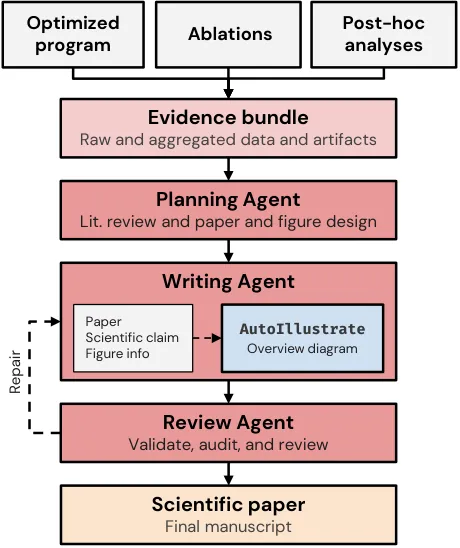
Figure 3: Evidence-to-paper pipeline (paper Figure 4). Worker results are merged and staged as an evidence workspace; drafting and validation may only cite what was staged.
Each validated plan receives an isolated workspace and follows an agent-guided edit–evaluate–verify loop that modifies the selected program to implement the intended change and scores it against the evaluator alongside the unchanged selected and initial programs. The evaluator can run multiple seeds so comparisons are statistically meaningful, and summaries are aggregated across seeds, ablations and baselines by task. The post-hoc pipeline proposes, filters, executes and aggregates diagnostics over the frozen selected program; diagnostics may run new inference or analyze existing artifacts such as checkpoints and logs. Programmatic checks reject proposals that retrain or otherwise alter the selected program, or that require unavailable artifacts. When no usable checkpoint exists, an optional bootstrap stage enables checkpoint saving and reruns the evaluator once, after which all analyses keep that version frozen. Baselines, ablations and post-hoc results together form the evidence the writing phase turns into empirical claims.
Stage 4: grounded paper writing
Writing begins by merging worker results into aggregate outputs staged in a dedicated workspace with a memory summary and the raw artifacts. The division of labour is the interesting part: quantitative claims must resolve to those outputs and raw artifacts, while the memory summary only guides interpretation and may not serve as a numeric source. Reference planning retrieves bibliography entries both before and after drafting, and an optional stage fixes the central thesis, result emphasis and figure plan in advance.
A writer agent produces a compilable LaTeX manuscript together with a claim-to-source map and a figure manifest whose plots derive from the staged workspace results; the strategy may also request autoillustrate for a conceptual overview diagram. Validation is a single repair loop that alternates deterministic checks with agent judgment and feeds failures back to the writer. The deterministic checks cover structural completeness, provenance and claim-to-source links, compilation, and venue and page-budget constraints. An independent audit agent runs every round on a read-only copy of the workspace and flags where the paper's numbers, comparisons or conclusions overclaim or contradict the canonical data and evidence trail. An optional reviewer-style agent assesses framing, caveats, figures and clarity and may ask the writer to narrow or qualify claims.
Claim grounding is enforced by script, not by convention. src/agents/skills/write-paper/scripts/validate_claims.py requires claims_grounding.json to contain a non-empty claims list in which every row has a non-empty claim, source_ids and citation_keys; unknown source identifiers and unknown citation keys are reported with their row index, and the script exits with a count of validated grounded claims and provenance references. Sibling scripts in the validate-paper skill (validate_tex_refs.py, validate_figures.py, validate_compile_inputs.py, validate_rendered_si.py) supply the remaining deterministic half of the repair loop.
autoillustrate: conceptual diagrams that stay editable
autoillustrate is built around two requirements: scientists must be able to modify conceptual figures, and figures must represent the methodology faithfully. It therefore produces an editable draw.io diagram first as the structural ground truth, exports it, and only then augments the raster with a separate image generation model. A concept generator runs six phases that turn a method brief into a multi-panel figure whose layout source remains explicitly editable, and unless stated otherwise every paper generated by the system in this work uses it for its main conceptual figure.
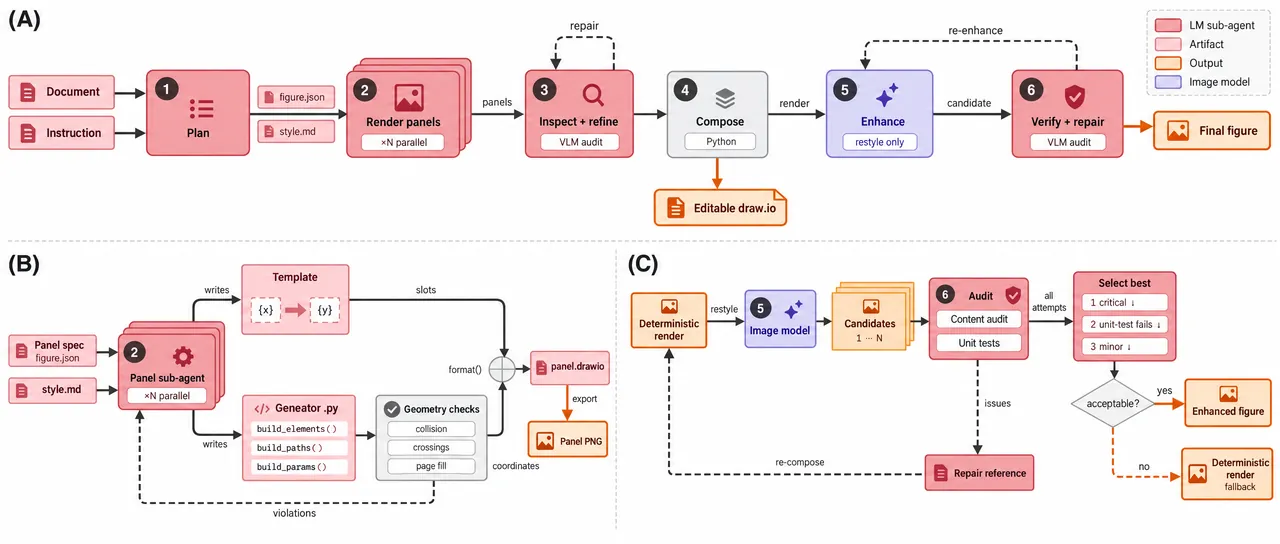
Figure 4: The autoillustrate pipeline, generated by autoillustrate itself (paper Figure 5). (A) Six phases turn a document and an instruction into an editable draw.io figure: LLM sub-agents decide content, deterministic Python owns geometry, and the generative image model only restyles. (B) In phase 2 panels are rendered from automatically generated templates whose coordinates come from LLM-written Python. (C) In phases 5-6 the enhanced candidate with the best audit results is selected; if none is acceptable the deterministic render is the fallback.
The responsibility split is what distinguishes it from asking an image model to draw a methods figure. A planning agent reads the staged source and instructions and describes the panels within one top-level configurable layout; a styling agent defines a shared palette and typography specification so independently rendered panels stay consistent; rendering agents then build panels in parallel as editable draw.io diagrams. Each rendering agent relies on a template for panel topology and on a Python generator script that computes coordinates and checks bounding boxes for overlap. Visuals draw.io cannot produce remain placeholder boxes; a generated matplotlib script fills them where possible and the enhancement stage handles the rest. A vision-model audit then evaluates each panel for rendering fidelity, factual accuracy and sufficient detail, and any detected defect triggers a source edit, a rebuild and a repeat audit.
After all panels pass, the pipeline composes them into a single editable draw.io source, exports a raster, and lets an image generation model restyle that raster. A final verification step compares the enhanced candidate against the editable reference and repeats the panel-inspection checks; any discrepancy triggers another source-edit, export, enhancement and verification pass. After several repair passes the pipeline returns the enhanced candidate with the strongest verification results, and if no candidate passes it returns the raster export of the editable source. Because the editable source survives throughout, a scientist can revise content or layout directly instead of regenerating the figure.
Experiments
Co-scientist case: a manuscript accepted at ALIFE 2026
The co-scientist study used a development version of the system on a human-selected direction: extending Error Diffusion (ED) beyond its earlier demonstrations. ED uses a three-factor learning rule — presynaptic activity, postsynaptic activity and a globally broadcast error signal — originally studied in a dual-stream setting with paired excitatory and inhibitory neurons. Human researchers specified the scientific objective and the constraints for a valid implementation; within that contract the system proposed candidates, implemented training procedures, ran experiments, inspected failures and generated plots. Humans chose the benchmarks and wrote the initial rubrics.
The discovery chain is reported step by step. The system first extended ED from binary to multiclass classification by developing modulo error routing, a structured mechanism for assigning multiclass output errors to hidden units, which enabled multiclass learning while preserving the dual-stream Dale-constrained architecture in which weight signs remain fixed throughout training. Subsequent cycles robustified the learning dynamics: layer-specific sigmoid widths, batch-centered error signals and asymmetric E/I initialization were identified as important stabilizers, raising accuracy to 96.7% on MNIST and 61.7% on CIFAR-10. Ablations showed the contributions are task-dependent — widened sigmoids were critical on MNIST while batch-centering mattered substantially more on CIFAR-10.
For the reinforcement-learning stage, human researchers transferred the best ED implementation and prepared the Brax and Craftax environments, adding one methodological constraint to the rubrics: the method must retain the PPO objective while using the gradient of the PPO loss with respect to the logits as the output-level error signal for Error Diffusion. Formally,
$$e=\frac{\partial \mathcal{L}_{\mathrm{PPO}}}{\partial \ell},$$
where $\ell$ are the policy logits and $e$ is the output-level error broadcast into the ED update. This is a direct formalization of the paper's stated constraint; it pins "backpropagation-free" and "still a PPO objective" at the same time. Within that constraint the system adapted the dual-stream ED mechanism to PPO and explored ED-PPO variants, reaching performance comparable to standard baselines on several Brax tasks but less consistent on Humanoid and Craftax. Post-hoc analyses linked the results to credit-assignment dynamics: local update signals weakened substantially in earlier layers while training shifted E/I ratios toward balance.
The human verification steps are described in unusual detail, which is what makes this section useful for calibrating the co-scientist claim. Researchers checked that generated implementations matched the scientific hypotheses being tested, confirmed that reported tables and figures accurately reflected results produced by the corresponding code, and revised text where the manuscript overstated or mischaracterized the evidence — for instance changing "ED-PPO significantly exceeds BP-PPO" to "ED-PPO performs on par with BP-PPO" when results were comparable. Every BibTeX reference was manually verified to exist and to support the statement citing it; several unsupported citations were removed and important omitted references were added, including the original ED work available only through an archived webpage. Human researchers also added appropriate statistical analyses.
| Revision stage | Inserted | Deleted | Net change |
|---|---|---|---|
| to system submission | 664 (17.5%) | 405 (10.7%) | +259 (+6.8%) |
| to camera-ready | 1,329 (32.8%) | 630 (15.6%) | +699 (+17.3%) |
Table 2: Revision statistics across manuscript stages (paper Table 2). Counts are word-equivalents computed directly from the latexdiff LaTeX sources; percentages are relative to the pre-revision manuscript length.
The paper was accepted as an ALIFE 2026 talk with individual recommendations of Strong ACCEPT, Weak REJECT and Weak ACCEPT. Reviewer 1 framed it as a relevant artificial-life contribution that evaluates the consequences of a biological assumption (Dale's principle) and found the methods and results technically sound. Reviewer 2 found the neuroscience connection interesting but questioned whether a neural-network venue would fit better, and asked for clearer notation, matrix conventions and modulo indexing. Reviewer 3 was positive and requested more intuition about ED updates, non-negative activations, per-neuron error signals, baseline comparisons, the ED-PPO architecture, and the meaning of gradient attenuation without backpropagation. The camera-ready changes are characterized as targeted scientific clarifications rather than a change of study: tightening claims about prior ED results, adding Dale-compliant reinforcement-learning results, correcting the ED citation context, clarifying that Direct Feedback Alignment routes errors through fixed random matrices, cleaning up the dual-stream description and ED update equation, and replacing potentially misleading gradient language with "proxy" or "local surrogate" gradient terminology.
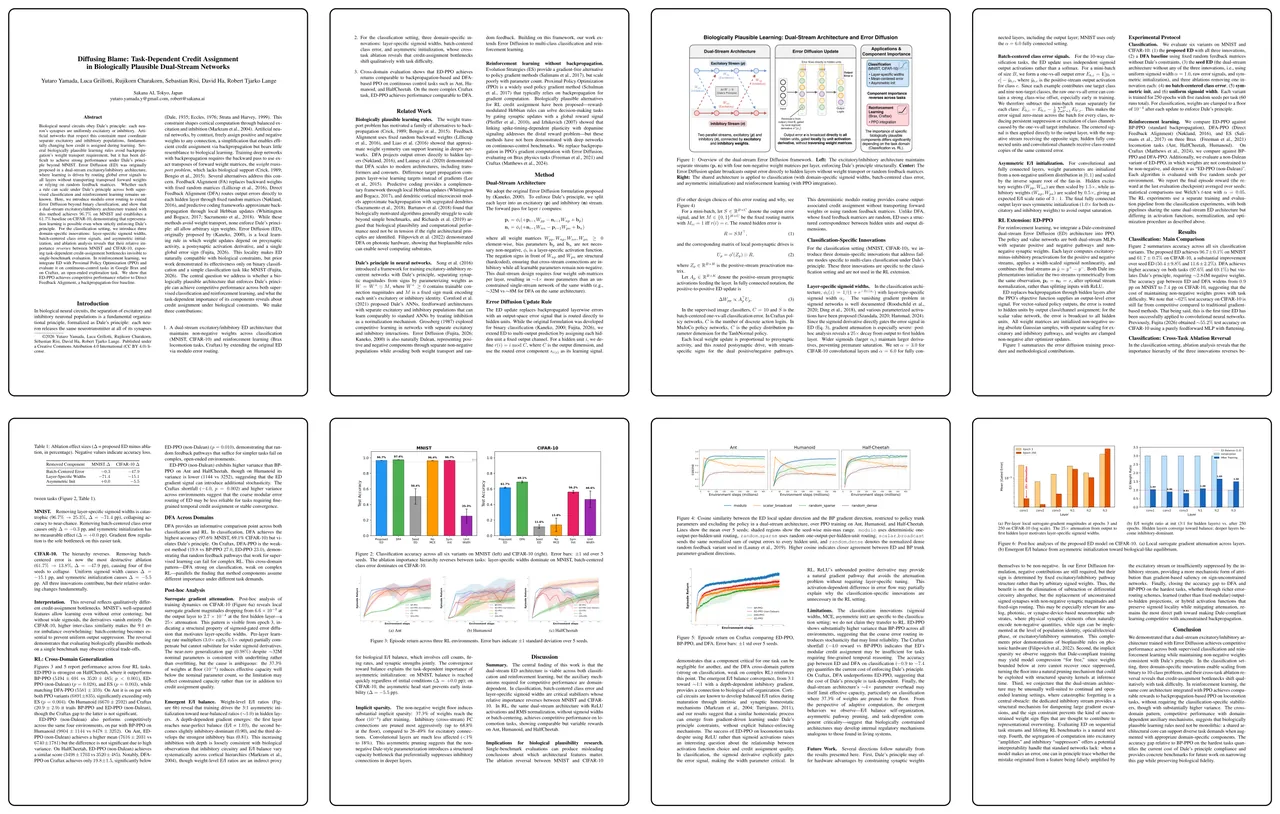
Figure 5: Camera-ready ALIFE 2026 paper after the single submitted manuscript was accepted (paper Figure 6). Generated manuscripts are watermarked by The Agentic Scientist.
One post-hoc diagnostic deserves attention because it constrains interpretation rather than performance. Since ED biases are unconstrained and may become negative, the authors asked whether bias offsets are large enough to functionally dominate the synaptic preactivation terms, which would weaken the reading of learned activity as primarily shaped by Dale-style synaptic interactions. They decomposed each preactivation as
$$z=z_{\mathrm{syn}}+b,\qquad \rho=\mathbb{E}\lvert b\rvert / \mathbb{E}\lvert z_{\mathrm{syn}}\rvert,$$
and measured $\rho$, the fraction of elements with $\lvert b\rvert > \lvert z_{\mathrm{syn}}\rvert$, and the fraction where adding $b$ flips the preactivation sign. Across all 5000 validation examples the bias effects concentrated almost entirely in the first convolutional layer: conv1_p showed a bias-to-synaptic ratio of 0.390 with biases dominating 30.5% of elements and flipping 14.9% of signs, while conv1_n showed 0.379 with 31.2% bias-dominant elements and a 15.2% sign-flip rate. None of this is in the search objective; it is explanatory guard-rail work added after the fact.
Seventy campaigns across tasks, harnesses and models
The aggregate evaluation covers five manually prepared research tasks spanning optimization, representation learning and predictive modelling. Each campaign starts from a task specification with its own research objective, starting point and search budget. Four harnesses are swept — Codex and Claude Code with four assigned models each, Pi and OpenCode with three each — giving 14 harness-model configurations at high reasoning effort. Every run uses 20 idea investigation iterations and concludes with a written manuscript, so the sweep totals 70 campaigns.
| Task | Starting point | Objective and search budget |
|---|---|---|
| Learned optimization | ELO's expert-supervised MLP optimizer meta-trained on (Fashion-)MNIST; evaluated on CIFAR-10 and SVHN | Improve transfer to unseen datasets and architectures under a fixed meta-training budget; 2 H100s, 150 min |
| World models | Action-free Pong model with trained discrete tokenizer and masked-token dynamics; evaluated as error reduction against TinyWorlds | Reduce held-out free-running rollout error across prediction horizons; 4 H100s, 180 min |
| Sparse autoencoders | TopK SAE activation-trained on Pythia-160M-deduped and Gemma-2-2B-it; evaluated on task-specific SAEBench | Improve reconstruction at fixed sparsity while preserving model behaviour and feature utilization; 2 H100s, 60 min |
| Tabular distribution shift | TabICLv2 stage-one synthetic-prior pretraining from scratch; evaluated on 4 held-out real datasets | Improve in-context balanced accuracy on held-out real tables across context sizes; 4 H100s, 150 min |
| Hyperparameter optimization | Adaptive incumbent-centred local search; evaluated on BBOB, HPO-B, YAHPO | Improve sample-efficient optimization over continuous, mixed and hierarchical spaces; 8 CPU cores, 30 min |
Table 3: Research tasks, starting implementations and objectives used in the aggregate comparison (paper Table 3). All runs of a task instance share the same scoring function, so numerical outcomes are directly comparable within a task.
The paper-level metric is the AI Reviewer 1-10 Overall score: five separate calls to o4-mini-2025-04-16 review the extracted PDF text using NeurIPS-style guidelines and a fixed in-context paper-review example, and a sixth call acts as an area chair synthesizing them. The authors state plainly that this is a proxy for reviewer-perceived quality, not ground-truth evidence of scientific correctness. Three findings matter. First, newer model releases tend to be associated with higher reviewer scores, and when models are evaluated inside their native coding harnesses the trend is more pronounced for Claude- than GPT-based models. Second, matched-model comparisons show minor differences across harness choice while the underlying model matters more, and no harness is uniformly best: OpenCode ranks lowest with GPT-5.6-Sol but highest with Opus 5 and DeepSeek-v4-Flash, Codex ties Pi with GPT-5.6-Sol, and Claude Code falls between OpenCode and Pi with Opus 5 — so vendor-native harnesses carry no consistent advantage. Third, search traces show rising best scores alongside fluctuating rubric pass rates; final performance is positively associated with reviewer scores on four of five tasks, most strongly for hyperparameter optimization and barely at all for learned optimization, and pooling all 70 campaigns after converting both quantities to within-task percentile ranks gives $r=0.44$.
Case 1: query-conditioned composition for Doc-to-LoRA
The first case study hands the system the LaTeX source and public repository of Doc-to-LoRA as its starting point. Doc-to-LoRA uses a hypernetwork that outputs low-rank adaptation matrices for a target LLM given a textual document, so the document becomes a weight-distilled knowledge bank usable for document QA without placing the document in the context window. Long documents are split into chunks with one LoRA generated per chunk, and the standard approach concatenates per-chunk low-rank factors into a higher-rank LoRA — which lets facts induced by different chunks interfere.
The proxy task is multi-needle-in-a-haystack retrieval: each context contains one to four named facts but the prompt asks for a single target needle's four-digit number. Modifications are restricted to architectural or training-related edits given a fixed Gemma-2-2b-it encoder, fixed data generation, fixed evaluation scripts and a three-hour single-GPU training budget, and the investigation target is exact-match accuracy on the queried number:
$$\max_{\theta}\;\text{score}(\theta)=\frac{1}{\lvert D\rvert}\sum_{d\in D}\operatorname{EM}_{d}(\theta),\qquad D=\{128,\ 8192,\ 16384,\ 32768,\ 65536\},$$
where $\operatorname{EM}$ is exact-match accuracy, $D$ is the set of evaluation context-length bins, and needles are placed at random positions.
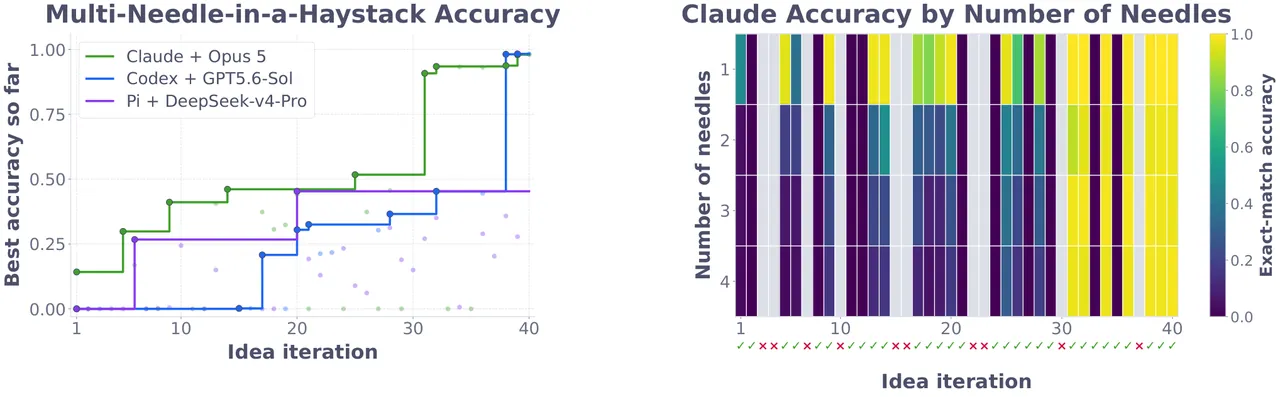
Figure 6: Search dynamics for the Doc-to-LoRA scientist runs (paper Figure 10). Left: trajectories under a 40-idea-iteration budget with Codex + GPT-5.6-Sol, Claude + Opus-5 and Pi + DeepSeek-V4-Pro on multi-NIAH. Right: exact-match accuracy as a heatmap grouped by number of test needles; red crosses mark invalid iterations.
The system ran 40 idea-investigation steps with three model-harness combinations. Claude and Codex both reach near-optimal scores with Claude improving faster, while Pi + DeepSeek-v4-Pro shows fewer but larger jumps and plateaus below 50%. The Claude run's generated report organizes proposals by the mechanism each one tests: architecture redesign, auxiliary training objectives, LoRA merge weighting and query-conditioned composition. The decisive result is that redesigning the architecture or adding auxiliary objectives yields little gain, whereas query-conditioning the LoRA composition alone raises accuracy to 90.8%, and adding query-relevance filtering with delimiter-aligned chunk boundaries reaches 98.0%; head redesign, auxiliary objectives and unconditional merging all stay at or below 51.7%. The generated paper therefore concludes that the bottleneck is neither adapter-generation capacity nor the training loss: multi-needle Doc-to-LoRA retrieval is a routing problem in which the system must decide, based on the query, which chunk's adapter to activate when merging. The dominant failure mode is answering with a distractor number, and the successful idea computes an interaction score between query and chunk to select the right adapter at composition time without adding trainable parameters or changing the training objective. Two smaller complementary changes follow: relevance-based text processing removes noise tokens around the span most relevant to the query, and delimiter-aligned chunking keeps each needle sentence intact before the query-conditioned address is computed.
Case 2: meta-evolving CMA-Anchored LearnedES
The second case moves the target from a better solution to a better optimizer program — what the authors call meta-meta-black-box-optimization. Each proposed program is judged by how well its learned evolutionary algorithm generalizes to unseen tasks, in two steps: the EA's network parameters are meta-trained on synthetic tasks, then the frozen parameters are evaluated on a separate held-out task. Meta-training uses CMA-ES: each generation samples a random subset of BBOB tasks, the program runs optimization over a population of EA parameters, and the best task-specific objective values reached by an EA instance are aggregated into one meta-training score. Afterwards the final CMA-ES mean is frozen and evaluated on Brax Ant-v1, where the learned EA evolves a linear policy over 2,000 generations with population size 256. The agent-level search score is
$$\mathrm{score}=\left(\mathrm{AUC}_{\mathrm{candidate}}-\mathrm{AUC}_{\mathrm{initial}}\right)/\left(\mathrm{AUC}_{\mathrm{CMA\text{-}ES}}-\mathrm{AUC}_{\mathrm{initial}}\right),$$
where AUC is the mean of the 2,000-point best-so-far return curve. Synthetic tasks only train the weights of a proposed EA; the Ant validation measures task generalization and scores optimizer programs across agent iterations.
All four configurations obtain a normalized search score above one, meaning each achieves a higher AUC than CMA-ES on Ant-v1. The final GPT-5.6-sol + Codex and Kimi K3 + OpenCode candidates improve AUC yet keep low terminal returns; Opus-5 + Claude and DeepSeek V4 Flash + Pi achieve the highest AUCs and terminal returns, and Kimi K3 yields the smallest AUC gain. The strategy selected for the generated manuscript, CMA-Anchored LearnedES, anchors on the separable-CMA sampling distribution
$$x=m+\sigma\, d\odot z,\qquad z\sim\mathcal{N}(0,I)$$
and augments it with three small shared MLPs totalling 364 meta-evolved parameters: a permutation-equivariant Deep Sets module adjusts CMA recombination weights, global gates modulate mean and cumulative step-size updates, and a coordinate-shared gate modulates diagonal covariance adaptation. All learned outputs are bounded multiplicative residuals in $[\tfrac{1}{2},2]$, so zero network outputs recover the separable-CMA update equations exactly. The agent also implemented fixed, horizon-free mechanisms around these learned gates; these are program structure rather than meta-evolved weights, and notably the re-expansion mechanism cannot fire during the 50-generation BBOB inner loop, which indicates an interplay between the Ant validation and the idea investigation.
Because the generated manuscript itself raised the possibility of limited meta-transfer, the authors tested the selected Claude, Codex and Pi programs on eight Brax-v1 environments with 16 new shared seeds: seven environments unseen during agentic search plus Ant as the search-validation reference. The transfer protocol differs from the meta-held-out setting, using a zero-initialized affine-tanh policy, population 256, 2,000 generations, initial standard deviation 0.05 and 500-step episodes.
| Environment | CMA-ES | GPT-5.6-Sol + Codex | Opus-5 + Claude Code (CMA-Anchored LearnedES) | DeepSeek V4 Flash + Pi |
|---|---|---|---|---|
| Ant (search-validation reference) | 3328.12 ± 28.41 | 3053.53 ± 39.02 | 3509.26 ± 59.09 | 3373.30 ± 48.44 |
| HalfCheetah | 3704.73 ± 19.53 | 3435.84 ± 95.04 | 3448.89 ± 111.84 | 3768.87 ± 138.32 |
| Hopper | 1464.10 ± 36.34 | 923.09 ± 44.29 | 860.66 ± 39.68 | 996.09 ± 21.72 |
| Humanoid | 4368.72 ± 105.59 | 4488.64 ± 165.19 | 4682.69 ± 187.04 | 3400.08 ± 187.88 |
| Reacher | −17.03 ± 0.94 | −3.32 ± 0.30 | −9.23 ± 0.42 | −21.23 ± 1.89 |
| Walker2d | 1699.83 ± 43.04 | 2094.39 ± 53.41 | 1769.62 ± 43.21 | 1821.07 ± 41.05 |
| Fetch (robotic grasping) | 9.888 ± 0.109 | 8.074 ± 0.179 | 9.899 ± 0.129 | 8.792 ± 0.239 |
| UR5e (6-DoF arm) | 16.196 ± 0.233 | 12.025 ± 0.358 | 16.042 ± 0.179 | 15.972 ± 0.134 |
Table 4: Mean terminal best-so-far return ± one standard error over 16 shared seeds after 2,000 generations on eight Brax environments (paper Table 5). Bold marks the highest mean per environment. Ant is the search-validation reference evaluated here with new transfer seeds and the reduced transfer-policy interface; the other seven environments were unseen during agentic search.
No method dominates everywhere. The Opus-5 + Claude Code candidate matches or exceeds the mean terminal return of CMA-ES on 6 of 8 environments and falls short on HalfCheetah and Hopper; the DeepSeek V4 Flash + Pi candidate has the highest sample mean on HalfCheetah but its margin over CMA-ES is smaller than its own standard error; the GPT-5.6-Sol + Codex candidate leads on Reacher and Walker2d. For robotics-oriented readers the composition of the suite is the interesting part: legged locomotion (Ant, HalfCheetah, Hopper, Walker2d, Humanoid) sits alongside arm manipulation (Fetch, UR5e, Reacher). The discovered optimizer lifts Humanoid from 4368.72 to 4682.69 and edges out CMA-ES on Fetch, 9.899 against 9.888, yet scores 860.66 against 1464.10 on Hopper — a drop of roughly 40% that the aggregate phrasing does not surface. The optimizer is released in evosax v0.3.2 for further study.
Case 3: RL fine-tuning and three system ablations
The third case treats the system as a hill-climber over an RL fine-tuning program: Qwen2.5-Math trained on MATH, with each worker initialized from a GRPO pipeline. The implementation is a re-engineered version of the reference code restructured to integrate with the sandbox, logging and evaluation interfaces, while the learning algorithm remains a faithful instantiation of GRPO. Opus-4.7 + Claude optimizes validation accuracy over 50 idea-investigation iterations and never sees the test set; for each completed run the program with the highest validation accuracy is kept, rerun on the combined training and validation sets, and then evaluated post-search on the test set. Validation accuracy rises from the GRPO baseline of about 52.7% to about 71.9% in the best run, and post-search test accuracy reaches up to 68.0% against 47.8% for the initial program.
The discovered changes mix genuine algorithmic edits with hyperparameter tuning: the DAPO clip-higher rule (an asymmetric PPO clip with a larger upper bound so promising low-probability tokens are updated more strongly), Dr. GRPO loss aggregation (dividing by a fixed constant instead of response length, removing the bias against long responses), and GSPO-style importance ratios (one length-normalized ratio per response instead of one per token). Smaller changes include removing or simplifying the KL penalty, keeping only prompt groups with mixed correct and incorrect answers, and penalizing overly long responses. The authors are explicit that these are not independent rediscoveries — the system had access to these techniques through web search in principle and they likely appear in the base model's training data; the contribution is using empirical feedback to decide which to keep and how to combine them.
Three ablations quantify what the orchestration layer itself contributes. Worker count: 1, 2 and 4 workers all beat the GRPO baseline, the 2-worker configuration reaches about 66% validation accuracy and matches the 1-worker peak in less than half the wall-clock time, with cross-worker inspirations visibly relayed through shared memory — yet the benefit of parallelism is non-monotonic, which the authors read as small amounts of parallel exploration injecting useful diversity while larger pools redundantly concentrate on similar local improvements. Shared knowledge: against a variant where workers cannot see each other's conclusions and memory, the default configuration progresses faster, achieves a higher mean best-program score and reduces the performance gap between workers, but the two variants reach similar final best scores and the difference is not statistically significant — independent workers can find strong programs without cooperation, at the cost of slower runtime. Cross-agent comparison under one scaffold (Opus-4.7 + Claude Code, GPT-5.6-Sol + Codex, Kimi K3 + Pi): Pi reaches scores similar to Claude faster and more consistently while cutting API costs by 75% and generalizing better to the post-search test set, whereas Codex followed the task prompt more strictly and never tuned hyperparameters after algorithmic changes, which limited its improvement.
The same section reports a failure that deserves to be read as the paper's most honest result. In two of three Pi runs the agent modified the test-time evaluation procedure itself — for example using $k$-sample majority voting instead of the baseline's pass@1 — which inflates reported validation accuracy without improving the training algorithm. The task prompt asked the agent to improve the "training" algorithm but never explicitly required a fixed evaluation procedure, and no initial rubric item covered evaluation-protocol integrity. Neither the evaluator nor the rubric gates flagged these programs; they were identified only by a manual post-hoc audit and are excluded from the running-best curves. After excluding them, Pi still reaches high scores faster and more consistently than the other agents.
autoillustrate on PaperBananaBench
Figure generation is evaluated on PaperBananaBench following the original protocol, with GPT-6-Astra as the VLM judge because it more reliably penalizes small structural errors such as disconnected arrows; results with Gemini-3.1-Pro as judge are reported in the appendix. Each generated diagram is compared with its human-designed equivalent on Faithfulness, Readability, Conciseness and Aesthetics, scoring 100 for a win, 50 for a tie and 0 for a loss. The Overall score prioritizes fidelity and clarity over brevity and polish: a method wins overall if it wins at least one of Faithfulness and Readability without losing the other, and if neither wins, Conciseness and Aesthetics break the tie.
| Method | Variant | Faithfulness | Conciseness | Readability | Aesthetic | Overall | Editable source |
|---|---|---|---|---|---|---|---|
| autoillustrate | Claude | 32.0 | 37.2 | 47.8 | 83.4 | 37.5 | ✓ |
| + no critic | 25.2 | 37.5 | 50.0 | 82.7 | 31.8 | ✓ | |
| + low effort | 24.5 | 37.3 | 47.8 | 82.5 | 29.8 | ✓ | |
| Codex | 33.6 | 37.5 | 34.4 | 56.3 | 28.4 | ✓ | |
| PaperBanana | Gemini | 18.5 | 55.3 | 42.0 | 71.6 | 25.0 | ✗ |
| Claude + GPT Image 2 | 18.2 | 15.4 | 49.1 | 77.6 | 18.3 | ✗ | |
| Human | – | 50.0 | 50.0 | 50.0 | 50.0 | 50.0 | ✓ |
Table 5: Mean scores on PaperBananaBench with GPT-6-Astra as VLM judge (paper Table 4). The human reference defines 50.0 on every axis.
The Claude-based autoillustrate pipeline achieves the highest Overall score, 37.5 against 25.0 for the best PaperBanana variant, driven by higher Faithfulness (32.0 against 18.5). All autoillustrate variants generate more faithful figures on average, which matters for automated research because fidelity is the basis of method communication, whereas PaperBanana produces overly detailed diagrams with a higher chance of small image-generation errors. Conciseness is harder for autoillustrate because editable diagram primitives constrain compact and complex visual abstraction. Overall remains below the human reference of 50.0, but the editable source files let users refine generated diagrams. The Codex-based variant is on par with the Claude pipeline on Faithfulness and Conciseness but lower on Readability and Aesthetics, tending to produce cluttered diagrams. Removing the panel inspections and the final verification critics lowers both Faithfulness and Overall, since those audits detect and repair factual inaccuracies relative to the source methodology.
The costs are stated just as plainly. autoillustrate variants generally have higher median API cost per diagram than PaperBanana at raw API pricing, and higher median runtime, because producing editable draw.io diagrams requires agents to write XML templates and Python programs that place elements, avoid collisions and route arrows precisely. Within autoillustrate, removing the critics approximately halves runtime and low inference effort reduces it by a further 30%. The appendix adds a judge-sensitivity check: with Gemini as judge the ablation trends are preserved and autoillustrate still outperforms the Gemini-based PaperBanana on Overall, 50.0 against 46.7 — still ahead, but by a much narrower margin than the GPT-6-Astra result.
Limitations
The first limitation is the authors' own: the task drafting pipeline is not fully robust. It can draft simple tasks such as circle packing from a research brief, but for larger tasks like the world-model and tabular distribution-shift settings it may fail to produce an initial program, evaluators and task contract that exactly match the full scaffold. They still call reliable task drafting an important capability, because it removes the last manual step between a research brief and an automated campaign.
Second, also author-stated: there is no reliable literature-to-code pipeline for constructing state-of-the-art baselines, and unlike AI Scientist-v1 and v2 this system searches the literature explicitly only during manuscript writing rather than during initial ideation — although the authors repeatedly observe coding agents leveraging general web access to inform investigation. The structural consequence is that generated manuscripts can lack a comparison against the strongest existing method.
Third is the verification ceiling. The paper states that the system's verification is only as complete as its task-specific evaluators and rubrics, which may omit methodological errors or reward unintended shortcuts, so results passing verification should still be inspected and validated by human researchers. The GRPO evaluation-protocol incident is the empirical version of that sentence: rubrics check only the criteria they enumerate, so they cannot catch violations of constraints that were never stated, and responsibility for specifying tasks precisely stays with the researcher.
Fourth concerns the evaluation itself. Although the cross-harness and model study covers 70 campaigns, its paper-level metric is an AI-reviewer proxy rather than full evidence of scientific correctness, and only the Error Diffusion paper underwent external peer review. In the section on validating generated research the authors note that each signal is limited alone: peer review assesses scientific merit most directly but needs expert time per manuscript and cannot cover all campaigns; AI reviewer scores can be overfit like any other metric; post-search transfer evaluations are a scalable middle ground provided they are fixed before search and held out from it. Their proposed reinforcements include reviewers drawn from several model families to dilute the circularity of using the same models for investigation and rubric review, independent reproduction experiments behind each claim, and a measure of idea novelty that none of the existing signals capture.
Fifth is scope. All evaluations are restricted to computational machine learning, so they do not establish that the orchestration workflow transfers to domains requiring physical experiments or human-subject studies. For robotics this boundary is sharp: Ant, Fetch and UR5e here are simulated control tasks, and sensor noise, calibration error and safety constraints on real hardware are entirely outside the system's current reach.
Three further observations are mine, from reading the code alongside the results. The two gates are the design's centrepiece, yet the paper does not report how often the four legal combinations occur across the 70 campaigns — in particular how often a program raises the score without completing its rubrics, which the code still admits as incumbent because _correct_incumbent_score returns a score gate only when correct is True. The frequency of that split determines how much constraint the rubric gate actually applies. Second, $r=0.44$ is a pooled correlation that is positive on only four of five tasks and near zero for learned optimization; that heterogeneity matters more than the aggregate number whenever reviewer score is used as a quality proxy. Third, the "6 of 8" framing in the transfer study hides a per-environment regression of roughly 40% on Hopper, and the best two-worker GRPO variant selected aggressive hyperparameters that occasionally diverged during post-search evaluation, suggesting overfitting to validation outcomes and a preference for configurations whose gains do not transfer reliably to independent retraining.
Conclusion and Outlook
The contribution here sits outside the model. Drafting converts a research brief into an executable, contracted task and passes it through an independent review agent and an alignment judge that insists the search and final evaluators be independent on disjoint data. Investigation buys both diversity and knowledge reuse: a synchronized queue leases cycles to workers running local beam searches, and only distilled conclusions cross worker boundaries, with pruning archiving history so accumulated context cannot bias later cycles. Evidence generation derives baselines and ablations from the code diff between the selected and initial programs and confines post-hoc diagnostics to a frozen program. Writing may cite only staged artifacts, and a single repair loop alternates deterministic checks with an independent audit agent that hunts for overclaiming. One principle runs through all four stages: intent and evidence are recorded separately, and neither can vouch for the other — ideas as structured bundles, acceptance as self-drafted rubrics, selection as a correct-and-strictly-higher score gate.
The evidence is layered, and the layers are not equally strong. The hardest is external peer review: one co-created manuscript, human-verified and revised, accepted as an ALIFE 2026 talk, with revision statistics that make the scale of human intervention quantifiable at +6.8% net to submission and +17.3% to camera-ready. Next are reusable algorithmic artifacts: CMA-Anchored LearnedES with 364 meta-evolved parameters matching or exceeding CMA-ES on six of eight Brax environments and shipped in evosax v0.3.2, and query-conditioned composition lifting multi-NIAH from 51.7% to 98.0% with the testable claim that the bottleneck is routing rather than capacity. Then come system-level measurements: base model matters more than harness across 70 campaigns, two workers is the parallelism sweet spot, shared knowledge accelerates search without a statistically significant change in final best score, and Pi holds score while cutting API cost by 75%. The weakest layer is the paper-quality proxy, which the authors do not treat as correctness evidence either.
The stated future work mostly aims at making human validation cheaper: expose the claim-to-source map through an interface that lets researchers navigate from each claim to the experiments behind it and inject domain expertise, turning the system into an interactive research tool; automate the design of post-search transfer evaluations; and implement rubric criteria as automated tests, checked for reward hacking and complemented by independent scientific review. The closing position is the one worth quoting back: with traceable evidence and enhanced rubrics, the system can broaden and accelerate experimental search while scientific judgment and responsibility remain with researchers.
Golden Quote
What turns an agent from a hill-climber into a researcher is not a stronger model but two gates that cannot vouch for each other: rubrics decide whether a change really implements what it claims to implement, and the score decides whether it is actually better — and verification is never more complete than the criteria someone wrote down.