Can Football Teach a Robot to Move?
Boston Dynamics teaches Atlas to play football using motion capture + RL for the Ghost Rabona kick. The whole-body coordination required transfers directly to industrial manipulation tasks.
Can Football Teach a Robot to Move?
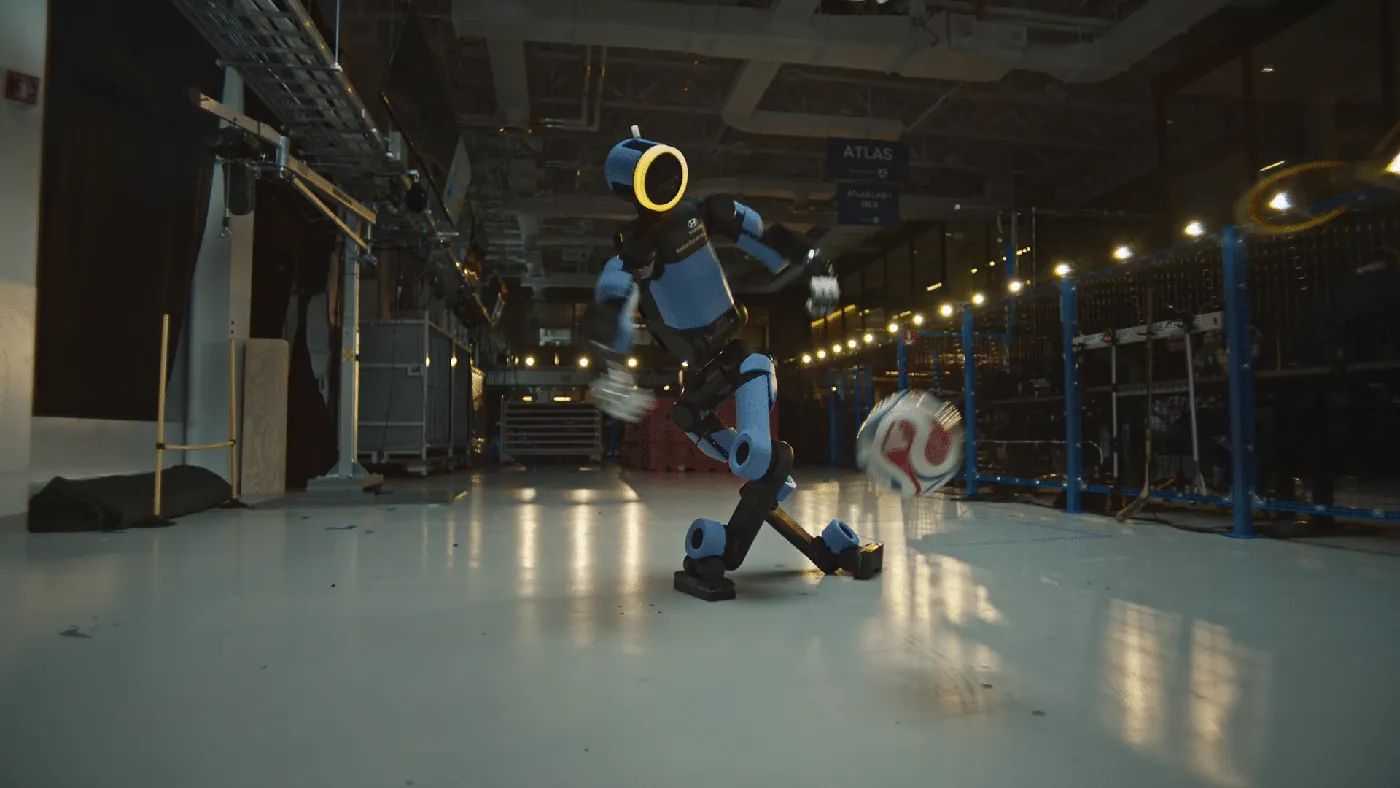
With the FIFA World Cup 2026™ coming up, Boston Dynamics worked with Hyundai to try something new: teaching Atlas to play football, mastering a complex Ghost Rabona kick. The "School of Football" is part of Hyundai's "Next Starts Now" campaign, showing that human athletes and robots share a common learning process: practice, review, analyze, and adjust.
The Ghost Rabona
The goal was to showcase the incredible mobility, agility, and whole-body control enabled by the Atlas humanoid robot. The team created the Ghost Rabona, combining a fake-out step-over with a crossed-leg rabona kick:
- Atlas walks towards the ball
- Atlas fakes the shot with its left leg
- Atlas crosses its right leg behind to strike the ball
This move is complicated for a human to perform, much less a robot. Atlas needs to move fast for a convincing fake, needs power and agility to take off from the ground and land again, while still remaining balanced to complete the kick. This combination of skills pushes the limits of physical intelligence.
Learning from Human Demonstrations
Just as a human athlete must practice to master intricate movements, Atlas requires training to perfect its skills. The robot uses reinforcement learning, undergoing extensive training in simulation to learn how to handle the physics of its own body to mimic human motion.
The first step is creating a reference input from human demonstration. Human demonstration simplifies robot programming, turning what used to be a complex coding process into an intuitive task. These demonstrations can come from various sources — including video, teleoperation, and motion capture.
For the Ghost Rabona, the team worked with a football player to develop and record a super dynamic motion. Using human motion capture allows rapid collection of numerous demonstrations while embedding them with a distinctively "human" style. The difficulty lies in adapting these movements to Atlas' kinematics, as there isn't a direct correspondence between human and robot morphology.
Retargeting and Reinforcement Learning
Through a retargeting process, human motion is mapped into Atlas kinematics. Once the reference trajectory is established, the machine learning process begins:
- Reference trajectory: Human motion capture data retargeted to Atlas' kinematic structure
- RL training: Thousands of parallel simulations on cloud GPUs train a policy to realize the behavior
- Speed: The robot gets the equivalent of a full year's worth of physical trial and error in just 24 hours
- Deployment: The learned policy works first-try on real hardware for almost all skills
If something fails, the team goes back to training, makes adjustments, and improves the behavior — the same iterative loop used for all Atlas skills.
Transferable Skills
Every time Atlas moves into a new environment, there's new training required. But the tools used to train the robot for football transfer to training it for jobs in warehouses or factories. There are also transferable skills honed playing football:
Unlike other sports that separate locomotion from manipulation, football demands mastering both at once. Athletes must balance and run while precisely controlling a ball with their feet — a significant hurdle for humanoid robots. Success requires a whole-body controller that dynamically coordinates every joint as a single system.
This same whole-body coordination is the essence of what Atlas needs to perform manipulation tasks in the workplace. Training generalist behavior for robots requires a vast variety of data and training — and thinking outside the box is one of the keys to unlocking generalizable behaviors.
Beyond the Lab
While Atlas was engineered for industrial and factory applications, its capabilities extend far beyond those environments. The football demonstration illustrates the extraordinary power and agility that define the robot. These skills are just the beginning of what Atlas can do, and Boston Dynamics continues to push the boundaries of what's possible in humanoid robotics.
Source: Boston Dynamics — Can Football Teach a Robot to Move?
Source:Boston Dynamicshttps://bostondynamics.com/blog/can-football-teach-a-robot-to-move/