ergoCub: Shared Embodied Intelligence for Humanoid Robots
Published in Nature Machine Intelligence, ergoCub is a humanoid robot designed via a shared embodied intelligence architecture that jointly optimizes hardware and control for human ergonomic metrics. L5-S1 torque drops ~50% during collaborative lifting, and walking step length increases 25% over its predecessor iCub3.
Abstract
Collaboration is central to human behaviour, enabling tasks beyond individual capability. This ability arises from coordinating actions through internal representations of others — a concept known as shared intelligence. Humans are also characterized by physical bodies and cognitive abilities optimized in response to their environment, a phenomenon referred to as embodied cognition. Designing humanoid robots that collaborate safely and effectively with people requires unifying these principles.
This article, published in Nature Machine Intelligence, proposes an architecture that integrates shared intelligence and embodied cognition to enable robots to physically collaborate with humans, where robot hardware and control are jointly optimized for human ergonomic metrics, using representations of the human body and motion intelligence. The concrete implementation is the humanoid robot ergoCub, developed at the Istituto Italiano di Tecnologia (IIT) in collaboration with the National Institute for Insurance against Accidents at Work.
Shared Embodied Intelligence
By shared embodied intelligence, the authors refer to the integration of shared intelligence and embodied cognition to equip an agent with both physical attributes and cognitive abilities optimized for collaboration with other beings. The proposed architecture enables simultaneous optimization of the robot's physical intelligence and hardware characteristics, taking into account not only the task and environment but also the physical intelligence and attributes of potential partners — whether human or robotic.
Humanoid robots are the target platform because their human-like form enables more natural physical interaction and facilitates task execution in environments designed for humans. The ergoCub robot is the concrete outcome of this architecture, with its name combining "ergo" (ergonomics) and "Cub" (referencing the iCub humanoid that served as the optimization starting point).
The Architecture
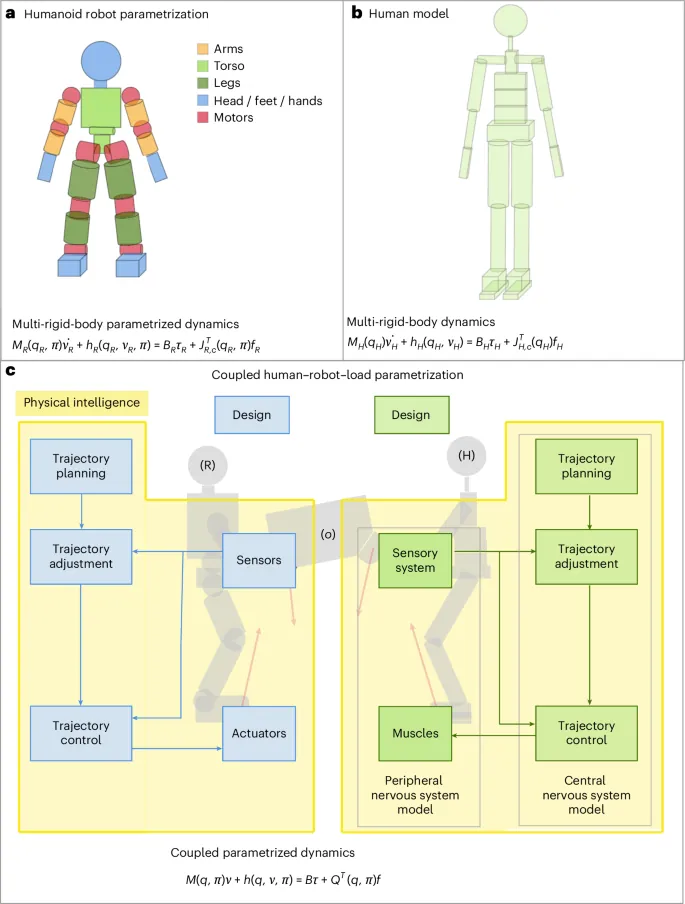
The shared embodied intelligence architecture is modular, composed of different blocks suitable for various robot tasks performed with or without a human collaborator. Two key elements define the framework:
- Agent design — the properties of the human body and the characteristics of the robot hardware.
- Physical intelligence representation — the components that define agent motion to achieve the desired behaviour, including trajectory blocks, sensors/sensory systems, and muscles/actuators.
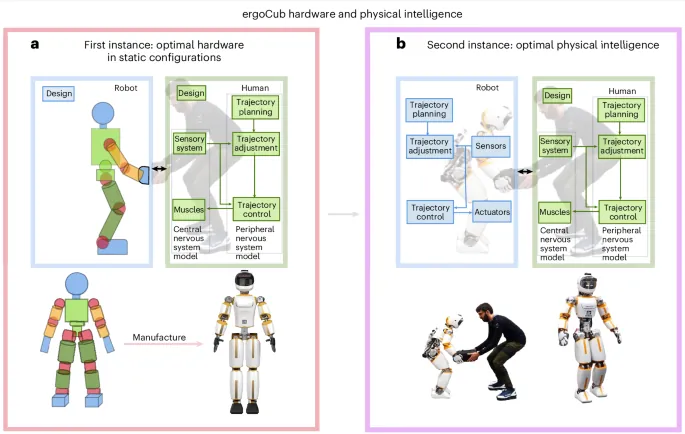
For both the human and the robot, a hierarchical control architecture models the physical intelligence, establishing a symmetry between the two agents. The key blocks include: (1) muscles/actuators for joint-level actuation; (2) sensors/sensory systems for perceiving environment and agent state; and (3) trajectory planning, adjustment, and control blocks for generating, refining, and executing trajectories.
Hardware Optimization: Designing for Ergonomics
The optimization problem was defined with two main objectives. The first was to improve ergonomics during human–robot collaborative lifting by minimizing the energy expenditure of both agents, quantified as joint torques, across several static lifting configurations. The second was to enhance walking performance by raising the robot's centre of mass (CoM), thereby increasing system bandwidth and robustness.
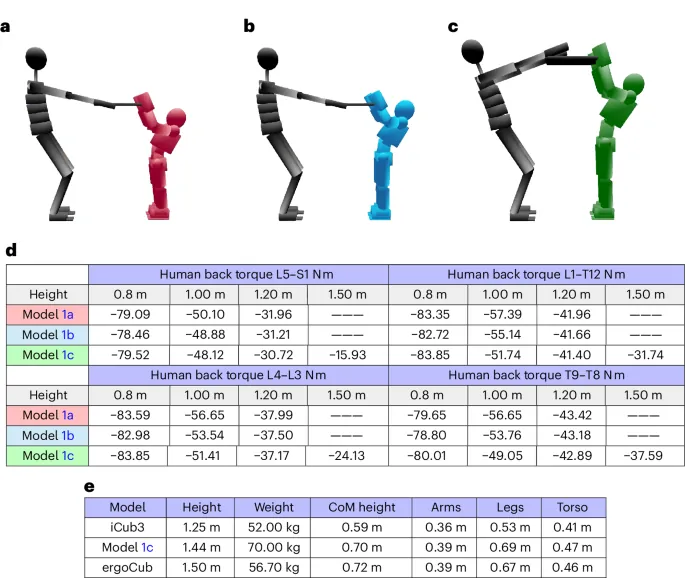
Compared with the original iCub3 design, the optimized models reduce human back stress at all load heights, with the greatest relief observed at the lumbosacral joint (L5–S1) — a region particularly vulnerable to high compressive forces during lifting. The selected "green" solution uniquely enables lifting tasks up to 1.5 m while decreasing back torque at nearly all heights.
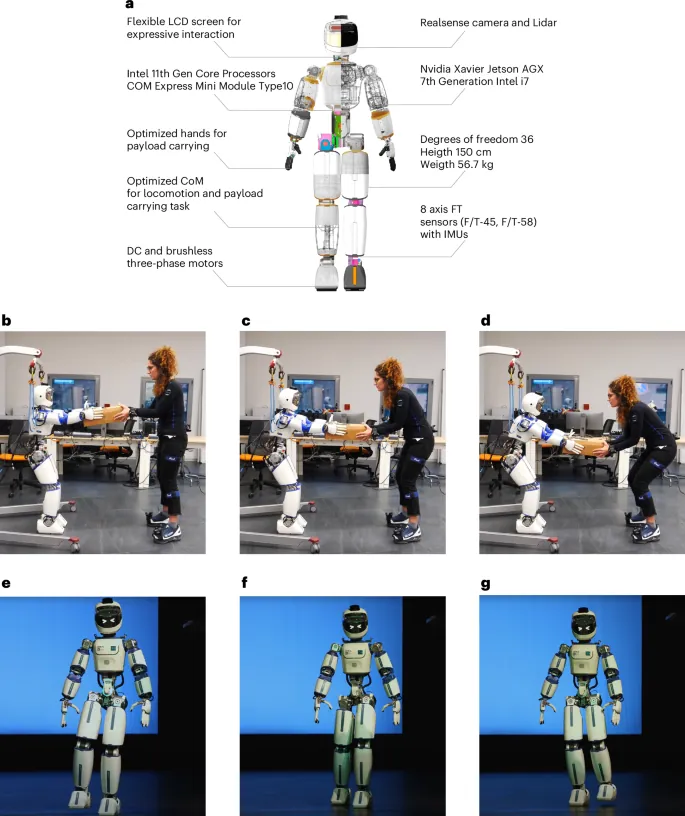
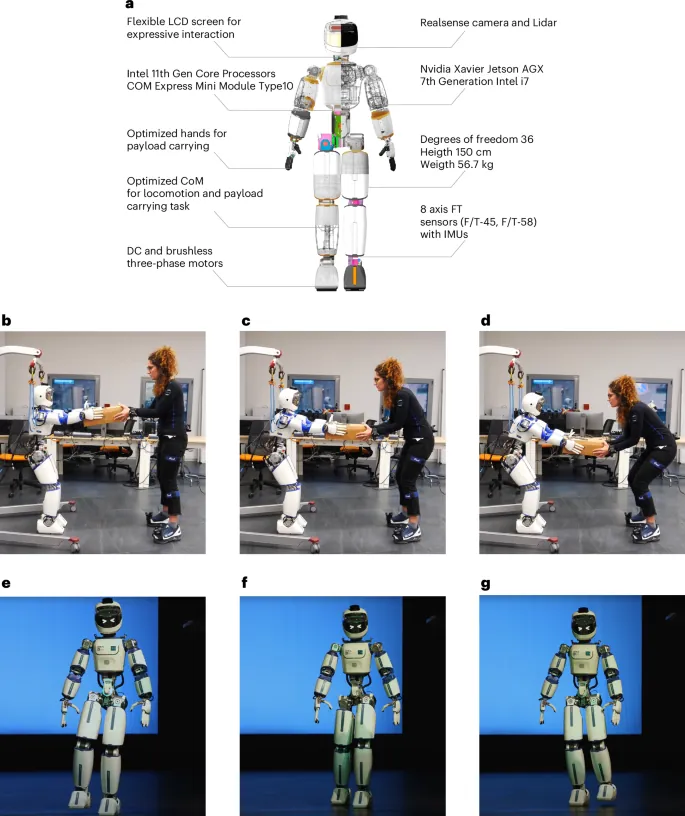
Starting with the identified optimal limb lengths, the team built ergoCub using metal extenders to achieve the desired measurements. The robot is approximately 0.25 m taller than iCub3, yet weighs only 56.70 kg — about 4 kg more than iCub3, and substantially lighter than the optimization-predicted 70 kg thanks to a dedicated manufacturing optimization process.
Physical Intelligence: Collaboration and Locomotion
Building on the optimized hardware, the control architecture addresses both collaboration and locomotion. For collaboration, the framework mirrors human and robot physical intelligence as hierarchical systems. This symmetry allows the robot to account for the human partner's behaviour and identify strategies that enhance collaboration.
In the tested scenario, the robot collaborates with a human partner to manipulate payloads of varying weights: empty, 1 kg, and 2 kg. During collaboration, the robot follows the human's movements while the human's ergonomic stress is continuously monitored. A human model is initialized by measuring the participant's height and weight, then continuously updated using data from non-intrusive wearable sensors.
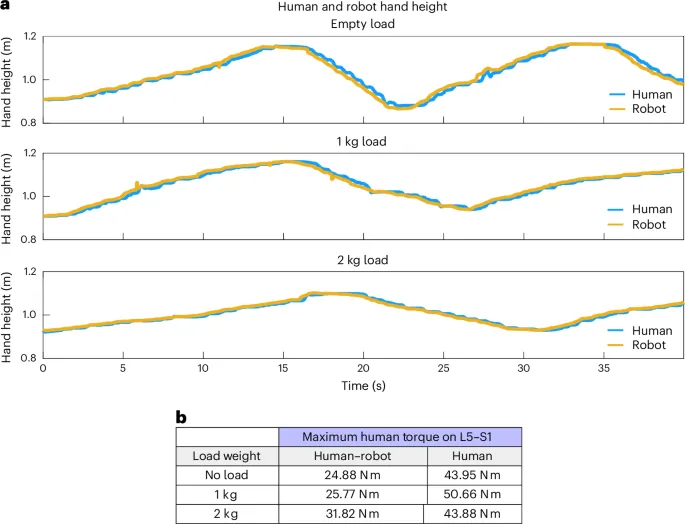
The results are striking: peak L5–S1 torque decreases from 43.95 Nm to 24.88 Nm with the empty load, and similar reductions are observed for 1 kg (50.66 → 25.77 Nm) and 2 kg (44.88 → 31.82 Nm) loads. The robot also uses its head-mounted LCD screen to display expressive feedback, signalling whether the human is experiencing high or low stress.
Locomotion Performance
The optimization process also specifically aimed to enhance robot locomotion. Compared with its predecessor iCub3, ergoCub walks faster and smoother: the maximal step length achieved is 0.35 m compared with 0.28 m on iCub3, with a minimal step duration of 0.5 s compared with 0.8 s — using the same walking command and control architecture.
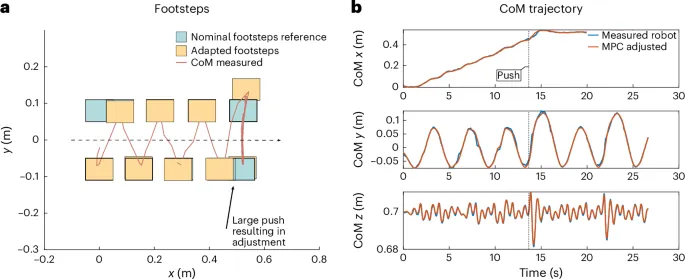
The robot can carry its rated payload of 6 kg while adjusting nominal footsteps to counter persistent disturbances, and can withstand impulsive pushes of 60–100 N while completing a straight-line walking task.
From Optimization to Real Hardware
Discrepancies between the optimization output and the manufactured robot arise from three sources: (1) geometric simplifications for tractable nonlinear optimization, (2) simplified inertial assumptions such as uniform density distributions, and (3) practical manufacturing constraints. Despite these challenges, the ergoCub robot successfully retains the ergonomic enhancements from the optimization process.
The team proposes several strategies to reduce the sim-to-real gap, including decomposing links into subcomponents, incorporating material-dependent density distributions, and progressive model refinement through calibration loops after prototype realization.
Discussion and Future Directions
The work contributes to the state of the art by deriving a methodology for designing humanoid robots that explicitly account for human comfort and task requirements already at the hardware design stage — not solely when implementing robot behaviour. The ergoCub robot represents a tangible realization of this methodology, demonstrating how human representations can be embedded into the robot's body and physical intelligence.
Future extensions include integrating short-horizon human motion forecasting within the robot's physical intelligence, encoding collaborative scenarios involving multiple human partners, and broader user studies assessing long-term interaction fluency and subjective comfort across diverse populations.
Open Source and Availability
The architecture, controllers, and differentiable models are publicly available:
- github.com/ami-iit/adam — differentiable robot dynamics
- github.com/ami-iit/shared-controllers — shared control framework
Source: Nature Machine Intelligence. Republished by RobotWorld with promotional content removed.
Source:Nature Machine Intelligencehttps://www.nature.com/articles/s42256-026-01272-2