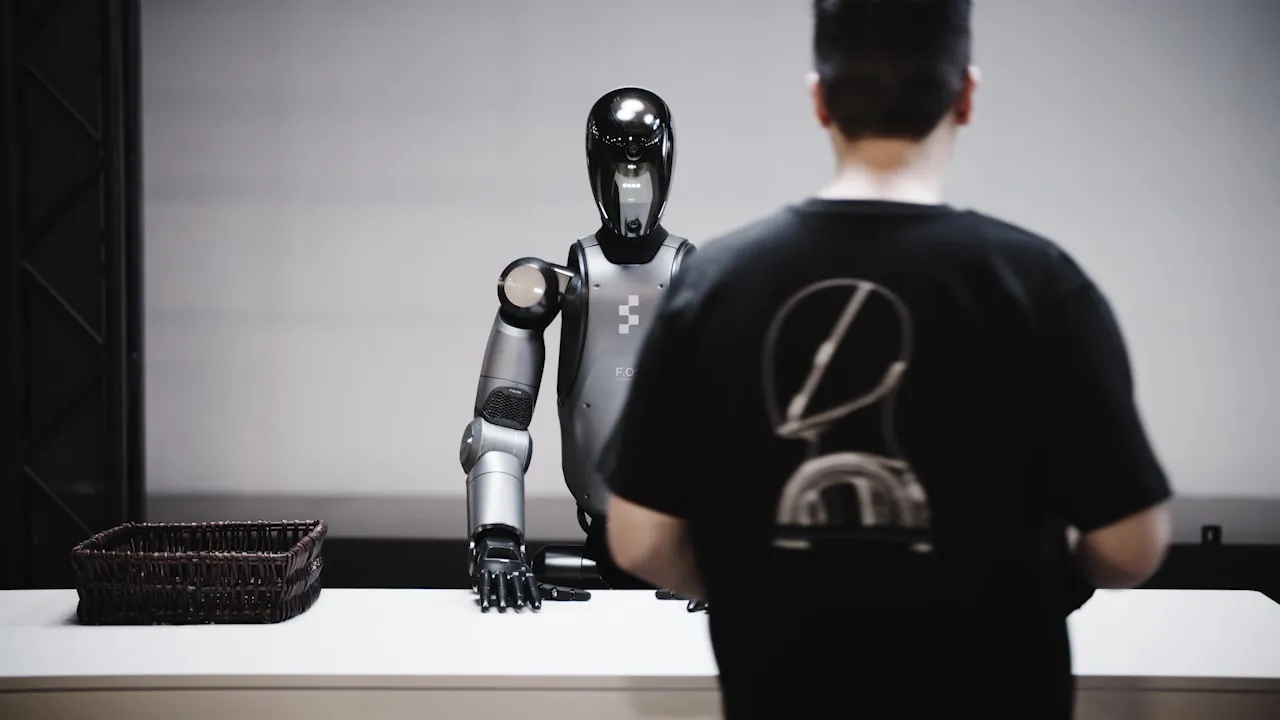
Helix Learns to Fold Laundry: First Humanoid with Multi-Fingered Autonomous Folding
Figure AI's Helix VLA model achieves first humanoid multi-fingered autonomous laundry folding. Same architecture seamlessly transitions from logistics to household chores with data-only change.
Helix Learns to Fold Laundry: First Humanoid Robot with Multi-Fingered Autonomous Folding
Source: Figure AI Official Blog
Helix, Figure's Vision Language Action (VLA) model, recently demonstrated an hour of fully autonomous package reorientation in a logistics setting. Now, the same model is tackling something entirely different: folding laundry.
Folding laundry sounds mundane for a person, but this is one of the most challenging dexterous manipulation tasks for a humanoid robot. Towels are deformable, constantly changing shape, bending unpredictably, and prone to wrinkling or tangling. There's no fixed geometry to memorize, and no single "correct" grasp point. Even a slight slip of a finger can cause the material to bunch or fall. Success requires more than just seeing the world accurately — it demands fine, coordinated finger control to trace edges, pinch corners, smooth surfaces, and adapt in real time.
Key Results:
- A first for humanoids. This is the first instance of a humanoid robot with multi-fingered hands folding laundry fully autonomously using an end-to-end neural network.
- Same architecture, data-only change. The same Helix architecture that solved logistic tasks was applied directly to laundry folding — with no modifications to the model or training hyperparameters. The only addition was the dataset.
- Natural multimodal interaction. In addition to folding, Helix learned to maintain eye contact, direct its gaze, and use learned hand gestures while engaging with people.
Video 1: Helix folds towels autonomously.
Without any architectural changes, Helix learned to:
- Pick towels from a mixed pile
- Adjust folding strategies based on starting configurations
- Recover from multi-pick errors by returning extra items
- Use fine manipulation skills, like tracing an edge with a thumb, pinching corners, or unraveling tangled towels — before completing folds
Critically, Helix does all of this without explicit object-level representations. For highly deformable items like towels, building such representations is brittle and unreliable. Instead, Helix operates entirely end-to-end: from vision and language input to smooth, precise motor control.
Why This Matters
The same general-purpose architecture, and the same physical platform, can seamlessly transition from industrial logistics to household chores. As we scale real-world data collection, we expect Helix's dexterity, speed, and generalization to keep improving across an even broader range of tasks.
Source:Figure AIhttps://www.figure.ai/news/helix-learns-to-fold-laundry