MiMo-V2.6 Deep Read: Six Days of Live RL, an AA Index of 46 and a Fully Open Self-Improvement Run
Xiaomi open-sources MiMo-V2.6 Pro/Flash: 30 live RL steps, ~750k trajectories at $850k/$2.62M; AA Index 46 tops open models, DeepSWE v1.1 gains +17/+14 out of sample; Vibe World, CUA, science and content demos plus 7k+ RL environments released.
MiMo-V2.6: Scaling Up Reinforcement Learning for Self-Improvement
Source: Xiaomi MiMo official blog, September 22, 2026
Today Xiaomi officially releases and open-sources the MiMo-V2.6 series. It is a key step on the company's RSI (recursive self-improvement) path: build on verifiable, complex tasks, scale up reinforcement-learning (RL) compute, and let the model keep expanding the boundary of its intelligence through continuous exploration and feedback.
"Where the path is flat and close, travelers are many; where it is rugged and distant, few reach the end." In an era where intelligence can be easily replicated, we choose to channel compute into real environments and let models learn by trial and error inside feedback loops. This road is slower and far less visible. The six days of Live RL training behind MiMo-V2.6 are a public trek along it; behind those six days sit half a year of foundational research and engineering trial and error.
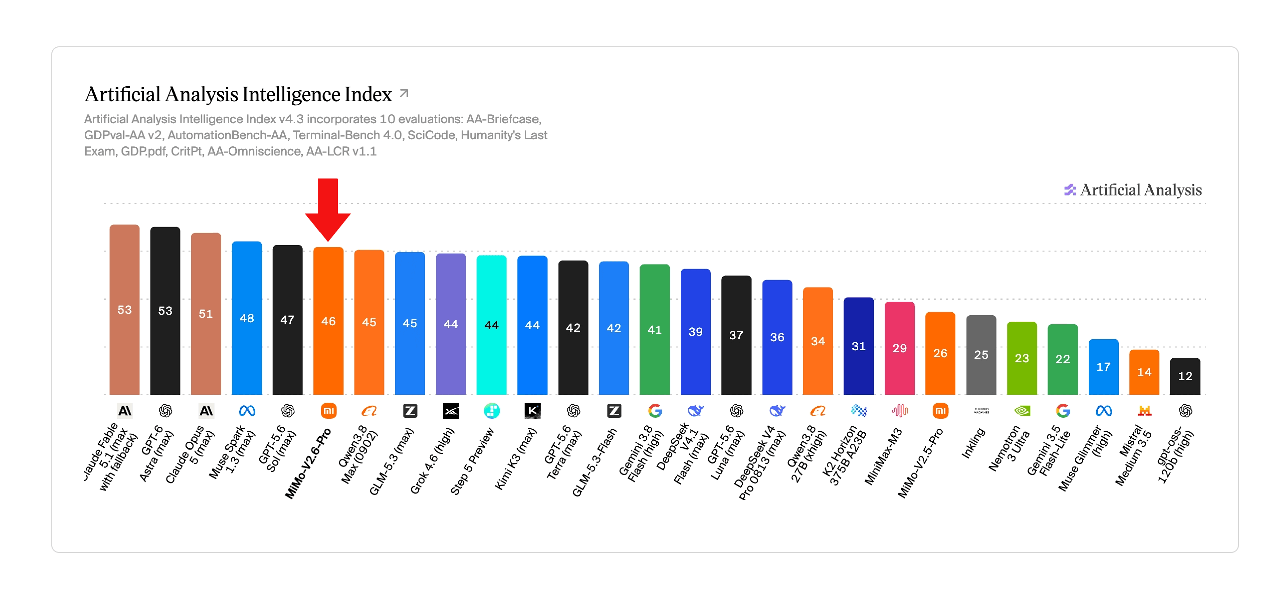
The MiMo-V2.6 series comprises two native fully multimodal models, Pro and Flash. Thanks to the expanded RL compute, MiMo-V2.6-Pro scores 46 on the Artificial Analysis Intelligence Index, surpassing Kimi K3 and Qwen3.8 Max to become the strongest open-source model available; a gap remains to the strongest closed-source models, Claude Fable 5.1 and GPT-6 Astra.
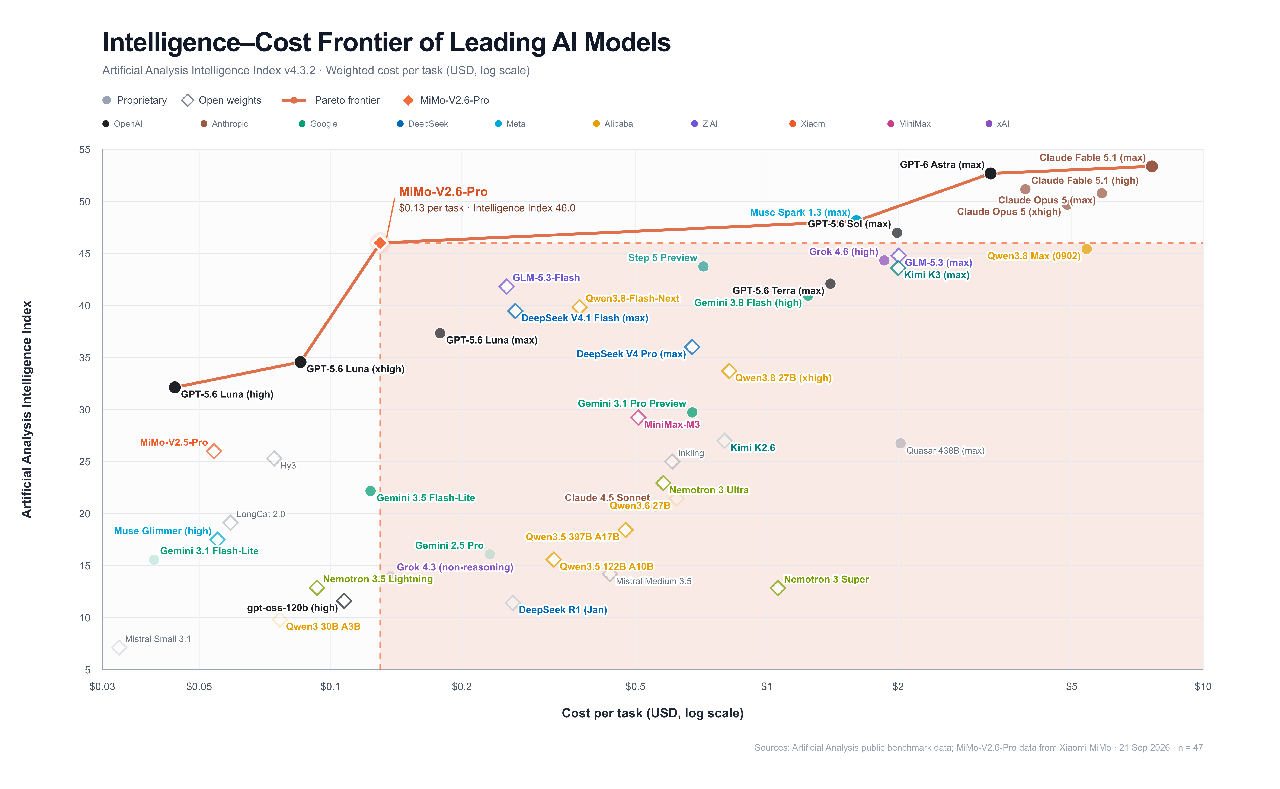
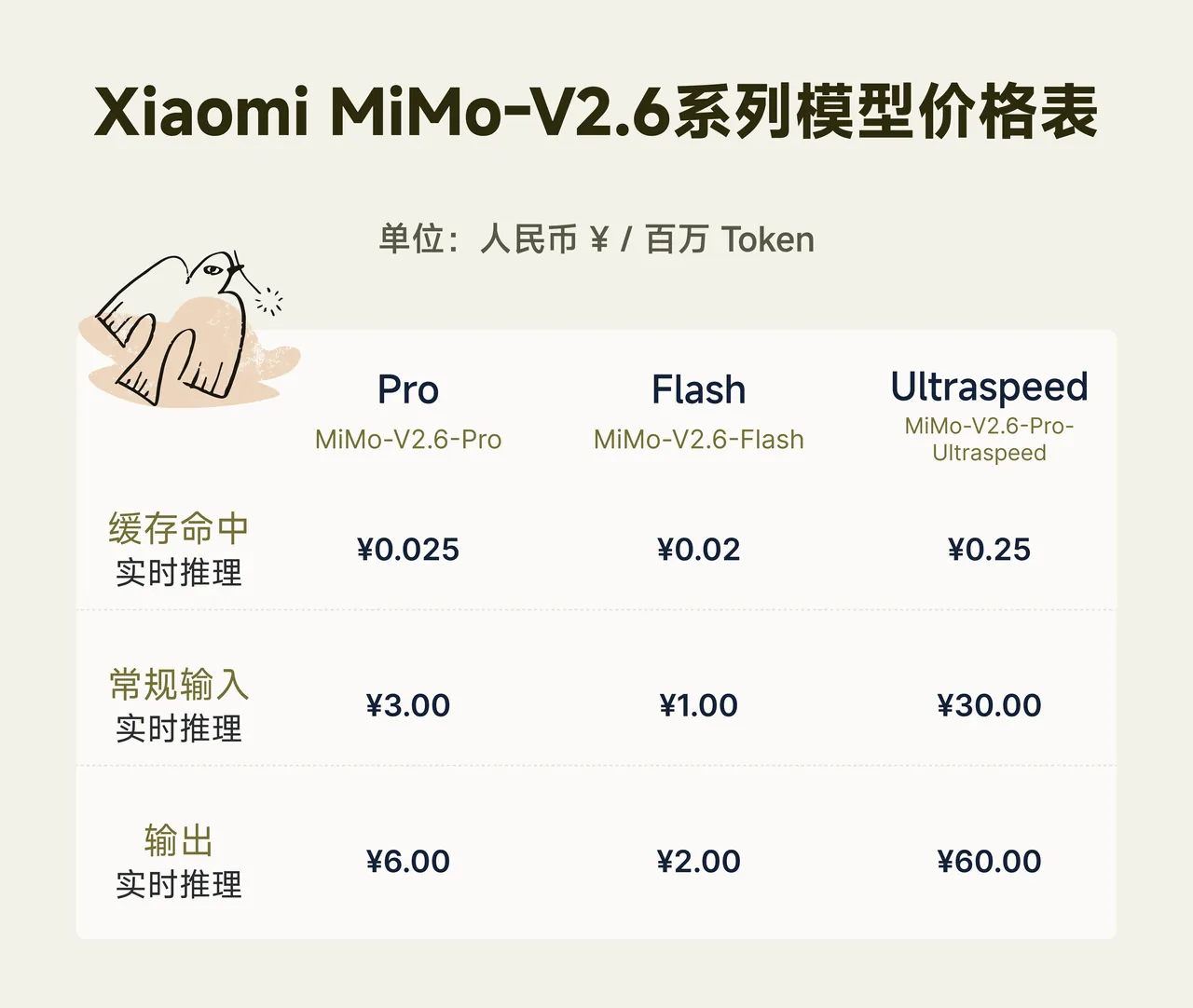
The series keeps the V2.5 API pricing. Intelligence up, price unchanged: the intelligence-cost Pareto frontier is pushed outward once again. MiMo-V2.6-Pro sets a new cost-performance record for domestic models, costing only 1/20 to 1/60 of overseas models at the same intelligence level.
Scale RL massively, open-source everything
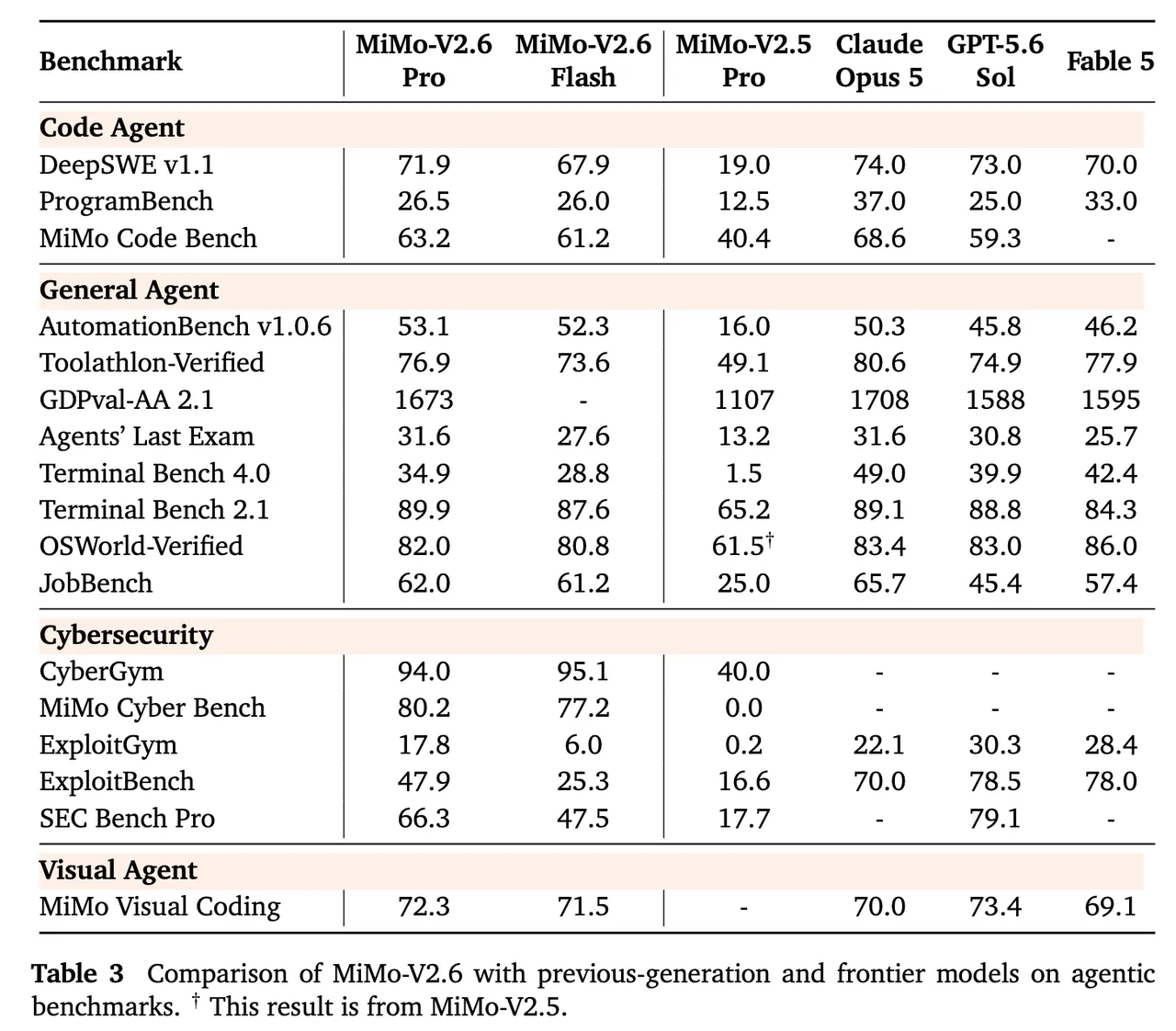
During RL training, MiMo-V2.6 is likely one of the domestic open-source models with the largest compute investment to date. After large-scale multi-task RL, MiMo-V2.6-Pro matches Claude Opus5 and GPT-5.6 Sol on most agent benchmarks, while MiMo-V2.6-Flash comprehensively surpasses MiMo-V2.5-Pro.
Throughout the run the team worked through fundamental research and engineering challenges in RL training and shared the experiment live. In under six days, MiMo-V2.6-Flash and MiMo-V2.6-Pro cost about $850k and $2.62M respectively, each completing 30 steps and roughly 750k trajectories in total; average training-task pass rates rose 25% and 12% relatively, and the out-of-sample long-horizon software engineering benchmark DeepSWE v1.1 improved by about 17 points (48.8 to 65.7) and about 14 points (58.4 to 72.6), showing RL's sample efficiency, steady improvement and out-of-sample generalization.
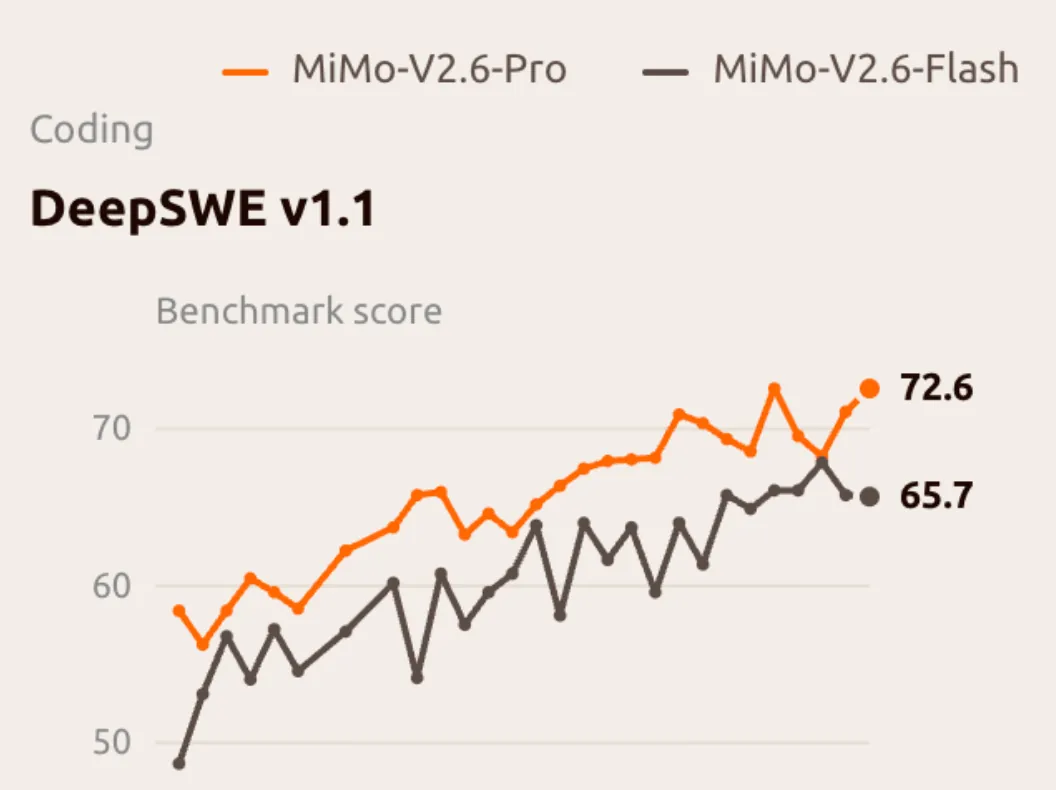
The training scales RL compute along three axes:
- Larger batches and higher throughput: large batches plus a fully asynchronous architecture give 1,568 samples per update, 1M-token context training, and 3.5-3.7B tokens per training step.
- More tasks and complex environments: a multi-task training system covering Code, General, Visual and Cyber, mixing multiple harnesses so different capability dimensions improve together.
- More grader compute: within-group relative comparison supplies more precise and diverse reward signals for long-horizon RL tasks, closing the self-improvement loop and steering the model toward shorter paths and fewer tokens per task.
As training scaled, the team froze the MoE router to suppress expert load drift and built a reward-hacking defense spanning reward design, adversarial evaluation, anomaly detection and cross-verification of validators, improving training stability and reward reliability.
To support large-scale mixed-task agentic RL, the team designed a unified trajectory representation and penalty mechanism to refine learning signals, supported high-concurrency interaction across agent frameworks, decoupled the control plane from the data plane to migrate massive trajectories, stabilized per-task sample ratios in mixed batches, and optimized the efficiency and consistency of the training and inference engines.
All of the above is open-sourced, including the full technical report, training environments and RL code, so more researchers can reproduce and verify the results and explore scaled RL and self-improvement further.
From Vibe Coding to Vibe World
MiMo-V2.6 fuses 3D spatial reasoning, multimodal perception and computer-use (CUA) abilities, extending what programming can reach: natural-language-driven coding tasks become "Vibe World" tasks, i.e. building interactive worlds.
3D open-world games
Given an image, video or text, MiMo-V2.6 decomposes the request into tasks that multiple agents complete collaboratively: 3D scene construction, interaction logic and visual verification, then iterates against render results until a runnable interactive world matches the user's intent.
Blender 3D modeling
From text descriptions or reference images, MiMo-V2.6 models objects and scenes in Blender, producing 3D assets usable for animation, 3D printing and game development.
Embodied intelligence
In embodied simulation, MiMo-V2.6 takes multi-view camera feeds as input, reasons and decides continuously, and closes the visual feedback loop to control a Franka Panda arm for grasping, color matching and precise placement.
Computer Use Agent
MiMo-V2.6 extends Computer Use by combining multimodal perception with natively trained action capabilities. It understands complex GUIs, uses common office and productivity tools for information retrieval, editing and data processing, and checks results, troubleshoots and adjusts its next actions from visual feedback.
Advancing frontier scientific research
Without RL specialized for scientific tasks, MiMo-V2.6 already shows application potential across research domains. From materials design to mathematical formalization, the following cases show how the model applies reasoning, programming and tool use to concrete research tasks.
A co-scientist for materials research
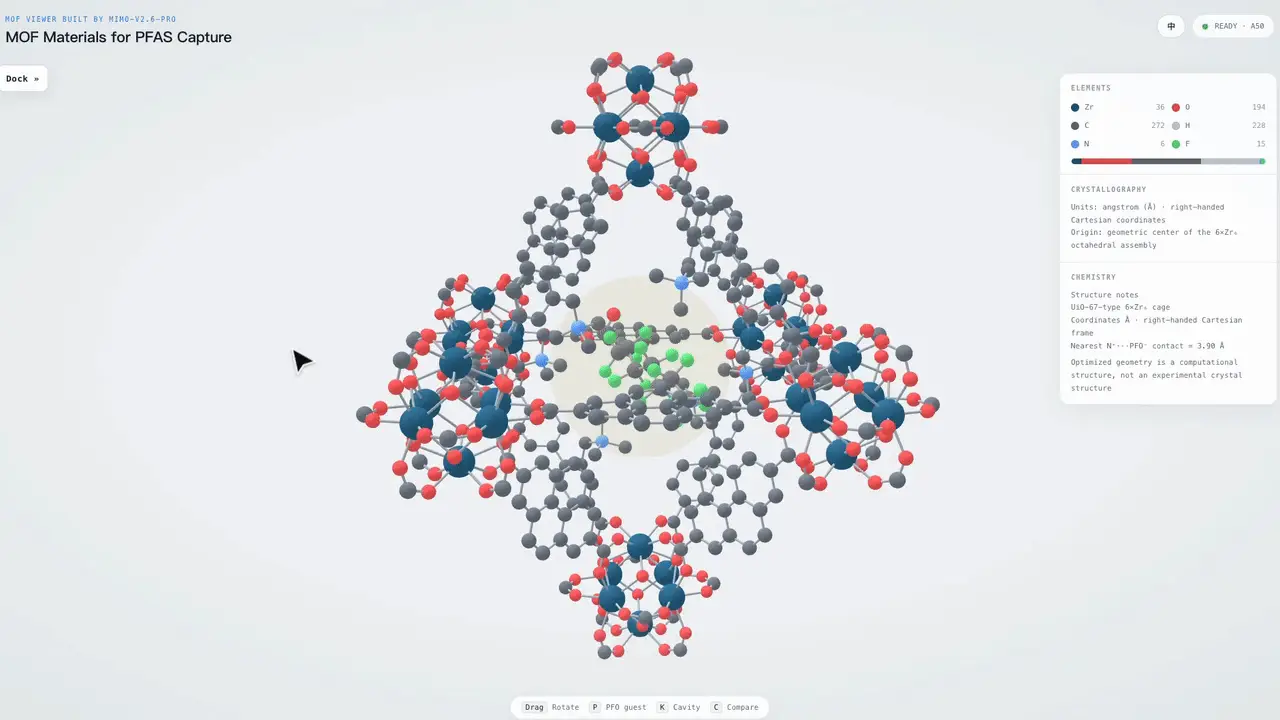
MiMo-V2.6-Pro assisted researchers with materials design and computational screening. Under multiple rounds of prompting from Xiaomi's frontier materials team it proposed several metal-organic framework (MOF) designs targeting the adsorption of PFAS, the "forever chemicals". Along the way the model retrieved and organized literature and patents, raised hypotheses and assessed the novelty of its designs.
It then ran "dry experiments": calling open-source computational tools to build simulation environments automatically, computing binding strengths between the designed MOFs and PFAS, and shortlisting the most promising candidates for later wet-lab validation.
Formal mathematical proof

MiMo-V2.6-Pro assisted researchers in fully formalizing, in Lean 4, the original main theorem of Li and Yorke's classic paper Period Three Implies Chaos. The theorem states that for a continuous interval self-map, a period-3 orbit entails orbits of every positive integer period plus an uncountable chaotic set.
Guided by an exploration strategy designed by the researchers, MiMo-V2.6-Pro advanced the formalization of the statement and proof through sub-agent collaboration. After revision and integration the project produced over 6,000 lines of Lean source; the complete proof passes the Lean kernel with no unfinished placeholders. The model received no Lean-specific post-training, which makes this a clean demonstration of its capacity for complex formal proof work.
Code-driven content creation and aesthetics
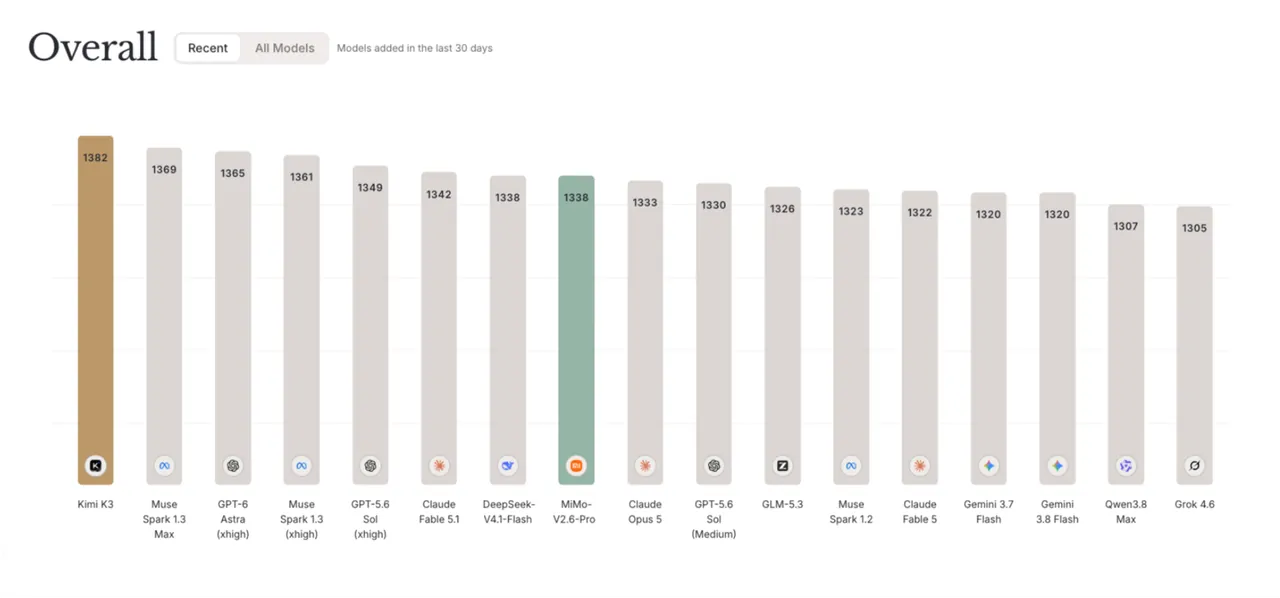
The series markedly improves the model's ability to create polished digital products: front-end pages, Figma designs, slides, SVG, video and music. On the design leaderboard Design Arena, MiMo-V2.6-Pro reaches a level comparable to Claude Opus 5 and GPT-5.6 Sol.
Front-end & PPT aesthetics
MiMo-V2.6 turns simple instructions into complete front-end interfaces and decks: structured layouts, carefully designed components, interactive elements and rich animation. It also drives Figma and image/video generation tools to produce on-style visual assets, keeping typography, palette and layout coherent while balancing aesthetics with readability and interaction.
Video creation
MiMo-V2.6 completes high-quality video end to end. For creative and product promos it handles visual design, shot and motion choreography, score synthesis and beat-matching; for science explainers it turns abstract concepts such as Fourier decomposition and convex hulls into plain narration and coherent animation, synthesizes voiceover with MiMo-V2.5-TTS aligned to the picture, and automates the whole pipeline from concept breakdown to final cut.
Music creation
MiMo-V2.6 further strengthens musical understanding, aesthetic judgment and knowledge use. It can already produce demo-grade pieces and assist professional composers and arrangers.
In the showcased case, MiMo-V2.6-Pro composed an orchestral work with about ten instruments on request, generated the score and autonomously converted it to MIDI. The piece reflects its understanding of instrumental roles and orchestration, and its ability to apply musical knowledge to melody and overall arrangement.
Getting started
Xiaomi MiMo Desktop client
The MiMo Desktop client and membership plans launch with the models (download). Members get MiMo-V2.6-Pro and Flash; you can also plug in your own API key. MiMo Desktop ships the UltraSpeed mode for MiMo-V2.6-Pro with up to 20x inference speed for real-time interaction. The original invitation beta ends in one week; qualified users keep access after switching model names.
Xiaomi MiMo API
The series is live on the Xiaomi MiMo open platform with unchanged pricing; MiMo-V2.6-Pro also offers UltraSpeed there (up to 20x). When calling the API, use the all-lowercase model names mimo-v2.6-pro, mimo-v2.6-flash and mimo-v2.6-pro-ultraspeed.
Fully open source
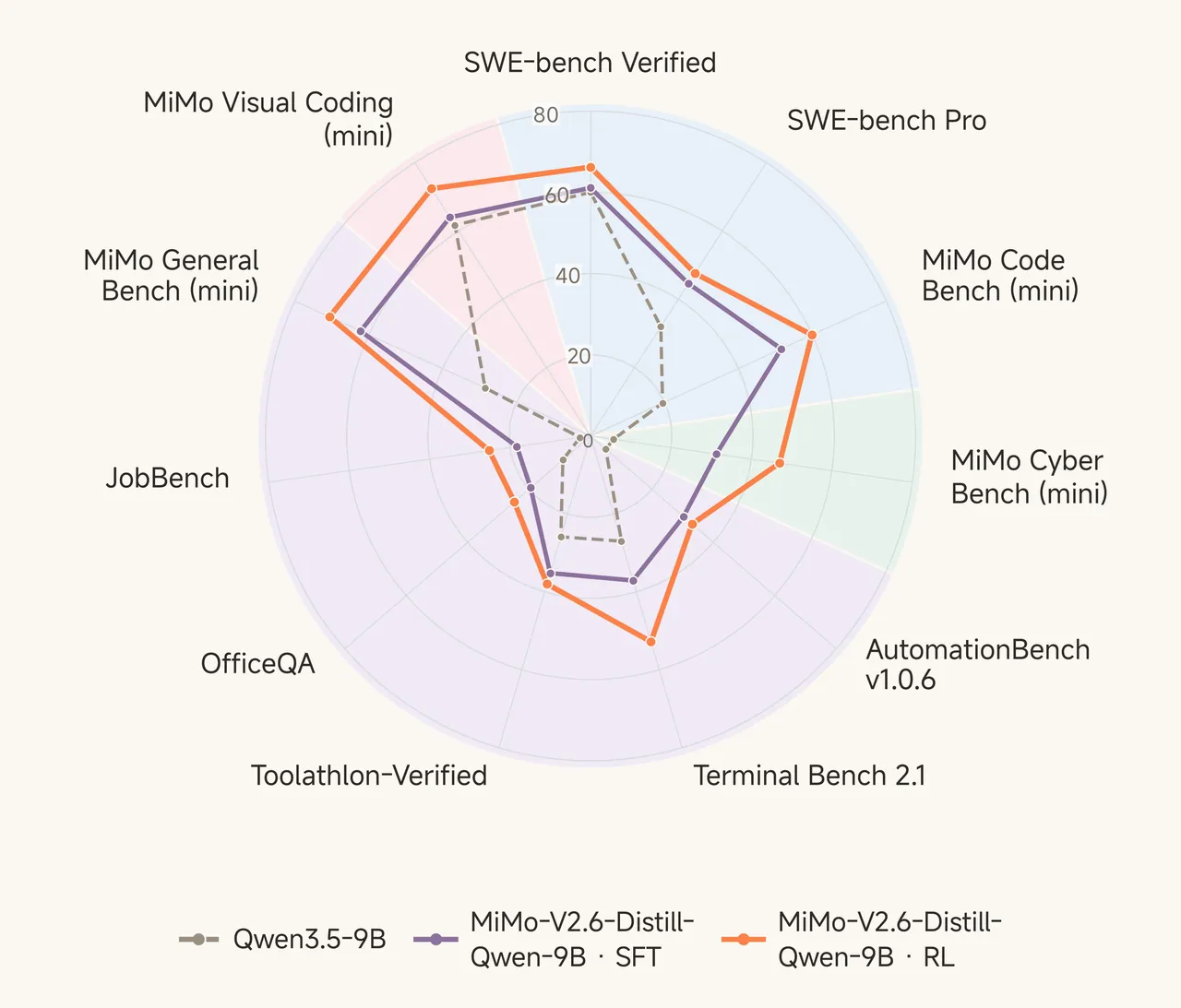
Xiaomi open-sources the MiMo-V2.6-Pro and Flash weights and technical report, together with MiMo-V2.6-Distill-Qwen-9B and the accompanying RL research resources:
- 7k+ high-quality RL task environments covering software engineering, vulnerability reproduction, knowledge work and web design/development. Starting RL from MiMo-V2.6-Distill-Qwen-9B improves over the SFT baseline on all 11 evaluations: SWE-bench Verified 61.1 to 66.2, MiMo Cyber Bench 31.3 to 47.0, Terminal Bench 2.1 37.1 to 52.8, MiMo Visual Coding 64.0 to 72.4;
- An end-to-end RL training framework built on verl, uni-agent and mini-swe-agent, covering environment interaction, trajectory collection, reward evaluation and policy optimization, so the community can iterate on training algorithms, reward mechanisms and agent harnesses;
- Lightweight composable harnesses: minimalist mini-harnesses that decouple system prompts, tools and context management into diverse, controllable training configurations. Multi-harness training folds diversity and neatness into RL, improving generalization across frameworks including unseen ones, and letting the community recombine components freely.
The hope is that this release gives the community a common foundation for exploring RL algorithms and agent mechanisms, and pushes agentic RL research forward. Open-source collection: XiaomiMiMo/mimo-v26.
Source: MiMo-V2.6: Scaling Up Reinforcement Learning for Self-Improvement, Xiaomi MiMo, September 22, 2026. Demo videos condensed into 77-second bilingual recaps by the Agientry video-recap engine (videostudio / Remotion).
Source:Xiaomi MiMohttps://mimo.mi.com/docs/zh-CN/news/latest/v2-6