BLOG
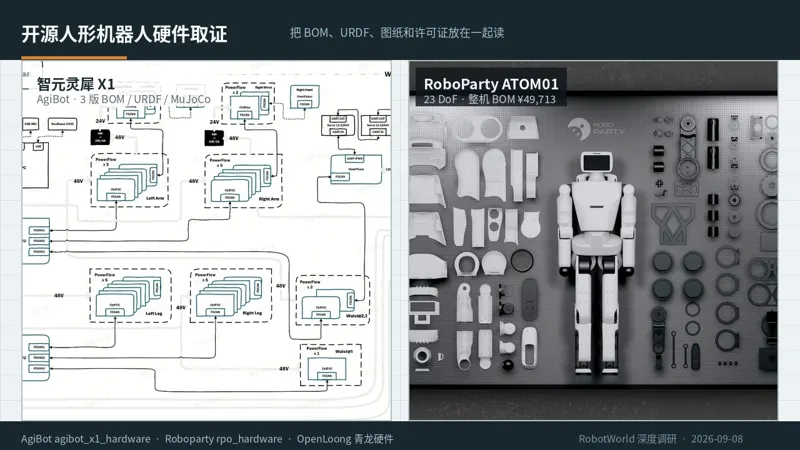
A humanoid robot is not an assembly of seven modules but a stack of physics equations that set each other's boundary conditions. This article computes the whole-machine stack layer by layer: joint motor modules (declared torque versus real quasi-static CoP demand — knee margins across three vendors converge to 2.23-2.42x while BHL's knee has only 1.51x) -> IMU (lever-arm pseudo-acceleration is 21,752x the sensor noise floor, so mounting position matters four orders of magnitude more than the datasheet) -> materials and structure (three BOM revisions of AgiBot's X1 as a load-path history: every part entering the closed-chain drivetrain upgraded to 7075-T6 / TC4 / 17-4PH) -> sensors (fix the observation space before the shopping list) -> battery and BMS ('all joints at peak simultaneously' is physically impossible: G1's 46,062 W against a 421 Wh pack is 109 C) -> software control and the CAN-level low-side boards (22 nodes at 500 Hz on one bus is 130.9% load, so it must be split into four) -> simulation training and sim-to-real: domain randomization, sim2sim, zero calibration (ATOM01's 2.093 rad waist-yaw assembly offset, the |q| < 1e-2 rad acceptance gate, and write_motor_flash() being a no-op in three of the four motor drivers), plus 10 of 13 real failure modes being hardware calibration rather than simulation fidelity. Every figure comes from programmatic parsing of the five machines' public model files, deployment and calibration source, plus official vendor specifications, and is recomputable.
Wheeled-base (half-body) humanoids are the fastest-moving form factor of the humanoid race: over 40% of humanoid products launched globally in 2025 use wheeled chassis, with travel speed 3-5x that of bipeds, 60%+ energy savings, and system cost one order of magnitude lower. Based on public sources and vendor research, this article dissects the chassis and lift designs of leading players (Galbot, AgiBot, UBTECH, Pudu, Astribot, Yifei, Zhipingfang, Topstar) across mecanum, omni-wheel, four-steer-four-drive and dual-differential chassis and screw / rigid-chain / belt lifting mechanisms; maps the supplier landscape (SEER, WIMAI, SLAMTEC, JIECANG and more); and answers the core question — in-house or outsourced? The answer: chassis and lift mechanisms are overwhelmingly developed in-house; outsourcing concentrates on commodity parts like wheels, motors and screws.
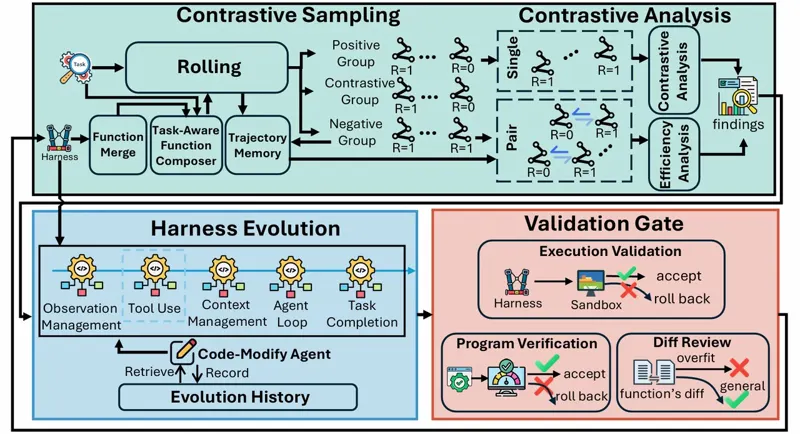
ModularRSI decomposes an agent harness into five functional modules, evolves them independently with 2,000 evolution instances disjoint from downstream benchmarks, contrastive trajectory diagnosis, scoped code modification, and validation gates. The TB-evolved harness raises Terminal-Bench 2.0 Acc from 47.57 to 52.43 and transfers across domains and foundation models including GLM-5.2, MiniMax-2.5, and DeepSeek variants.
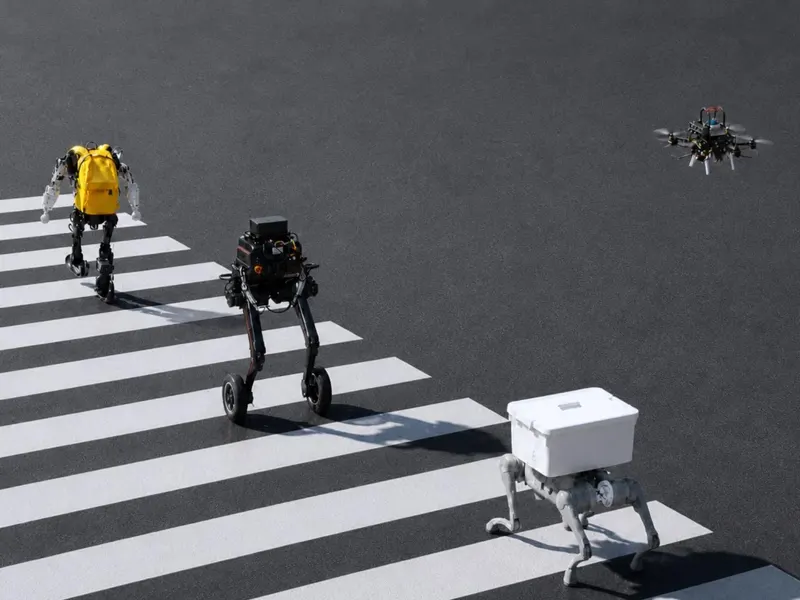
Light Origins' Real2Sim2Real engine turns 2,000+ internet-sourced scenes into 4,000+ hours of aligned VLA experience. LightNav-0 tops 10 simulated settings and transfers zero-shot to humanoid, quadruped, aerial, and wheeled robots.
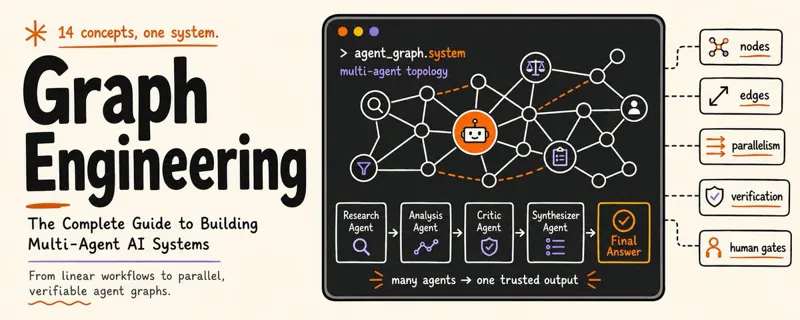
The hard problem in multi-agent systems is not making one agent smarter, but deciding how work itself should move. This long-form guide introduces Graph Engineering: use the dependency test to expose fake dependencies, measure latency by critical path instead of total steps, compress deterministically before reasoning, give verifiers a falsification objective, model human approval as an edge rather than a node, freeze rules that sit outside optimization, and adopt five canonical graph shapes plus a paste-ready graph spec template — along with clear criteria for when NOT to build a graph at all.
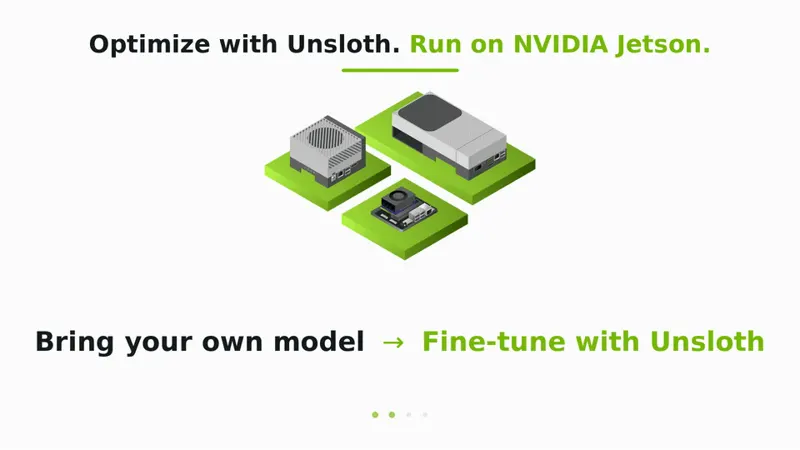
Official Jetson AI Lab tutorial: fine-tune models directly on Jetson with Unsloth and JetPack 7.2 using memory-efficient QLoRA, export to GGUF, and run locally with llama.cpp. Two hands-on examples: Qwen3.5-4B vision-language model on Jetson Orin Nano (LaTeX OCR fine-tuning), and NVIDIA Nemotron 3.5 Lightning 30B-A3B on Jetson AGX Thor (3 training steps in 44.8s, 66.1 tokens/sec with Q4_K_M quantization). No cloud required.
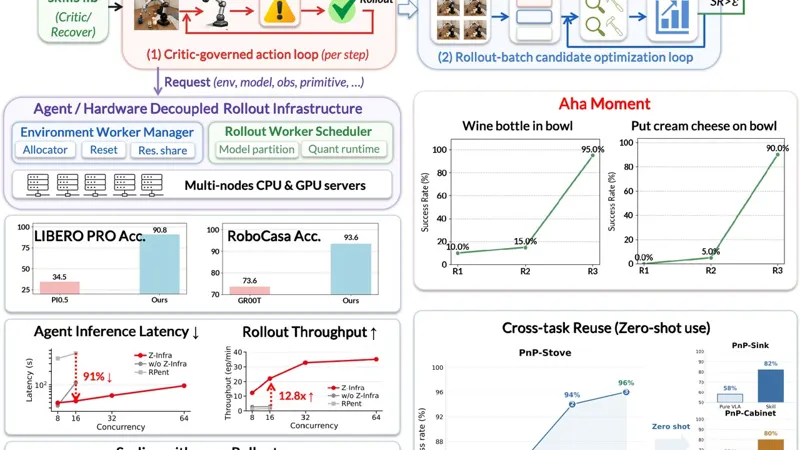
Tsinghua AIR and Z-Trans AI present Zetta ζ, a closed-loop embodied harness that improves a frozen VLA policy without a single gradient update. Instead of fine-tuning, it evolves the execution harness around the policy: code-based runtime critics watch every action, recovery skills take over on deviation, and a validation gate admits only skills that generalize. The frozen baseline scores 31.0% on LIBERO-Pro; the same policy under Zetta ζ reaches 92.5% (+56.3 absolute points), with a +20-point gain to 93.6% across 18 RoboCasa tasks. Z-Infra scales valid rollout throughput 20.6× and speeds inference 11.1×. Skills transfer zero-shot, and clear robotic "aha moments" emerge.
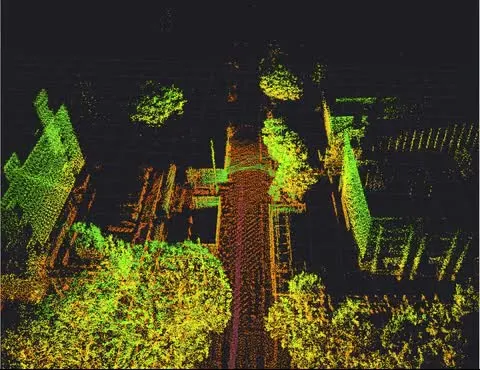
glass-LIO is an open-source scan-to-map LiDAR-inertial odometry for the Livox MID-360, described by its author as “written to be read”: each of its six pipeline stages has a deep-dive write-up, the manifold Gauss-Newton solver is under 200 lines of Eigen with no Ceres/GTSAM, and every bug that produces plausible output is documented — including the full failure post-mortem of tight coupling diverging on real data. It runs real time at 10 Hz on the test bag with zero dropped scans and steady RMSE around 0.13 m.
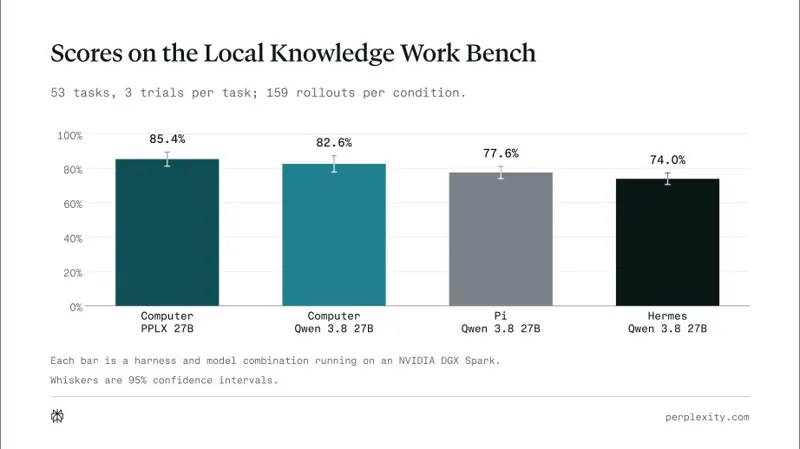
Perplexity details Portable Computer, a local-first agent whose model, harness, conversation and trajectory live on-device by default, with web search, connectors and cloud advisor escalation only on user-approved demand. A lean local harness (on-demand skills, CLI connectors, self-verification, sandboxed execution) is co-designed around Qwen 3.8 27B, then post-trained into PPLX 27B. On the 53-task Local Knowledge Work Bench, Computer scores 82.6% vs Hermes 74.0% and Pi 77.6%, rising to 85.4% with PPLX 27B; it also leads BrowseComp (66.7%) and ParseBench-100 (65.1%) with the least time and tokens, while advisor escalation recovers ~3/5 of the Terminal Bench 2.1 frontier gap at ~2/3 of frontier cost.
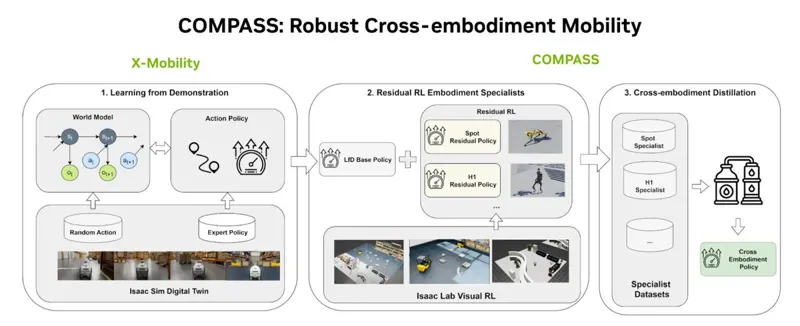
NVIDIA COMPASS framework enables cross-embodiment navigation via residual RL and skill synthesis. A coding agent automates environment validation, scene preparation, smoke testing, residual specialist training, and checkpoint evaluation with human approval gates. Uses Spot quadruped as reference across built-in warehouse, SAGE-10K, and NuRec captured environments.
Dyna says Din Tai Fung will scale its robots after crossing the customer ROI threshold. Dyna-2 raises napkin folding from 35 to 95 per hour with quality improving from 75% to 93%, reaching 1,590 table-ready napkins daily. The essay details the production stack: reliable episode capture, automatic SOP labeling, failure drill-downs, hardware degradation prediction, and a deployment flywheel that can reach ROI in three days.
MHS uses standardized drivers, read/write primitives, natural-language machine descriptions, and MCP/CLI/API control to connect heterogeneous lab and manufacturing equipment to AI agents. The preview includes AWS, Doosan, Universal Robots, Tecan, QIAGEN and others, while emphasizing expert oversight for physical reasoning and safety.