OPEN SOURCE DEEP DIVE
Takto One: Open-Source Hand Exoskeleton
Open-source hand exoskeleton: 12 joint encoders, 8 tendon-driven motors, on-device Teensy control, and synchronized capture/EMG for motion capture, teleoperation and haptics research.
A closed-loop research platform for the hand
TAKTO ONE is an open-source hand exoskeleton that reads four long fingers with 12 AS5600 magnetic encoders and actuates them through 8 motors and tendons. Its control loop runs on a Teensy 4.1, so the device does not need a host computer for basic execution. That makes it usable as one platform for motion capture, teleoperation, and haptics research.
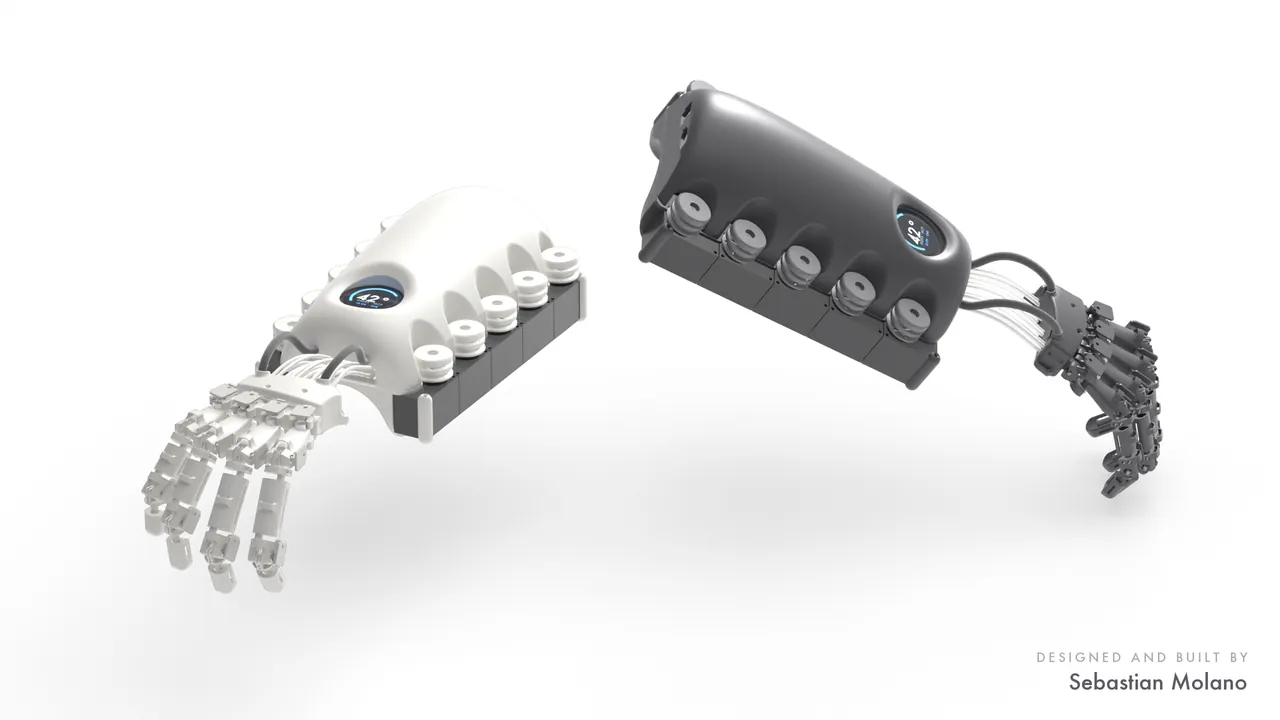
The repository includes 71 printed parts, two custom PCBs, complete KiCad sources and manufacturing outputs, Teensy firmware, a Dynamixel bus interface, and a full BOM. Actuation is EUR 1040 of an approximately EUR 1222.25 build; the author therefore identifies reduced motor count and a better series-elastic transmission as two of the most useful contribution areas.
Sensing, control, and EMG
The browser twin updates at 60 Hz, firmware streaming defaults to 50 Hz, and the embedded control loop can run up to 2 kHz; these are distinct rates. The device also puts 14 encoder channels, hand and forearm IMUs, EMG envelope and RMS, and motor telemetry into one frame stream and SD-card log, which makes it useful for building synchronized multimodal intent datasets.
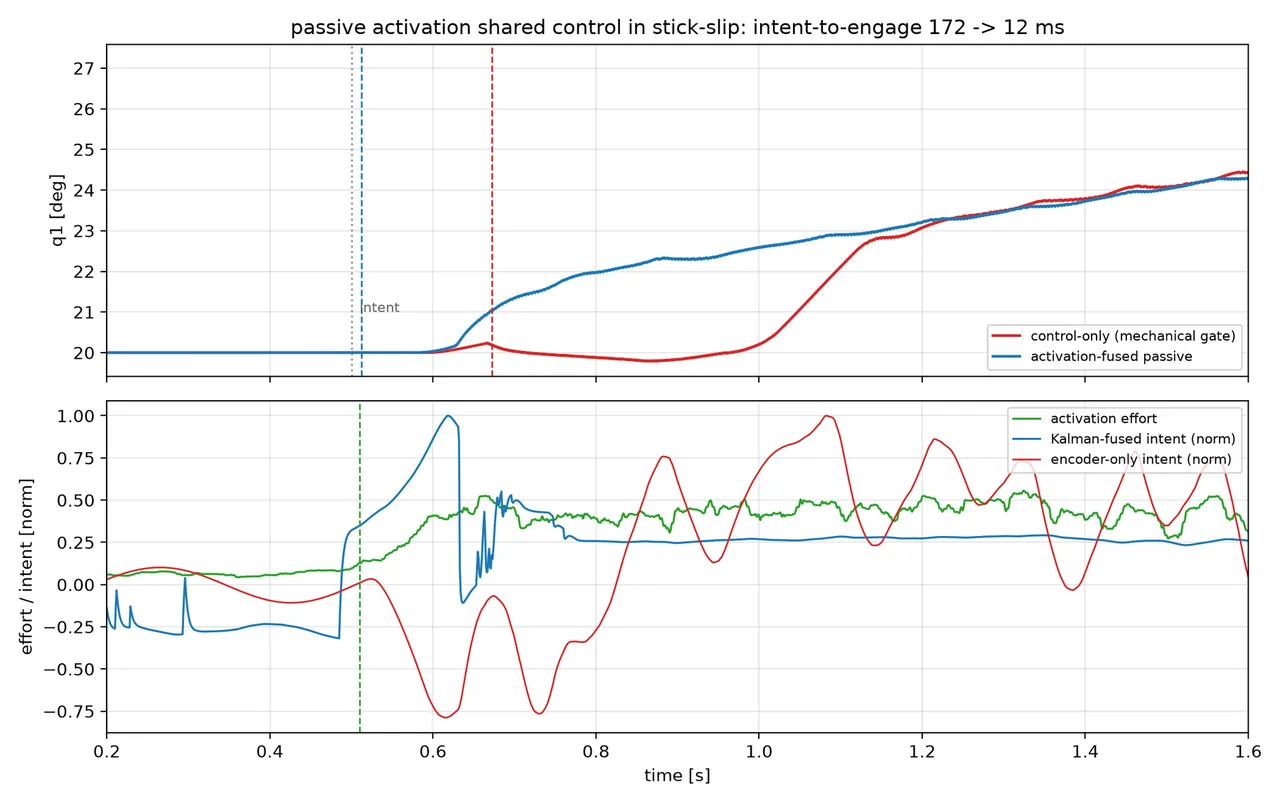
The EMG input uses a MyoWare 2.0 sensor with a standard three-electrode interface. The firmware oversamples at approximately 1 kHz and reduces it to mean envelope plus RMS. The interface is ready for intent-aware shared control, but the repository is explicit about the boundary between research and completed engineering.
Verified capability and limits
| Status | Detail |
|---|---|
| Verified | Firmware runs on hardware; 12 magnetic encoders read together; two IMUs are fitted; four long-finger assemblies are built and instrumented; motors drive the fingers with and without the elastic element. |
| Included demos | Browser console, 3D twin, AR layer, and mobile app can run in simulation; SD-card session logs support replay. |
| Not characterized | Force rendering, transparency control, and assistance behavior are not characterized in this repository; users must validate limits and safety before worn experiments. |
| Known limits | Eight motors are expensive; the series-elastic actuation is simple; the device is not a medical device or certified protective product. |
The repository also includes TAKTO-SIGN, a German sign-language capture, training, and live-recognition stack, as a concrete use case. Robot-hand teleoperation, rehabilitation assessment, precision machine control, and larger shared datasets are stated as future directions rather than delivered features.
SOURCE LINKS