Skip to content
←Back to Papers

PAPER DEEP DIVE

NVIDIAHumanoidFoundation Models

GR00T N1: NVIDIA Humanoid Robot Foundation Model

GR00T N1 is NVIDIA's humanoid foundation model combining vision-language understanding with action generation for cross-platform transfer.

GR00T N1 is NVIDIA's humanoid foundation model combining vision-language understanding with action generation for cross-platform transfer.

Related Papers

TacitVLA: Reasoning Vision-Language-Action Models Without Reasoning Latency

TacitVLA: Reasoning Vision-Language-Action Models Without Reasoning Latency

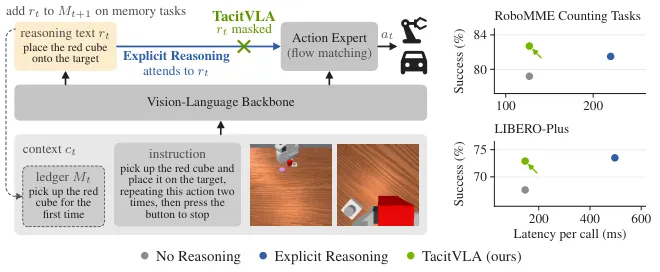
Textual reasoning before acting has improved vision-language-action (VLA) models, but at the cost of latency: every action conditioned on the reasoning text must wait for autoregressive decoding. We show that actions do not need to wait for or condition on the generated reasoning to benefit from it, because the reasoning supervision already improves the backbone representation. We introduce TacitVLA, a reasoning VLA whose action expert never attends to the reasoning it generates for the current call. On long-horizon tasks where the reasoning text also serves as episodic memory, it can generate each entry during action execution rather than before acting. We evaluate it in a controlled study on four benchmarks spanning manipulation and autonomous driving, memory and non-memory tasks: RoboMME, RMBench, LIBERO, and PhysicalAI-AV. On all four, TacitVLA matches the performance of its explicit-reasoning counterpart at up to 3.4x lower latency, and matches the latency of the same architecture trained without reasoning at up to +17.1% success. In absolute terms, it surpasses the best previously published results on the RoboMME Counting suite (82.7% vs. 66.8%) and RMBench (77.5% vs. 56.5%), and reaches 72.9% on LIBERO-Plus and a 52.5% scene score on the public split of the PhysicalAI-AV closed-loop driving challenge. Project page: https://tacitvla.github.io.

Jack Lu, Yurong You, Boyi Li · 61 views · Oct 13, 2026
VLAEmbodied ReasoningManipulationOct 13, 2026
DyaPlex: Full-Duplex Speech-Motion Model for Dyadic Interaction

DyaPlex: Full-Duplex Speech-Motion Model for Dyadic Interaction

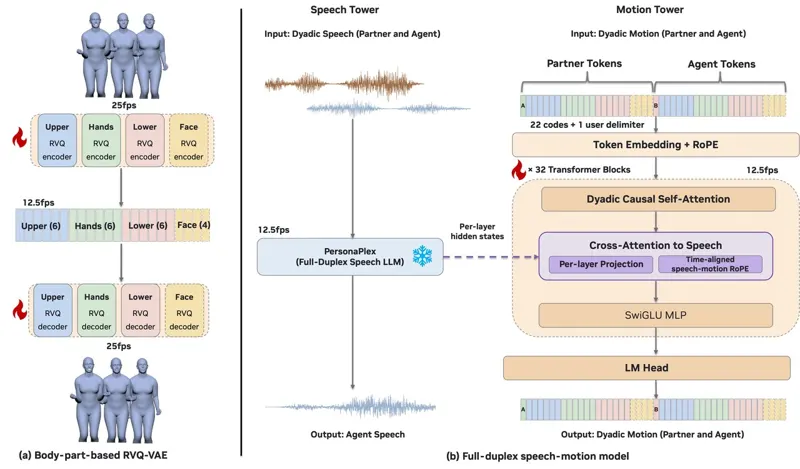
We present DyaPlex, a streaming, full-duplex speech-and-motion model designed for dyadic interaction. To capture the continuous and reciprocal nature of human communication, this full-duplex capability empowers the agent to simultaneously perceive and generate both speech and physical motion in a streaming fashion. At its core, our method leverages the strong priors of a foundational full-duplex speech model and integrates a novel motion pathway, thereby achieving fully synchronized multi-modal interaction. Specifically, we design a dual-tower Transformer architecture that preserves the zero-shot conversational reasoning of a frozen base speech model while constructing a deeply coupled, streaming motion pathway. By introducing a unified dyadic token interleaving mechanism and guiding cross-attention via a time-aligned speech-motion RoPE, our model effectively aligns autoregressive motions with rich latent speech features. Trained on the 4,000-hour Seamless Interaction dataset, our model effectively captures cross-speaker dependencies and establishes new state-of-the-art performance across both monadic and dyadic human interaction benchmarks.

Koki Nagano, Hongyu Liu, Seonwook Park · 242 views · Jun 2, 2026
Full-DuplexCo-Speech MotionDigital HumanJun 2, 2026
SoL-Pi: Recursively Scaling Auto-Research Loops for Efficient Agent Harness

SoL-Pi: Recursively Scaling Auto-Research Loops for Efficient Agent Harness

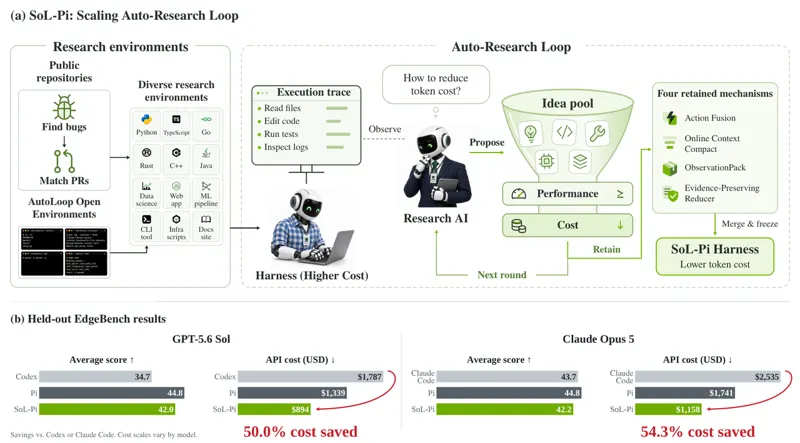
As coding agents move from supervised code completion to unattended, around-the-clock exploration, their work expands into long trajectories of reasoning, tool use, and feedback. SoL-Pi scales recursive auto-research across executable environments to discover reusable harness mechanisms. Four retained mechanisms improve action execution, context compaction, observation handling, and delegated reading, reducing recorded token traffic by 44.7-49.0% and API cost by about one third at comparable EdgeBench performance.

Haozhe Liu, Tian Ye, Sensen Gao · 797 views · Sep 17, 2026
Agent HarnessRecursive self-improvementToken EfficiencySep 17, 2026
Fast-FoundationStereo: Real-Time Zero-Shot Stereo Matching

Fast-FoundationStereo: Real-Time Zero-Shot Stereo Matching

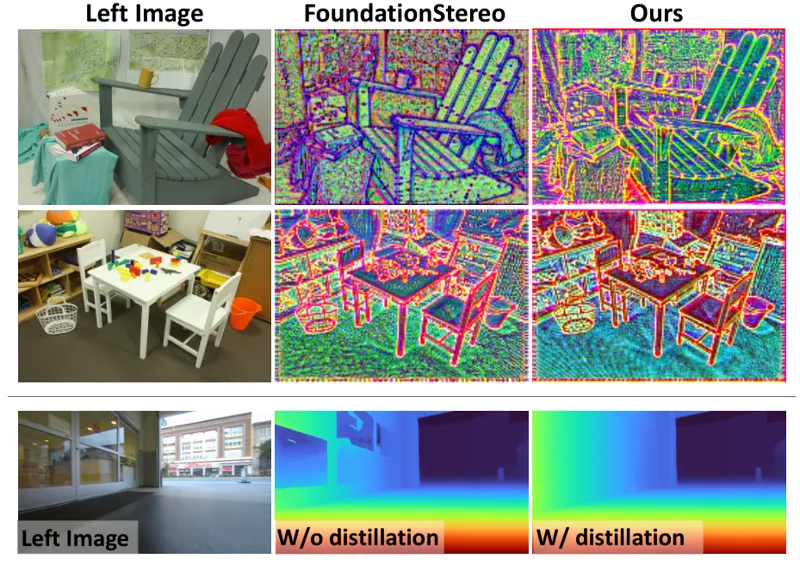
Fast-FoundationStereo accelerates the three bottlenecks of FoundationStereo separately: distillation compresses the hybrid monocular+stereo backbone into one efficient student, blockwise NAS searches cost-filtering designs under latency budgets with ILP, and structured pruning guided by a recurrent dependency graph slims the ConvGRU refinement module. Trained with 1.4M auto pseudo-labeled in-the-wild stereo pairs, it runs over 10x faster than FoundationStereo while nearly matching zero-shot accuracy, setting a new state of the art among real-time methods on Middlebury, ETH3D, KITTI and Booster.

Bowen Wen, Shaurya Dewan, Stan Birchfield · 549 views · Dec 11, 2025
Stereo MatchingDepth EstimationNVIDIADec 11, 2025

As an Amazon Associate, we earn from qualifying purchases.