PAPER DEEP DIVE
AwareVLN: Reasoning with Self-awareness for Vision-Language Navigation
Vision-and-Language Navigation (VLN) requires an agent to ground language instructions to its own movement within a visual environment. While state-of-the-art methods leverage the reasoning capabilities of Vision-Language Models (VLMs) for end-to-end action prediction, they often lack an explicit and explainable understanding of the relationships between the agent, the instruction, and the scene. Conversely, explicitly building a scene map for heuristic planning is intuitively appealing but relies on additional 3D sensors and hinders large-scale vision-language pre-training. To bridge this gap, we propose AwareVLN, a novel framework that equips the navigation model with a self-aware reasoning mechanism, enabling it to understand the agent's state and task progress in a fully end-to-end and data-driven manner. Our approach features two key innovations: (1) a structural reasoning module that fosters spatial and task-oriented self-awareness, and (2) an automatic data engine with progress division for effective training. Extensive experiments on various datasets in Habitat simulator show our AwareVLN significantly outperforms previous state-of-the-art vision-language navigation methods. Project page: https://gwxuan.github.io/AwareVLN/.
AwareVLN: Reasoning with Self-awareness for Vision-Language Navigation
Paper: AwareVLN: Reasoning with Self-awareness for Vision-Language Navigation
Authors: Wenxuan Guo, Xiuwei Xu, Yichen Liu, et al. (Tsinghua University)
Link: arXiv:2605.22816 | Project: gwxuan.github.io/AwareVLN/ | Simulator: Habitat
One-line summary: A navigation model that sparsely triggers structured self-aware reasoning at key nodes—analyzing scene, assessing progress, planning next steps—rather than reasoning every step or not at all, substantially outperforming prior end-to-end VLN methods on R2R-CE and RxR-CE.
Background and Motivation
Vision-and-Language Navigation (VLN) requires an agent to navigate in unknown environments following natural language instructions, grounding linguistic concepts to visual scenes and physical movements. Conventional approaches rely on constructing explicit topological graphs for task planning and vision-language grounding, but this paradigm depends on precise 3D sensing and SLAM systems. Recently, VLM-based end-to-end methods leverage large-scale vision-language pre-training to directly map instructions and observations to robot actions, eliminating the need for additional sensors.
However, current VLM-based VLN methods focus on taming VLMs for direct action prediction, overlooking their inherent reasoning capabilities. The end-to-end navigation process is largely unexplainable and lacks robustness—struggling with precise subtask planning and error correction due to a fundamental lack of self-awareness. Nav-R1 attempts explicit reasoning through a dual-system mechanism at fixed intervals, but its reasoning supervision data comes from querying a general VLM on past observations, lacking rich self-aware knowledge. Its reasoning often fails to provide deep insights into the navigation process and trajectory errors, serving merely as text output rather than guiding subsequent action generation.
AwareVLN's starting point: how can a model accurately reason about the current agent state and task progress from observation history within an end-to-end framework? The key insight—reasoning need not occur at every step, but should be sparsely triggered at key navigation nodes, ensuring both computational efficiency and genuine self-awareness.
Method
1. Problem Formulation
This work considers VLN in unknown continuous 3D environments (VLN-CE). The agent receives a natural-language instruction $\mathcal{I}=\{w_{1},\dots,w_{l}\}$ describing how to navigate from start to destination. At each time step $t$, the agent receives an egocentric RGB observation stream $\mathcal{O}_{t}=\{\mathbf{x}_{0},\dots,\mathbf{x}_{t}\}$ from a monocular camera, without depth or pose information. The goal is to predict actions from a discrete set $\mathcal{A}=\{\texttt{FORWARD},\texttt{TURN-LEFT},\texttt{TURN-RIGHT},\texttt{STOP}\}$, where each action is a motion primitive (e.g., moving 25cm forward or rotating 15°).
2. Unified Reason-Act Framework
AwareVLN adopts a unified VLM that jointly performs reasoning and action prediction. Given instruction $\mathcal{I}$ and observation sequence $\mathcal{O}_{t}$, a tokenizer $f_{\mathrm{tok}}(\cdot)$ converts textual inputs (instruction $\mathcal{I}$ and most recent reasoning $\mathcal{R}$) into token sequences, while a vision encoder $f_{\mathrm{vis}}(\cdot)$ extracts visual embeddings from raw RGB observations. For efficiency, 8 frames are uniformly sampled as visual input. The step count between the current frame and the previous reasoning step is encoded as a relative positional cue, fused with reasoning text for explicit temporal context:
$$\mathcal{R}^{\prime}=\mathcal{R}\oplus(t-t_{\mathrm{prev}})$$
where $t_{\mathrm{prev}}$ is the time step of the last reasoning output. Based on this combined context, the unified policy $\pi_{\theta}$ produces a logit $d$ and textual output $y_{t}$:
$$d,\,y_{t}=\pi_{\theta}\big(f_{\mathrm{tok}}(\mathcal{I}),\,f_{\mathrm{tok}}(\mathcal{R}^{\prime}),\,f_{\mathrm{vis}}(\mathcal{O}_{t})\big)$$
The model decides between reasoning and acting modes by comparing special token logits:
$$\mathcal{D}=\begin{cases}\texttt{[REASON]},&\text{if }d_{\texttt{[REASON]}}>d_{\texttt{[ACT]}}\\[4pt]\texttt{[ACT]},&\text{otherwise}\end{cases}$$
When [REASON] is predicted, the model produces a textual description summarizing the agent's understanding and progress. When [ACT] is predicted, the model generates an action command specifying next executable steps. This unified, language-driven formulation integrates perception, reasoning, and control seamlessly.
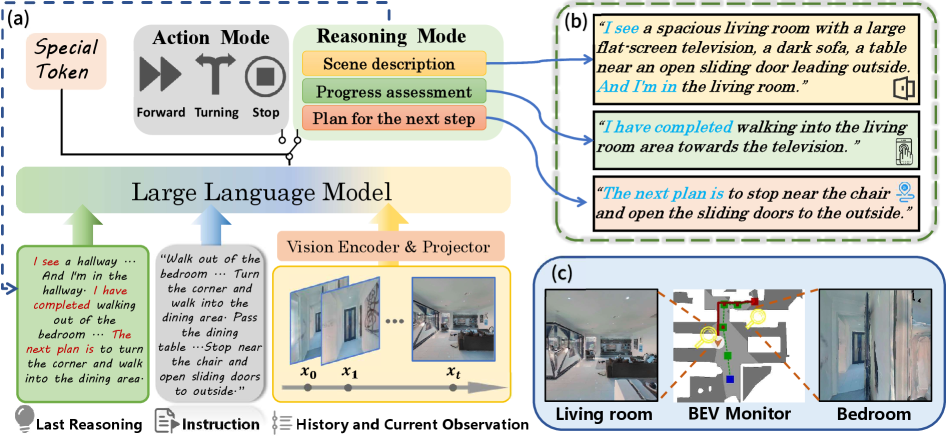
Figure 2: AwareVLN framework. (a) Unified VLM with both action prediction and self-reflective reasoning. (b) Multi-dimensional causal reasoning: scene description → progress assessment → next-step plan. (c) Sparse reasoning at key nodes.
3. Structural Reasoning Mechanism
Reasoning is triggered at three types of key states: (i) Subtask completion—when the model detects a sub-instruction has been fulfilled, triggering reasoning to summarize progress and plan the next step; (ii) Path deviation—when inconsistencies between expected and observed visual cues are identified, entering reasoning to analyze errors and propose corrective actions; (iii) Stopping error—in the final navigation stage when current visual context deviates from the target description.
The reasoning uses a triplet structured format: Scene description (concise depiction of visual context at the key node), Progress assessment (analysis of current status including which instruction parts are completed and whether deviations occurred), Plan for next step (high-level intention or strategy for the next navigation phase).
graph TD
  A[Input: Instruction I + Obs O_t] --> B[Unified VLM Policy pi_theta]
  B --> C{Compare special token logits}
  C -->|d_REASON > d_ACT| D[REASON Mode]
  C -->|otherwise| E[ACT Mode]
  D --> F[Scene desc + Progress assess + Next plan]
  F --> G[Update reasoning text R]
  G --> B
  E --> H[Parse actions a_{t+1:t+k}]
  H --> I[Execute actions]
  I --> J[New obs x_{t+1}]
  J --> B
  style D fill:#f5a623,stroke:#b97316,color:#fff
  style E fill:#4a90d9,stroke:#2c5f8a,color:#fff
  style C fill:#7ed321,stroke:#4a8a14,color:#fff
4. Automatic Data Engine
To efficiently obtain large-scale, high-quality reasoning supervision without manual annotation, an automatic data engine is designed. Navigation trajectories are collected in the Habitat simulator, with key reasoning nodes automatically determined using room-level semantic annotations and ground-truth waypoints. Two complementary collection strategies: ground-truth following (strictly along reference trajectories) and DAgger-based collection (early-stage model navigates autonomously, corrected back to reference path when deviating, producing realistic trajectories with natural errors and corrections).
Key node identification: subtask completion is detected via room category changes along the trajectory (e.g., "leave bedroom, turn right into living room"); path deviation and stopping errors are detected by computing spatial deviation between executed trajectory and ground-truth waypoints, marking nodes where error exceeds a threshold.
Reasoning supervision generation: a general VLM (Qwen-VL-Max) transforms contextual information into structured reasoning outputs via a multi-turn conversation pipeline. The first round inputs the complete episode observation sequence and language instruction for global understanding; subsequent rounds feed each key node's type, preceding visual observations, room transition info, and navigation progress estimate. Deviation nodes additionally receive subsequent correction observations, enabling the VLM to infer causal relations between errors and recovery.
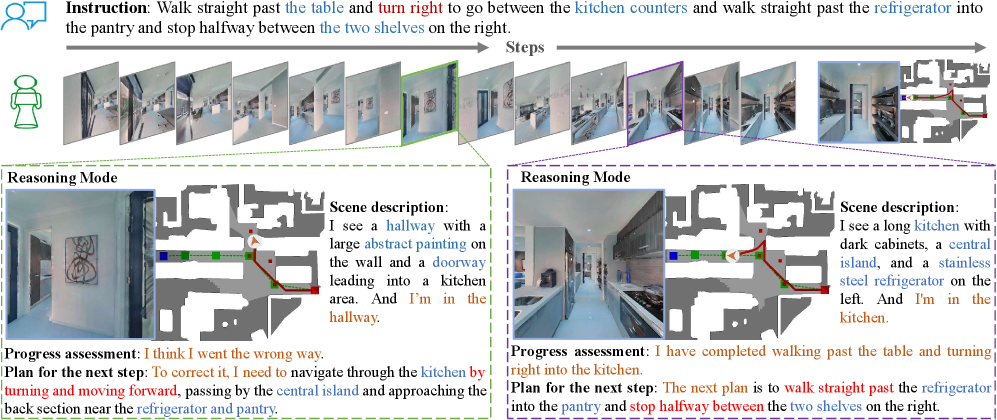
Figure 3: Automatic Data Engine. Key reasoning nodes are automatically identified using room-level semantics and ground-truth waypoints, with rich multimodal context fed to a general VLM to generate structured reasoning supervision.
Experimental Results
Main Comparison
Compared with SOTA methods on R2R-CE and RxR-CE Val-Unseen. AwareVLN uses only monocular RGB (no depth, panoramic, or odometry), achieving the best among all methods not relying on simulator pre-trained waypoint predictors.
| Method | Input | R2R SR↑ | R2R SPL↑ | RxR SR↑ | RxR SPL↑ |
|---|---|---|---|---|---|
| AwareVLN (ours) | Monocular RGB | 65.4 | 55.1 | 67.6 | 56.1 |
| HPN+DN (waypoint predictor) | Pano+Depth+Odo | 36.0 | 34.0 | — | — |
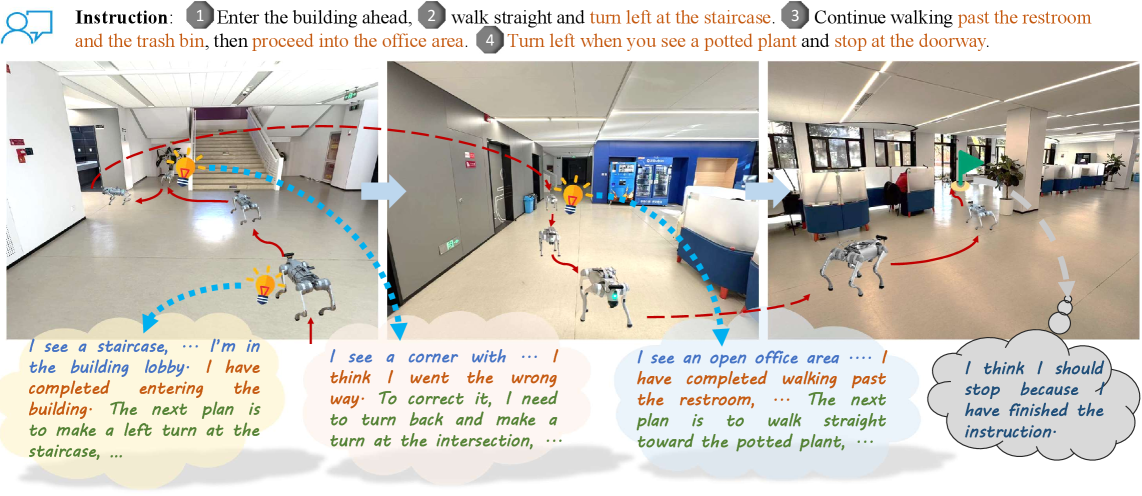
Figure 1: AwareVLN selectively triggers self-aware structured reasoning at key navigation nodes, explicitly analyzing spatial state, task progress, and instruction alignment.
Ablation Studies
| Variant | R2R SR | R2R SPL | RxR SR | RxR SPL |
|---|---|---|---|---|
| Complete reasoning data | 65.4 | 55.1 | 67.6 | 56.1 |
| w/o Subtask Completion | 52.3 | 50.7 | 52.7 | 45.0 |
| w/o Path Deviation | 55.1 | 51.5 | 54.0 | 49.3 |
| w/o Stopping Error | 60.0 | 57.5 | 61.2 | 53.2 |
Removing subtask completion causes the largest drop (SR 65.4→52.3), as the model loses track of overall instruction progress. Removing path deviation hinders error recognition and correction; removing stopping error prevents accurate goal arrival judgment.
| Reasoning Schedule | R2R SR | RxR SR |
|---|---|---|
| With special tokens (sparse) | 65.4 | 67.6 |
| Without special tokens | 62.5 | 62.1 |
| Dense reasoning every frame | 63.8 | 65.4 |
Sparse reasoning (only at keyframes) outperforms both dense per-frame reasoning and the variant without special tokens, validating the effectiveness of structured output and sparse triggering while ensuring computational efficiency.
Instruction tokens
$$ \mathcal{I}=\{w_{1},\dots,w_{l}\} $$
Observation history
$$ \mathcal{O}_{t}=\{\mathbf{x}_{0},\dots,\mathbf{x}_{t}\} $$
LimitationsAuthor-stated: Reasoning supervision data is generated by a general VLM (Qwen-VL-Max), whose reasoning quality is bounded by that VLM's capability. If the VLM misunderstands specific scenes, the generated reasoning supervision may contain errors.
Analysis: Key node identification relies on Habitat simulator's room-level semantic annotations, which are unavailable in real environments—the data engine's sim-to-real transfer is not thoroughly validated. Reasoning is triggered only at key nodes, but key node detection itself depends on model predictions—misfires or misses could cause decision errors. Only 8 uniformly sampled observation frames are used; early critical visual information in long-horizon navigation may be discarded. The action space uses discrete motion primitives (25cm forward, 15° rotation), which is coarse-grained and may be limited in scenarios requiring fine-grained motion.
Conclusion and Future Work
AwareVLN's core contribution elevates self-aware reasoning from a binary choice between per-step execution and no reasoning at all, to structured analysis sparsely triggered at key navigation nodes. Through the unified [REASON]/[ACT] special token framework, reasoning and action mutually enhance each other within a single VLM. The automatic data engine leverages simulator semantic annotations and a general VLM to generate structured reasoning supervision at scale without manual annotation. Ablation studies prove all three reasoning node types (subtask completion, path deviation, stopping error) are indispensable, and sparse reasoning outperforms dense. Using only monocular RGB to surpass methods relying on depth, panoramic views, and odometry validates that reasoning capability can substitute for sensor redundancy.
Navigation doesn't require thinking at every step—but reflecting at critical moments beats never reflecting or being perpetually distracted.
SOURCE LINKS