Skip to content
← Tags

#Embodied AI (382)

HALO: A Unified Vision-Language-Action Model for Embodied Multimodal Chain-of-Thought Reasoning

HALO: A Unified Vision-Language-Action Model for Embodied Multimodal Chain-of-Thought Reasoning

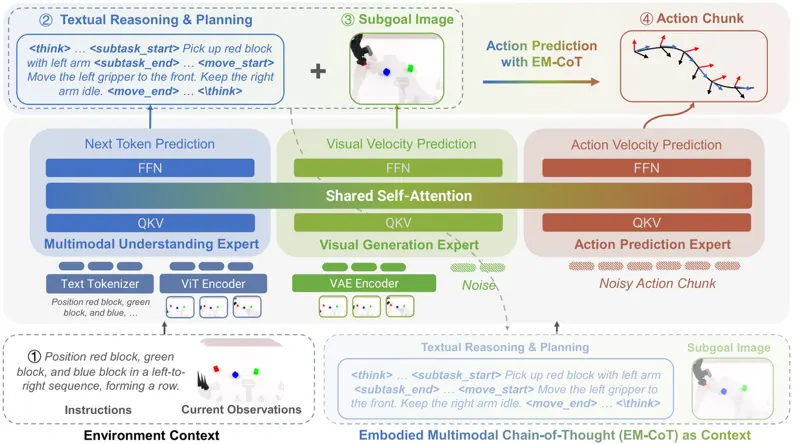
Vision-Language-Action (VLA) models have shown strong performance in robotic manipulation, but often struggle in long-horizon or out-of-distribution scenarios due to the lack of explicit mechanisms for multimodal reasoning and anticipating how the world will evolve under action. Recent works introduce textual chain-of-thought or visual subgoal prediction within VLA models to reason, but still fail to offer a unified human-like reasoning framework for joint textual reasoning, visual foresight, and action prediction. To this end, we propose HALO, a unified VLA model that enables embodied multimodal chain-of-thought (EM-CoT) reasoning through a sequential process of textual task reasoning, visual subgoal prediction for fine-grained guidance, and EM-CoT-augmented action prediction. We instantiate HALO with a Mixture-of-Transformers (MoT) architecture that decouples semantic reasoning, visual foresight, and action prediction into specialized experts while allowing seamless cross-expert collaboration. To enable HALO learning at scale, we introduce an automated pipeline to synthesize EM-CoT training data along with a carefully crafted training recipe. Extensive experiments demonstrate that: (1) HALO achieves superior performance in both simulated and real-world environments, surpassing baseline policy pi_0 by 34.1% on RoboTwin benchmark; (2) all proposed components of the training recipe and EM-CoT design help improve task success rate; and (3) HALO exhibits strong generalization capabilities under aggressive unseen environmental randomization with our proposed EM-CoT reasoning.

Quanxin Shou, Fangqi Zhu, Shawn Chen · 88 views · Feb 24, 2026
VLARobot Manipulation
Feb 24, 2026
Envisioning Agentic Robotics: A New Era of Robotic Systems

Envisioning Agentic Robotics: A New Era of Robotic Systems

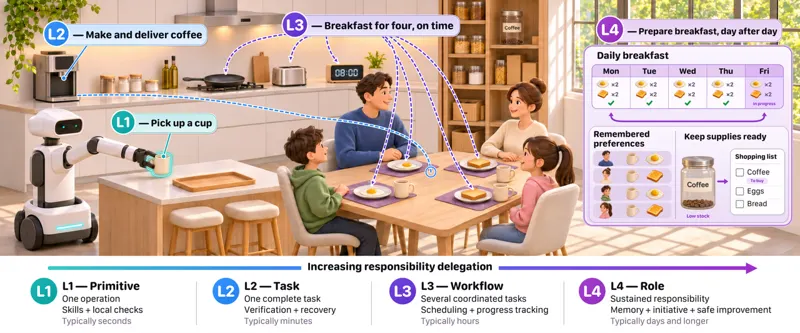
The release of GPT-6 Astra marks the emergence of a new paradigm in robotics: agentic robotics. Within weeks, frontier models with agentic harnesses matched or exceeded task-specific policies on many embodied benchmarks. Instead of training a dedicated policy for each family of tasks, an agentic robotic system applies a foundation model to open-world embodied tasks. It operates in a closed loop: observing the environment, interpreting user intent, reasoning about the task, invoking skills and tools, verifying outcomes, and adapting its strategy. Despite these advances, the community has yet to converge on a shared definition, a reliable evaluation framework, or a research roadmap. We argue that Embodied System 2, realized by a foundation model together with an embodied harness, forms the decision-making core of agentic robotics. Its central challenge is to translate general-purpose reasoning into effective and verifiable actions under physical constraints such as limited reaction time, mechanical limits, unpredictable environment changes, and irreversible consequences. Motivated by this perspective, we propose an evaluation framework that measures both model capabilities and closed-loop system performance. Furthermore, we identify the principles that carry over from digital to physical agents and the challenges that must be addressed to achieve reliable physical autonomy. On top of the Embodied System 2 and the evaluation framework, we envision a research roadmap toward sustained autonomy: the ability to perform work safely and reliably with progressively broader responsibility, from executing individual primitives to fulfilling standing roles.

Grid Robotics, Qingfeng Lan, Duo Li · 262 views · Nov 13, 2026
Agentic RoboticsAI
Nov 13, 2026
XBot-Omni: An Omni-Modal Model for Embodied Understanding and Interaction

XBot-Omni: An Omni-Modal Model for Embodied Understanding and Interaction

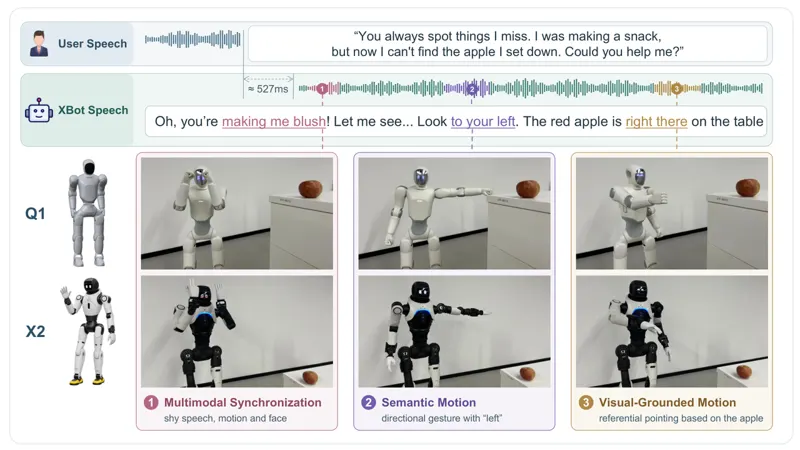
Embodied interaction requires an agent to integrate multimodal perception with verbal and nonverbal behaviors to effectively communicate its intentions, including speech, body motion, and facial expressions. We present XBot-Omni, a Thinker–Talker–Actor architecture that extends the Omni paradigm to robotic modalities, including body motion and facial expressions, with ``X'' representing the extensibility to robotic-specific modalities. The Thinker processes text, images, audio, and video to formulate contextually appropriate responses, which are then realized by the Talker and Actor through speech and coordinated bodily expressions, respectively. In this report, we innovatively introduce the concept of ``Actor'' as a dedicated component for embodied agents: a coordinated, streaming module that leverages the native representations of the Thinker and Talker within an end-to-end pipeline, introducing only modest latency overhead. This unified architecture enables multimodal generation conditioned on omni-modal inputs directly to prevent information loss in staged designs. We comprehensively evaluate XBot-Omni across seven benchmarks, demonstrating strong multimodal understanding capabilities on both general-domain and robot-centric videos, as well as high-quality, natural, and well-coordinated motion generation. Furthermore, our results validate its capability to generate embodied multimodal responses directly from omni inputs, meeting the diverse requirements of embodied interaction. XBot-Omni enables robots not only to perceive the omni world but also to express themselves through speech and bodily behaviors, extending Omni models from conversational interaction to embodied communication in physical environments.

Kerui Gu, Xing Fu, Shuoyang Sun · 246 views · Nov 12, 2026
Embodied AIOmni-Modal Model
Nov 12, 2026
As an Amazon Associate, we earn from qualifying purchases.