PAPER DEEP DIVE
VLA-Corrector: Lightweight Detect-and-Correct Inference for Adaptive Action Horizon
Vision-Language-Action (VLA) foundation models have recently achieved strong progress in embodied intelligence. To reduce policy-call frequency while preserving temporal coherence, most generative policies adopt an action chunk mechanism, executing multiple future actions in an open-loop manner under a fixed action horizon. However, this "predict-then-blindly-execute" paradigm sacrifices closed-loop reactivity: in contact-rich physical interactions, even small local perturbations can rapidly amplify within the open-loop blind spot, leading to compounding errors and ultimately task failure. To address this limitation, we propose VLA-Corrector, a lightweight corrective inference framework for action-chunked VLA policies. Without modifying the backbone policy weights, VLA-Corrector introduces a lightweight Latent-space Vision Monitor (LVM) that continuously compares predicted and actual visual feature evolution, enabling online detection of visual dynamics deviations. Once persistent deviation is detected, the system triggers a truncation event, discards the remaining stale actions, and invokes corrective replanning via Online Gradient Guidance (OGG). The detect-and-correct mechanism of VLA-Corrector naturally induces an event-triggered adaptive action horizon: it preserves long-horizon execution when the current chunk remains reliable, and invokes short-horizon corrective replanning when execution begins to drift. In doing so, VLA-Corrector mitigates the trade-off imposed by static horizons between execution robustness and policy-call frequency. It can be integrated into different VLA models without further retraining the VLA backbone, interrupting compounding errors while preserving much of the efficiency benefit of action chunking and substantially improving robustness in long-horizon, contact-rich robotic manipulation tasks.
Paper: VLA-Corrector: Lightweight Detect-and-Correct Inference for Adaptive Action Horizon | Authors: Yi Pan, Miao Pan, Qi Lu, Jiaming Huang, Man Zhang, Siteng Huang, Xin Li, Jie Zhang, Yongliang Shen, Xuhong Zhang, Wenqi Zhang (Zhejiang University / Alibaba DAMO Academy) | Link: arXiv:2607.01804 | Code: released (LeRobot fork)
One-Sentence Summary
VLA-Corrector is a lightweight inference-time correction framework that leaves the VLA backbone weights untouched: a Latent-space Vision Monitor (LVM) continuously compares predicted versus actually observed visual feature evolution, and when a persistent drift is detected it triggers an interrupt that discards the stale action chunk and invokes corrective replanning through Online Gradient Guidance (OGG), turning a fixed action horizon into an event-triggered adaptive horizon.
Background and Motivation
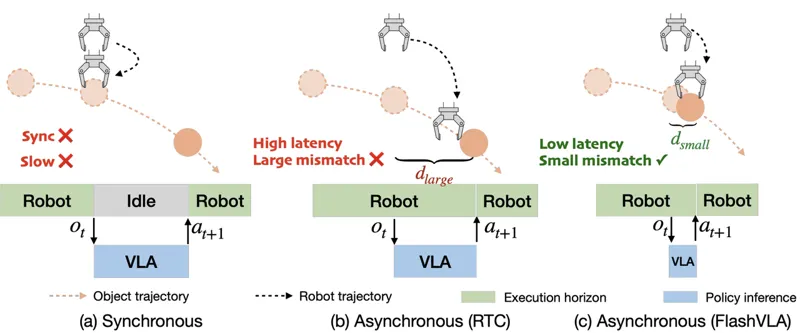
Vision-Language-Action (VLA) foundation models unify perception, language, and action generation in a single framework and have become a leading route toward general-purpose robot control. Modern VLA policies rely on generative action models such as diffusion models and flow matching to capture the high-dimensional, multi-modal distribution of continuous robot actions. However, the per-step latency of generative models precludes closed-loop replanning at every control step, creating a fundamental tension between action expressiveness and high-frequency feedback control.
The common engineering compromise is the action chunk: a single forward pass predicts a sequence of future actions, and the controller executes only the first $H$ steps, called the action horizon. This amortizes policy-call frequency and improves temporal smoothness, but it also creates an open-loop blind spot with two compounding risks. First, the policy lacks real-time reactivity: fresh observations arrive at every control step, yet the system ignores them until the horizon ends, leaving it unable to respond to unexpected slippage, collision, or pose drift as they occur. Second, errors can accumulate within the blind spot beyond the point that replanning can recover from: if deviations go uncorrected long enough, the robot drifts into an out-of-distribution state rarely seen in training, at which point even the next replanning call cannot steer execution back to the intended trajectory and the task fails.
Crucially, both risks worsen as the horizon grows. The paper quantifies this trade-off by sweeping horizons on three VLA backbones: larger horizons substantially reduce policy calls but lower success rates. For $\pi_{0.5}$, increasing the horizon reduces policy calls by about four times while dropping success from roughly 64% to below 49%; SmolVLA and X-VLA show the same trend. Moreover, the best horizon depends on task difficulty, environmental dynamics, and sim-to-real mismatch, so no single static horizon remains optimal across scenarios.
This leads to a crisp reframing: the key is not to choose a better fixed horizon, but to decide when the current chunk should stop being trusted. Two questions follow: (1) how to detect execution deviations in time and terminate stale actions before errors compound beyond recovery; and (2) how to correct the trajectory after truncation, since naive replanning alone is often insufficient because the VLA may re-generate actions that still fail to escape the deviated state.
VLA-Corrector answers both with a detect-and-correct inference-time scheme. The LVM continuously compares predicted and observed visual evolution during open-loop execution; once persistent deviation is detected it triggers an interrupt event that immediately truncates the remaining stale actions and invokes a new action generation. Rather than relying on naive replanning, OGG exploits the discrepancy between predicted and observed visual dynamics to inject a corrective gradient during the new action generation, actively steering the robot back toward the intended trajectory instead of hoping that re-inference recovers naturally. Together they transform a fixed horizon into an adaptive horizon with self-correcting re-inference, preserving long-horizon efficiency and short-horizon responsiveness.
Preliminaries: Action Chunks and Open-Loop Execution
In embodied continuous control, the current visual observation $o_t$ is encoded into a latent representation $Z_t^{\mathrm{real}}=\mathcal{E}(o_t)$ by a visual encoder $\mathcal{E}$. To balance policy-call frequency and action smoothness, a generative VLA policy parameterized by $\theta$ predicts an action chunk in a single inference call:
$$A_t=[a_t,a_{t+1},\dots,a_{t+C-1}]\sim\pi_{\theta}(\cdot\mid Z_t^{\mathrm{real}},\,l)$$
where $a_t$ is a single control action and $l$ is the language instruction. At deployment only the first $H$ actions (with $H\leq C$) are executed sequentially; this execution window is the action horizon, with execution queue $Q_t=[a_t,\dots,a_{t+H-1}]$, during which the controller does not query the VLA again. The entire design of VLA-Corrector builds on the fact that fresh observations remain available during the queue even though the policy is not re-queried.
Method
The core idea is to decouple action generation from execution monitoring: the VLA backbone generates action chunks while VLA-Corrector monitors whether execution remains on track and intervenes only when drift emerges. The method has four parts: training an external latent dynamics corrector, online anomaly detection with the LVM, event-triggered truncation, and OGG-based corrective replanning. The framework is trained after the VLA policy is obtained and never modifies backbone weights.
1. Training the External Latent Dynamics Corrector
The VLA backbone is first fine-tuned on the benchmark training set, then frozen; its visual encoder $\mathcal{E}$ extracts visual latents from demonstration trajectories. Given a transition $(o_t,a_t,o_{t+k})$, the current and future real latent states and their difference form the supervision target for short-horizon visual latent evolution:
$$Z_t^{\mathrm{real}}=\mathcal{E}(o_t),\quad Z_{t+k}^{\mathrm{real}}=\mathcal{E}(o_{t+k}),\quad \Delta Z_{t+k}^{*}=Z_{t+k}^{\mathrm{real}}-Z_t^{\mathrm{real}}$$
A lightweight external dynamics corrector $M_{\phi}$ is then trained to predict this residual evolution from the current latent state and the executed action:
$$\Delta\hat{Z}_{t+k}=M_{\phi}(Z_t^{\mathrm{real}},\,a_t)$$
Rather than predicting the absolute future latent state, $M_{\phi}$ predicts a residual visual latent evolution, which actively suppresses static scene content and encourages focus on task-relevant dynamics. The training objective combines magnitude matching and directional consistency:
$$\mathcal{L}_{\mathrm{corr}}=\left\|\Delta\hat{Z}_{t+k}-\Delta Z_{t+k}^{*}\right\|_2^2+\beta\left[1-\mathrm{CosSim}\!\left(\Delta\hat{Z}_{t+k},\,\Delta Z_{t+k}^{*}\right)\right]$$
where $\beta$ balances residual accuracy and directional alignment. The trainable component is not the VLA policy but a lightweight latent dynamics module trained separately on frozen VLA features, so the corrector can be retrained or replaced per benchmark without re-optimizing the expensive backbone. It is trained on demonstration trajectories because its goal is not to model all possible futures like a full world model, but to learn whether local latent dynamics remain consistent with on-track execution; demonstrations, despite small teleoperation jitter, capture behavior that keeps the task progressing. Since this is a local, low-dimensional prediction task, a lightweight MLP suffices: a roughly 40M-parameter corrector already provides an effective monitoring and corrective signal at very low training cost.
2. Latent Visual Dynamics for Online Anomaly Detection (LVM)
After training $M_{\phi}$, it is used online to monitor whether the current action chunk remains reliable. At control step $t$, the LVM predicts the expected short-horizon latent residual from the executed action and current latent state, $\Delta Z_{t+k}^{\mathrm{exp}}=M_{\phi}(Z_t^{\mathrm{real}},a_t)$. Meanwhile, although the policy is not re-queried, the latest observation remains available: encoding the future observation yields the actual residual $\Delta Z_{t+k}^{\mathrm{real}}=Z_{t+k}^{\mathrm{real}}-Z_t^{\mathrm{real}}$. The LVM measures the mismatch between expected and actual latent evolution:
$$E_t=1-\mathrm{CosSim}\!\left(\Delta Z_{t+k}^{\mathrm{exp}},\,\Delta Z_{t+k}^{\mathrm{real}}\right),\qquad \mathrm{CosSim}(\mathbf{u},\mathbf{v})=\mathbf{u}^{\top}\mathbf{v}\,/\,(\|\mathbf{u}\|\,\|\mathbf{v}\|)$$
A larger $E_t$ indicates stronger visual dynamics mismatch, providing a continuous signal for event-triggered truncation. The signal costs only a forward pass through the visual encoder and the lightweight MLP, far cheaper than a full VLA inference.
3. Event-Triggered Truncation under Robust Online Monitoring
Given the continuous score $E_t$, the system must decide when a deviation is persistent enough to justify intervention. Directly thresholding $E_t$ is unstable because transient visual outliers cause false triggers. The paper therefore uses a robust event-triggered rule with dynamic thresholds and persistence checking: it maintains a sliding window of recent scores $\mathbf{E}_W=\{E_{t-w+1},\dots,E_t\}$ and computes its median $M_e$ and median absolute deviation:
$$\mathrm{MAD}=\mathrm{median}\!\left(|E_i-M_e|\right),\quad E_i\in\mathbf{E}_W$$
Two adaptive thresholds then form a hysteretic state machine:
$$T_{\mathrm{on}}=M_e+\lambda_{\mathrm{on}}\,\mathrm{MAD},\qquad T_{\mathrm{off}}=M_e+\lambda_{\mathrm{off}}\,\mathrm{MAD},\qquad \lambda_{\mathrm{on}}>\lambda_{\mathrm{off}}$$
$T_{\mathrm{on}}$ confirms persistent deviation while $T_{\mathrm{off}}$ provides hysteresis to prevent rapid oscillation between normal and abnormal states. To avoid triggering on isolated spikes, a persistence counter $c_t$ increments when $E_t>T_{\mathrm{on}}$ and resets when $E_t<T_{\mathrm{off}}$; an interrupt event fires only when $c_t\geq p$ holds consecutively, where $p$ is a patience parameter. Once triggered, VLA-Corrector discards the remaining actions in the current queue and re-queries the policy in corrective mode; if $h$ actions were already executed from the queue, the realized horizon becomes $H_{\mathrm{adaptive}}=h$, preserving long-horizon execution during stable phases while shortening it when persistent visual drift indicates the chunk is no longer reliable.
4. Online Gradient Guidance for Corrective Inference (OGG)
Truncation stops stale actions, but recovery still depends on the next replan. After an interrupt event, VLA-Corrector applies OGG only to the single policy call immediately following the interrupt, guiding that recovery replan toward a corrective latent direction. At denoising step $\tau$ of flow matching, let $A^{\tau}$ be the noisy action chunk; the VLA predicts a velocity field $v_{\tau}=\pi_{\theta}(A^{\tau},Z_t^{\mathrm{real}},\tau)$, from which the clean chunk is estimated as $\hat{A}_0=A^{\tau}-\tau v_{\tau}$ with first action $\hat{a}_t=\hat{A}_0[0]$. The corrector then predicts the latent effect of this candidate action:
$$\Delta\hat{Z}_{\mathrm{act}}=M_{\phi}(Z_t^{\mathrm{real}},\,\hat{a}_t)$$
Let $t-k$ be the last stable step before the interrupt. The expected residual is $\Delta Z_{\mathrm{exp}}=M_{\phi}(Z_{t-k}^{\mathrm{real}},a_{t-k})$ and the accumulated deviation is $\Delta Z_{\mathrm{dev}}=Z_t^{\mathrm{real}}-Z_{t-k}^{\mathrm{real}}$; the corrective latent direction is:
$$\Delta Z_{\mathrm{corr}}=\Delta Z_{\mathrm{exp}}-\Delta Z_{\mathrm{dev}}$$
This direction preserves the intended local dynamics while compensating for drift accumulated during open-loop execution. OGG aligns the predicted action effect with $\Delta Z_{\mathrm{corr}}$ through:
$$\mathcal{L}_{\mathrm{OGG}}=1-\mathrm{CosSim}\!\left(\Delta\hat{Z}_{\mathrm{act}},\,\Delta Z_{\mathrm{corr}}\right)$$
and injects the resulting gradient into the flow-matching velocity:
$$v_{\tau}^{\mathrm{guide}}=v_{\tau}-\eta\,\nabla_{v_{\tau}}\mathcal{L}_{\mathrm{OGG}},\qquad A^{\tau-\Delta\tau}=A^{\tau}-\Delta\tau\,v_{\tau}^{\mathrm{guide}}$$
where $\eta$ controls guidance strength. Because OGG modifies the velocity field rather than directly perturbing action coordinates, it remains compatible with the original flow-matching process and yields smoother corrective replanning. OGG introduces extra gradient computation only for the single recovery query after an interrupt; subsequent calls return to standard inference unless another interrupt is detected.
The figure below shows the overall pipeline: starting from the standard chunked VLA pipeline (A), the LVM detects persistent drift and triggers an interrupt (B); the event truncates stale actions and switches the next replan from normal flow matching to OGG-guided flow matching (C); OGG uses expected and observed latent evolution to guide the replan back toward a recoverable trajectory (D).
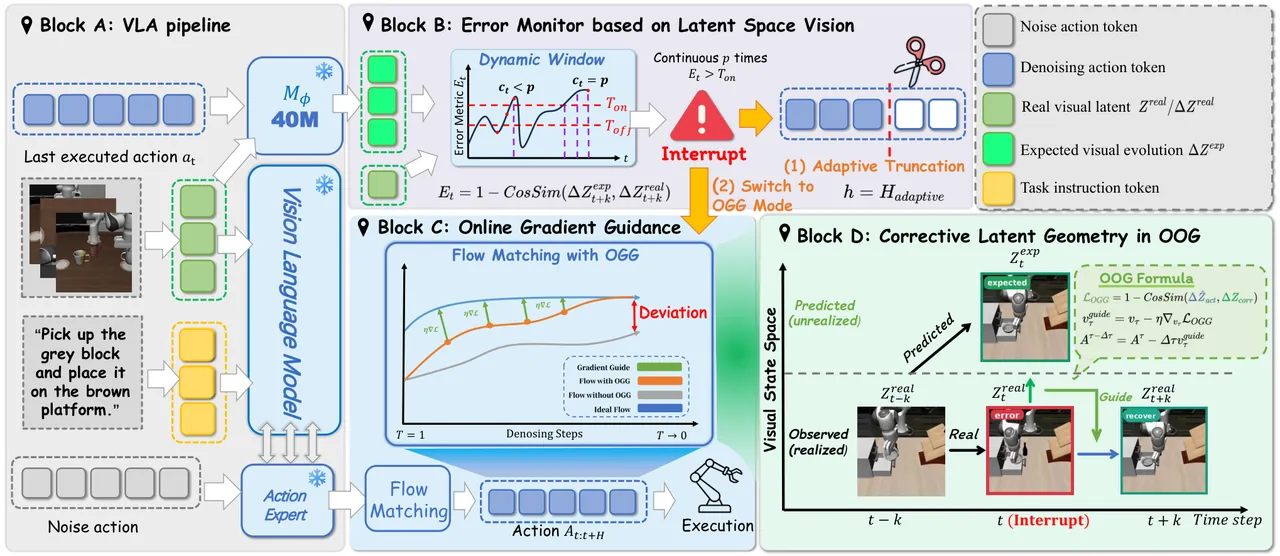
Figure 1: VLA-Corrector overview (paper Figure 3). A: standard chunked pipeline; B: latent-space vision monitoring and interrupt; C: online gradient guidance; D: corrective latent geometry in CGS.
flowchart TD
    A["Block A standard chunked inference VLA backbone emits action chunk"] --> B["Execute first H steps open-loop blind spot no policy query"]
    B --> C["Block B Latent-space Vision Monitor compare expected vs observed residual get inconsistency score Et"]
    C --> D{"Et exceeds Ton for p consecutive steps persistent drift"}
    D -- no --> B
    D -- yes --> E["Interrupt event discard remaining stale actions in queue"]
    E --> F["Block C/D Online Gradient Guidance target corrective direction inject gradient into velocity field"]
    F --> G["Generate corrected action chunk restore closed-loop reactivity"]
    G --> B
Experiments
Evaluation spans the MetaWorld and LIBERO simulation benchmarks plus a real AgileX PiPER arm, with $\pi_{0.5}$ as the main backbone and SmolVLA / X-VLA for cross-architecture validation. We discuss cross-architecture generalization, sample efficiency, the performance-efficiency trade-off, mechanism analysis, and real-world transfer.
Cross-Architecture Generalization (MetaWorld)
VLA-Corrector consistently improves all three backbones, with larger gains on harder tasks. Average success rises by 15.65 points for $\pi_{0.5}$, 4.75 for SmolVLA, and 4.05 for X-VLA; the strongest gain appears on the Very Hard split of $\pi_{0.5}$, from 41.0% to 65.0%. This shows the correction mechanism is most effective on contact-rich, error-sensitive tasks.
| Backbone | Method | Easy | Medium | Hard | Very Hard | Avg. |
|---|---|---|---|---|---|---|
| pi0.5 | Baseline | 70.5 | 45.0 | 38.3 | 41.0 | 48.70 |
| pi0.5 | + VLA-Corrector | 83.2 | 61.7 | 47.5 | 65.0 | 64.35 |
| SmolVLA | Baseline | 81.3 | 53.6 | 51.7 | 61.0 | 61.90 |
| SmolVLA | + VLA-Corrector | 83.4 | 56.0 | 64.2 | 63.0 | 66.65 |
| X-VLA | Baseline | 72.5 | 46.4 | 48.3 | 55.0 | 55.55 |
| X-VLA | + VLA-Corrector | 74.4 | 50.0 | 50.0 | 64.0 | 59.60 |
Table 1: MetaWorld cross-architecture success rate (%). Corresponds to paper Table 1.
Sample Efficiency (LIBERO)
The paper further tests whether VLA-Corrector can compensate for limited task-specific data. Starting from the public LeRobot few-shot checkpoint, the few-shot fine-tuned $\pi_{0.5}$ reaches 94.00% average success; adding VLA-Corrector raises it to 97.80%, surpassing the fully fine-tuned baseline (96.95%). This suggests few-shot fine-tuning already learns much of the normal task trajectories but lacks coverage of drifted states and their recovery behaviors; VLA-Corrector improves recovery at inference time by interrupting error accumulation early and guiding corrective replanning, rather than by exposing the backbone to more rare failure cases during training.
| Model | Object | Spatial | Goal | Long | Avg. |
|---|---|---|---|---|---|
| pi0.5 (Full Fine-tuned) | 99.4 | 98.2 | 97.8 | 92.4 | 96.95 |
| pi0.5 (Few-shot Fine-tuned) | 97.8 | 95.4 | 96.2 | 86.6 | 94.00 |
| pi0.5 (Few-shot) + VLA-Corrector | 99.8 | 100.0 | 98.0 | 93.4 | 97.80 |
Table 2: LIBERO sample efficiency (%). Corresponds to paper Table 2.
Performance-Efficiency Trade-off and Data Efficiency
The full horizon sweep shows VLA-Corrector does not buy success by querying the policy more often; it improves success-per-call. Across the three backbones the largest success-per-call gains reach 29.9% for $\pi_{0.5}$, 45.3% for SmolVLA, and 39.1% for X-VLA. For example, on SmolVLA at horizon 10, success improves from 61.90% to 73.00% while policy calls drop from 19.27 to 15.64. For $\pi_{0.5}$ at horizon 50, success rises from 48.72% to 58.70% while average calls fall from 5.15 to 4.98, a +24.6% efficiency gain. This supports the adaptive-horizon hypothesis: long chunks remain useful during stable execution but should be interrupted once latent visual dynamics indicate drift.
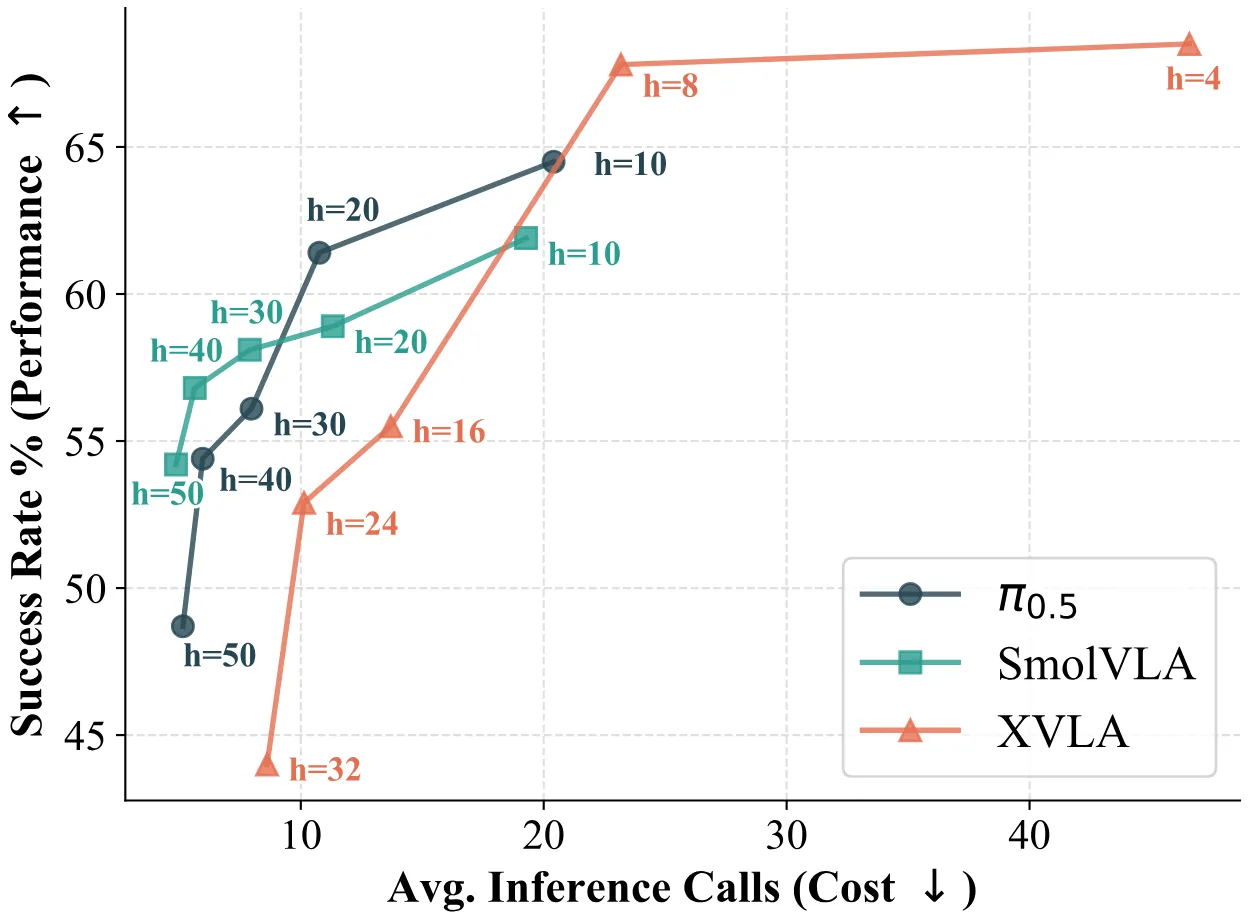
Figure 2: Performance-efficiency trade-off across fixed horizons (paper Figure 2). Larger horizons cut calls but lower success, consistently across backbones.
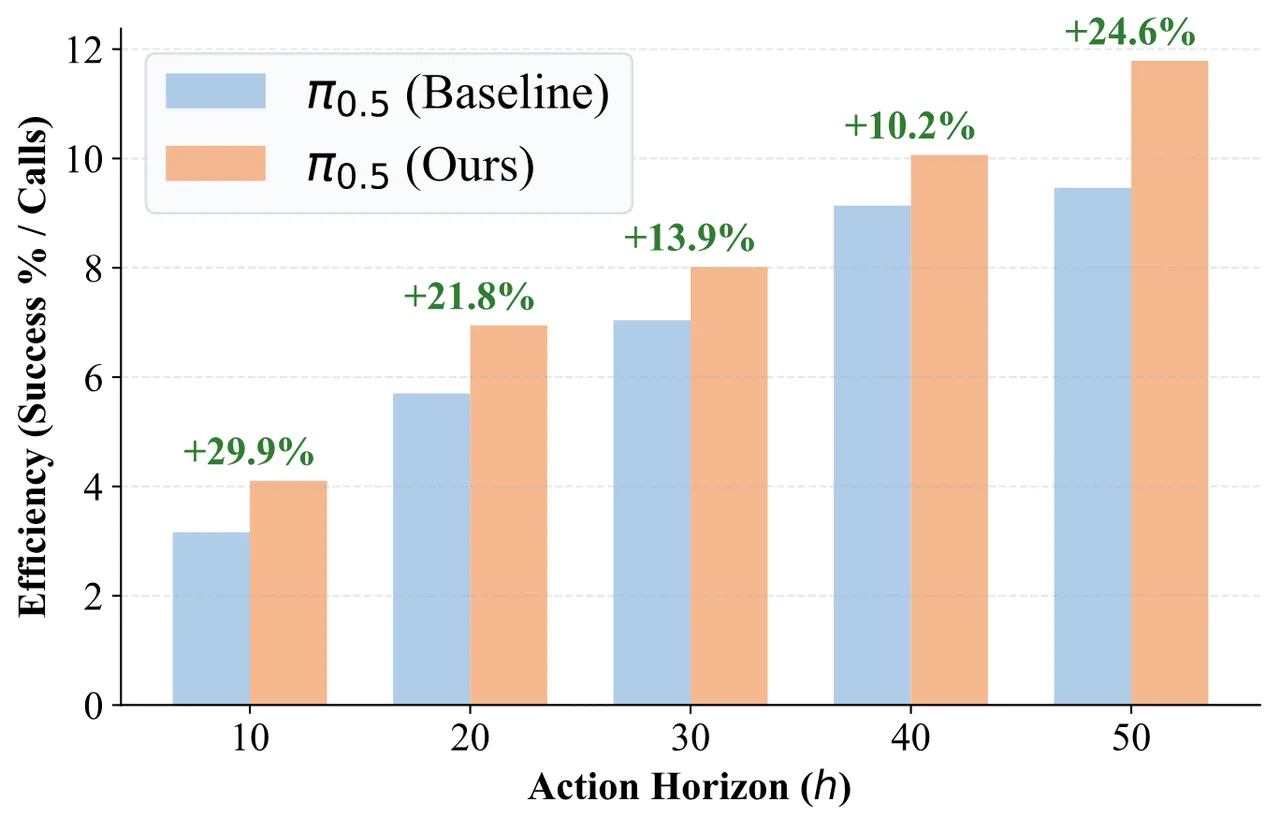
Figure 3: Success-per-call efficiency gains per horizon (paper Figure 4). Gains grow with horizon, up to +24.6%.
Corrector training is also data-efficient: subsampling MetaWorld demonstrations at ratios $r\in\{0.2,0.4,0.6,0.8,1.0\}$, the $r=1.0$ corrector reaches 54.32% average success (versus a 48.72% baseline, +5.60), with performance saturating around $r\approx0.6$-$0.8$. The lightweight latent-dynamics corrector only needs to capture a local on-track consistency signal rather than a complete dynamics model.
Mechanism Analysis: LVM Detection and OGG Correction
The LVM provides an informative and well-timed drift signal. Successful episodes concentrate at low $E_t$ while failed episodes show a heavier high-score tail and trigger more interrupt events, indicating $E_t$ captures failure-prone visual dynamics mismatch. Manually dividing MetaWorld trajectories into critical phases (precise grasping, alignment) and non-critical phases (tolerant transport after a stable grasp), 83.7% of truncations occur in critical phases and only 16.3% in non-critical phases, verifying the adaptive-horizon intuition: the method does not shorten the horizon everywhere but preserves long-horizon efficiency in tolerant phases and restores short-horizon precision in error-sensitive phases.
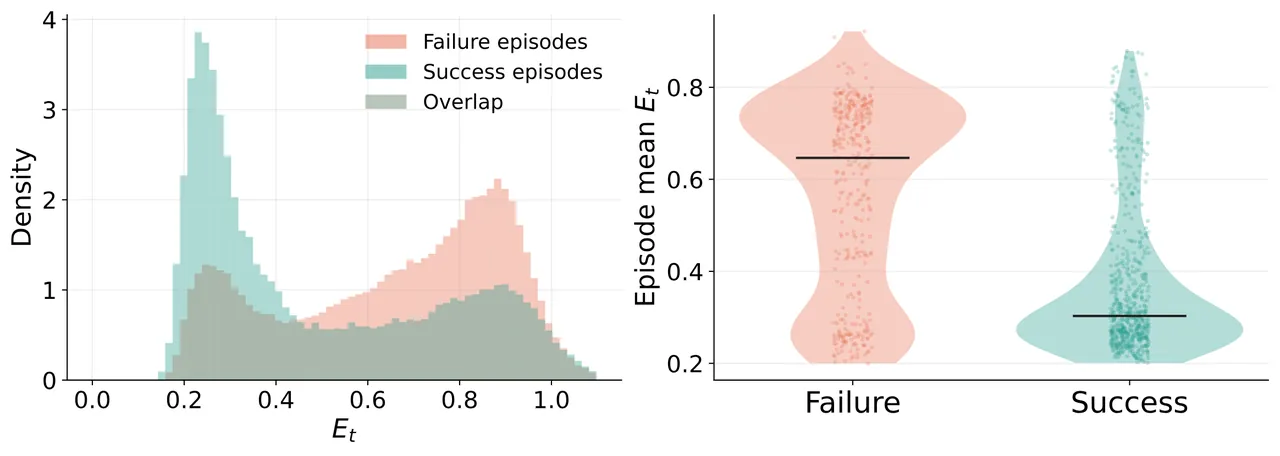
Figure 4: Distribution of $E_t$ for successful versus failed episodes (paper Figure 5). Failures show a heavier high-score tail.
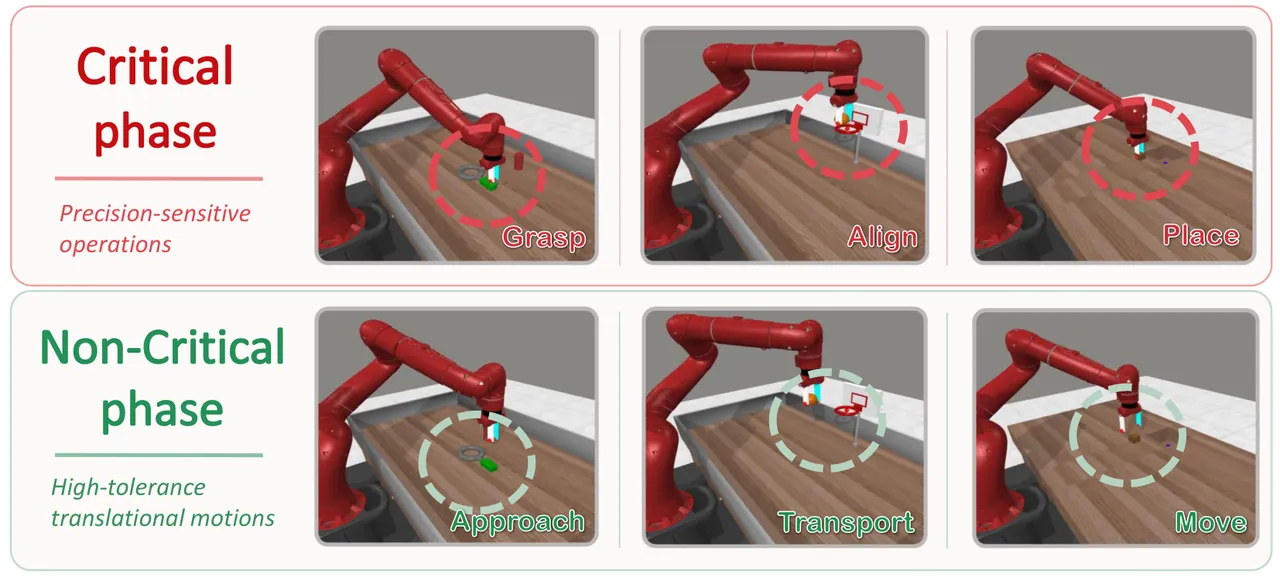
Figure 5: Truncation distribution by task phase (paper Figure 6). 83.7% of truncations occur in critical phases.
The isolated contribution of OGG is measured by comparing standard re-inference against OGG-guided re-inference after the same interrupt-triggered truncation: OGG improves post-interrupt recovery across all difficulty levels with an average gain of 0.23, showing that guided re-inference raises the quality of the recovery replan beyond merely stopping stale actions. Component ablations are equally clear: truncation alone lifts average success from 48.70% to 60.35%, and adding OGG further raises it to 64.35%.
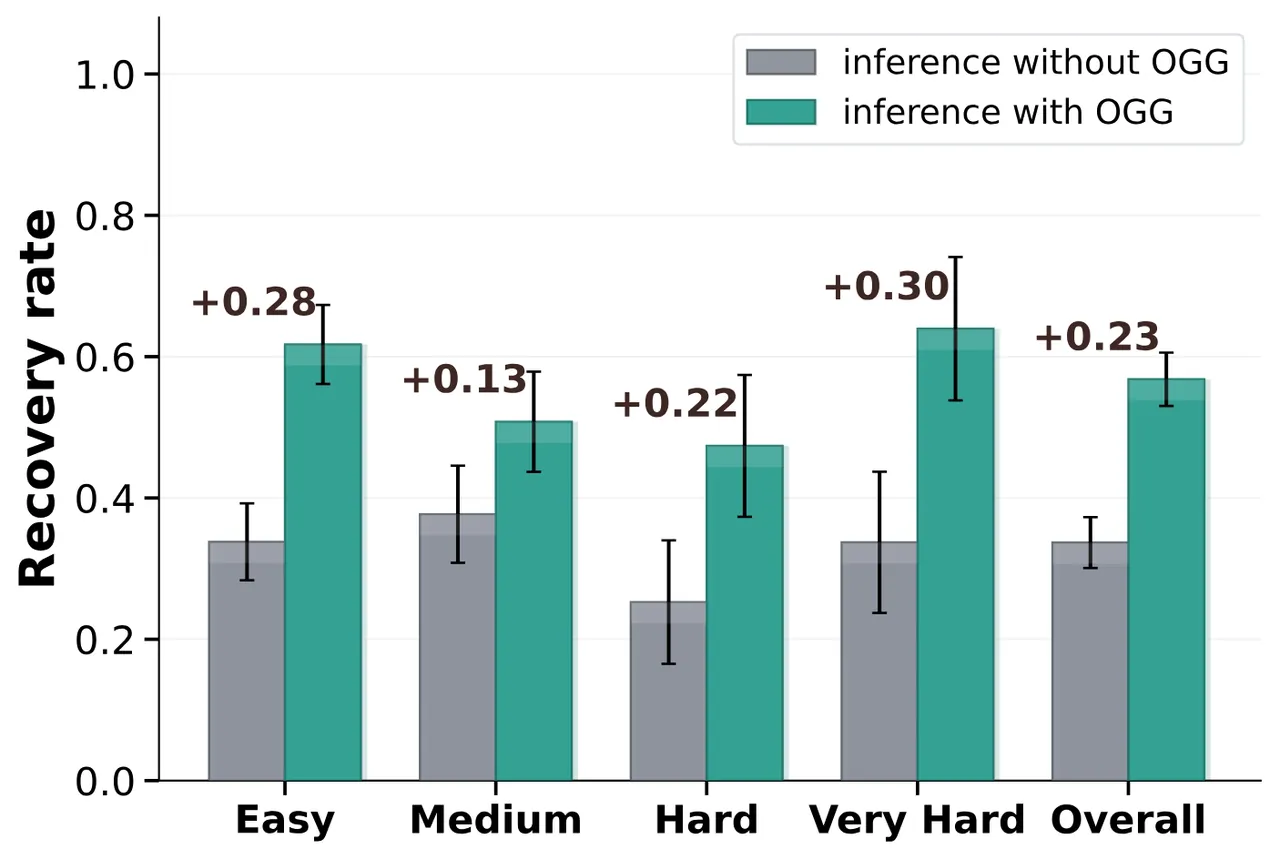
Figure 6: Post-interrupt recovery rate (paper Figure 7). OGG-guided inference consistently outperforms standard inference, +0.23 on average.
A detector-design control further supports decoupling: coupling the monitor into $\pi_{0.5}$ as an internal auxiliary head (predicting the same short-horizon latent residual) yields only 49.55%, whereas the decoupled external LVM reaches 64.35%. A plausible reason is that the internal auxiliary objective updates backbone representations also used for VLM-to-action planning, harming the original action generation; the external LVM learns the monitoring signal on frozen features without modifying the policy representation.
Real-World Evaluation (AgileX PiPER)
Real experiments use an AgileX PiPER 6-DoF arm with $\pi_{0.5}$ as backbone, across three task groups (pick-and-place, alignment, disturbance recovery) of three tasks each with 20 trials per task. VLA-Corrector improves all three groups, raising average success from 55.6% to 73.3%; the gain is modest on pick-and-place (+8.3), larger on alignment (+16.6), and largest on disturbance recovery (+28.3). The trend matches the intended role: preserve standard execution performance, improve precision-sensitive manipulation, and help most when online disturbances make the remaining action chunk outdated.
| Method | Pick-place | Alignment | Disturbance | Avg. |
|---|---|---|---|---|
| pi0.5 Baseline | 70.0 +/- 11.6 | 56.7 +/- 12.5 | 40.0 +/- 12.4 | 55.6 +/- 7.3 |
| + VLA-Corrector | 78.3 +/- 10.4 | 73.3 +/- 11.1 | 68.3 +/- 11.8 | 73.3 +/- 6.5 |
Table 3: Real-world success rate (%) on AgileX PiPER with 95% binomial confidence intervals. Corresponds to paper Table 5.
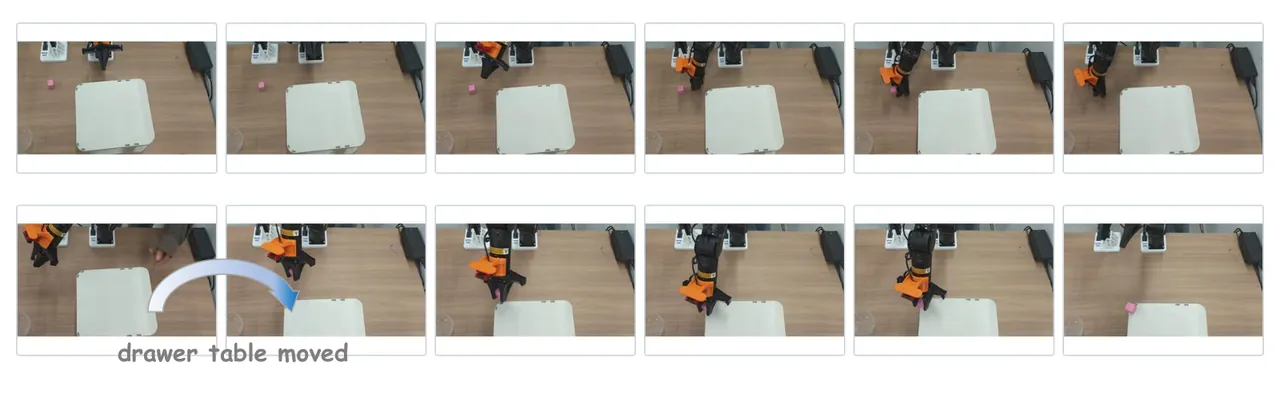
Figure 7: Real-world disturbance recovery demo (paper Figure 12). The drawer / insertion target is moved during execution and the robot must recover from an outdated action chunk.
Limitations
An author-stated limitation is the wall-clock overhead of OGG: because OGG performs online gradient computation during recovery inference, overall wall-clock inference time increases by 1.62x-1.68x relative to the same pipeline with OGG disabled; a single OGG-guided recovery query takes about 588.52 ms versus 278.01 ms for standard chunked inference (about 2.12x). The authors stress the overhead is event-triggered and amortized to roughly +7.93 ms per executed step, but it remains a practical constraint for latency-sensitive high-frequency control.
A second author-stated limitation is limited cross-domain corrector transfer: a corrector trained on LIBERO demonstrations improves the MetaWorld baseline only from 48.7% to 51.8% (+3.1), whereas the domain-matched MetaWorld corrector reaches 58.7% (+10.0). The corrector captures partially transferable notions of on-track visual dynamics, but domain-matched demonstrations remain important for accurate deviation detection and effective corrective guidance.
Two design-level caveats are also worth noting. First, the monitoring signal derives entirely from visual latent evolution, so disturbances that produce little visual change (e.g., purely force- or contact-level slippage where the image barely changes) may go undetected; the authors' real-world failure analysis likewise notes that a 6-DoF arm without force feedback can fail on tight alignment due to contact geometry, friction, or small height errors even when the visual target is corrected. Second, several event-triggering hyperparameters (window size 15, lambda_on 3.0, lambda_off 2.0, patience p 5, cooldown 10 steps) must be set per scenario; although sensitivity analyses show eta 1 and a 40M LVM suffice, optimal configurations may need recalibration across task families.
Conclusion and Outlook
VLA-Corrector studies the open-loop blind spot of action-chunked VLA policies, where fixed horizons improve policy-call efficiency but let stale actions accumulate errors. It responds with a lightweight detect-and-correct layer that monitors latent visual dynamics, truncates stale actions when drift persists, and guides the next inference toward recovery. The results show that small inference-time modules can provide targeted robustness gains without retraining the VLA backbone. Rather than replacing action chunking, VLA-Corrector makes it adaptive: long-horizon execution is preserved when reliable, while corrective replanning is invoked when the current chunk should no longer be trusted. For robot developers this offers a low-cost, pluggable robustness path: stacking a roughly 40M monitor/corrector on top of a frozen strong backbone substantially reduces compounding errors in long-horizon, contact-rich manipulation.
Golden Quote
"The key is not to choose a better fixed horizon, but to decide when the current chunk should stop being trusted."
- Paper introduction