PAPER DEEP DIVE
An offline approach to fNIRS-guided reinforcement learning for robot behavior
Human-in-the-loop Reinforcement Learning has become a popular approach to training, finetuning, and aligning robot behavior with user preferences. Our paper explores the feasibility of using brain signals via functional near-infrared spectroscopy (fNIRS) to modulate robot learning in simulation. We compare agents trained on passive (observational) versus active (demonstrative) interaction tasks, and test multiple methods for enhancing the RL algorithm with the neural signal, focusing on parameter augmentation rather than replacement. We further examine how model granularity and noise affect agent learning. Our results show that this framework is effective: the neural signal improves learning when augmenting trajectory priorities and state-action q-values. Additionally, the framework learns successfully from offline data, offering a practical alternative for settings where real-time BCI setups are impractical or only limited data is available.
One-Sentence Summary
NEURO-LOOP injects offline fNIRS (functional near-infrared spectroscopy) brain signals into the RL training loop, augmenting trajectory priorities and Q-values rather than replacing them. Q-value augmentation works best, reward augmentation has no effect, and the framework functions purely offline — no real-time BCI hardware required.
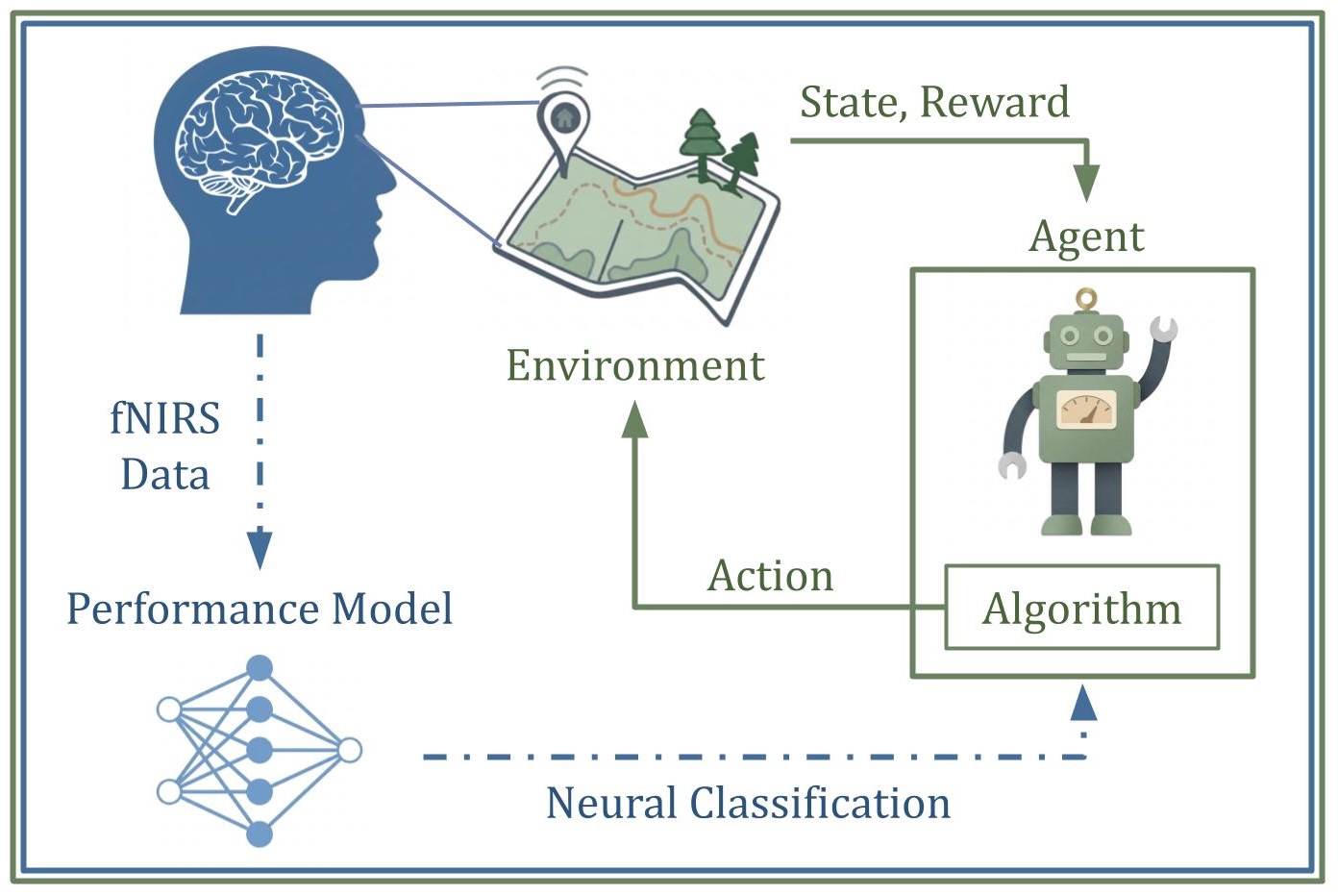
Figure 1 — NEURO-LOOP overview. Offline fNIRS data trains a performance model that injects neural classification into the RL loop, augmenting (not replacing) priority, reward, or Q-values to guide policy learning.
1. Background & Motivation
Human-in-the-Loop RL (HITL-RL) trains/fine-tunes/aligns robot behavior via human feedback. Existing methods (learning from demonstration, preference learning, intervention learning) require explicit feedback via speech, physical demonstration, or interface preferences. Two problems arise:
- Cognitive overload: sustained attention and expert feedback burden the human teacher.
- Bias & exclusion: assumes implicit reactions follow training-set distributions, requiring users to move and speak — excluding people with motor/speech impairments.
Implicit HITL-RL uses passive feedback (gesture, expression, voice inflection) but still requires movement. This work uses brain signals as feedback, requiring no movement or speech. It uses fNIRS — slower hemodynamic signal but higher spatial resolution than EEG, more robust to certain artifacts.
Core question: Can offline fNIRS data (not real-time BCI) augment RL training, enabling deployment where real-time pipelines are impractical or data is limited?
2. Core Method
NEURO-LOOP injects fNIRS signals into DDPG-HER + Prioritized Experience Replay. Key design: augment not replace — neural signal modulates existing RL parameters rather than replacing the reward function.
2.1 Interaction Tasks
- Passive: participant observes robot performing fetch-and-place. ~50/50 optimal/suboptimal.
- Active: participant teleoperates robot. Suboptimal, noisier data (non-expert demos).
- Pooled: combines both.
2.2 Performance Model & Output Calibration
Three granularity levels mapping fNIRS features to agent optimality labels:
- Binary: Optimal/Not Optimal, $g_b \in \{0,1\}$
- Ternary: Optimal/Suboptimal/Not Optimal, $g_d \in \{0,1,2\}$
- Continuous: regressor predicting error vs near-optimal policy, $g_e \in \mathbb{R}$
Regressor output calibrated as:
$$n_t = (x_t + c_t \cdot \mu_X[0]) \cdot \beta$$
Classifier output calibrated as:
$$n_t = (x_t + c_t \cdot \mu_X[\hat{y}_t]) \cdot \beta$$
where $\hat{y}_t$ is raw model output, $x_t$ the parameter to augment (Reward/Priority/Q-value), $\mu_X$ describes expected parameter value per optimality class, $n_t$ the final value injected into RL.
2.3 Augmentation Techniques
| Condition | Modulation | Result |
|---|---|---|
| Baseline | Data injected, no neural augmentation | Control |
| Prioritization | $n_t$ modulates trajectory priority | Third best |
| Reward Aug | $n_t$ modulates domain reward | No improvement |
| Q-Aug | $n_t$ modulates state-action Q-value | Best |
| All | Combines three | ~Q-Aug |
2.4 Noise Injection
With probability $\tau$: flip classifier outputs or shift regressor outputs (random 0-1), testing robustness.
flowchart TB
    A[Offline fNIRS Data
21 participants] --> B[Performance Model
Binary/Ternary/Continuous]
    B --> C[Calibrate Output
n_t = f(x_t, c_t, mu_X)]
    C --> D{Augmentation Method}
    D --> E1[Prioritization
modulate trajectory priority]
    D --> E2[Reward Aug
modulate domain reward]
    D --> E3[Q-Aug
modulate state-action Q-value]
    D --> E4[All
combine three]
    E1 & E2 & E3 & E4 --> F[DDPG-HER + Prioritized Replay]
    F --> G[Robot Policy
Fetch-and-Place Task]
    style E3 fill:#dcfce7,stroke:#16a34a
    style E2 fill:#fee2e2,stroke:#dc2626
    style C fill:#e0e7ff,stroke:#2563eb
3. Experimental Results
Public fNIRS + robot behavior dataset, 21 participants (14F 11M, ages 19-27), evaluated every 10,000 steps, 25 episodes/evaluation. Metrics: total episode return and success rate.
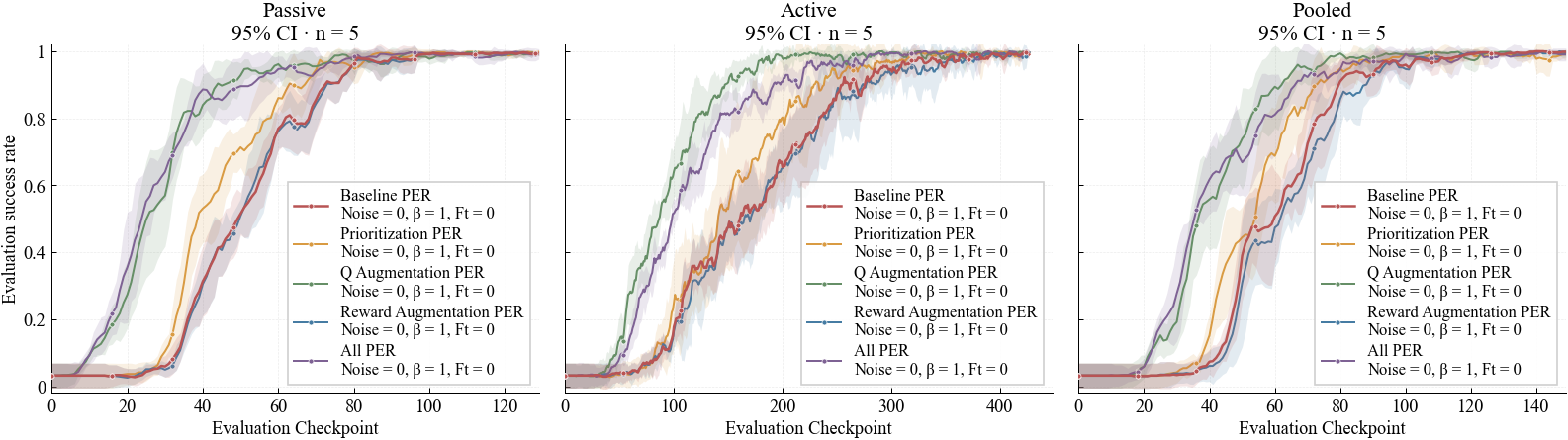
Figure 2 — Binary performance model augmentation method comparison under best settings. Q-Aug and All consistently outperform Baseline. Prioritization ranks third; Reward Aug similar to Baseline. Error bars: 95% CI.
3.1 Augmentation Methods
- Q-Aug and All best: consistently outperform Baseline and all others — Q-value most directly influences policy.
- Prioritization third: modest but consistent improvement — competing with already-established TD-error ranking.
- Reward Aug ineffective: no significant improvement — consistent with [19]: neural feedback on reward pipeline performs like dense reward function.
3.2 Model Granularity
| Setting | Best Granularity | Reason |
|---|---|---|
| Passive | Continuous | 50/50 optimal split, continuous signal most informative |
| Active | Binary/Ternary | Demo data accumulates error, continuous hard to parse |
| Pooled | Binary | F1=0.67-0.72 (binary) vs 0.47-0.50 (ternary) |
3.3 Noise Robustness
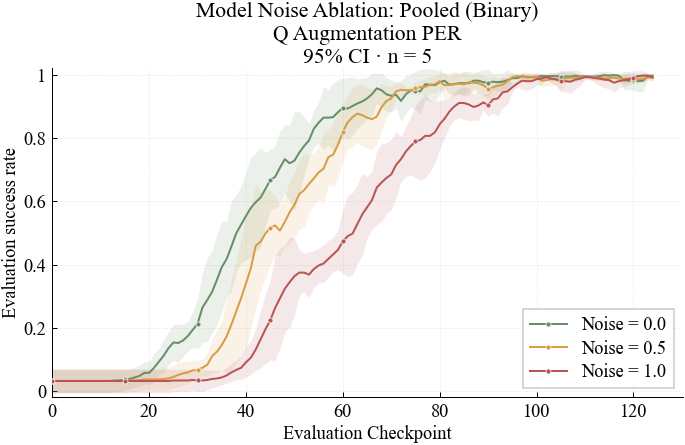
Figure 3 — Model noise effect. Conditions significantly above Baseline (Q-Aug) degrade with noise; conditions at Baseline level (Reward Aug) unaffected. Suggests improvements stem directly from neural signal.
- Q-Aug: degrades as noise increases.
- Reward Aug: virtually unaffected.
- Setting noise to 0.5 makes binary converge to ternary — confirming ternary underperformance due to noisier output.
4. Main Contributions
- NEURO-LOOP framework: First systematic framework for injecting offline fNIRS brain signals into RL training, testing augmentation methods, model granularity, noise robustness, and finetune checkpoints.
- Augment not replace: Neural signal modulates existing RL parameters (priority/reward/Q-value) — Q-value best, reward ineffective.
- Offline viability: Works purely offline, no real-time BCI hardware/calibration overhead — deployable where real-time pipelines impractical.
- Noise robustness analysis: Systematically characterizes tolerable noise levels — gains erode as noise increases.
5.
门控模块输出预测
$$ \mathcal{M}_{g}(f_{t})=\hat{y}_{t} $$
置信度估计
$$ c_{t}=1-\hat{e}_{t} $$
噪声调整公式
$$ n_{t}=(x_{t}+c_{t}\cdot\mu_{X}[\hat{y_{t}}])\cdot\beta $$
Limitations & Future WorkAuthor-stated limitations:
- Agent performance labels are a function of agent optimality, not guaranteed to reflect participant's true judgment — assumes alignment with near-optimal policy.
- 4-second neural feature windows sidestep the credit assignment problem; temporal delay between fNIRS hemodynamic response and agent interaction is not standardized.
- No comparison against other HITL approaches — unclear what neural signal contributes beyond existing feedback channels.
Analysis:
The key value is proving offline brain signals can augment RL training — Q-value augmentation's consistent improvement and noise-degradation pattern convincingly show effects stem from neural signal, not framework artifacts. However, offline methods rely on pre-recorded data mapped to specific tasks; transferring to new tasks requires re-collecting brain data. The 4-second window is an engineering compromise; fNIRS hemodynamic delay (6-8s peak) makes fine causal attribution difficult. The most critical future direction is extending to online real-time settings and physical robots — the leap from simulation to real deployment.
6. Conclusion
This work shows fNIRS signals can update a robot learning algorithm and improve training efficiency. NEURO-LOOP evaluates different augmentation methods, model granularity, and noise robustness. Results show the pipeline works purely offline — a practical alternative for settings where real-time BCI is impractical. Q-value augmentation works best, reward augmentation has no effect, and augment-not-replace is the core design principle.
The framework provides a starting point for extending to real-time, physically embodied human-robot interaction. Key challenges: aligning performance labels with user judgment, standardizing fNIRS delay handling, systematic comparison with other HITL paradigms.
SOURCE LINKS