PAPER DEEP DIVE
When to Plan: Learning to Select Between Reactive Control and Deliberative Planning
It has long been recognized that humans have the ability to switch between fast, reactive decision-making and slower, deliberative planning. In this paper, we study the question of how to learn this ability, known as meta-reasoning, in artificial agents. We model reactive decision-making as a policy that directly maps state observations to actions. Such policies can be trained with reinforcement learning (RL) or imitation learning, but may generalize poorly outside of their training distribution. Alternatively, model-based decision-time planning is more likely to produce good actions across a broader set of states but requires additional computation time, which delays acting. In this work, we introduce an RL method for training a meta-reasoning policy that allocates computation by conditioning on a reactive-policy uncertainty score. This score enables it to predict when the reactive policy is likely to perform poorly and when planning is needed. We conduct an empirical study on motion planning and navigation environments, showing that this design enables the meta-reasoning policy to learn when the reactive policy provides a good-enough action versus when decision-time planning is needed. Additionally, we show that our design enables the meta-agent to shift toward fully reactive control as the reactive policy improves.
Paper: When to Plan: Learning to Select Between Reactive Control and Deliberative Planning
Link: arXiv:2607.16421v1, 2026 (RLC 2026)
Affiliation: Prediction and Action Lab (PAL), University of Wisconsin–Madison
Code: ❌ No public code released
1. Abstract
This paper studies the meta-reasoning problem: how an RL agent can learn to dynamically allocate computation between a fast reactive policy and a slower decision-time planner. The reactive policy produces an action from a single forward pass but only performs well within its training distribution; the planner produces good action sequences from any state but at additional computational cost. The authors formalize this as a meta-MDP using the options framework, training a meta-policy that selects between reactive action and variable-depth planning based on uncertainty signals from the reactive policy. Across 5 motion planning and navigation tasks, the adaptive meta-policy outperforms all fixed-compute baselines (always-react, always-plan) in time to reach goal states. Ablations confirm that reactive uncertainty and observation history are the most critical components.
2. Background and Motivation
Agents in large, open-ended environments face a core tradeoff: fast reactive control vs slow deliberative planning. Reactive policies (single forward pass) are cheap but distribution-constrained; planners (world-model-based) produce near-optimal actions across the full state space but are computationally expensive. Planning is most valuable in states outside the reactive policy's training distribution.
Limitations of existing methods:
- Event-triggered replanning: Assumes agents always plan, only learning when plans become invalid, not considering computation minimization for faster task completion;
- Variable-length options: Optimize action efficiency rather than computation allocation, without explicitly modeling the reactive-planning cost tradeoff;
- Model-free/model-based control arbitration: Relies on hand-designed switching rules or uncertainty heuristics, ignoring model-based planning computation; or assumes equal inference time for planning and reactive control.
Cognitive science (dual-process theories, bounded rationality) suggests humans deliberate when expected value exceeds cost, directly motivating the formulation of planning as a time-costly option.
3. Core Method
3.1 Meta-MDP Formalization
The meta-reasoning problem is formalized as a meta-MDP: $\tilde{\mathcal{M}}=(\tilde{\mathcal{S}},\mathcal{O},\tilde{\mathcal{P}},\tilde{r},\gamma)$, where $\tilde{\mathcal{S}}$ is the meta-state space, $\mathcal{O}$ is the options space ($o\in\mathcal{O}$ is a possibly temporally-extended choice action), $\tilde{\mathcal{P}}$ is the meta-transition function, $\tilde{r}$ is the meta-reward, and $\gamma$ is the discount factor. The meta-state space need not correspond directly to the world-environment state space $\mathcal{S}$.
Two types of options:
- Planning option $\pi_k$: Uses the planner to generate a horizon-$k$ plan $p=[a_0,a_1,\dots,a_{k-1}]$, executed open-loop. Planning cost $c_p(k)=-\alpha k$ ($\alpha$ = per-step planning time penalty), execution cost $c_a=-1$ (per step), total reward $\tilde{r}_{\tilde{t}}=c_p(k)+k\cdot c_a=-\alpha k-k$.
- Reactive option $\pi_r$: $c_p=0$, total reward $\tilde{r}_{\tilde{t}}=c_a=-1$. Near-optimal in-distribution $\mathcal{S}_{ID}$: $V^{\pi_r}(s)\approx V^*(s)$, but far worse out-of-distribution $\mathcal{S}_{OOD}$: $V^{\pi_r}(s)\ll V^*(s)$.
3.2 Meta-Observation Design
The meta-policy operates on an internal state $\tilde{s}$ computable without search. The observation concatenates three components:
$$\hat{s}_{\tilde{t}}=[u_{\tilde{t}},d_{\tilde{t}},\tilde{a}_{\tilde{t}-1}]$$
where $u_{\tilde{t}}$ is the reactive policy uncertainty score, $d_{\tilde{t}}$ is current distance to goal, and $\tilde{a}_{\tilde{t}-1}$ is the previous meta-action. An $n$-step history is also provided:
$$\tilde{s}_{\tilde{t}}=[\hat{s}_{\tilde{t}},\hat{s}_{\tilde{t}-1},\dots,\hat{s}_{\tilde{t}-(n-1)}]$$
The action space includes a reactive option and N planning options (different horizons):
$$\mathcal{O}=\{\pi_{\mathrm{r}},\pi_{k_{1}},\pi_{k_{2}},\dots,\pi_{k_{N}}\}$$
3.3 Reactive Uncertainty: Ensemble Method
The reactive policy is implemented as an ensemble of $M$ neural networks. For continuous control, each network outputs an action mean $\mu_i\in\mathbb{R}^{D}$; the ensemble action and uncertainty are:
$$a=\frac{1}{M}\sum_{i=1}^{M}\mu_{i},\qquad u(s)=\sum_{j=1}^{D}\mathrm{Var}_{i}\!\left[\mu_{i,j}\right]$$
For discrete action spaces, each network outputs a categorical distribution $\mathbf{p}_i$, averaged $\bar{\mathbf{P}}=\frac{1}{M}\sum_{i=1}^{M}\mathbf{p}_i$; the ensemble action and uncertainty are:
$$a=\arg\max_{j}\,\bar{P}(j),\qquad u(s)=-\sum_{j=1}^{J}\bar{P}(j)\log\bar{P}(j)$$
High uncertainty corresponds to out-of-distribution inputs where planning may be beneficial.
flowchart TD
    A[Environment State s] --> B[Reactive Policy Ensemble
M=4 Neural Networks]
    B --> C[Action a_r + Uncertainty u_t]
    C --> D[Meta-Observation s_tilde
= u_t, d_t, a_prev + History]
    D --> E[Meta-Policy π_Ω
PPO Trained]
    E --> F{Select Option}
    F -->|Reactive π_r| G[Execute Reactive Action One Step]
    F -->|Planning π_k| H[A* Planner
horizon=k]
    H --> I[Execute k-step Plan Open-Loop]
    G --> J[Environment Step]
    I --> J
    J --> A
3.4 Training Procedure
- Meta-policy: PPO (Stable Baselines3, default hyperparameters), 4-step observation history;
- Reactive policy: Pretrained by behavior cloning from planner-generated trajectories on in-distribution tasks, $M=4$ networks;
- Planner: A* planner with a given accurate world model, constrained to maximum horizon;
- Joint-training setting: State-action pairs from planning options recorded to replay buffer; after each rollout, ensemble members trained by behavior cloning; meta-policy tracks reactive policy improvement.
4. Key Experiments
4.1 Environment Suite
5 environments, 20 tasks each (half in-distribution, half OOD), 30 seeds per task, 300 evaluation episodes per seed:
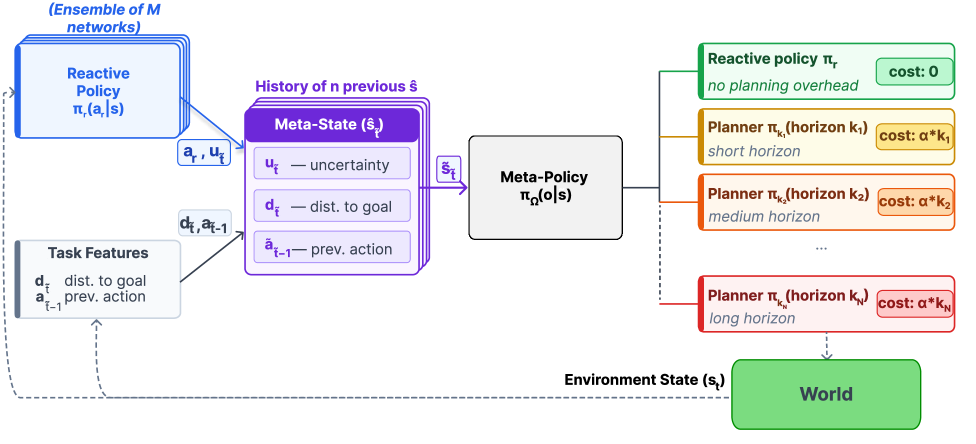
Figure 1: Environment suite. Box Push, DoorKey, Fetch, Maze, Navigation — varying in state space type, task structure, and reactive policy difficulty.
- Box Push: Simplified Sokoban, 6×6 grid, 3 boxes, irrecoverable incorrect moves, symbolic observations;
- DoorKey: MiniGrid multi-stage task (pickup key → unlock door → reach goal), symbolic observations;
- Fetch: Modified Gymnasium Robotics Fetch Reach with obstacles, 7-DOF arm joint-space control, planner operates in Cartesian space;
- Maze: Grid maze, 5 start/goal pairs per obstacle configuration, image observations;
- Navigation: Continuous navigation, continuous displacement control, image observations.

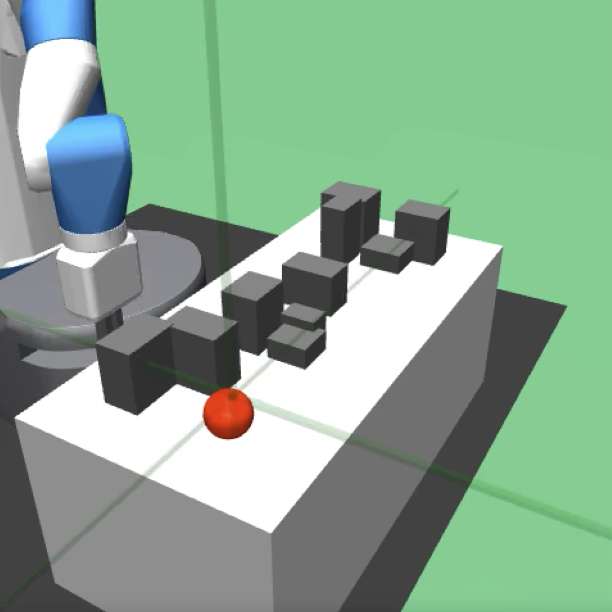
Left: Box Push environment (simplified Sokoban, irrecoverable errors); Right: Fetch environment (7-DOF arm with obstacles).
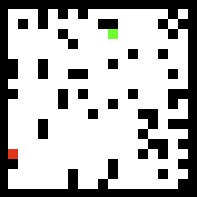
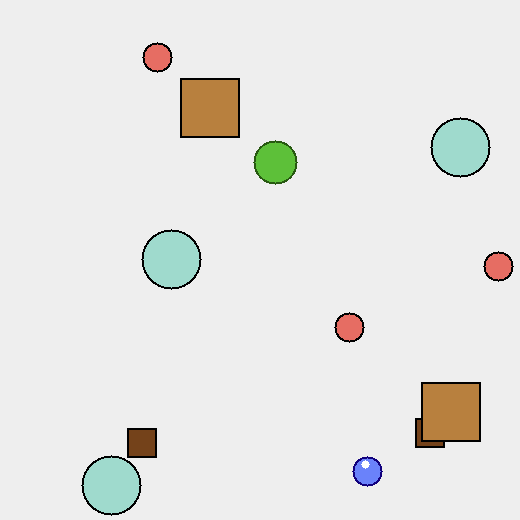
Left: Maze environment (grid maze); Right: Navigation environment (continuous navigation).
4.2 Main Results: Meta-Policy vs Fixed-Compute Baselines
Average episode return (includes acting and planning cost; higher is better):
| Environment | Meta-Policy | Always React | Short Plan | Medium Plan | Long Plan |
|---|---|---|---|---|---|
| Box Push | -24.3 | -133.0 | -306.1 | -44.7 | -59.8 |
| DoorKey | -25.1 | -135.2 | -126.7 | -27.2 | -32.0 |
| Fetch | -12.2 | -132.4 | -51.0 | -70.7 | -30.0 |
| Maze | -19.3 | -56.2 | -89.6 | -37.8 | -24.5 |
| Navigation | -39.6 | -140.8 | -41.2 | -45.4 | -46.9 |
The meta-policy achieves the best (or within CI of best) in all 5 environments. Box Push has irrecoverable errors — the meta-policy learns to avoid reactive control and short plans; Fetch converges to >75% reactive control, suggesting partial generalization but OOD still needs planning.
4.3 Ablation: Meta-Observation Components
Removing one observation component at a time (average episode return):
| Removed | Box Push | DoorKey | Fetch | Maze | Navigation | Average |
|---|---|---|---|---|---|---|
| (Full) | -24.3 | -25.1 | -12.2 | -19.3 | -39.6 | -24.1 |
| Distance | -20.9 | -34.3 | -12.5 | -19.7 | -41.2 | -25.7 |
| History | -110.7 | -26.1 | -21.1 | -19.1 | -40.7 | -43.5 |
| Previous Action | -36.3 | -29.1 | -12.1 | -19.3 | -37.9 | -27.0 |
| Uncertainty | -73.9 | -27.9 | -16.1 | -25.0 | -41.2 | -36.8 |
History and Uncertainty are the most critical components. Removing History degrades Box Push 4.5× and Fetch 1.7× — without progress tracking, it's unclear if the reactive agent moves toward the goal. Removing Uncertainty also drops Box Push and Fetch significantly — without directly determining in/out-of-distribution, the meta-agent cannot perform optimally.
4.4 Environment Characteristics Influence
Analysis by varying three environment characteristics:
- In-distribution task proportion: As in-distribution proportion increases, the meta-policy shifts toward reactive control, with reactive action proportion roughly tracking in-distribution proportion. At all-in-distribution, converges to fully reactive — correctly interpreting reactive competence.
- Planning cost $\alpha$: As $\alpha$ increases, meta-policy relies more on reactive control. Even though reactive policy produces suboptimal OOD actions, time saved by avoiding planning suffices for better returns in some cases. Short/medium/long plan ratios remain roughly constant — the meta-policy learns when to plan, not how long to plan.
- Environment stochasticity $\epsilon$: No noise to low noise ($\epsilon=0.1$): reactive percentage rises from ~45% to ~70% (long planning drops from ~20% to ~5%). Long plans are most affected by noise since errors compound over plan duration. At high noise, short/medium planning slightly increases — still useful for OOD states.
4.5 Joint Training: Tracking Improving Reactive Policy
Joint training on Box Push, DoorKey, Maze (Fetch, Navigation excluded due to compute). Planning-option state-action pairs added to replay buffer; after each rollout, ensemble members trained by behavior cloning. As training progresses:
- Meta-policy shifts toward reactive control across all environments, converging to fully reactive execution;
- Reactive uncertainty signal converges to low disagreement — ensemble uncertainty reflects reactive policy strength;
- This creates a learning curriculum: the meta-policy calls planning in OOD states (best immediate reward + generates training data), the reactive policy trains on OOD states, uncertainty decreases, and the meta-policy recognizes improved competence and stops calling planning.
5. Limitations and Future Work
- Perfect world model assumption: The method assumes the planner uses an accurate world model, which rarely holds in real-world settings. Cognitive science suggests humans account for model uncertainty when deciding whether to plan; extending to learned world models with state uncertainty is a natural next step.
- Single-agent static environments: Environments limited to single-agent and static during plan creation. Extending to dynamic environments and interruptible plans would test generalization of the reactive-planning tradeoff.
- Hand-designed features: Meta-observation relies on hand-designed features. More expressive uncertainty estimates (Bayesian or flow-based) or learned observation representations could improve high-dimensional generalization.
- Tracking worsening reactive policy: The meta-policy can track improving reactive policies, but whether it can track worsening ones (insufficient capacity or catastrophic forgetting) is an open question.
- Broader applications: The reactive-planning tradeoff is structurally similar to LLM fast single-pass generation vs slow chain-of-thought reasoning, and VLA fast lightweight (robot) vs large slow (cloud) models.
6. Conclusion
This paper presents an RL method for learning adaptive computation allocation through a meta-reasoning policy. The approach conditions on reactive policy uncertainty and high-level state features to select between a fast reactive option and planning options — where planning improves action quality at the cost of time. Across a suite of motion planning and navigation tasks, the meta-policy outperforms all fixed-compute heuristic baselines when optimizing for time-to-goal. Ablations confirm that reactive uncertainty and observation history are the most critical components of the meta-state. The meta-policy adapts to environment characteristics: increasing planning cost shifts allocation toward reactive control, and increasing in-distribution coverage shifts allocation away from planning. Finally, conditioning on uncertainty signals enables the meta-policy to converge to exclusively reactive control in a joint-training setting where the reactive policy continues to learn. These results show that high-level state and reactive competence signals are sufficient for a meta-reasoning policy to effectively allocate computation across environments and training regimes.
SOURCE LINKS