PAPER DEEP DIVE
RoboInter1.5: A Holistic Intermediate Representation Suite for Embodied World Modeling and Robotic Manipulation
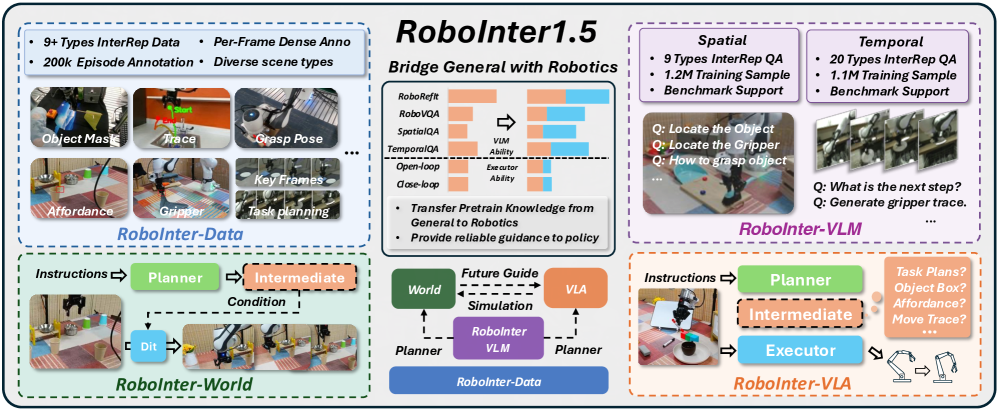
Existing robot datasets remain expensive to curate, embodiment-specific, and insufficiently annotated with the fine-grained structure required for generalizable reasoning, execution, or long-horizon environment dynamics simulation. Building on our prior work, RoboInter1.0, we present RoboInter1.5, an extended and holistic suite of intermediate representations for both robotic manipulation and embodied world modeling. RoboInter1.5 provides a unified resource of data, benchmarks, and models centered on dense manipulation-oriented intermediate representations. Specifically, RoboInter-Data contains over 230k manipulation episodes across 571 scenes with dense per-frame annotations covering more than ten types of intermediate representations, including subtasks, primitive skills, object and gripper grounding, segmentation, affordance, grasp poses, contact points, motion traces, etc. Built upon these annotations, RoboInter-VQA introduces spatial and temporal embodied VQA tasks to benchmark and improve the intermediate-representation reasoning capabilities of our RoboInter-VLM. RoboInter-VLA further studies how such representations benefit action execution through implicit, explicit, and modular plan-then-execute paradigms. To better model the physical world, we further introduce RoboInter-World, which leverages intermediate representations as structured conditioning signals for controllable prediction of future world states. Extensive evaluations demonstrate that RoboInter1.5 provides a unified spatiotemporal scaffolding for intermediate representations. Rather than treating intermediate representations merely as interpretable signals, RoboInter1.5 conceptualizes them as a bidirectional interface that both regularizes low-level action spaces and constrains the latent rollouts of open-world physical simulators.
1. Overview
With rapid advances in foundation models, both Vision-Language-Action (VLA) policies and embodied world models have progressed significantly. Yet existing robot datasets remain expensive to curate, embodiment-specific, and lack fine-grained intermediate representation annotations needed for generalizable reasoning, execution, and long-horizon dynamics simulation.
RoboInter1.5 extends the prior RoboInter1.0, providing a holistic suite of intermediate representations spanning data, benchmarks, and models. The core idea treats intermediate representations as a bidirectional interface connecting semantic understanding, physical execution, and future simulation — both regularizing low-level action spaces and constraining latent rollouts of open-world physical simulators.
2. Dataset: RoboInter-Data
RoboInter-Data contains over 230k manipulation episodes across 571 scenes with dense per-frame annotations covering 10+ types of intermediate representations.
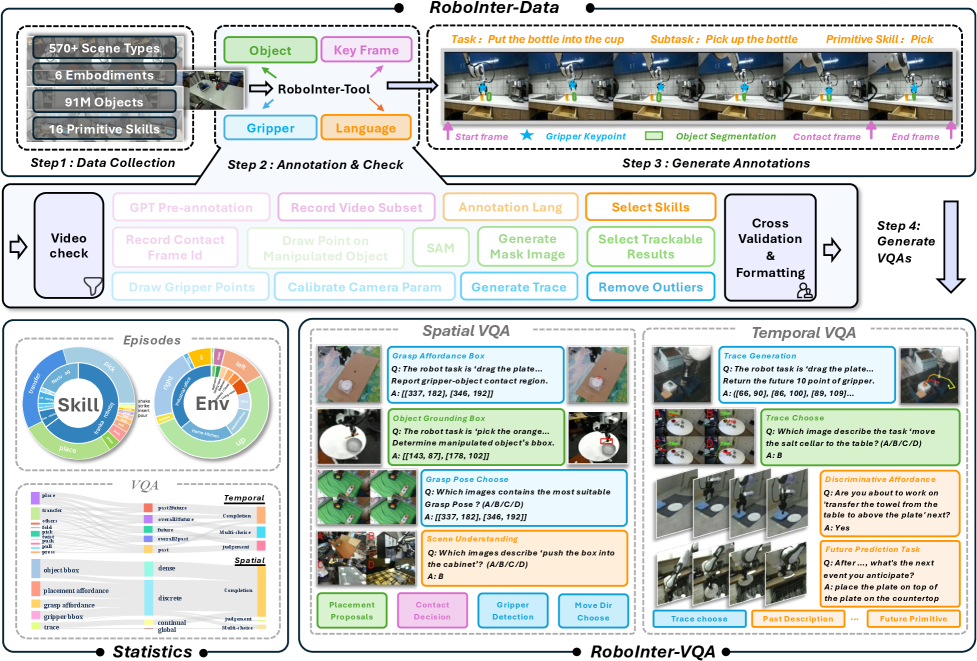
Data sources include In-the-Wild (diverse indoor scenes from Droid, RH20T, OXE) and Table-Top (tabletop interactions from RH20T). The RoboInter-Tool semi-automatic annotation tool performs:
- Task decomposition & keyframes: 15 predefined primitive skills, ChatGPT preliminary labels, human verification
- Object recognition: SAM2 segmentation and tracking with async review
- End-effector localization: calibration matrix + gripper detection + point tracking for 2D trace reconstruction
- Grasp annotation: affordance box and contact points from contact frame
- Placement annotation: object position at subtask end as target placement
- Gripper annotation: anchor points projected 3D→2D forming gripper bounding box
Statistics: ~61M-frame object annotations, ~70M-frame gripper traces, 190k affordance/placement proposals, 760k language clip annotations.
| Dataset | Videos | Scenes | Dense Types | Method |
|---|---|---|---|---|
| LLARVA | 311 | - | Trace | Auto |
| ECoT | 60k | 12 | Partial CoT | Auto |
| ShareRobot | 51k | 102 | Partial | Human+Auto |
| RoboInter-Data | 230k | 571 | 10+ all types | Human+Auto |
3. RoboInter-VQA
Annotations are converted into embodied VQA tasks organized along two axes:
- Spatial VQA: understanding (3 selection + 1 judgment) and generation (5 prediction tasks: object box, grasp pose, placement, keypoints, gripper box)
- Temporal VQA: understanding (5 selection + 4 judgment) and generation (trace generation, multi-step planning under varying context completeness)
Statistics: ~1M spatial generation, 172k spatial understanding, 131k temporal generation, 935k temporal understanding entries. 7,246 videos as evaluation pool.
4. Method
4.1 RoboInter-VLM Planner
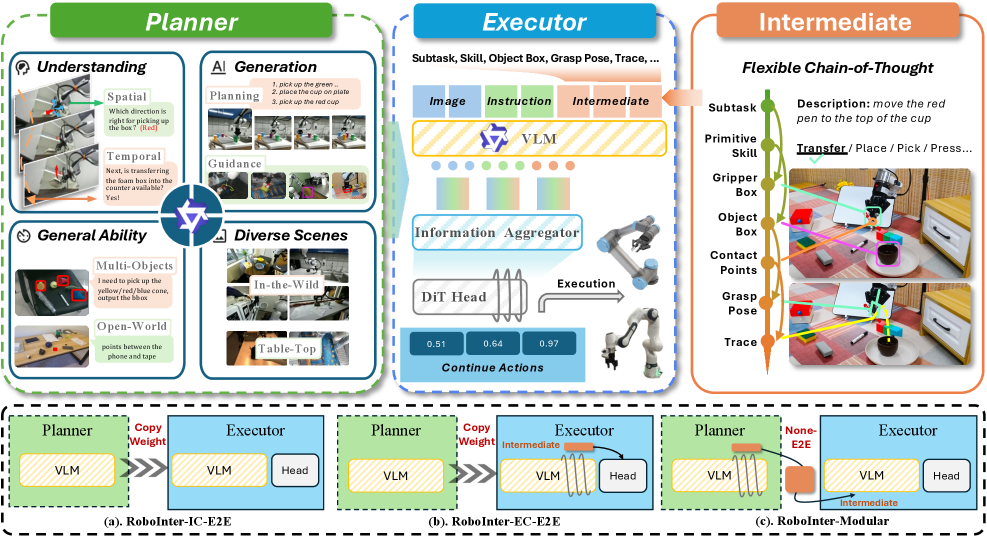
Base VLMs (Qwen2.5-VL-3B/7B, LLaVA-OneVision-7B) fine-tuned on RoboInter-VQA to generate Functional Chain-of-Thought (F-CoT) content, flexibly combining subtasks, skills, object boxes, affordance boxes, motion traces, etc.
4.2 RoboInter-VLA: Plan-Then-Execute
Three paradigms supported:
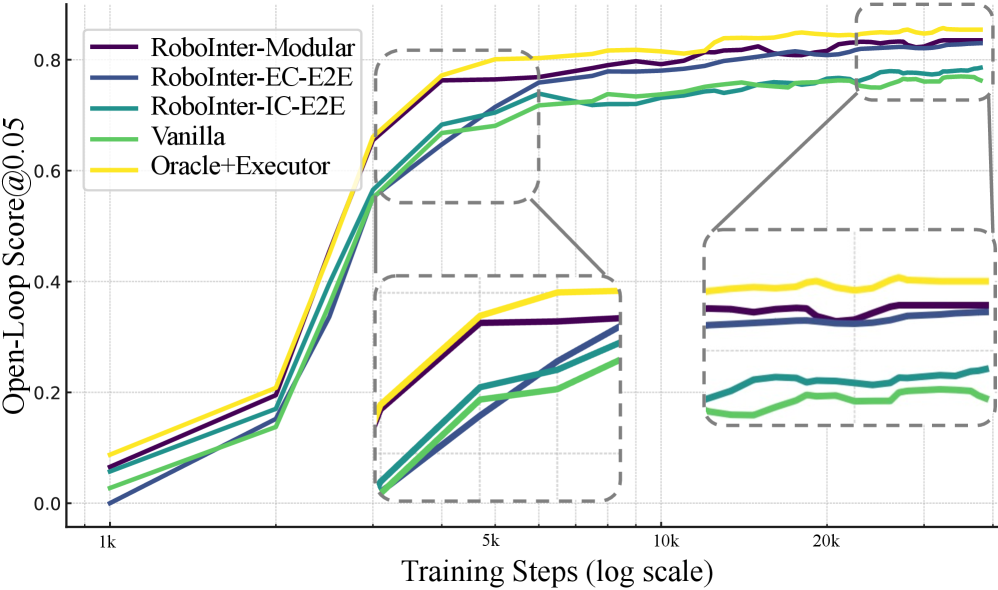
- RoboInter-IC-E2E: VLM generates F-CoT, directly consumed by DiT head (implicit integration)
- RoboInter-EC-E2E: Joint optimization of action prediction and CoT generation (explicit joint)
- RoboInter-Modular: Planner generates F-CoT, Executor conditions on it (modular), supporting textual (Te-Modular) and visual-prompted (Im-Modular) F-CoT
4.3 RoboInter-World: Controlled Imagination
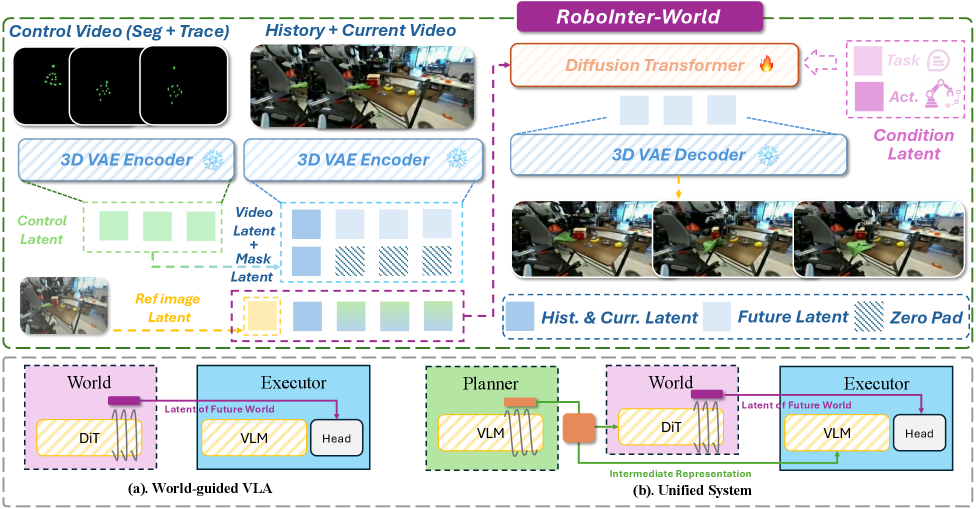
Uses intermediate representations as structured conditioning signals for controllable future world state prediction. Denoising model:
$$f_{\theta}(x_{t},t\mid z^{\mathrm{hist}},c,a,u)$$
where $z^{\mathrm{hist}}$ = observed history latents, $x_{t}$ = noisy future latent at diffusion timestep $t$, $c$ = language instruction, $a$ = robot action sequence, $u$ = control video from intermediate representations.
Optimization objective:
$$\mathcal{L}_{\mathrm{world}}=\mathbb{E}_{y,\epsilon,t}\left[\left\|v_{t}-f_{\theta}(x_{t},t\mid z^{\mathrm{hist}},c,a,u)\right\|_{2}^{2}\right]$$
where $v_{t}$ is the flow-matching target from noisy latent $x_{t}$ to clean latent $y$.
Key design: control video constructed by rendering object sample points and gripper traces onto a blank canvas, leveraging pretrained vision model spatial priors. Mask latent distinguishes history/future content. Stochastic perturbations on intermediate representations during training enhance robustness to imperfect planner-generated controls at inference.
5. Architecture
flowchart TB
    subgraph Data Layer
        RD[RoboInter-Data
230k episodes, 10+ types]
        RVQA[RoboInter-VQA
Spatial + Temporal]
        RCV[RoboInter-CV
Control Video Dataset]
    end
    RD --> RVQA
    RD --> RCV
    subgraph Model Layer
        VLM[RoboInter-VLM
Planner generates F-CoT]
        VLA[RoboInter-VLA
IC-E2E / EC-E2E / Modular]
        WM[RoboInter-World
Controlled World Model]
    end
    RVQA --> VLM
    VLM -->|F-CoT| VLA
    RCV --> WM
    WM -->|Predicted future latents| VLA
    style RD fill:#4f9eff,color:#fff
    style VLM fill:#ff6b6b,color:#fff
    style WM fill:#51cf66,color:#fff
6. Experimental Results
6.1 Planner Benchmarking
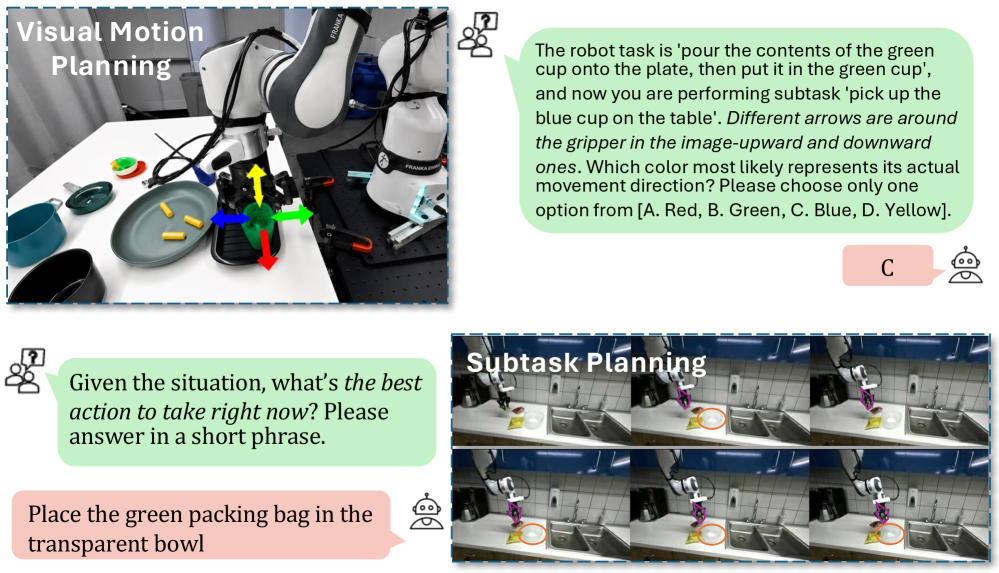
On Where2Place, RoboRefIt, and RoboVQA benchmarks, RoboInter-VLM substantially outperforms base models. At 3B scale, RoboInter-Qwen-3B improves 49.1% over RoboBrain2.0 on RoboRefIt and 12.7% on RoboVQA. At 7B scale: 76.8% and 42.8% respectively.
| Model | Where2Place ↑ | RoboRefIt ↑ | RoboVQA ↑ |
|---|---|---|---|
| QwenVL2.5-7B | 18.9% | 75.8% | 38.4 |
| RoboBrain2.0-7B | 63.6% | 8.8% | 31.6 |
| RoboInter-Qwen-7B | 65.8% | 85.6% | 74.4 |
| RoboInter-LLaVAOV-7B | 66.3% | 89.3% | 74.5 |
6.2 Intermediate Representation Ablation
Coarse representations (subtask, primitive skill) yield only marginal improvements; spatially grounded representations (object box, gripper box, affordance) yield larger gains; Trace introduces dense temporal information with the most significant improvement.
| Variant | OLS@0.1 | OLS@0.05 | OLS@0.03 | OLS@0.01 |
|---|---|---|---|---|
| Vanilla | 0.6793 | 0.3608 | 0.1753 | 0.0189 |
| +Subtask | 0.6965 | 0.3676 | 0.1770 | 0.0171 |
| +Object Box | 0.7025 | 0.3849 | 0.1988 | 0.0294 |
| +Gripper Box+Affordance | 0.7245 | 0.4083 | 0.2114 | 0.0297 |
| +Trace (All) | 0.7511 | 0.4640 | 0.2705 | 0.0587 |
6.3 Closed-Loop Real-World Evaluation
On Franka Research-3 arm, 4 tasks (Object Collecting, Cup Stacking, Towel Folding, Clutter Cleaning), 15 ID + 15 OOD trials each. RoboInter-IC-E2E: ID success 77.3% (vs Vanilla 65.0%), OOD 58.3% (vs 38.3%). EC-E2E shows only 8.3% ID→OOD degradation (vs IC-E2E's 19%), demonstrating stronger generalization.
6.4 World Model Benchmarking
Replacing raw action control with intermediate representations (Seg+Trace): 14B model PSNR 18.26→21.05, LPIPS 0.171→0.102. Gains are larger with limited history context (H1P3: +1.50 PSNR) and most significant for long prediction horizons (H4P16: +2.79 PSNR).
| Model/Control | H/P | PSNR ↑ | SSIM ↑ | LPIPS ↓ |
|---|---|---|---|---|
| Baseline Action | 4/3 | 24.87 | 0.878 | 0.054 |
| Seg+Trace | 4/3 | 25.00 | 0.881 | 0.049 |
| Baseline Action | 4/16 | 18.26 | 0.750 | 0.171 |
| Seg+Trace | 4/16 | 21.05 | 0.810 | 0.102 |
6.5 World Model Guides VLA
Feeding RoboInter-World's predicted latent features to the VLA executor yields consistent and substantial gains across all thresholds, approaching the Oracle upper bound. Standard world model baseline (I2V-Baseline) predictions can be harmful (degrading performance under strict thresholds), showing unstructured predictive features introduce noise.
7.
世界模型训练损失
$$ \mathcal{L}_{\mathrm{world}}=\mathbb{E}_{y,\epsilon,t}\left[\left\|v_{t}-f_{\theta}(x_{t},t\mid z^{\mathrm{hist}},c,a,u)\right\|_{2}^{2}\right] $$
上下文特征拼接
$$ h^{\mathrm{ctx}}=\left[\phi_{\mathrm{text}}(c);\phi_{\mathrm{act}}(a)\right] $$
策略动作输出
$$ \mathbf{a}_{t}=f_{a}\bigl(f_{r}\bigl(f_{v}(\mathbf{o}_{t}),\ell\bigr)\bigr) $$
ConclusionRoboInter1.5 provides a unified intermediate representation platform: RoboInter-Data sets a new standard with 230k densely annotated episodes; RoboInter-VQA systematically evaluates VLM embodied understanding and generation; RoboInter-VLA integrates geometric priors into modular and end-to-end control frameworks; RoboInter-World leverages these representations for accurate future dynamics prediction. Experiments demonstrate that intermediate representations — especially dense temporal traces — bring significant gains across reasoning, execution, and world modeling, with the three mutually reinforcing.
SOURCE LINKS