PAPER DEEP DIVE
Teachy Mini: Development and Preliminary Evaluation of a Knowledge-Based Generative Social Robot for Higher Education
Generative social robots (GSRs) powered by large language models offer new possibilities for personalized tutoring in higher education, but also introduce risks related to misinformation, missing transparency, or reinforcing incorrect student responses. Prior work identified knowledge-based design (KBD) requirements that define the informational prerequisites for GSRs to manifest responsible and effective tutoring behavior in higher education. In this paper, we operationalized selected KBD requirements in the Reachy Mini robot platform through system prompting, retrieval-augmented generation, and stateful prompt orchestration. As a result, we present Teachy Mini, a GSR tutoring system that was developed using KBD. To test the system, we conducted a preliminary evaluation study. Participants (N = 24) completed a robot-guided learning session about research methodologies. They learned either with Teachy Mini or with a control version that did not follow KBD principles. Teachy Mini was perceived as significantly more aligned with responsible tutoring behavior than the control robot. Moreover, a manipulation check illustrated that Teachy Mini used personalization, slide-grounded explanations, Socratic questioning, affective support, and learner-anchored feedback more consistently than the control robot. No significant between-condition differences were found in system acceptance, intrinsic motivation, or learning effectiveness, although exploratory analyses suggested a positive effect of KBD on objective learning gains when accounting for learner preferences. Overall, the study offered an initial implementation and preliminary evaluation of KBD for GSR tutoring, indicating that KBD can shape responsible robot behavior and potentially increase learning effectiveness in robot-supported learning.
Teachy Mini: A Knowledge-Based Generative Social Robot Tutor for Higher Education
Authors: Stephan Vonschallen, Karim Kaufmann, Dominique Oberle, Friederike Eyssel, Theresa Schmiedel (Zurich University of Applied Sciences · Bielefeld University) | arXiv:2607.22345v1 (2026-07-24) | Domain: cs.RO | Ethics: EUB-2025-369 | Preregistered: aspredicted.org #287000
One-Sentence Summary
Teachy Mini operationalizes previously identified Knowledge-Based Design (KBD) requirements on the open-source Reachy Mini desktop social robot through dynamic system prompting, retrieval-augmented generation, and stateful prompt orchestration; a 24-participant controlled study shows the KBD version is perceived as significantly more aligned with responsible tutoring behavior (d=0.93), while system acceptance, intrinsic motivation, and learning effectiveness show no significant differences, and an exploratory path model suggests perceived responsible behavior may mediate KBD's effect on acceptance and motivation.
Background and Motivation
Teachers and students in higher education increasingly rely on technology-supported learning to address large class sizes and self-directed study demands. While study groups and personal tutoring support this process through explanation, feedback, and social motivation, their availability is often limited by time, access, and institutional resources. Social robots offer a complementary approach, providing interactive learning support, fostering engagement, and creating social presence. Yet effective tutoring requires more than delivering factual information: it demands nuanced social understanding, adaptive communication, pedagogically appropriate feedback, and sensitivity to learner motivation.
Integrating large language models (LLMs) into social robots has enabled LLM-driven generative social robots (GSRs) capable of open-ended, context-sensitive dialogue—flexibly responding to learner questions, providing personalized explanations, and sustaining real-time tutoring conversations. This is a substantial departure from earlier tutoring robots whose limited dialogic flexibility constrained educational utility. But GSRs in education also introduce substantial risks: LLM-based systems generate responses probabilistically and may produce inaccurate or misleading explanations, confirm incorrect learner statements due to sycophantic behavior, decrease critical thinking, or even discriminate against students. In higher education, where students interact under evaluative pressure and rely on such systems for exam preparation, these risks are amplified.
The authors previously identified Knowledge-Based Design (KBD) requirements for tutoring-oriented GSRs in higher education, defining the informational prerequisites for responsible and effective tutoring behavior. But these requirements had never been implemented and empirically tested in an educational context—whether KBD requirements can be translated into a functioning tutoring GSR and whether such an implementation positively impacts learners remained unclear. This work fills that gap by developing and testing Teachy Mini, a GSR tutoring prototype operationalizing KBD requirements, compared against a control version with the same hardware, conversational capabilities, and language model but without KBD.
The core idea of KBD is that responsible tutoring behavior depends on the knowledge available to the robot. A robot that knows its role and boundaries, can use relevant learner information, and is grounded in the educational context should be better able to behave transparently, pedagogically appropriately, and responsively to student needs. KBD organizes knowledge into three categories: self-knowledge (role, capability boundaries, behavioral norms), user-knowledge (learner profile, preferences, emotional state, learning progress), and context-knowledge (learning materials, educational strategies, course information, physical environment). Figure 1 shows the full KBD requirements identified by Vonschallen et al.
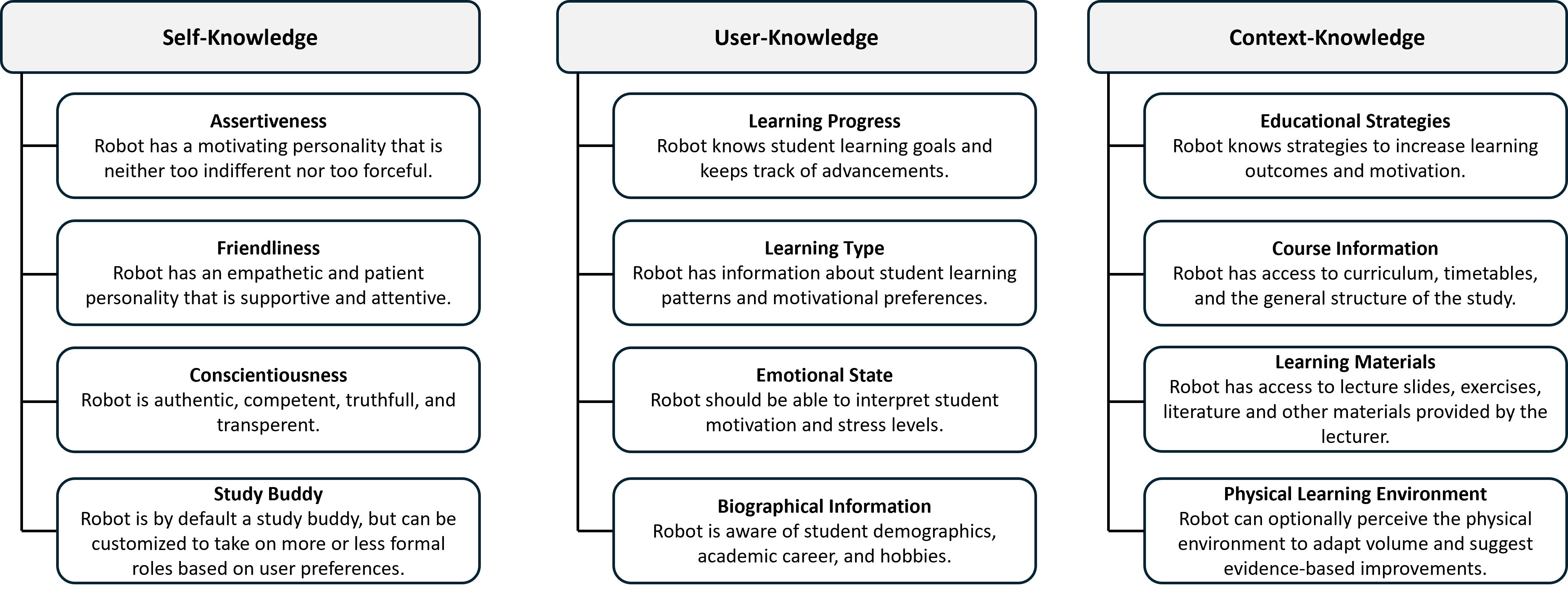
Figure 1: Knowledge-Based Design requirements identified by Vonschallen et al., spanning self-knowledge, user-knowledge, and context-knowledge categories.
Prototype Development and Knowledge Integration
Hardware Platform and Conversation System
Teachy Mini is implemented on the open-source Reachy Mini platform (Pollen Robotics), a small desktop social robot suitable for individual learning interactions, supporting spoken dialogue and providing simple embodied social cues through head and antenna movements. The communication system builds on an adapted Reachy Mini Conversation App using the OpenAI Realtime API (gpt-realtime-1) for real-time spoken conversation and adaptive motion. The researchers modified several app functions to improve interaction quality: recovery from incomplete model responses, higher interruption thresholds, and removal of potentially distracting non-verbal idle movements during pauses.
Three Knowledge Injection Methods
The system uses three main methods to provide the robot with required knowledge: dynamic system prompting, retrieval-augmented generation (RAG), and stateful prompt orchestration. System prompting gives the system instructions about its overarching behavior and role; dynamic system prompting combines stable instructions with dynamic elements that can change within an interaction to allow personalization. RAG retrieves relevant information from an external knowledge source and makes it available to the LLM during generation, grounding outputs in task-specific material rather than relying solely on general training data. Stateful prompt orchestration dynamically updates or supplements model instructions during interaction based on dialogue states—for example, when a confusion pattern like "I don't understand this" is detected, a state-specific instruction is injected: "Rephrase your final thought in simple words using different vocabulary and a concrete analogy. Do NOT repeat the same words."
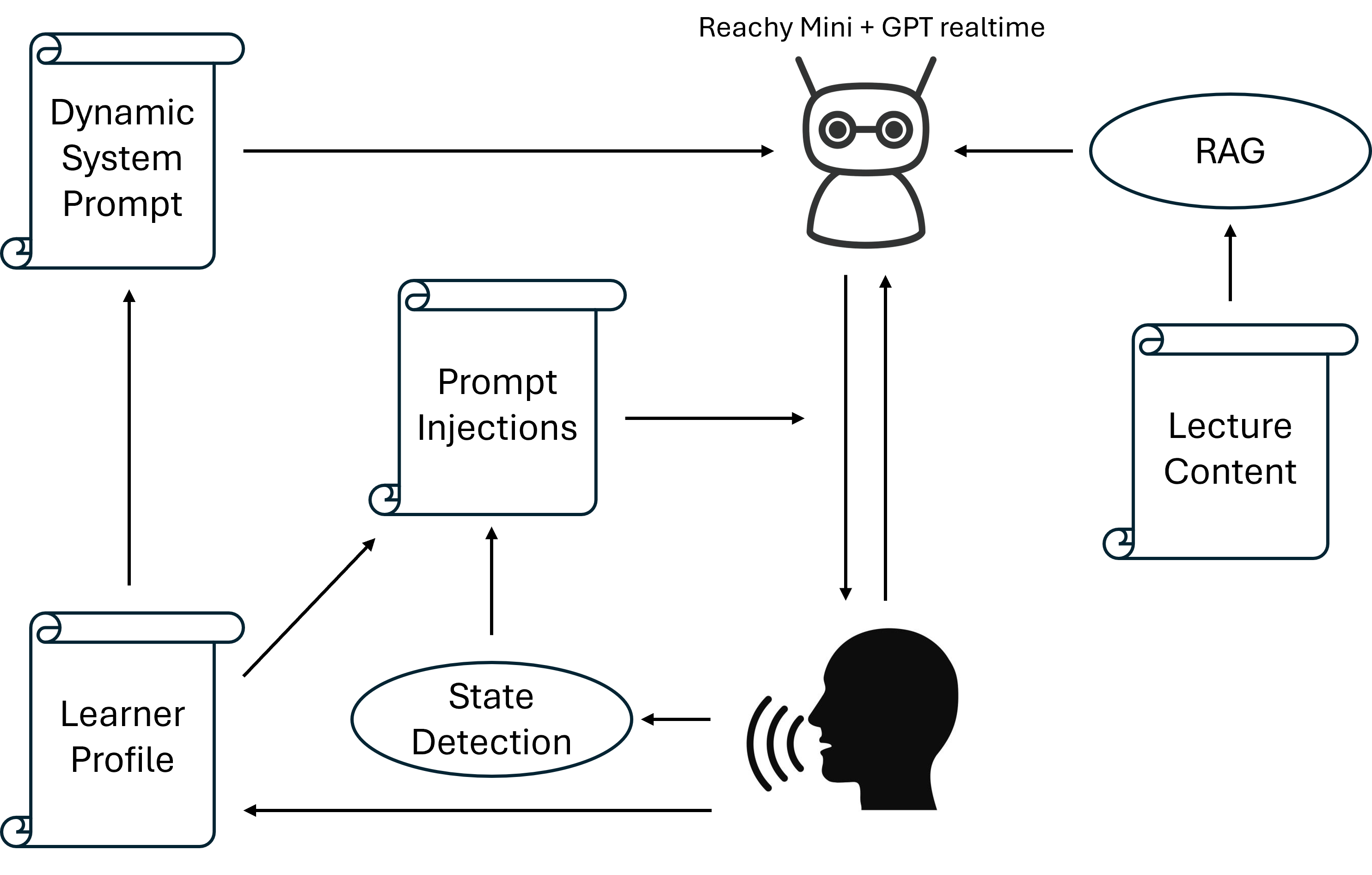
Figure 2: Overview of prompt orchestration—the dynamic system prompt contains static instructions with dynamic variable placeholders drawn from a learner profile; RAG provides lecture content; regex detection of dialogue states triggers state-specific instruction injection.
Operationalizing KBD Requirements
Based on this architecture, the study integrated selected self-knowledge, user-knowledge, and context-knowledge design requirements. Because Teachy Mini targets experimental single-session interactions, "course information" (requiring long-term interaction) was not integrated; "learning progress" was only partly addressed via learner goals; "physical learning environment" was omitted due to privacy concerns and mixed perceived usefulness; only the "study buddy" role profile was used for consistency.
User-knowledge was integrated through personalization. Most learner-related information was acquired through a brief onboarding conversation where Teachy Mini asked seven opening questions covering "biographical information," "learning type," and "learning progress" design requirements (Table 1). Acquired information was extracted via rule-based regex parsing, stored in a user profile, and added to the system prompt. The "emotional state" requirement was integrated through state detection—the robot received prompt-injected information about whether the user appeared frustrated, uncertain, or confused.
| Question | Content | Design Requirement |
|---|---|---|
| Q1 | What is your name? How would you like me to address you? | Biographical Information |
| Q2 | What are you studying, and which semester are you in? | Biographical Information |
| Q3 | What motivates you when learning? What drives you? | Learning Type |
| Q4 | How do you prefer to learn: structured with clear steps, or exploratory? | Learning Type |
| Q5 | What do you enjoy doing in your free time? Hobbies or interests? | Biographical Information |
| Q6 | What learning atmosphere do you prefer: strictly factual, or with some humor? | Role |
| Q7 | What would you like to achieve in today's session? A specific learning goal? | Learning Progress |
Table 1: The seven opening questions during onboarding and their corresponding KBD design requirements.
Context-knowledge ensured sensitivity to the educational context. The "learning materials" requirement was implemented via a PDF upload mechanism—users could drag-and-drop lecture slides, and the system accessed them via RAG for context-sensitive topic knowledge. The "educational strategies" requirement was implemented through dynamic system prompting and stateful prompt orchestration: the robot was instructed to use scaffolding strategies including Socratic questioning, targeted hints, simplified explanations, and corrective feedback. The system prompt included instructions to ask an in-depth question after each concept was explained to check understanding, with content-sensitive questions like "Which point differentiates concepts A and B the most?"
Formalizing State Detection
The core of stateful prompt orchestration is a regex-based state detector. Let the user utterance be $u$, the predefined state pattern set be $\mathcal{P} = \{p_1, \ldots, p_K\}$, and each pattern $p_k$ be associated with a state-specific instruction $s_k$. The detection process is formalized as:
$$S(u) = \{ s_k \mid u \text{ matches } p_k,\; p_k \in \mathcal{P} \}$$
Detected state instructions $S(u)$ are injected into the next user prompt. The defined states include frustration, uncertainty, confusion, requests for content explanations, requests for more depth, and requests to stop asking questions. While less flexible than learned detectors, this rule-based approach guarantees reproducibility and determinism in a controlled experiment—critical for causal attribution.
Preliminary Evaluation
Design and Hypotheses
The study used a two-group between-subjects design. Participants interacted with one of two Reachy Mini tutoring prototypes: a KBD condition (Teachy Mini, configured with KBD requirements) and a control condition (same platform and LLM but without KBD). Four hypotheses were derived from prior work: H1 greater system acceptance; H2 greater intrinsic motivation; H3 greater objective (H3a) and subjective (H3b) learning effectiveness; H4 greater perceived alignment with responsible robot tutoring behavior.
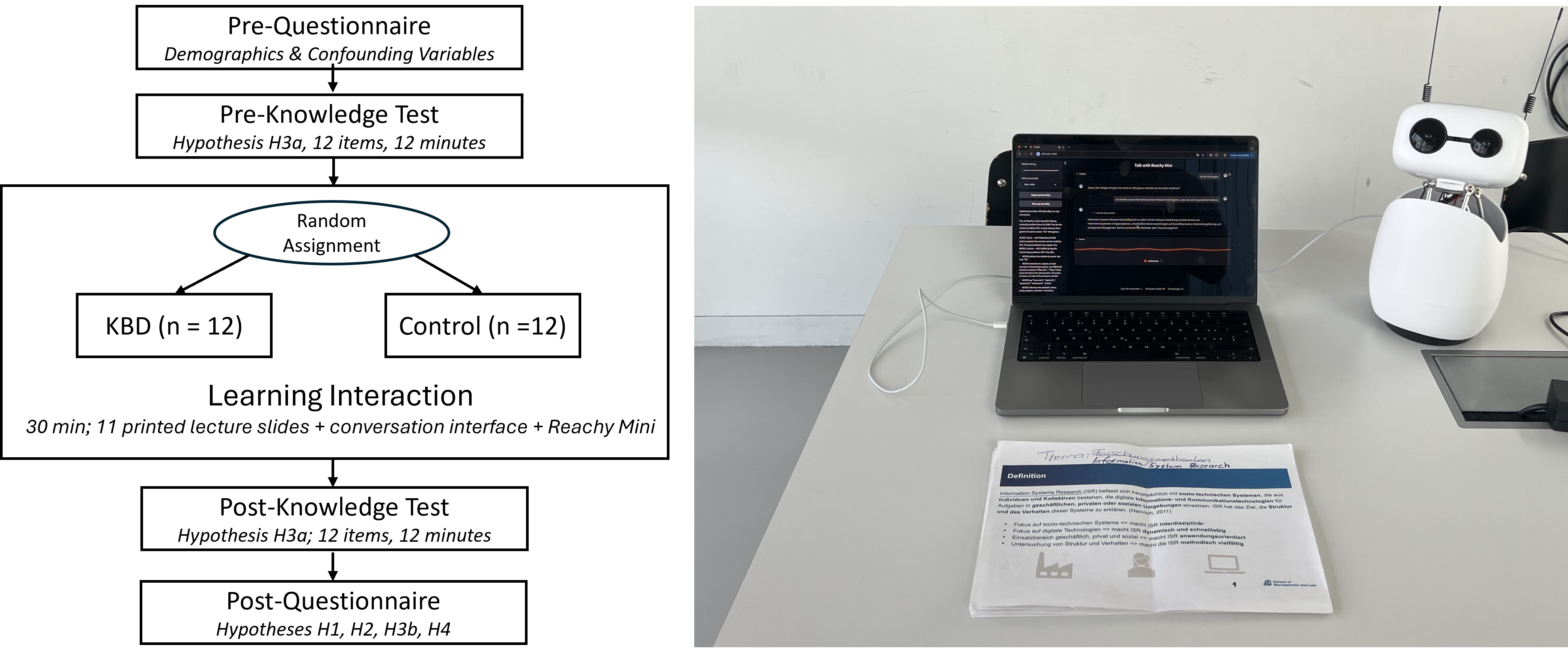
Figure 3: Study procedure and setup—participants completed a robot-guided learning session under either the KBD or control condition.
Sample
Recruited via convenience sampling, the final sample was 24 participants (collected March-April 2026). Mean age 31 (SD=4.31, range 23-36), 16 male, 8 female. Half were currently enrolled students, half had graduated within the previous four years. The most common field was information systems (n=14), with others in law, engineering, social sciences, design, and architecture. Education levels were relatively high: 4 secondary, 13 bachelor's, 7 master's. Only 1 of 24 had previously interacted with a social robot. All interactions were in German.
Main Hypothesis Results
H1 (system acceptance) was not supported. A Welch two-sample t-test showed near-identical scores for KBD (M=5.04, SD=1.61) and control (M=5.01, SD=1.10):
$$t(19.43) = 0.057,\quad p = .955,\quad 95\%\text{CI} = [-1.148,\, 1.212]$$
H2 (intrinsic motivation) was not supported. The KBD group (M=5.30, SD=1.27) was descriptively higher than control (M=4.88, SD=1.41) but not significantly:
$$t(21.76) = 0.762,\quad p = .454,\quad 95\%\text{CI} = [-0.718,\, 1.551]$$
H3a (objective learning effectiveness) was tested via ANCOVA with pretest as covariate. The overall model was significant, explaining 23.4% of posttest variance:
$$F(2,21) = 4.506,\quad p = .024,\quad R^2 = 0.234$$
Pretest was a significant predictor (B=0.394, p=.008). The KBD group had a mean learning gain of 0.75 points (SD=1.54) versus 0 (SD=1.54) for control, but the condition effect was not significant (B=0.447, p=.344). H3b (subjective learning effectiveness) also showed no significant difference.
H4 (perceived responsible behavior) was supported—the strongest finding. The KBD group (M=5.49, SD=1.23) scored significantly higher than control (M=4.47, SD=0.95):
$$t(20.65) = 2.277,\quad p = .034,\quad 95\%\text{CI} = [0.087,\, 1.950],\quad d = 0.930$$
The effect size d=0.93 is large, indicating a substantial KBD impact on perceived responsible behavior.
| Hypothesis | Metric | KBD | Control | Statistic | p | Result |
|---|---|---|---|---|---|---|
| H1 | System Acceptance | 5.04 (1.61) | 5.01 (1.10) | t=0.057 | .955 | Not supported |
| H2 | Intrinsic Motivation | 5.30 (1.27) | 4.88 (1.41) | t=0.762 | .454 | Not supported |
| H3a | Objective Learning | gain 0.75 | gain 0.00 | B=0.447 | .344 | Not supported |
| H4 | Perceived Responsible Behavior | 5.49 (1.23) | 4.47 (0.95) | t=2.277 | .034 | Supported |
Table 2: Summary of the four main hypothesis tests. Only H4 reached significance, with effect size d=0.93.
Exploratory Analysis and Path Model
Linear regressions explored confounding variables. After including learning preference (group vs. solo) as a covariate, the KBD condition coefficient became positive and significant (B=1.714, t=2.355, p<.05, CI=[0.142, 3.285])—meaning that accounting for learner preferences, KBD had a positive effect on objective learning gains. Pearson correlations (Table 5) revealed significant positive associations between acceptance and motivation (r=.692), acceptance and subjective learning effectiveness (r=.729), and motivation and subjective learning effectiveness (r=.727).
Based on these correlations, the researchers explored a path model (Figure 4) with perceived responsible behavior as a predictor of motivation and acceptance. Tested via structural equation modeling, fit indices were good (to be interpreted cautiously given small sample):
$$\chi^2(2) = 2.197,\quad p = .333,\quad \text{CFI} = .991,\quad \text{TLI} = .972,\quad \text{RMSEA} = .059,\quad \text{SRMR} = .074$$
Key path coefficients: KBD → perceived responsible behavior $\beta = .437$ (p=.017); perceived responsible behavior → motivation $\beta = .588$ (p<.001); perceived responsible behavior → acceptance $\beta = .512$ (p=.021). Indirect effects of KBD on acceptance $\beta = .224$ (p=.016) and on motivation $\beta = .257$ (p=.019). The model explained 19.1% of variance in perceived responsible behavior, 34.6% in motivation, and 26.3% in acceptance.
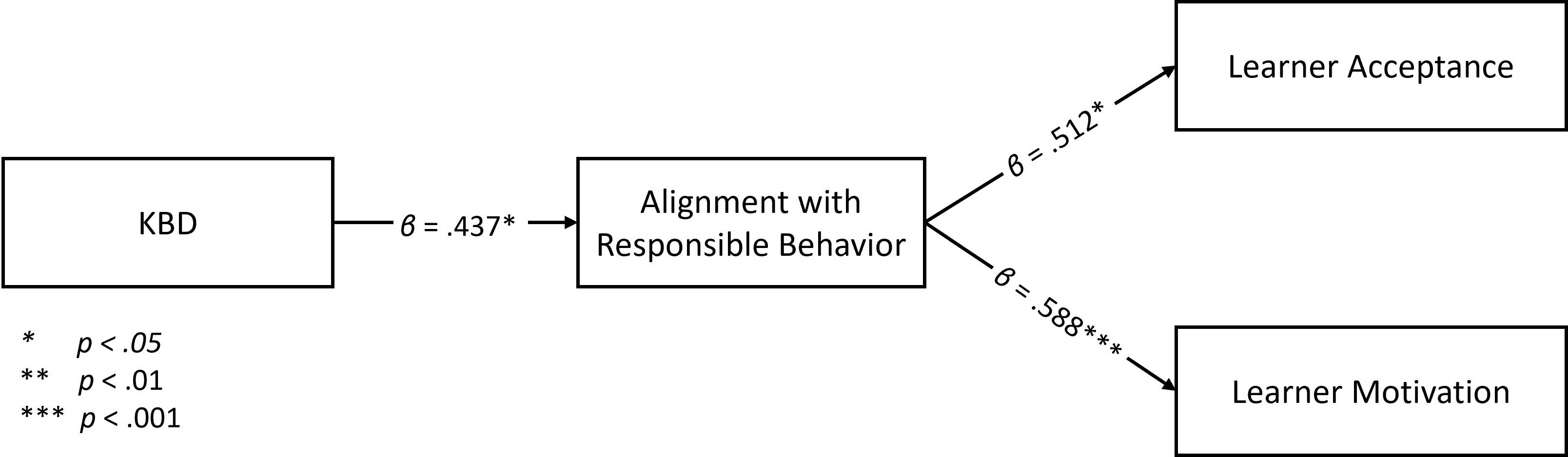
Figure 4: Proposed path model—KBD indirectly affects learner motivation and system acceptance through perceived responsible behavior.
System Architecture Diagram
flowchart LR
  subgraph Onboarding["Onboarding Phase"]
    OQ["Seven opening questions
Q1-Q7 acquire user info"]
    RE["Regex parsing
extract biographical/learning-type/goal"]
    LP["Learner profile
dynamic variable placeholders"]
  end
  subgraph Runtime["Real-time Interaction"]
    UI["User utterance u"]
    SD["State detector S(u)
regex match frustration/confusion/uncertainty"]
    SI["State-specific instruction injection
e.g. simplify/affective support"]
    SP["Dynamic system prompt
static instructions + learner profile vars"]
    RAG["RAG retrieval
lecture slide PDFs"]
    LLM["gpt-realtime-1
OpenAI Realtime API"]
    RM2["Reachy Mini
speech + head/antenna motion"]
  end
  OQ --> RE --> LP
  LP --> SP
  UI --> SD --> SI
  SP --> LLM
  RAG --> LLM
  SI --> LLM
  LLM --> RM2
Limitations
Incomplete KBD implementation (author-acknowledged). This study implemented only a subset of previously identified KBD requirements. While learning materials, personalization, educational strategies, role, friendliness, assertiveness, and conscientiousness were directly implemented, other requirements such as long-term learning progress, course schedules, grades, richer emotion recognition, and physical learning environment awareness were not or only partially addressed. A fully developed KBD robot should also be more customizable by students and moderated by lecturers. The evidence should thus be read as a partial KBD implementation rather than the complete framework.
Small sample and single interaction (author-acknowledged). The 24-participant sample limits statistical power, making moderate effects on acceptance, motivation, and learning effectiveness hard to detect. Almost all participants had no prior social robot experience, so novelty effects may have influenced responses. Effects on motivation, acceptance, and learning may require repeated exposure to emerge, and longitudinal field studies are needed.
Slides introduce additional variance. Lecture slides were available in both conditions, so overall learning progress may have partly stemmed from self-engagement with slides rather than robot interaction, potentially diluting the experimental manipulation.
State detection is regex-based rather than learned. Rule-based pattern matching guarantees reproducibility but is limited in flexibility—complex emotional expressions or subtle confusion signals may be missed, affecting timely injection of state-specific instructions.
Summary and Outlook
This work developed Teachy Mini, a GSR tutoring prototype operationalizing selected KBD requirements, and preliminarily evaluated it in a 24-participant controlled study. The strongest finding is that students in the KBD condition significantly perceived the robot as more aligned with responsible tutoring behavior (d=0.93), providing preliminary support for the core KBD assumption that responsible behavior can be shaped by systematically configuring what the robot knows. Results for acceptance, motivation, and learning effectiveness were inconclusive, but an exploratory path model suggests perceived responsible behavior may mediate KBD's effect on acceptance and motivation, and that accounting for learner preferences reveals a positive KBD effect on objective learning gains.
The study demonstrates that KBD can be treated as an empirically testable design approach rather than only a conceptual framework. Future research should test more complete KBD implementations with larger samples and repeated interactions, examining whether effects persist after novelty fades. From an applied perspective, as generative AI becomes increasingly integrated into learning technologies, the central question is not only whether systems can produce fluent dialogue but whether they can be configured to support learners in accurate, transparent, motivating, and autonomy-preserving ways—KBD offers one practical orientation.
From a broader perspective, Teachy Mini represents a shift in educational robotics from "conversational fluency" to "behavioral responsibility." When LLM-driven robots enter evaluative settings, "what it knows" is more fundamental than "what it says"—self-knowledge demarcates capability boundaries to prevent hallucination, user-knowledge drives personalization to avoid one-size-fits-all, and context-knowledge ensures content grounding to prevent misinformation. The systematic injection of these three knowledge types may be the critical step from "can chat" to "can teach" for generative social robots.
Golden Lines
"The future of educational AI is unlikely to depend solely on building systems that know and explain more, but on systems that support students in thinking critically."
"KBD moves responsible behavior from abstract design principles to empirically evaluable system configurations—what the robot knows shapes what it does."
SOURCE LINKS