PAPER DEEP DIVE
SOLO: Stable Omni-terrain Long-Horizon Perceptive Humanoid Locomotion
Humans traverse complex terrain over long distances without losing balance, whereas perceptive humanoid policies become fragile as perception and control errors accumulate. We present SOLO, a unified framework addressing two compounding causes of this long-horizon fragility: dense terrain reconstruction smooths action-critical details, and pointwise imitation lacks temporal credit assignment. Its Query Reconstructor (QR) uses Fourier-encoded cell queries to retrieve spatially specific evidence from depth-proprioception tokens, preserving sharp terrain boundaries. Trajectory-Aware MSE (TA-MSE) Distillation adds next-state teacher-student disagreement to the PPO reward, enabling Generalized Advantage Estimation to propagate future disagreement penalties to preceding actions. In simulation, QR reduces height-map L1 error by factors of 3.3-4.0, while TA-MSE surpasses PPO and MSE+PPO in curriculum progression. On stress-test terrains, SOLO achieves 97.5% mean traversal success and 96% stepping-stone success, versus 75.0-75.6% and 0-3% for dense-reconstructor variants. Deployed zero-shot with only a chest-mounted depth camera and proprioception, SOLO completes a continuous 1.5-km outdoor route and an indoor mixed-terrain course. Project page: https://sunpihai-up.github.io/solo/
Paper: SOLO: Stable Omni-terrain Long-Horizon Perceptive Humanoid Locomotion
Authors: Pihai Sun, Gang Han, Jingkai Sun, Jiahao Ma, Zeran Su, Zelin Tao, Peiran Liu, Shuai Shi, Wei Cui, Zifan Wang, Jialin Yu, Wen Zhao, Kangning Yin, Jiaxu Wang, Jiahang Cao, Lingfeng Zhang, Hao Cheng, Jian Tang, Yijie Guo, Qiang Zhang
Paper: arXiv:2608.26583
Project: sunpihai-up.github.io/solo
Code status: No public repository was available at paper release; the project page labels the release as a preview.
One-sentence summary
SOLO combines per-cell query-based terrain reconstruction with trajectory-aware distillation to attack two compounding sources of long-horizon fragility, enabling a humanoid to walk 1.5 km outdoors with one chest-mounted depth camera and proprioception.
Why isolated-obstacle success is not enough
When humans cross trails, stairs, and sparse footholds, perception and control form a closed loop: each foot placement changes the next state, while corrective actions stop small errors from becoming falls. Humanoid robots face the same loop, but extended deployment repeatedly encounters terrain transitions, viewpoint changes, and contact errors. Local mistakes can compound rather than reset.
Teacher–student reinforcement learning is now standard. A privileged simulator teacher sees the true height map and state; a deployable student uses onboard depth and proprioception and imitates the teacher. The paradigm works well in short trials because each episode resets local errors. A continuous real route is less forgiving.
SOLO identifies two coupled failure modes. First, dense terrain reconstructors encode depth history with CNN–RNNs and decode a local height map from a shared representation. That shared bottleneck behaves like a low-pass filter: it captures broad geometry but smooths stair edges and stepping-stone boundaries that matter for action selection. Second, conventional distillation uses action MSE at the current state, so it cannot distinguish actions with similar present error but different future consequences. Without trajectory-level credit assignment, a plausible action can drive the student into a state where teacher matching later becomes difficult.
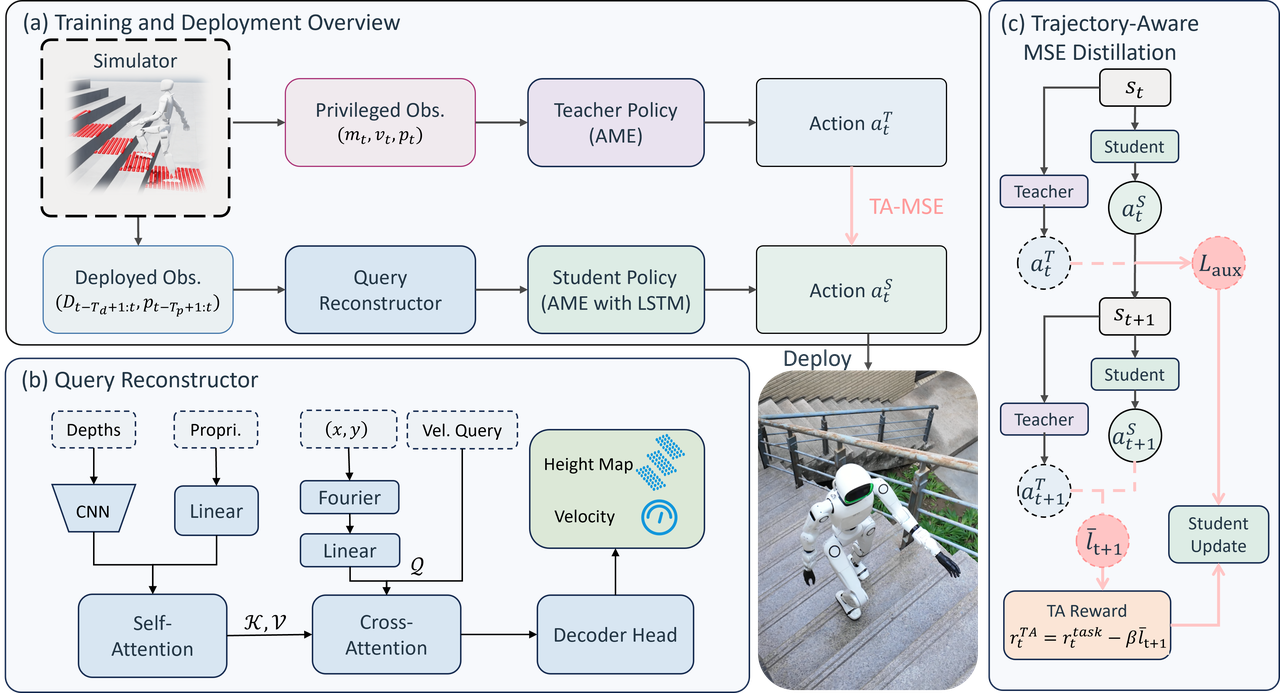
The paper responds with two mechanisms. Query Reconstructor (QR) gives every height-map cell a Fourier-encoded query that retrieves spatially specific evidence from depth–proprioception tokens. Trajectory-Aware MSE (TA-MSE) adds next-state teacher–student disagreement to the PPO reward, allowing GAE to propagate future penalties back to earlier actions.
The deployed system uses no external localization, mapping, or motion capture. Only QR and the student remain at run time, consuming four D455 depth frames, ten proprioceptive/control frames, and a human planar velocity command to produce 25 joint targets at 50 Hz.
Teacher–student setting and preliminaries
At simulator state $s_t$, the privileged teacher observes $o_t^T=(m_t,v_t,p_t)$: a clean local height map $m_t$, realized base velocity $v_t$, and $p_t=[\omega_t^b,g_t^b,c_t,q_t,\dot q_t,a_{t-1}]\in\mathbb{R}^{84}$, containing angular velocity, gravity direction, velocity command, joint state, and the previous action. The student receives only $o_t^S=(D_{t-T_d+1:t},p_{t-T_p+1:t})$.
Teacher $\pi_T$ and student $\pi_S$ share an Attention-based Map Encoder (AME) backbone; the student adds an LSTM proprioceptive bypass to retain rollout history. QR maps student observations to $(\hat m_t,\hat v_t)$, and the recurrent student combines these estimates with proprioception to output an action distribution. Both policies output 25-dimensional offsets from default joint positions.
Training has three stages. Stage 1 trains the privileged teacher with AMP-regularized PPO. Stage 2 transfers only shape-compatible AME parameters, initializes the student action head and LSTM bypass randomly, and distills with TA-MSE while the student still receives privileged terrain input. Stage 3 replaces privileged terrain with QR estimates, jointly fine-tunes the student, and updates QR from the QR-conditioned student’s on-policy buffer. Thus QR is supervised on states actually visited by the student that will consume it.
Query Reconstructor: every cell asks its own question
QR predicts a robot-centric local height map and base velocity from deployable observations. Instead of decoding all locations from one shared bottleneck, it assigns each map cell a spatial query that retrieves location-specific evidence from sensor-history memory.
The memory is built from two streams. A lightweight ResNet encodes each depth frame into visual tokens, while a per-frame MLP embeds proprioception with learned temporal position embeddings. The concatenated tokens pass through a Transformer encoder, yielding $M_t$. Visual evidence, robot motion, and contact phase are therefore interpreted jointly.
For a map with $N=G_xG_y$ cells, each cell’s planar coordinate is Fourier-encoded and projected into a query $q_i$. The $N$ queries attend to $M_t$ through stacked multi-head cross-attention; a height head maps decoded query $q_i'$ to cell height $\hat h_i$. A separate learned velocity query attends to the same memory and decodes the 3-DoF base velocity $\hat v_t$.
The reconstruction objective is:
$$\mathcal{L}_{rec}=\lambda_h\frac{1}{N}\sum_{i=1}^{N}|\hat h_i-h_i^{GT}|+\lambda_v\|\hat v_t-v_t^{GT}\|_1$$
In Stage 3, policy updates consume detached QR predictions, while reconstruction updates optimize only QR. This prevents supervised reconstruction gradients from interfering with the policy update.
flowchart LR
  A["Depth history
D455"] --> C["ResNet visual tokens"]
  B["Proprioceptive history
84-D / 10 frames"] --> D["MLP + temporal positions"]
  C --> E["Transformer sensor memory Mt"]
  D --> E
  F["Height-map cells
Fourier queries"] --> G["Cross-attention decoding"]
  E --> G
  G --> H["Per-cell height map m_hat"]
  E --> I["Velocity query"]
  I --> J["Base velocity v_hat"]
  H --> K["AME student policy"]
  J --> K
  B --> L["LSTM bypass"]
  L --> K
  K --> M["25 joint targets @50Hz"]
TA-MSE: turn future disagreement into present reward
The usual MSE+PPO baseline adds current-state action matching on the student rollout:
$$L_{aux}(\theta)=\mathbb{E}_t\left[\|\mu_\theta(h_t^S)-\mu_T(o_t^T)\|_2^2\right]$$
This treats samples independently and does not model how the current action changes later visited states. TA-MSE keeps the auxiliary loss but evaluates both policies after the system moves from $s_t$ to $s_{t+1}$:
$$\bar\ell_{t+1}=\operatorname{sg}\left(\|\mu_\theta(h_{t+1}^S)-\mu_T(o_{t+1}^T)\|_2^2\right)$$
Here $\operatorname{sg}$ is a stop-gradient and stores the value directly. The training reward becomes:
$$r_t^{TA}=r_t^{task}-\beta\bar\ell_{t+1}$$
The preceding transition is immediately penalized for creating a difficult next state. More importantly, the PPO return and GAE propagate later disagreement back through the sampled trajectory without another critic, dynamics model, or teacher rollout.
The trajectory-weighted imitation return for action $a_t$ is:
$$G_t^{imit}=-\beta\sum_{k=t+1}^{T_R}\gamma^{k-t-1}\operatorname{sg}[\bar\ell_k]$$
The unified objective is:
$$\max_\theta J_{PPO}(\theta;r^{TA})-\lambda L_{aux}(\theta)$$
Setting $\lambda=0,\beta=0$ recovers PPO; $\lambda>0,\beta=0$ is MSE+PPO; $\lambda>0,\beta>0$ is TA-MSE. This formulation makes the controller comparison directly interpretable.
Real-robot deployment
SOLO is command-conditioned: a human supplies only planar joystick velocity $c_t$, while the learned policy handles terrain perception and whole-body control. The paper deploys zero-shot on Omni without external state or mapping. Across ten trials on each of seven isolated terrains, SOLO records 69/70 successes; the only failure occurs on stepping stones.
| Terrain | Success |
|---|---|
| Ascending stairs | 10/10 |
| Descending stairs | 10/10 |
| 20° slope | 10/10 |
| 40 cm high platform | 10/10 |
| 50 cm gap | 10/10 |
| Movable obstacle | 10/10 |
| Stepping stones | 9/10 |
| Overall | 69/70 |
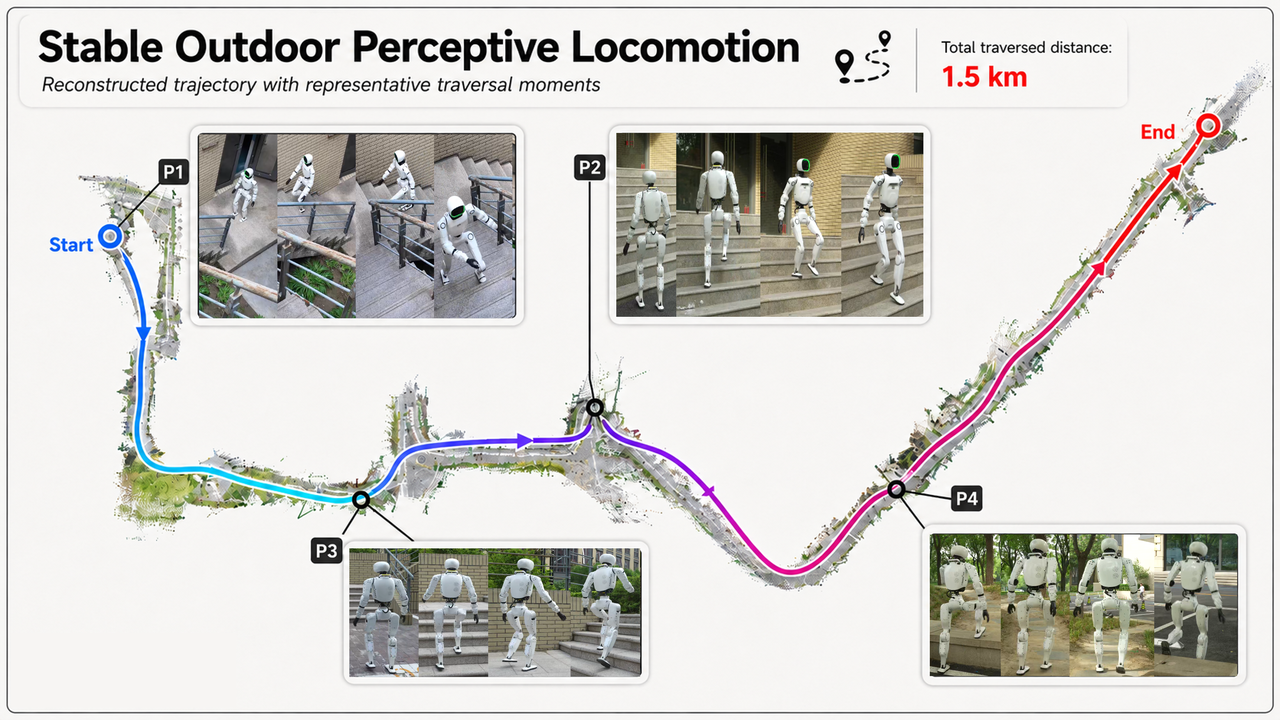
The outdoor route includes natural stairs, slopes, grass transitions, and uneven ground. SOLO completes 1.5 km continuously without policy reset or physical assistance. The indoor course concentrates ascending stairs, stepping stones, a gap, descending stairs, and a movable obstacle into one uninterrupted run.
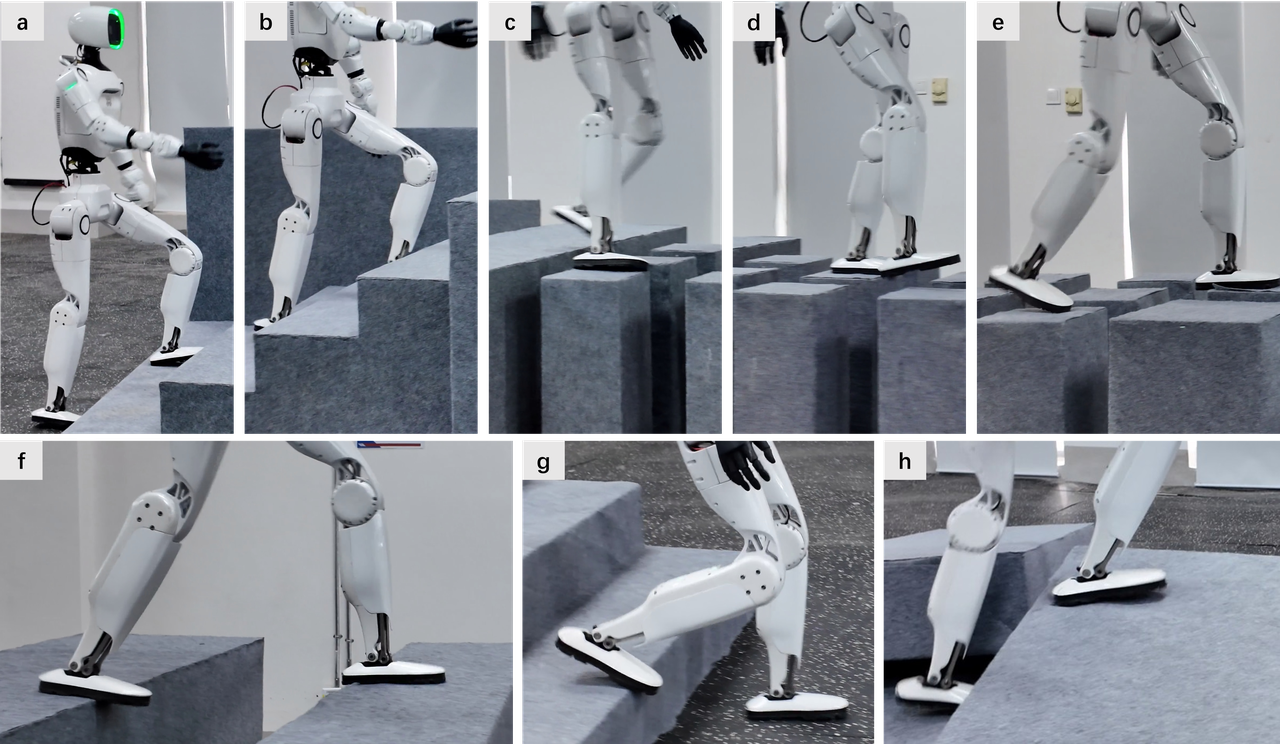
The paper also contextualizes reported hardware setups: AME uses Qualisys and a mesh; CReF uses one depth camera; RPL uses two hardware depth cameras and reports a 50 m course and curved stairs; SOLO uses one depth camera and reports stepping stones, a 1.5 km outdoor route, and more than 100 stairs in one ascent. This is contextual rather than a strict same-protocol ranking.
Reconstruction accuracy and foothold quality
With teacher, task, curriculum, training budget, and distillation objective fixed, the paper compares a START-style recurrent dense decoder, a DPL-style cross-attention reconstructor, and QR using per-cell L1 at the highest curriculum difficulty.
| Method | Gap | Random grid | Down-25 | Down-35 | Up-25 | Up-35 | Step stones | High plane | Average |
|---|---|---|---|---|---|---|---|---|---|
| START | 10.11 | 5.18 | 8.35 | 5.32 | 8.10 | 5.54 | 14.76 | 3.31 | 7.59 |
| DPL | 10.62 | 8.09 | 11.74 | 7.47 | 10.68 | 7.57 | 12.75 | 5.16 | 9.26 |
| QR | 2.27 | 2.43 | 2.03 | 1.47 | 1.89 | 1.31 | 5.92 | 0.97 | 2.29 |
QR reduces average error from 7.59/9.26 cm to 2.29 cm, a 3.3–4.0× improvement. The absolute gain is largest on stepping stones, where sharp height discontinuities make per-cell fidelity critical. Under the offline protocol, QR records 2.98±0.07 cm overall L1 and 0.386±0.008 Edge F1@1, versus 4.32–4.36 cm and 0.214–0.242 for START and DPL.
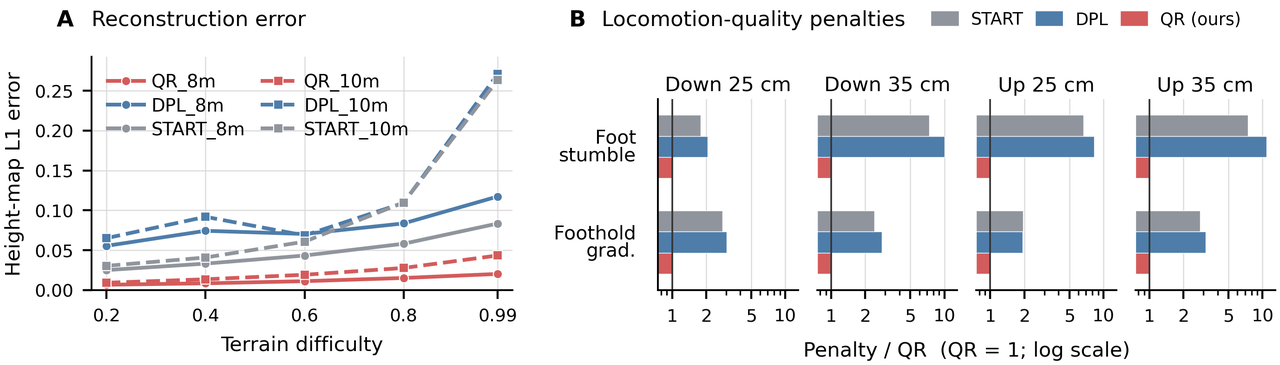
All reconstructors train on 8 m scenes and are evaluated on matched 8 m and unseen 10 m scenes. At difficulty 0.99, QR rises from 0.020 m to 0.043 m; DPL rises from 0.117 m to 0.271 m, and START from 0.084 m to 0.264 m. On unseen 10 m scenes, DPL and START incur 6.2× and 6.1× QR’s error, showing QR’s robustness to terrain-extent shift.
Curriculum progress and highest-difficulty success
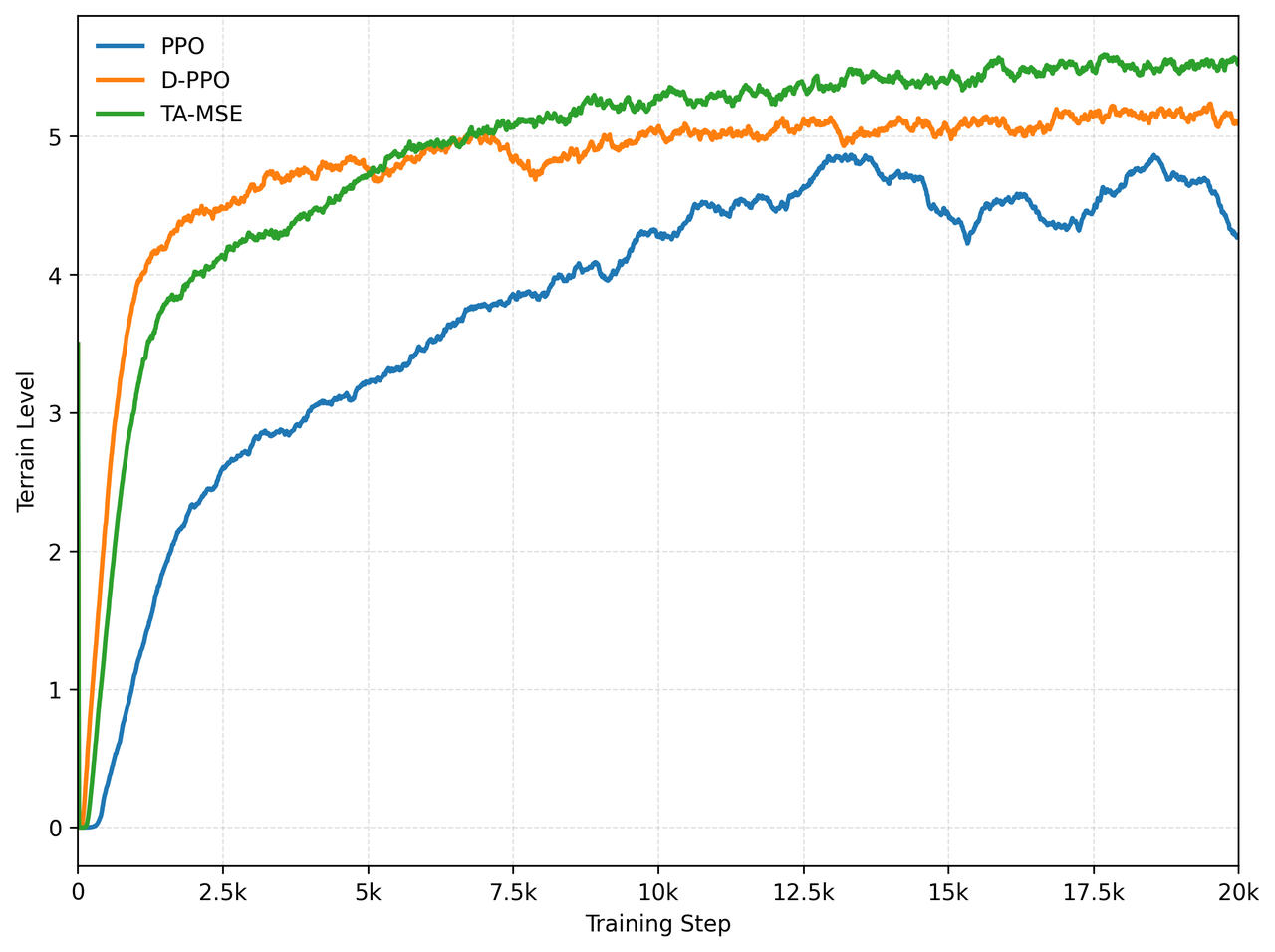
The distillation-curriculum study occurs before QR is introduced, with the same teacher, privileged map input, terrain curriculum, initialization, and training budget. The metric is the mean curriculum level reached. TA-MSE reaches the ceiling of about 5.5, while MSE+PPO plateaus near 5.1 and PPO remains below 5.0 with larger oscillations.
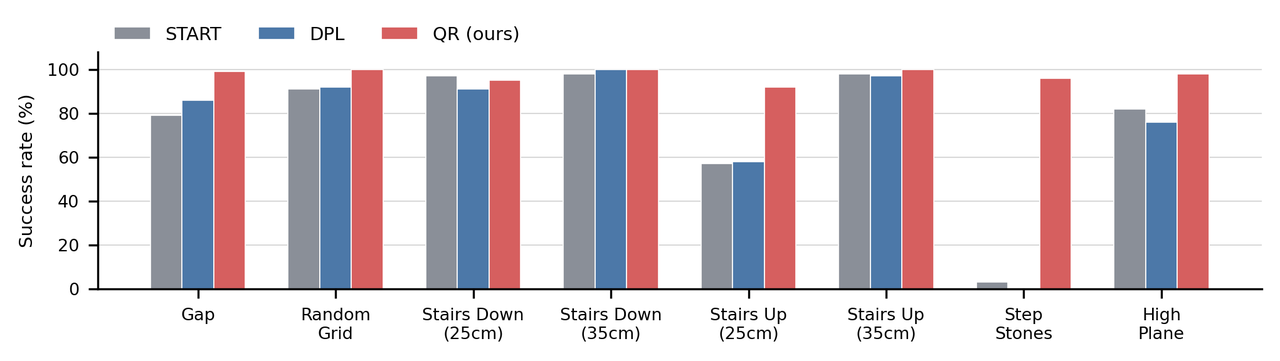
With TA-MSE fixed, the highest-difficulty experiment compares reconstructors. QR improves mean success from 75.0–75.6% to 97.5% and worst-case terrain success from 0–3% to 92%. On stepping stones, QR reaches 96%, START 3%, and DPL 0%. START and DPL incur foot-stumble and foothold-gradient penalties 1.78–7.40× and 1.94–10.83× QR’s levels.
Limitations and critical assessment
First, the front-facing camera leaves a rear blind spot. The authors explicitly note that backward locomotion over changing terrain cannot see geometry behind the robot. Longer-lived memory, as in LF2WB, could retain foothold geometry outside the current view.
Second, the 2.5D height map represents one ground surface per cell. Transparent or reflective surfaces can corrupt depth, and multi-layer geometry is not naturally represented. Complementary sensing and volumetric terrain models are the proposed extensions.
Third, SOLO remains command-conditioned rather than autonomous. A human supplies planar velocity commands; the policy handles perception and control. Route-level planning, obstacle avoidance, and goal understanding remain outside the system, so the 1.5 km walk is not full autonomous navigation.
Fourth, hardware context comparisons are not fully protocol-matched. Table 2 aggregates what each related system reported under its own hardware setup and evaluation. It is useful context but not a controlled ranking.
Fifth, public code is absent. The project page is a preview and does not yet release code or final BibTeX. The method is described in detail, but independent reproduction requires the future release.
Conclusion
SOLO’s contribution is not merely adding sensors. It re-examines two quiet failure sources in teacher–student pipelines: shared decoders erase local geometry, and pointwise imitation lacks future credit. QR preserves boundaries by asking each cell for its own evidence; TA-MSE shapes the PPO return with next-state disagreement. The mechanisms act on different parts of the pipeline and are complementary.
The evidence chain is unusually coherent: lower reconstruction error leads to lower foothold penalties, higher curriculum levels, higher stress-test success, and finally long-horizon hardware deployment. This component-to-system linkage is stronger than a single aggregate score.
The natural next steps are long-lived or multi-view memory, volumetric terrain representations, and integration with autonomous planning. The first two are explicitly identified by the authors; the third is necessary for a complete outdoor mobility system.
Long-horizon stability is not making every step perfect; it is ensuring that every error is fed back before it becomes a fall.