PAPER DEEP DIVE
Why is AI-generated language so hard to understand?
The authors compare psycholinguistic processing-cost features across 14 language models in chat, coding, and essay settings. Relative to round-trip paraphrases, frontier models overuse low-frequency n-grams, long dependencies, stacked noun compounds, denominal verbs, reduced object relatives, and atypical animacy patterns. They hypothesize that post-training for math, code, and verifiable rewards rewards information density rather than human communication. A Qwen2.5-1.5B Instruct experiment with GRPO shows that a simple length penalty can create a near-categorical preference for shorter variants and transfer to some untrained constructions. Task success therefore does not guarantee human-comprehensible language.
Authors: Thomas Hikaru Clark, Matias B. Martin, and Kyle Mahowald
Paper: arXiv:2610.29162v1, October 21, 2026. Areas: computation and language, artificial intelligence.
Code status: No authors’ public implementation was found from the paper, author pages, or exact-title repository searches. The paper gives unusually detailed prompts, corpora construction rules, reward definitions, and training hyperparameters, but an end-to-end reproduction still requires rebuilding the collection harness.
One-sentence summary
Across a new multi-domain corpus and a targeted reinforcement-learning intervention, the authors argue that modern language models can systematically favor shorter, denser, and less human-parseable constructions when training rewards task correctness but not communicative clarity.
The question behind the “AI writing” intuition
Readers often recognize model-generated prose without being able to name what is wrong. A sentence may be grammatical and factually useful while still feeling like a compressed internal note. This paper turns that impression into two hypotheses. H1 asks whether frontier and near-frontier models overuse linguistic constructions that psycholinguists already associate with human processing difficulty. H2 asks whether post-training for math, code, reasoning, and verifiable rewards creates a pressure for information density that competes with communication.
The distinction matters because pretraining and post-training expose models to different pressures. Human language has evolved and is learned under working-memory limits, incremental parsing, and communicative feedback. A speaker can keep an optional word to help a listener, avoid an ambiguous noun stack, or choose a longer phrasing when the referent is hard to predict. Many post-training rewards instead check only whether a final answer passes a verifier. If both the short and long version of a sentence are valid and equally correct, the objective has no direct reason to prefer the version that helps a person follow the reasoning.
The paper does not reduce readability to sentence length. It selects features with prior psycholinguistic evidence: low-frequency n-grams, long syntactic dependencies, object relative clauses, reduced object relatives, stacked noun compounds, denominal verbs, and inanimate subjects paired with verbs that normally select animate subjects. These measures probe prediction, memory, syntactic reanalysis, bracketing ambiguity, and selectional restrictions. Their shared connection is that a sentence can save words while asking the comprehender to do more work.
This framing also changes the interpretation of model style. A dense construction is not a random verbal tic if it repeatedly appears when a more conventional paraphrase is available. It can be a rational response to an objective that values compact task success. The authors therefore describe the possible emergence of a model-oriented dialect: efficient for computation and long contexts, but not necessarily efficient for human monitoring.
How the paper operationalizes comprehension cost
For lexical predictability, the paper counts unattested bigrams and computes trigram perplexity under an independent model. A system that removes redundant or predictable material can become locally less predictable to a human-like language model and can produce more word pairs absent from the reference corpus. For syntax, the paper measures dependency length after standardizing for sentence length. Longer dependencies keep more unresolved structure active in working memory.
Object relatives are split into versions with and without an overt relativizer. Reduced relatives save an obligatory-looking surface word but may delay the cue that tells the reader a relative clause has begun. Stacked noun compounds are sequences of at least three nouns in a modifier relation. They can be informationally efficient, yet the missing bracketing can make interpretation slower or ambiguous. Denominal verbs turn a noun into a verb and often replace a longer phrase, while inanimate subjects with animate-selecting verbs replace a more literal explanation with personification or metonymy.
The round-trip translation comparison is the central identification idea. Each English sentence is translated independently into Japanese and then back into English with NLLB-200 3.3B. Japanese is chosen because a pivot language less closely related to English tends to create more diverse paraphrases. The round trip is intended to preserve the semantic content while normalizing unusual lexical and syntactic choices. If a difficult feature falls sharply after the round trip, the original model had access to a more conventional way of expressing the same content.
Translation is not a clean experimental scalpel. It can introduce translationese, simplify content, change document structure, and alter length. The authors therefore use several checks rather than relying on one comparison: model outputs are compared with genre-matched human data, against their round-trip paraphrases, and across model families and training stages. This triangulation supports a narrower claim than “the model is objectively incomprehensible”: the model selects forms that are unusual relative to available paraphrases and that prior work associates with higher human processing cost.
Experiment 1 spans 14 models and three settings. Chat contains ten fixed topics, ten conversations per model, 120 conversations, and 1,428 analyzed replies. Coding contains five public Python repositories, nine frontier or near-frontier models, and 45 agentic sessions. Essays contain seven PERSUADE 2.0 prompts, ten model essays per model-prompt pair, and 980 essays total. The human essay baseline retains 2,934 student essays with a holistic score of 5 or 6.
The chat conversations are capped at 12 model replies, with subsequent user turns generated by a simulated conversational partner. Coding sessions run for up to 11 episodes before a fixed closing request. The authors ran every model through the same Pi agent scaffold, disabled its extensions, skills, prompt templates, context files, context compaction, and retry logic, and used provider defaults for generation. This does not remove every vendor difference, but it avoids comparing one model’s bare output with another model’s fully customized product interface.
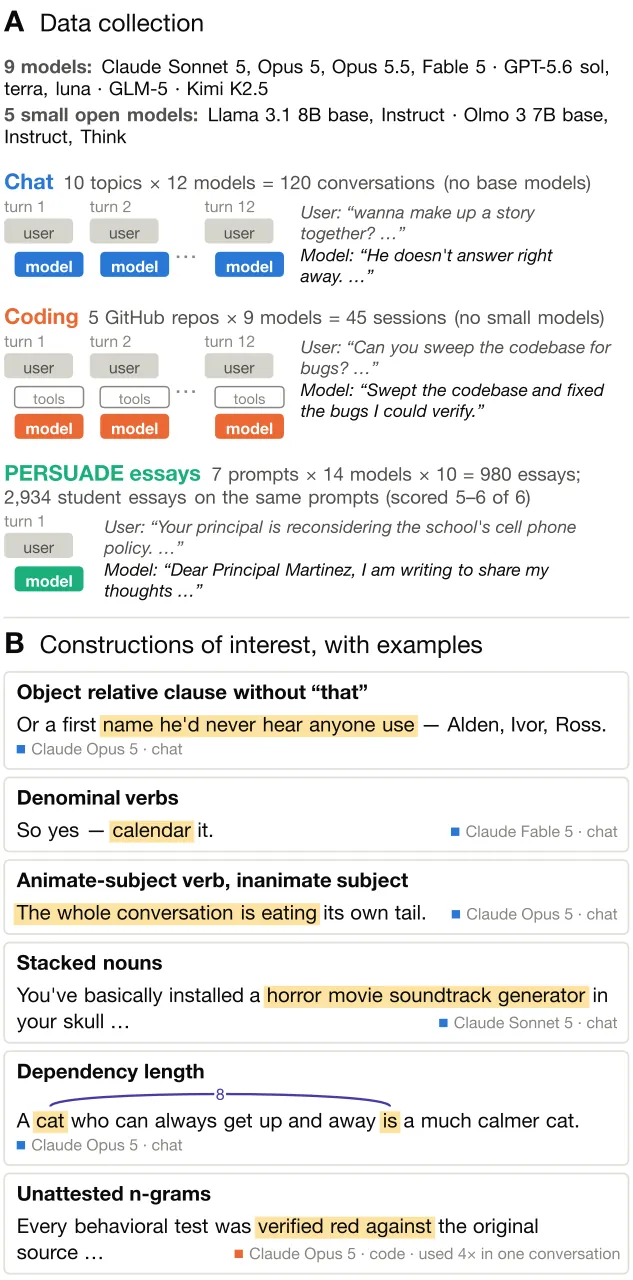
Figure 1: The paper’s study design. The upper panel summarizes the 14 models and three collection settings, while the lower panel shows overlapping constructions in an example model reply: a reduced object relative, a denominal verb, an inanimate subject, and a low-frequency noun stack.
What the observational corpus shows
The first result supports H1, with important variation by model and setting. Across all three settings and nearly all frontier or near-frontier models, round-trip translation reduces the rate of unattested bigrams and lowers trigram perplexity. Most frontier models show the same direction for denominal verbs, inanimate subjects, and object relatives without a relativizer. Conversely, object relatives with an overt relativizer become more frequent after the round trip. That opposite movement is consistent with a preference for omitting an optional word.
Against human baselines, all nine frontier or near-frontier models use more low-frequency n-grams and more inanimate subjects with animate-selecting verbs. Most also exhibit longer dependencies, more stacked noun compounds, and more reduced object relatives in chat. Coding follows a similar direction. Essay effects are smaller on several measures, which the authors tentatively attribute to the absence of repeated turns and accumulated conversational context.
The model-family comparison is more informative than a single average. Llama 3.1 8B base and Instruct and Olmo 3 7B base and Instruct change least under round-trip translation and are closest to the student-essay measures. Olmo 3 7B Think, however, resembles the frontier models. This pattern weakens a simple “larger model is always less human-like” explanation: a reasoning post-training stage can move a relatively small model far along the same axis.
Claude Opus 5.5 provides a second useful contrast. The paper reports lower values than Opus 5 on 19 of 21 model-by-setting comparisons for difficulty-linked measures, with eight comparisons having non-overlapping 95% intervals. This does not prove that every Opus 5.5 response is easier for every reader. It does show that the observed profile is not an unavoidable consequence of greater capability. A newer system can move in the opposite direction, which makes post-training and evaluation choices plausible intervention points.
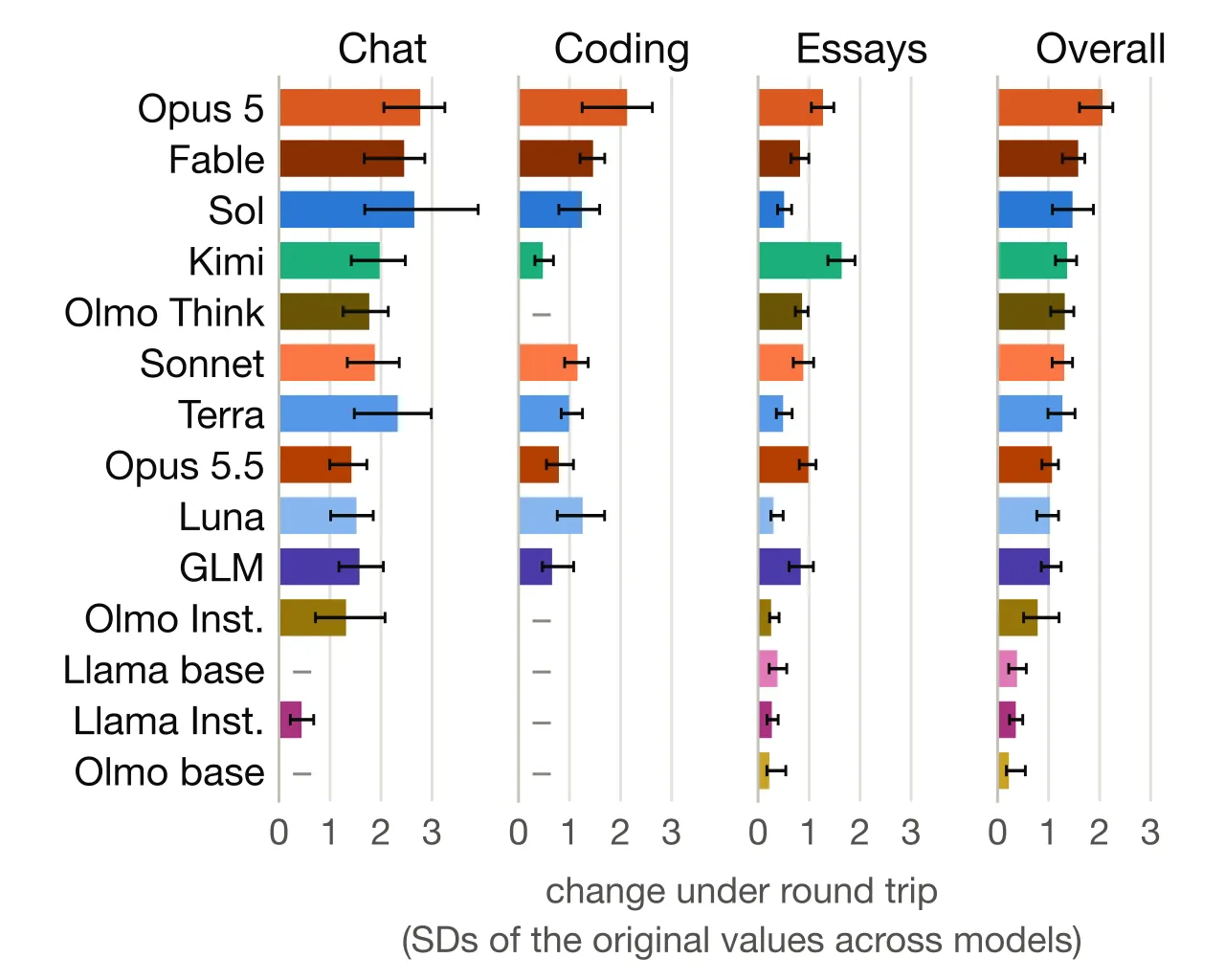
Figure 2: Change under English-to-Japanese-to-English translation, grouped by model and setting. Bars are 95% bootstrap intervals. Most frontier models show the largest reductions in processing-cost features, while several smaller open models remain close to the human paraphrase profile.
Figure 3 separates two questions that are easy to blur: whether model text differs from human text, and whether it differs from a semantically matched paraphrase. A model can be close to one human corpus on one measure while still showing a clear within-item shift after round-trip translation. The paper uses the combination to argue that the characteristic profile is not merely a property of the requested topic or genre.
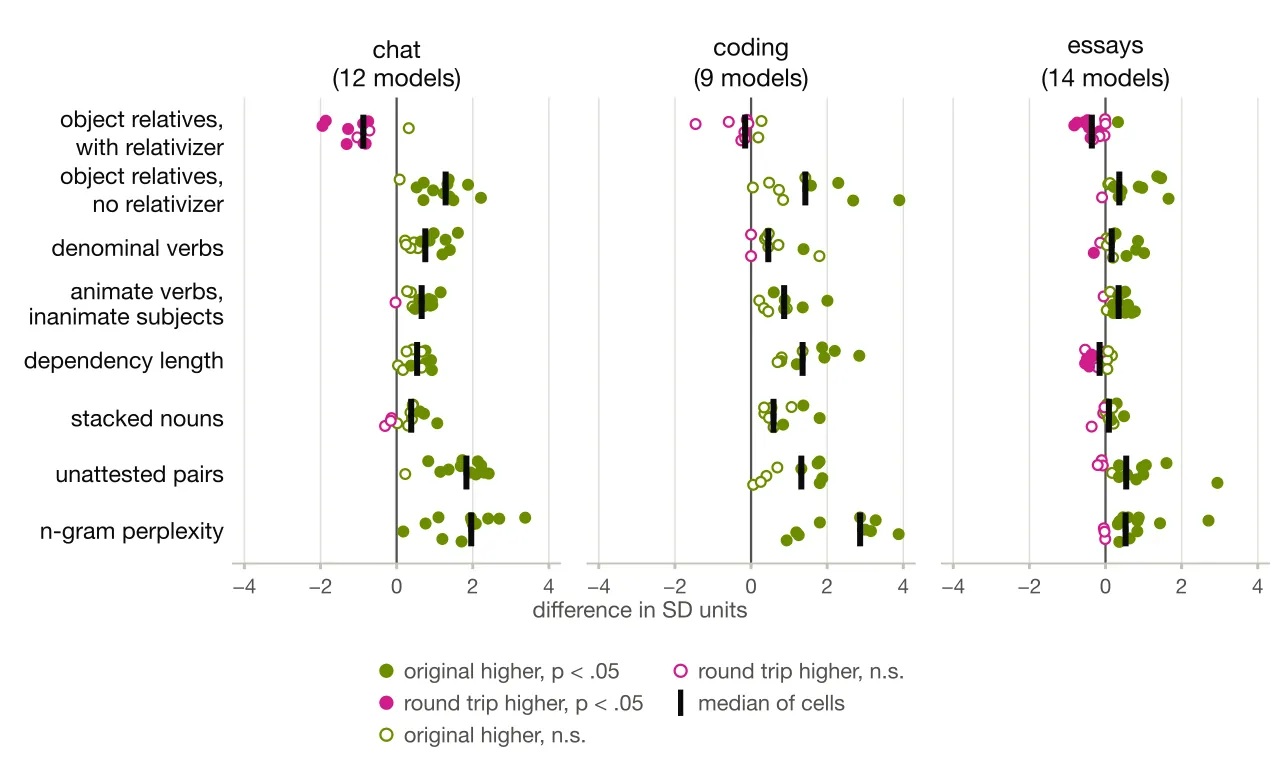
Figure 3a: Feature changes across chat, coding, and essay settings. Filled points mark significant differences, hollow points non-significant ones, and the right column summarizes medians across model-setting cells.
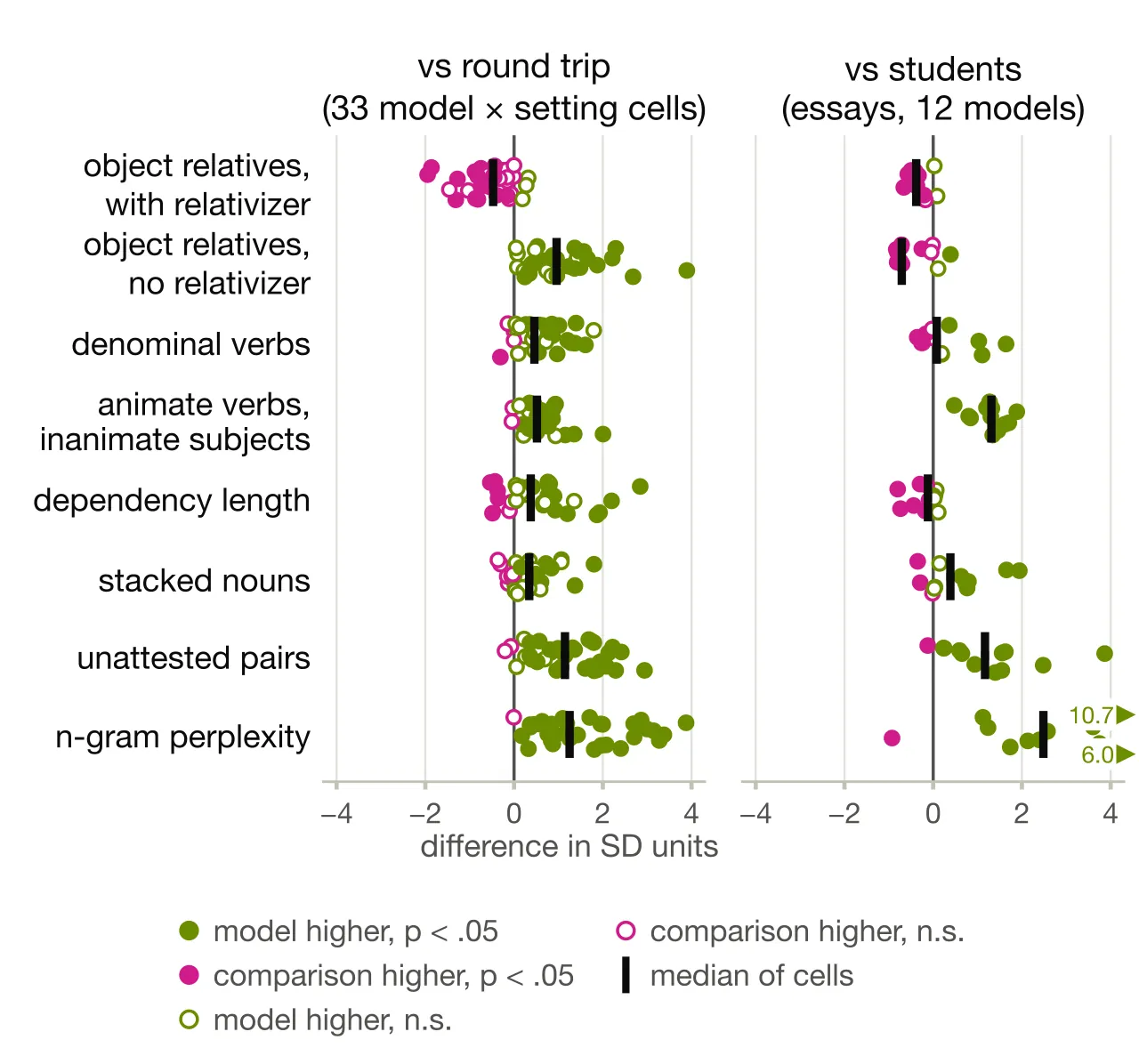
Figure 3b: Models compared with human student essays. The strongest shared departures are low-frequency n-grams, denominal verbs, and inanimate subjects, but the size and even direction of some other differences vary by model.
| Evidence layer | Scale | Purpose |
|---|---|---|
| Chat | 12 models, 10 topics, 120 conversations, 1,428 replies | Multi-turn everyday interaction |
| Coding | 9 frontier models, 5 repositories, 45 agentic sessions | Long tool-use and code-review interaction |
| Model essays | 14 models, 7 prompts, 10 essays per pair, 980 essays | Single-turn persuasive writing |
| Human essay baseline | 2,934 PERSUADE 2.0 essays scored 5 or 6 | Prompt-matched human comparison |
| Paraphrase control | NLLB-200 3.3B, English to Japanese to English | Hold semantics roughly fixed while changing form |
Table 1: Exact evidence scale from Sections 3 and A. Discarded API attempts are not included in the analyzed corpus.
Why compression can become an intelligibility problem
The proposed mechanism is not that brevity is inherently bad. It is that maximum information density conflicts with uniform information density. Human speakers often distribute information more evenly, adding a cue where the comprehender is likely to need it. A model rewarded only for solving a task can remove those cues whenever the validator accepts the shorter solution. The resulting sentence may be optimal for a token budget and still be worse for a person who has to parse it incrementally.
This becomes more consequential in long contexts. A single omitted cue may cost little, but repeated compression can make an entire explanation harder to audit. It can also hide whether the model reached the right answer through a valid process or merely produced the expected final string. The paper’s concern therefore connects readability to monitorability: a language that is efficient for the model but opaque to humans weakens the human’s ability to check plans, code changes, and reasoning traces.
The evidence is proxy-based. The paper measures constructions associated with reading difficulty in prior psycholinguistics, but it does not run a large human reading-time or comprehension experiment on these exact outputs. The defensible conclusion is that models over-select known cost-bearing constructions, not that every such construction caused measurable misunderstanding in every context. Direct user studies are the next step, especially with domain experts who must audit code and agent behavior.
A causal proof of concept with length-penalized GRPO
Experiment 2 replaces speculation about post-training with a controlled intervention. The base model is Qwen2.5-1.5B-Instruct. It converts structured event descriptions into English sentences. Every event admits at least one syntactic alternation in which the two versions are both valid but one uses fewer tokens. Training includes dative, object-relative, complement-clause, and same-length particle-order items. Held-out near-transfer items involve the optional word “that” in `sure that` and `so that`. Far-transfer items include genitive, quantifier, passive, and purpose-clause alternations that are never targeted during training.
| Alternation | Short form | Long form | Tokens saved | Role |
|---|---|---|---|---|
| Dative | gave his wife a gift | gave a gift to his wife | 1 | Trained |
| Object relative | the book the professor wrote | the book that the professor wrote | 1 | Trained |
| Complement clause | knew the answer was wrong | knew that the answer was wrong | 1 | Trained |
| Particle control | picked up the book | picked the book up | 0 | Length control |
| Passive | a falling branch hit it | it was hit by a falling branch | usually 2 | Far transfer |
| Genitive | noticed the old house’s roof | noticed the roof of the old house | 1 | Far transfer |
| Purpose clause | left early to catch the train | left early in order to catch the train | 2 | Far transfer |
Table 2: Alternations from the paper’s Table 3. The passive saves two tokens for 132 of 150 items, three for 15 items, and one for three items.
The optimization objective combines a task reward with a KL penalty against a reference policy:
$$J(\theta)=\mathbb{E}_{x,y\sim\pi_\theta}\left[R(x,y)-\beta\operatorname{KL}\!\left(\pi_\theta(y\mid x)\,\|\,\pi_{\mathrm{ref}}(y\mid x)\right)\right]$$For a fixed reward, the regularized optimum has a closed-form reweighting interpretation:
$$\pi^{*}(y\mid x)=\frac{1}{Z(x)}\pi_{\mathrm{ref}}(y\mid x)\exp\!\left(\frac{R(x,y)}{\beta}\right)$$If a short alternative saves $\Delta$ tokens and receives the same correctness and format reward, the predicted log-odds shift is:
$$\log\frac{\pi^{*}(s\mid x)}{\pi^{*}(l\mid x)}=\log\frac{\pi_{\mathrm{ref}}(s\mid x)}{\pi_{\mathrm{ref}}(l\mid x)}+\frac{\lambda\Delta}{\beta}$$This equation explains why either increasing the length penalty $\lambda$ or decreasing the KL coefficient $\beta$ should favor the short alternative. It also predicts that the same preference may cross from trained to unfamiliar alternations if the model learns a general compression policy rather than memorizing individual templates.
The reward used in training is:
$$R(x,y)=c(x,y)f(y)-\lambda|y|$$Here $c(x,y)$ is correctness, $f(y)$ is a format check, and $|y|$ is completion length. GRPO then samples a group of completions and uses the group mean as the baseline:
$$A_i=R_i-\frac{1}{G}\sum_{j=1}^{G}R_j$$The sequence objective and per-token clipped update are:
$$\mathcal{L}(\theta)=-\frac{1}{NL_{\max}}\sum_{i=1}^{N}\sum_{t=1}^{|y_i|}\ell_{i,t}$$ $$\ell_{i,t}=w_i\min\!\left(\rho_{i,t}A_i,\operatorname{clip}(\rho_{i,t},1-\epsilon,1+\epsilon)A_i\right)-\beta k_{i,t}$$The training setup uses LoRA rank 16 and scaling 32 on every linear layer. The run lasts 500 steps over 4,000 prompts, including 3,750 distinct prompts. Each step samples eight prompts and 16 completions per prompt, for 128 completions, with a maximum completion length of 64 tokens. The grid is $\lambda\in\{0,0.01,0.03,0.1\}$, $\beta\in\{0,0.04\}$, and seeds 0, 1, and 2, yielding 24 runs and about 31 GPU-hours on one NVIDIA L40S.
flowchart LR
  A["Qwen2.5-1.5B-Instruct"] --> B["Sample 16 GRPO completions"]
  B --> C["Correctness and format reward"]
  C --> D["Subtract per-token length penalty"]
  D --> E["Group-mean advantage and policy update"]
  E --> F["Trained alternations
dative object relative complement"]
  E --> G["Near transfer
sure that and so that"]
  E --> H["Far transfer
genitive passive purpose quantifier"]
  F --> I["Short-form selection rate"]
  G --> J["Unseen context preference"]
  H --> K["Evidence for general compression"]
Figure 4: The paper-specific causal chain. The prompt never explains the alternations or asks for compression. Only the reward changes, so a shift in grammar is an emergent response to the length cost.
Results: a simple penalty produces a categorical shift
The clearest result occurs without KL regularization. When the length penalty is zero, different seeds select the short alternative at rates ranging from 0% to 100%, meaning no stable preference. Every positive length penalty makes all seeds converge to a near-categorical preference. For both trained “that” alternations, the short variant is chosen more than 98% of the time at every positive penalty. That is very different from human speakers, who vary the choice with predictability, discourse, and processing context.
With KL regularization, the probability of the short form still rises as the penalty increases, but the slope is gentler. This fits the closed-form intuition: the reference model restricts how far the policy can move for a given reward difference. The experiment therefore demonstrates both a main effect and a controllable tradeoff between task reward, compression, and distributional drift.
Near transfer is consistent. The model also drops optional “that” in `sure that` and `so that`, even though those exact contexts were not trained. Far transfer is much weaker. Of four unrelated alternations, only the genitive shifts with the length penalty, and only without KL. Passive and purpose clauses do not move, while the quantifier alternation is already near ceiling in the base model. Reporting this boundary is important: the result supports a transferable compression preference, but not an unrestricted claim that a token penalty rewrites all of English syntax.
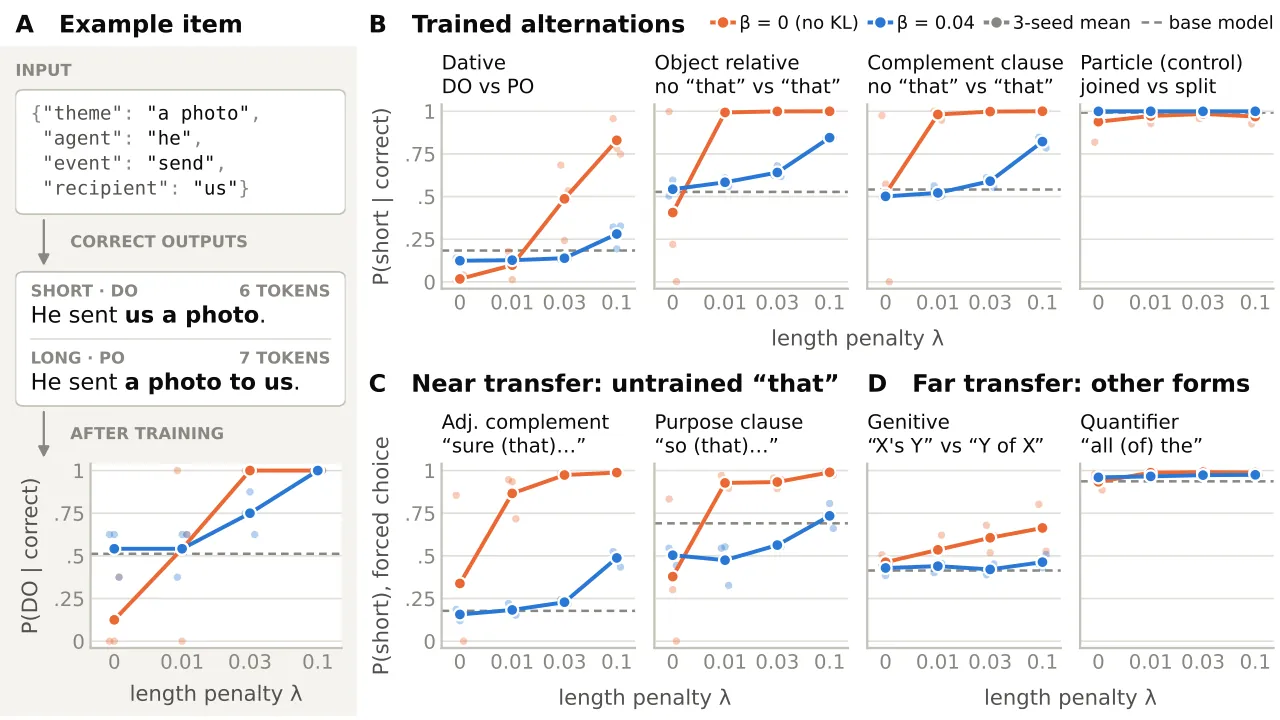
Figure 5: Core intervention result. Panel A gives an event and its two valid realizations. Panel B shows the share of correct unseen outputs using the short form. Panels C and D show forced-choice probabilities. Orange is no KL, blue is $\beta=0.04$, and faint lines are individual seeds.
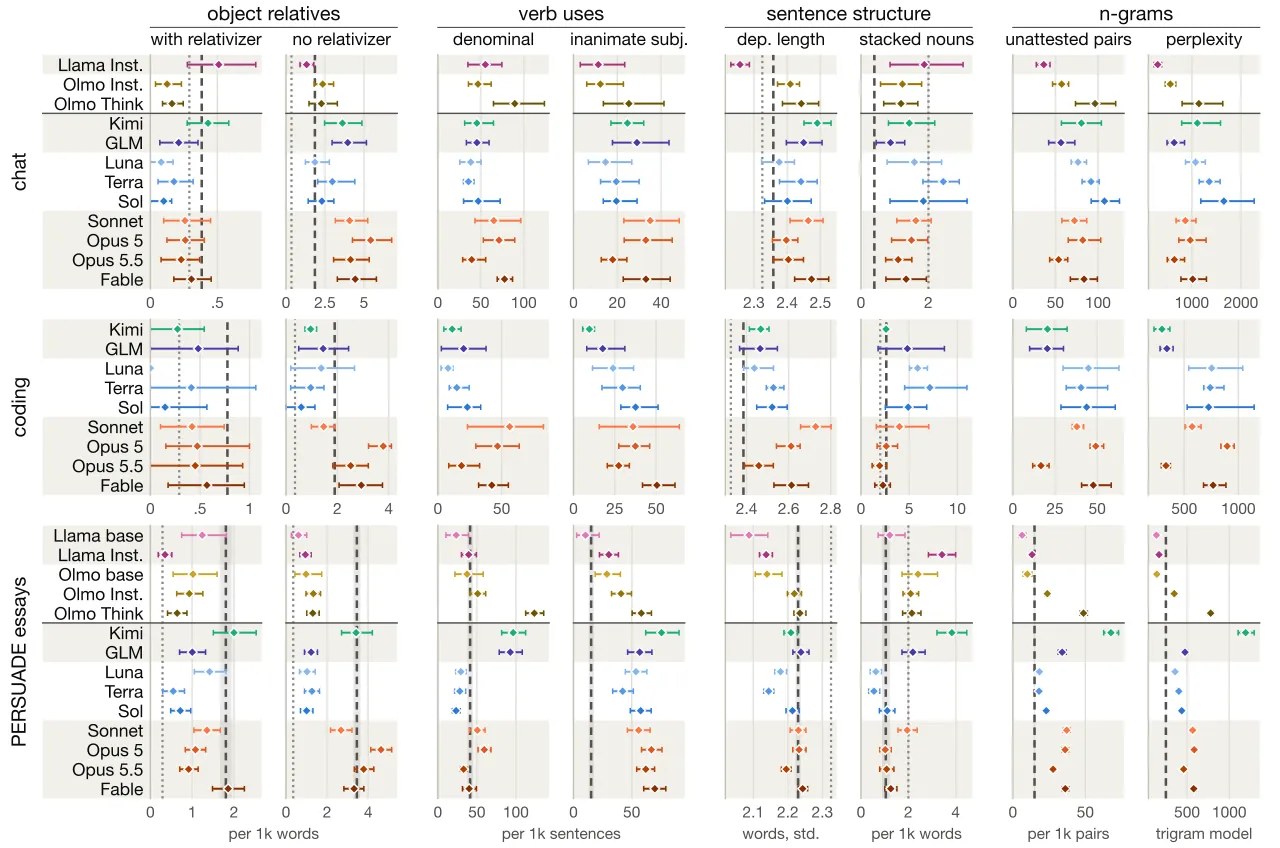
Figure 6: Human-baseline detail. Dashed lines denote OpenSubtitles for chat, StackExchange for coding, and student essays for essay prompts; the dotted line is Wikipedia. The figure prevents a single “model versus human” summary from hiding large feature-specific differences.
| Configuration | Value in the paper |
|---|---|
| Base and adapter | Qwen2.5-1.5B-Instruct; LoRA rank 16, alpha 32 |
| Training | 500 steps; 4,000 prompts; 3,750 distinct prompts |
| Sampling | 8 prompts per step, group size 16, 128 completions per step, max 64 tokens |
| Grid | $\lambda\in\{0,0.01,0.03,0.1\}$; $\beta\in\{0,0.04\}$; three seeds |
| Compute | 24 runs; one NVIDIA L40S; approximately 31 GPU-hours |
| Collection cost | USD 211.78 for analyzed runs; USD 251.19 including discarded, pilot, and verification runs |
Table 3: Training configuration and cost, drawn from Tables 1 and 4 and Appendices A and C.
What the paper establishes, and what it does not
The first contribution is measurement. The work converts a broad complaint about AI style into a set of falsifiable measures and compares them across model families, domains, human references, and semantically matched paraphrases. It shows that some processing-cost features are pervasive enough to be a system-level property rather than an isolated prompt artifact.
The second contribution is mechanism. The length-penalty experiment demonstrates that a minimal reward change can alter grammatical choice without any instruction to compress or any explicit mention of the target alternations. That makes information density a credible causal ingredient. It does not show that RLVR is the only cause of every observed frontier-model behavior, nor that a commercial system’s post-training pipeline contains this exact penalty.
The third contribution is a path to mitigation. Opus 5.5’s lower values relative to Opus 5 suggest that model development can move toward more human-like processing demands. The broader implication is that communication quality can be evaluated and optimized directly, for example with reader comprehension, explanation faithfulness, monitorability, or human feedback on clarity. A model should not have to choose between task success and understandable communication merely because the reward sees only one of them.
For robotics and embodied AI, the connection is indirect but practical. Natural language is used for operator instructions, progress reports, failure explanations, code review, and tool traces. A compressed construction that saves tokens may still create extra human verification work. The paper does not test robot policies or embodied models, so its findings should not be presented as direct evidence of unsafe robot behavior. They do identify a human-factors axis that embodied-agent evaluations should include when language is part of the control or audit loop.
Limitations
The authors explicitly state that they examine only a subset of commonly used models, analyze only English, and use a limited number of conversation seeds and repositories. Replication across more topics, codebases, model families, languages, and repeated sampling runs is necessary. Provider models can also change behind an API name, so the exact model ordering should be treated as a snapshot rather than a permanent benchmark.
The authors also acknowledge a causal-identification limit. The ideal study would intervene throughout the proprietary post-training process of frontier models, but that is infeasible at scale. The paper therefore relies on observational evidence plus a small open-model proxy. The intervention strongly supports the possibility of the proposed mechanism, but it does not reconstruct the training history of each closed model.
A third limitation concerns measurement validity. The chosen features have established associations with human processing difficulty, but they are not direct comprehension outcomes. A follow-up should measure reading times, eye movements, comprehension questions, recall, and task completion with representative readers. Round-trip translation can also alter content and style, so statistical control of semantic equivalence remains imperfect.
The proof-of-concept also has finite scope. One 1.5B-parameter model, one structured event-to-sentence task, four trained alternations, 500 optimization steps, and a 64-token completion ceiling cannot cover long-form explanations or realistic agent trajectories. The near transfer is encouraging, while the weak far transfer sets a useful boundary. More work is needed to estimate how quickly a compression preference accumulates in multi-turn, tool-using, or long-context training.
The scene-level explanation is another place for caution. The paper suggests that larger effects in chat and coding may come from repeated turns and accumulated compression pressure. Those settings also differ in prompts, simulated users, output lengths, and tool availability. The corpus is therefore stronger evidence for a cross-domain phenomenon than for a precise estimate that isolates number of turns as the cause.
Conclusion
The paper’s defensible conclusion is conditional and consequential: when a model is rewarded for correct, compact task behavior without a corresponding reward for human understanding, it can reliably choose legal constructions that increase psycholinguistic processing cost. Fourteen models provide evidence that this pattern is widespread, and the GRPO experiment demonstrates that a minimal token penalty can produce a near-categorical grammatical preference, including some transfer to unseen contexts.
Readability is therefore not a cosmetic layer added after capability. It is part of the objective that determines which valid explanations and plans a model will prefer. For systems whose language must be audited by people, comprehension and monitorability belong in training and evaluation alongside correctness.
Paper quotation: “For frontier LLMs, the training objectives that make them successful at tasks like agentic coding and mathematical reasoning, especially with long and expensive context windows, are not guaranteed to be aligned with the same pressures that influence human language.”
SOURCE LINKS