PAPER DEEP DIVE
ECHO: In-Context Behavior foundation model for Humanoid Whole-Body Control
Humanoid behavior foundation models (BFMs) acquire diverse skills through large-scale motion imitation and massively parallel reinforcement learning, yet broad behavioral capability does not ensure precise execution across physical conditions. Without distinguishing the underlying dynamics, policies may favor conservative compromises over environment-specific precision. We introduce ECHO, an in-context BFM that turns interaction experience into environment-specific control, separating general behavioral capability from dynamics-specific execution. Mixed and Annealed Sampling first establishes a behavior prior in a single pretraining stage by balancing targeted practice with broad motion coverage. Building on this prior, Context Representation and Residual Adaptation learns structured dynamics representations from interaction histories to guide residual corrections to the frozen prior, enabling adaptation without test-time parameter updates. Extensive experiments show that ECHO outperforms all baseline methods across diverse motions and physical conditions. Moreover, deployment on the Unitree G1 demonstrates whole-body teleoperation spanning extreme acrobatics and terrain interaction, alongside payload adaptation in manipulation and whole-body control. Page is available at https://mwondering.github.io/echo-bfm/
One-Sentence Summary
ECHO separates broad humanoid competence from environment-specific precision: Mixed and Annealed Sampling builds one versatile whole-body prior, while Context Representation and Residual Adaptation infer hidden dynamics from interaction history and correct the frozen prior without test-time parameter updates.
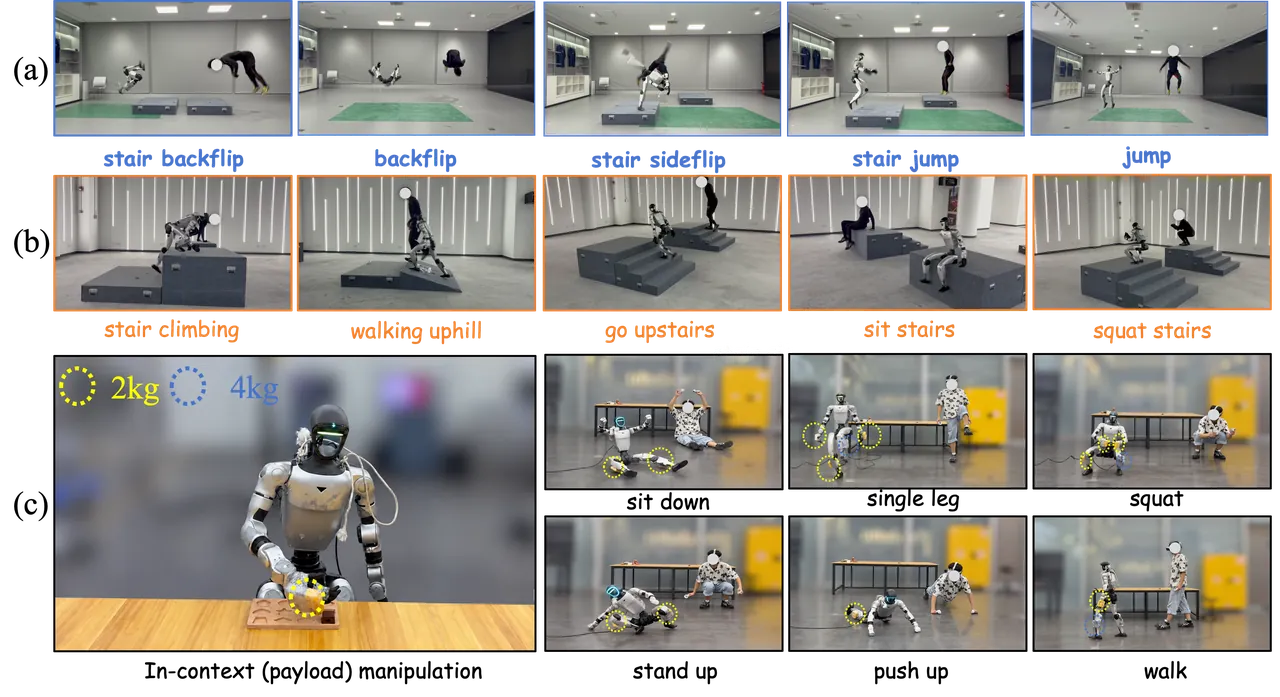
Figure 1: Overview of ECHO. One behavioral prior supports extreme acrobatics and terrain interaction, while interaction-derived context changes control under payloads in manipulation and whole-body tasks.
Motivation
Humanoid behavior foundation models have made substantial progress by treating large-scale motion imitation as a proxy for general control. A single policy can learn to walk, crawl, dance, climb, recover from the floor, and reproduce highly dynamic reference motions. Success in this setting is usually measured by trajectory tracking, but tracking accuracy depends on both the reference and the physical system that executes it. The same commanded pose can require different torques when the feet encounter lower friction, the hands carry a load, or the joints respond differently because of armature and actuator variation.
Standard domain randomization addresses this mismatch by exposing training to many physical conditions. The resulting policy is robust, yet it can also become a compromise. A controller trained across several friction levels may choose a gait that is safe everywhere rather than precise anywhere. A controller trained with variable payloads may learn a generic conservative response instead of inferring whether the current mass is concentrated at the torso, wrist, or shin. Broad coverage solves the question of what actions are possible, but not the question of how the current action should be executed.
The paper argues that the missing signal is already available in the robot's experience. When a foot touches the ground, the next few proprioceptive states encode how quickly forward velocity decays. When a wrist payload moves the center of mass, identical joint targets produce a different body response. A fixed physical configuration therefore leaves a temporary signature in the sequence of actions and state transitions. The control problem is to compress that sequence into a latent estimate useful for the next commands.
This framing leads to a deliberate division of labor. A pretrained prior supplies the behavioral repertoire. A context encoder identifies the physical situation from observable history. A residual actor makes small changes to the prior action. The prior and encoder can remain frozen while the residual policy learns how to use context. During deployment, no weights are updated; adaptation occurs because the history and latent change as the robot interacts with its environment.
The practical motivation is equally important. ECHO is trained and deployed on a Unitree G1 using more than 1,200 hours of filtered motion data. Retraining the entire behavior model whenever an object is attached would be impractical. The proposed system instead aims to keep the same motion interface and let an internal dynamics estimate adjust execution within a session.
Problem Formulation
The paper models control under changing physical conditions as a family of Markov decision processes indexed by an environmental configuration $c$. The configuration may include mass distribution, foot friction, payloads, and actuator properties, but it is not directly observed at deployment. The process is written as:
$$ \mathcal{M}_{c}=\langle\mathcal{S},\mathcal{A},\mathcal{T}_{c},\mathcal{R},\gamma\rangle. $$
Let $s_t^{p}$ denote noisy proprioception and $m_t$ the reference-motion target. A conventional behavior foundation model computes $\pi(a_t\mid s_t^{p},m_t)$ with one mapping shared across all dynamics. ECHO introduces a context variable $z_t$, producing $\pi(a_t\mid s_t^{p},m_t,z_t)$. The evidence for $z_t$ is the history of completed states and actions:
$$ \mathcal{H}_{t}\triangleq\left(s_{0}^{p},a_{0},s_{1}^{p},a_{1},\ldots,s_{t-1}^{p},a_{t-1},s_{t}^{p}\right). $$
The encoder is intended to recover a control-relevant representation of the hidden configuration:
$$ z_{t}=E_{\varphi}(\mathcal{H}_{t})\approx z_{c}\triangleq g(c). $$
This is not a claim that the encoder identifies every physical parameter exactly. The latent needs to preserve differences that change future control, such as where mass was added, whether the foot is slipping, or whether the body responds more slowly to a joint command. With the environment sampled from $p(c)$, the policy objective is:
$$ \max_{\pi}\;\mathbb{E}_{\substack{c\sim p(c)\\\tau\sim p_{\pi}(\tau\mid c)}}\left[\sum_{t=0}^{T-1}\gamma^{t}r_{t}\right]. $$
The difficulty is that deployment provides neither $c$ nor gradients for adaptation. The policy must transform past transitions into future action changes. The history is therefore not an auxiliary replay buffer; it is the only observation channel for system identity.
Method
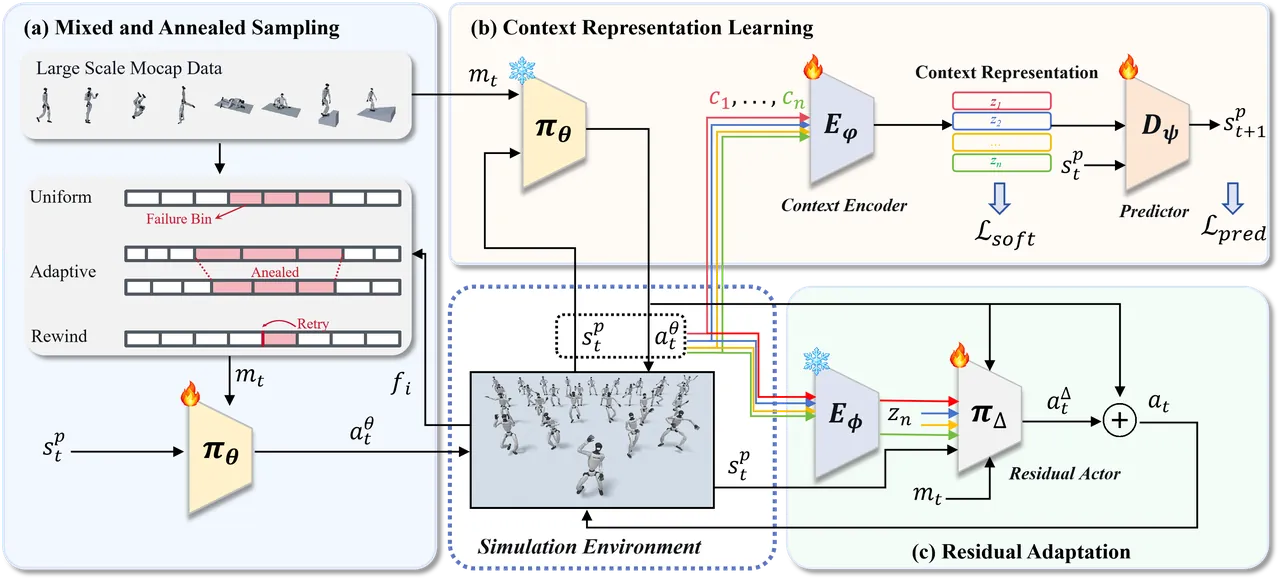
Figure 2: Method overview. MIAS trains the behavioral prior; the context encoder learns from dynamics prediction and physical-neighborhood alignment; the residual actor converts context into corrections.
ECHO-PRE: one prior for four capability families
The first stage trains the behavior prior ECHO-PRE on motion tracking. The paper requires a single policy to cover everyday motion, high-dynamic skills, contact-rich floor behavior, and terrain interaction. This requirement matters because the later residual adapter should inherit a broad base rather than a collection of isolated experts.
The filtered training corpus contains 220,560 sequences and approximately 222.46 million frames. At 50 frames per second, this equals 1,235.88 hours. MotionDecode contributes 953.17 hours, BONES-SEED contributes 260.85 hours, 100STYLE contributes 18.63 hours, and LAFAN1 contributes 2.52 hours. Flat-ground and terrain augmentation subsets add 75,158 and 51,765 frames. AMASS is deliberately excluded, making the later AMASS-2000-Random benchmark an out-of-distribution test of unseen everyday motions.
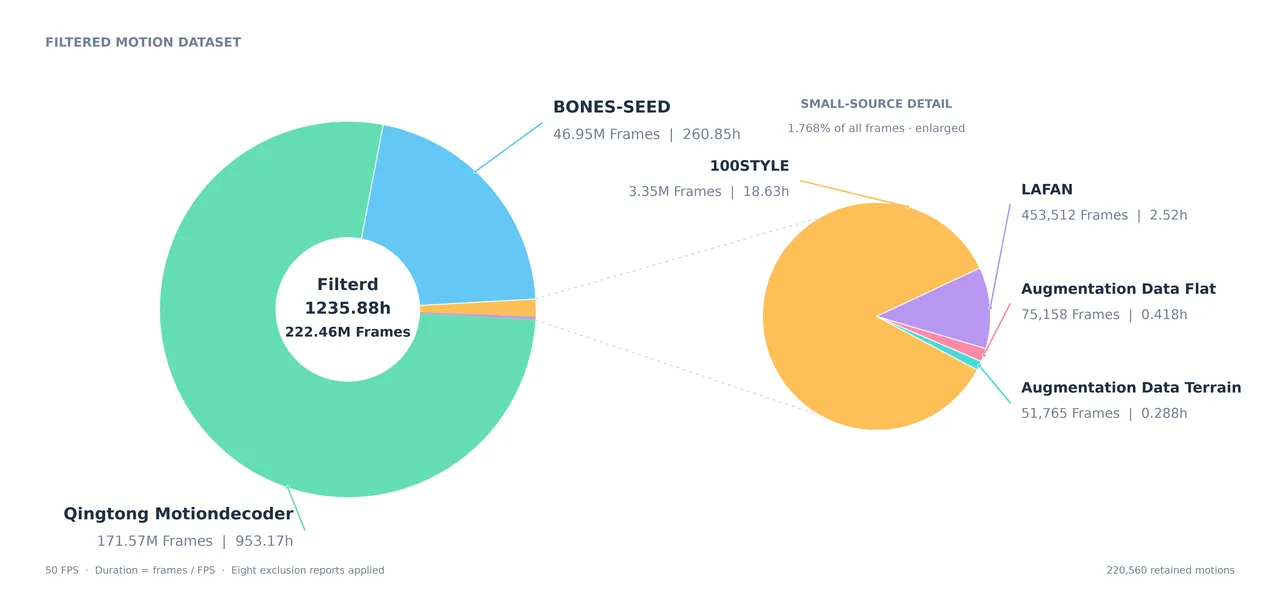
Figure 5: Composition of the filtered training corpus. The left chart uses frame counts by source, while the right chart expands the smaller contributors. All values refer to retained data after filtering.
MIAS: balance targeted repair with repertoire coverage
Uniform action sampling is poorly matched to long motion clips with short critical phases. A flip may be determined by a small number of frames, yet those frames form a tiny fraction of the corpus. Replaying failures can increase practice on these phases, but a sampler that follows failure forever will reduce diversity and overfit the latest weak segment.
MIAS combines failure rewind, uniform sampling, and failure-adaptive sampling. It partitions reference motion into temporal bins and tracks the empirical failure rate $f_i$ and valid frame count $\ell_i$. A preliminary concentration on failed bins is:
$$ \widetilde{p}_{i}\propto \ell_{i}\exp(f_{i}/T)\,\mathbf{1}\{f_{i}>0\}. $$
The probability mass is capped and redistributed at both the bin and motion levels. This prevents one difficult motion from occupying most of the batch and creates the adaptive distribution $\mathcal{P}_{\mathrm{A}}$. The complete sampler mixes rewind $\mathcal{P}_{\mathrm{R}}$, uniform $\mathcal{P}_{\mathrm{U}}$, and adaptive $\mathcal{P}_{\mathrm{A}}$ sampling. Let $d\in\{0,1\}$ indicate whether the preceding trajectory failed:
$$ \mathcal{P}_{d}=d\rho_{\mathrm{R}}\mathcal{P}_{\mathrm{R}} +(1-d\rho_{\mathrm{R}})\left[\rho_{\mathrm{U}}\mathcal{P}_{\mathrm{U}} +(1-\rho_{\mathrm{U}})\mathcal{P}_{\mathrm{A}}\right]. $$
The appendix sets $\rho_{\mathrm{R}}=1/3$ and $\rho_{\mathrm{U}}=1/2$. After a tracking failure, rewind, uniform, and adaptive branches each receive one third of the probability. After normal completion or timeout, rewind is disabled and uniform and adaptive sampling each receive one half. A failure is therefore repaired without making the sampler blind to unrelated motions.
The second control is annealing. Temperature $T$ and probability cap $C$ follow a cosine schedule:
$$ \theta_{k}=\mathcal{A}\!\left(k;\theta_{\mathrm{start}},\theta_{\mathrm{end}},K_{\theta}\right), \qquad \theta\in\{T,C\}. $$
As training proceeds, higher temperature flattens the adaptive distribution and a lower cap returns mass to more motion bins. ECHO-PRE first concentrates practice where the policy fails, then broadens coverage as competence improves. This is the mechanism that lets one pretraining stage produce both high-dynamic specialization and general motion coverage.
CRA stage one: memory for recent and session-level evidence
Once ECHO-PRE is frozen, CRA collects rollouts from the prior and learns a context encoder. The history is split into a short-term component and a long-term component:
$$ \mathcal{H}_{t}=(\mathcal{S}_{t},\mathcal{M}_{t}), \qquad z_{t}=E_{\varphi}(\mathcal{H}_{t}). $$
The short-term history $\mathcal{S}_{t}$ captures fine-grained recent responses. It is cleared when the reference motion changes or an episode resets. The long-term memory $\mathcal{M}_{t}$ stores completed chunks and survives motion changes and episode resets within the same physical session. Consequently, evidence that the right shin is heavier can carry from one motion to the next. A new physical session clears everything.
The encoder produces a 64-dimensional latent from at most 350 completed interactions. The short history is one second, or 50 control steps, while the long-term component aggregates earlier chunks into a fixed-size representation. The memory therefore separates rapid response from persistent system identity without allowing the encoder input to grow without bound.
CRA stage two: prediction makes the latent physically useful
Environment classification alone can be misleading. Two contexts can be easy to separate while containing little information about how the body will react. ECHO therefore trains a forward predictor with the encoder. The target $y_t$ contains privileged robot state, foot kinematics, contact forces, and binary contact indicators. Conditioned on a context fixed over the horizon, the predictor estimates future outcomes:
$$ \hat{y}_{t+k}=D_{\psi}\!\left(\mathcal{H}_{t+k-1},a_{t+k-1};z_{t}\right). $$
The predictor rolls its input history forward with recorded states or model predictions, while the applied target sequence is used as input. Its objective averages prediction error over $K_{\mathrm{p}}$ steps:
$$ \mathcal{L}_{\mathrm{pred}}=\mathbb{E}\left[ \frac{1}{K_{\mathrm{p}}}\sum_{k=1}^{K_{\mathrm{p}}} \ell_{\mathrm{pred}}(\hat{y}_{t+k},y_{t+k})\right]. $$
If two environments produce different future contact forces under the same action, the context must encode something that explains the difference. The privileged labels are used only during training. At deployment the encoder sees history alone, and the predictor is discarded.
CRA stage three: preserve physical neighborhoods across motions
Prediction can create clusters whose geometry does not reflect physical similarity. To address this, ECHO aligns neighborhoods in context space, denoted $P$, with neighborhoods in physical-parameter space, denoted $Q$:
$$ \mathcal{L}_{\mathrm{soft}} =\frac{1}{n}\sum_{i=1}^{n} D_{\mathrm{KL}}\!\left(Q_{i:}\,\|\,P_{i:}\right). $$
The encoder and predictor optimize the combined objective:
$$ \mathcal{L}_{\mathrm{ctx}} =\mathcal{L}_{\mathrm{pred}}+\mathcal{L}_{\mathrm{soft}}. $$
The two terms are complementary. Prediction asks the latent to explain future dynamics. Soft alignment asks physically nearby systems to remain neighbors even when their reference motions differ. An ablation later separates these roles: removing the predictor preserves much of environment classification but destroys the linear readability of friction, while removing soft alignment weakens cross-motion retrieval and separation.
Residual adaptation without test-time weights updates
After context learning, both the encoder and ECHO-PRE are frozen. A residual actor receives proprioception, the motion target, the latent context, and the prior action. The final command is:
$$ a_{t}^{\theta}=\pi_{\theta}(s_{t}^{p}),\quad a_{t}^{\Delta}=\pi_{\Delta}(s_{t}^{p},m_{t},z_{t},a_{t}^{\theta}),\quad a_{t}=a_{t}^{\theta}+a_{t}^{\Delta}. $$
Freezing the prior protects broad behavioral competence from being overwritten by a narrow adaptation dataset. The residual actor also has a smaller learning problem: instead of rediscovering a whole-body skill, it learns how the current environment should shift an already reasonable command. At deployment the predictor is absent. The loop is action, new transition, updated context, residual correction.
flowchart LR
    DATA[Filtered motion corpus] --> PRE[Pretrain ECHO-PRE]
    PRE --> MIAS[MIAS sampling]
    MIAS --> PRE
    PRE --> ROLL[Frozen prior rollouts]
    ROLL --> ST[Short-term history]
    ROLL --> MT[Session long-term memory]
    ST --> ENC[Context encoder]
    MT --> ENC
    ENC --> LAT[64-d dynamics latent]
    LAT --> PRED[Forward predictor]
    PRED --> LOSS1[Multi-step prediction objective]
    LAT --> SOFT[Physical neighborhood alignment]
    SOFT --> LOSS2[KL neighborhood objective]
    LOSS1 --> ENC
    LOSS2 --> ENC
    LAT --> RES[Residual actor]
    PRE --> RES
    RES --> CMD[Prior action plus residual]
    CMD --> WORLD[Hidden physical dynamics]
    WORLD --> ST
    WORLD --> MT
The diagram reflects the paper's actual dependencies. MIAS is confined to pretraining. Prediction and soft alignment train the encoder. The residual actor is trained after the encoder and prior are frozen. The predictor has no role in deployment.
Experimental Design
All experiments use the Unitree G1. Training uses PPO in Mjlab. The nominal environment has foot friction 0.6, no added payload, and no external perturbation. Necessary Domain Randomization varies torso mass and center of mass, foot friction, controller gains, joint armature, and intermittent external forces. Heavy Domain Randomization extends this range with payloads on all four limbs.
HDR samples 0 to 2.5 kg per hand and 0 to 4.0 kg per shin, for at most 13 kg in total. Foot friction spans 0.3 to 2.0, torso center of mass shifts by up to 7.5 cm per axis, payload center of mass shifts by another 5 cm per axis, and payload inertia is recomputed. ECHO-N and ECHO-H start from the same frozen ECHO-PRE but train CRA under NDR and HDR respectively.
Motion tracking is evaluated on AMASS-2000-Random and BONES-SEED-100-HighDynamic. AMASS is excluded from training and tests generalization to 2,000 unseen everyday motions. The high-dynamic set contains 33 ground-interaction, 33 extreme, and 34 dance motions from the training distribution. Metrics are success rate, global MPJPE, root-relative MPJPE, acceleration error, and velocity error.
Results
MIAS changes the high-dynamic failure profile
| Method | AMASS success rate | AMASS g-MPJPE / mm | High-dynamic success rate | High-dynamic g-MPJPE / mm |
|---|---|---|---|---|
| SONIC v1.1 | 0.9633 | 316.651 | 0.5800 | 343.124 |
| HEFT | 0.9785 | 261.573 | 0.6200 | 391.094 |
| ECHO-PRE without MIAS | 0.9720 | 331.235 | 0.4500 | 365.075 |
| ECHO-PRE | 0.9832 | 207.995 | 0.7200 | 244.772 |
| ECHO-N | 0.9827 | 203.149 | 0.7633 | 235.410 |
The largest MIAS effect appears on the high-dynamic benchmark. Removing it drops success from 72.00% to 45.00% and raises global MPJPE from 244.772 to 365.075 mm. The same ablation changes AMASS global MPJPE from 207.995 to 331.235 mm. These are not small calibration differences. They indicate that uniform sampling leaves critical high-dynamic phases under-trained, while adaptive practice with annealing preserves enough coverage to improve both benchmarks.
CRA provides a second, smaller improvement on nominal dynamics. ECHO-N moves AMASS success from 98.32% to 98.27%, which is not a success-rate gain, but reduces global MPJPE from 207.995 to 203.149 mm. On high-dynamic motions it raises success from 72.00% to 76.33% and lowers global MPJPE from 244.772 to 235.410 mm. The nominal setting is intentionally easy, so the result is best interpreted as evidence that context does not damage the prior and can improve execution precision even without heavy randomization.
Under HDR, inferred context approaches privileged dynamics
| Environment and method | Success rate | g-MPJPE / mm | MPJPE / mm | Velocity error |
|---|---|---|---|---|
| Nominal: RMA-Teacher | 0.9798 | 189.908 | 24.062 | 2.772 |
| Nominal: ECHO-H | 0.9748 | 190.088 | 24.496 | 2.760 |
| HDR: RMA-Teacher | 0.8827 | 216.826 | 30.063 | 3.591 |
| HDR: RMA-Student | 0.8700 | 224.568 | 30.542 | 3.648 |
| HDR: ECHO-H | 0.8922 | 210.351 | 30.463 | 3.530 |
RMA-Teacher receives the true dynamics parameters, while ECHO-H receives only interaction history. In nominal dynamics, ECHO-H reaches 97.48% success versus 97.98% for the teacher. Under HDR, ECHO-H reaches 89.22% versus 88.27%, reduces global MPJPE from 216.826 to 210.351 mm, and also improves velocity error. It does not win every metric: the teacher's root-relative MPJPE remains lower at 30.063 mm versus 30.463 mm. The paper's claim that ECHO-H leads on four of five HDR metrics is therefore more precise than a blanket statement of superiority.
The ablations clarify what a useful latent must contain. Vanilla uses the same residual architecture but no dynamics representation and reaches 86.32% under HDR. Any2Track uses history and a world-model objective but reaches 84.55%, failing to improve consistently over Vanilla. A latent that merely summarizes history is not enough. It must preserve physical differences that the residual actor can exploit.
Context geometry carries payload and friction information
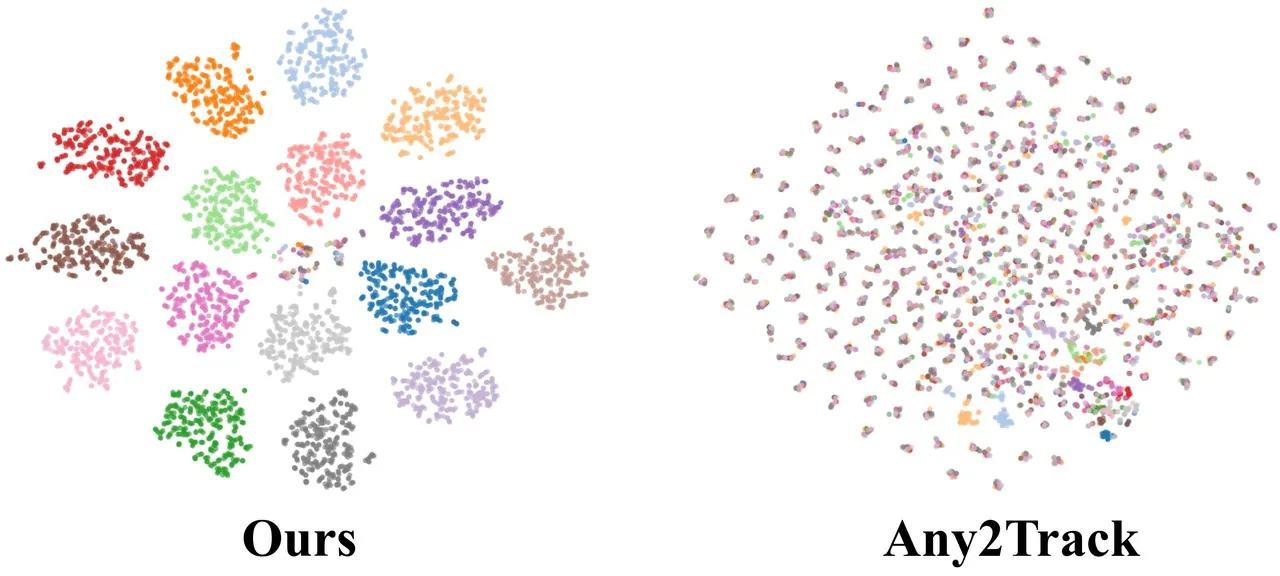
Figure 3: Qualitative t-SNE comparison of ECHO and Any2Track. Colors denote physical environments; ECHO shows clearer environment-wise grouping across motions.
| Representation ablation | Env. accuracy / % | Cross-motion mAP / % | Silhouette | Payload mass R² | Friction R² |
|---|---|---|---|---|---|
| Without soft alignment | 97.125 | 91.282 | 0.4337 | 0.7869 | 0.9069 |
| Without predictor | 97.141 | 93.761 | 0.4555 | 0.4777 | -0.0132 |
| ECHO | 97.478 | 93.872 | 0.4642 | 0.8357 | 0.9208 |
The representation study uses 40 LAFAN motions, 1,024 HDR environments, and 325,193 shared valid history windows. A frozen encoder is followed by linear probes. ECHO reaches 97.478% environment identification and 93.872% cross-motion retrieval mAP. More importantly, payload mass has linear $R^2=0.8357$ and friction has $R^2=0.9208$. High classification alone would prove that environments are separable; the readouts show that physically meaningful quantities remain accessible.
The predictor ablation is particularly informative. Without it, retrieval and silhouette remain close to the full model, yet friction $R^2$ collapses from 0.9208 to -0.0132 and payload mass falls from 0.8357 to 0.4777. Prediction is therefore not needed merely to form clusters. It is needed to make the latent contain dynamics that can explain future transitions. Soft alignment has a different role: removing it reduces cross-motion mAP by 2.59 percentage points and lowers silhouette by 0.0305, showing weaker consistency across motions and weaker cluster separation.
The t-SNE plot supports the same interpretation qualitatively. ECHO forms clearer environment-specific groups than the Any2Track implementation on 16 selected environments. The authors correctly note that this comparison is qualitative because the two methods differ in inputs, capacity, history length, and training setup. The numerical probes carry more weight than the visualization.
Longer context improves multiple physical readouts
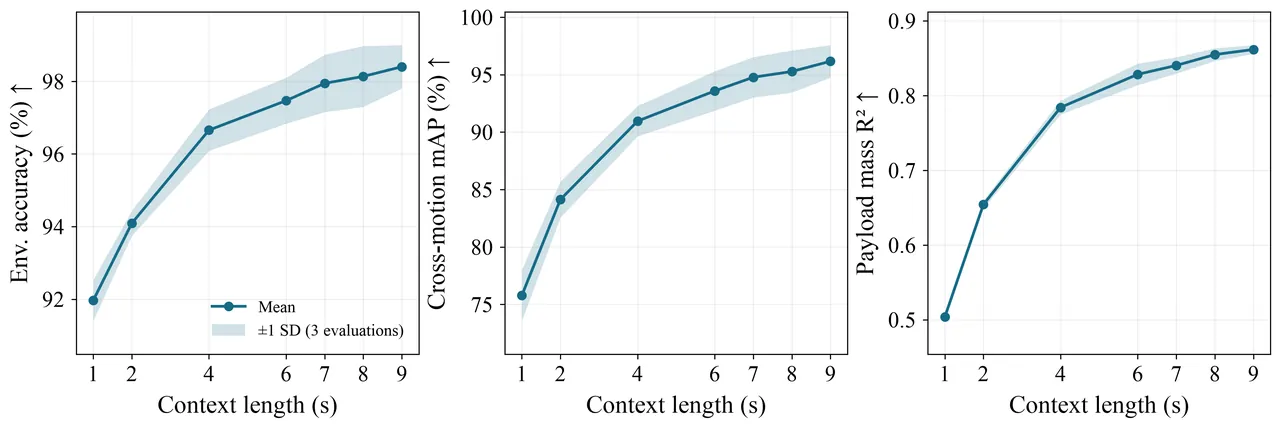
Figure 4: Context-length scaling on LAFAN-40. Environment identification, cross-motion retrieval, and payload-mass readout improve as total context increases from one to nine seconds.
With the short history fixed at 50 steps, the total context budget is increased from 1 to 9 seconds. Environment identification rises from 91.967% to 98.403%, cross-motion mAP from 75.778% to 96.165%, and payload mass $R^2$ from 0.5037 to 0.8618. The monotonic trend indicates that system identity is not reliably identified from a single short response. Evidence accumulates across multiple action segments and contact events.
This result justifies the two-level memory. A short window is needed for rapid reaction after a load moves or the foot slips. A longer session memory averages over motion-specific effects and supplies stable evidence about persistent physical properties. The design has a tradeoff: old evidence remains useful when the environment is fixed, but becomes stale if the load changes without a session boundary.
Real-robot deployment includes manipulation, terrain, and acrobatics
The real G1 demonstration spans standing-to-floor transitions, platform climbing and descent, crawling, single-leg balance, squatting, sitting, and aerial flips under one pretrained prior. With wrist and limb payloads, ECHO-H continues manipulation and whole-body behaviors. When a payload is attached or removed, the controller changes its response from recent interaction rather than from a weight update.
Quantitative testing covers Charleston, single-leg balance, sit-to-stand, and prone-crawl-to-stand. Each checkpoint is run ten times per motion. Every numerical entry corresponds to 10/10 successes; Fail means 0/10. Without payload, ECHO-N obtains MPJPE-L values of 47.98, 39.69, 49.73, and 53.65 mm, better than HEFT, SONIC v1.1, and ECHO-PRE. With 2 kg on each lower leg, ECHO-H obtains 52.07, 41.79, 49.95, and 54.41 mm, lower than Vanilla and RMA-Student on all four motions.
| Real-robot condition and method | Charleston | Single-leg balance | Sit / stand | Crawl / stand |
|---|---|---|---|---|
| No payload: HEFT | 51.47 | 42.53 | Fail | Fail |
| No payload: SONIC v1.1 | 54.81 | 45.21 | Fail | 65.84 |
| No payload: ECHO-PRE | 48.50 | 42.13 | 53.70 | 55.74 |
| No payload: ECHO-N | 47.98 | 39.69 | 49.73 | 53.65 |
| 2 kg per shin: Vanilla | 64.23 | 43.52 | 51.51 | 69.52 |
| 2 kg per shin: RMA-Student | 57.18 | 45.39 | 75.58 | 77.74 |
| 2 kg per shin: ECHO-H | 52.07 | 41.79 | 49.95 | 54.41 |
The failures matter as much as the mean errors. HEFT and SONIC fail all ten sit-to-stand trials and also fail crawl-to-stand in HEFT. ECHO-PRE completes those posture transitions, showing that broad pretraining changes the feasible behavior set, not just accuracy on already successful motions. Under leg payload, RMA-Student degrades to 75.58 mm on sit-to-stand while ECHO-H remains at 49.95 mm. That gap is consistent with the claimed benefit of context-conditioned residual control.
The authors also demonstrate a 10 kg distributed load across hands and legs with single-leg balance, squatting, and forward bending, plus manipulation with a wrist payload. These demonstrations do not replace the controlled table, but they show that the method is not confined to one clean motion family.
Interpretation and Evidence Boundary
The strongest methodological claim is the separation between capability and execution. MIAS changes what the prior can do. CRA changes how the prior performs in the current physical condition while leaving its weights intact. This decomposition explains why the paper evaluates both general motion tracking and adaptation against baselines with different assumptions. MIAS is tested through pretraining ablations and external trackers. CRA is tested through residual-policy comparisons, representation probes, context-length scaling, and real-robot payload trials.
The evidence also clarifies why prediction and geometry are both required. A purely discriminative context can identify an environment while discarding the physical variables needed for action correction. A predictor can encode future outcomes but may organize environments arbitrarily. The full method asks for both dynamics relevance and physically consistent neighborhoods. The ablation results support this interaction rather than treating either loss as a generic add-on.
ECHO differs from online adaptation methods that optimize parameters after deployment. The latent changes continuously as observations arrive, but the behavior prior, encoder, and residual actor remain fixed. This avoids catastrophic forgetting and keeps inference predictable. The cost is that the system cannot invent a response outside the context and residual distributions learned in training. If a new physical effect is not represented during simulation, the latent can only approximate it by similarity to existing conditions.
The residual formulation also creates a useful safety property. Since corrections are added to a pretrained tracking action, the prior remains the dominant behavioral source. The paper does not quantify bounds on the residual magnitude or provide a formal stability guarantee, so this is an architectural bias rather than a certified safety mechanism. For deployment, residual clipping and fallback controllers would still be separate engineering requirements.
Limitations
The first author-stated limitation is the dependence on simulated rollouts and privileged supervision. The predictor learns from robot state, foot kinematics, contact forces, and contact labels that are available in simulation but not directly at deployment. The encoder is trained to work from observable history, yet the supervision distribution still comes from simulation. Generalization to physical effects outside the domain-randomization ranges requires further evidence.
The second limitation is the fixed-parameters-within-a-session assumption. The long-term memory is retained across motions and episode resets because the physical context is assumed constant. This is useful when adapting to a known payload, but unannounced changes inside a session can make old evidence stale. The paper explicitly identifies "change-aware context memory" as future work rather than claiming the current mechanism solves it.
The third limitation is scope. Evaluation covers the Unitree G1 and reference-conditioned whole-body control. The paper does not test transfer across humanoid embodiments, integration with autonomous task planning, or visual perception of objects during manipulation. A behavior prior can produce an action for a reference target, but selecting the right target in a long-horizon task is outside the demonstrated loop.
An independent reproducibility limitation is that the public project repository contains only the project-page source. The paper documents the method, randomization ranges, data composition, and many metrics, but training code, reward implementation, action-filtering details, exact configuration files, and model weights are not publicly available. Reproducing ECHO therefore requires reconstructing substantial infrastructure around Mjlab and the Unitree G1 model.
There are also evaluation gaps. The high-dynamic comparison and the explicit HDR adaptation comparison use different benchmark scopes: Table 2 evaluates tracking at nominal dynamics, while Table 3 evaluates adaptation on AMASS under nominal and HDR conditions. This is reasonable for isolating different questions, but it leaves the combination of high-dynamic motions and heavy randomization less directly characterized. Real-robot evidence uses ten trials per checkpoint and motion, which demonstrates feasibility but is not enough to estimate rare falls or safety-tail risk.
Conclusion
ECHO proposes a practical decomposition for humanoid behavior foundation models. Mixed and Annealed Sampling builds a single broad prior by temporarily concentrating on difficult motion bins and then restoring coverage. Context Representation and Residual Adaptation converts interaction history into a dynamics latent, supervises that latent with future-state prediction and physical-neighborhood alignment, and uses a residual actor to adapt a frozen prior. The control policy changes execution without changing its parameters at test time.
The experiments provide converging evidence. MIAS raises high-dynamic success from 45.00% to 72.00%. CRA further reaches 76.33% and lowers tracking error. Under HDR, context-conditioned ECHO-H reaches 89.22% success without privileged parameters, compared with 88.27% for RMA-Teacher. Representation probes show that payload and friction remain linearly readable, and context scaling from one to nine seconds improves all reported readouts. Real G1 trials add successful acrobatic, terrain, posture-transition, manipulation, and payload scenarios.
The remaining work is well defined. The method needs memories that detect within-session changes, stronger evidence beyond the training randomization, and tests across embodiments and autonomous planning. Even with those limits, ECHO offers a clear architectural answer to a central whole-body control problem: preserve a broad behavior prior, infer the current physical condition from experience, and learn only the correction needed to execute that behavior well.
A behavior foundation model defines the robot's repertoire; an in-context residual defines how that repertoire should meet the physics of this moment.