BRACE: Adapting Whole-Body References for Force and Terrain Aware Humanoid Motion Tracking
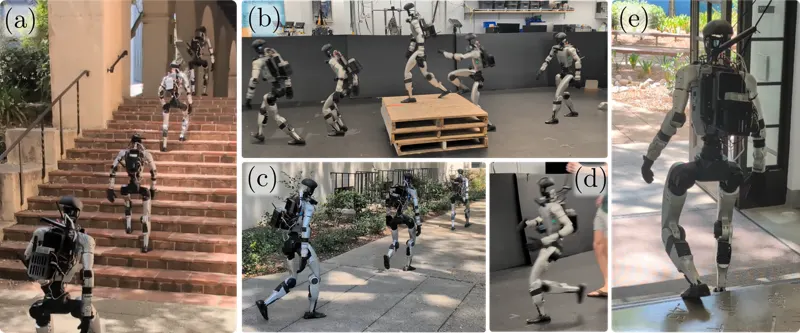
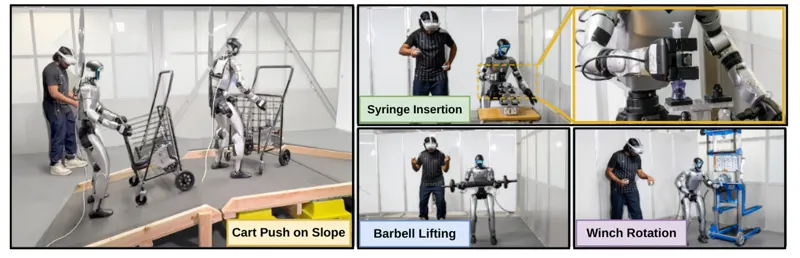
Whole-body tracking has become the interface through which operators drive humanoid robots, yet the references it consumes are recorded on level ground and carrying nothing, so the tracker knows neither the forces the robot must exchange with objects nor the terrain it stands on. Existing controllers address one side of the gap: force-capable policies command an end-effector force but prescribe no whole-body pose, while terrain-adaptive trackers treat loads as disturbances to reject rather than wrenches to command. BRACE folds both into the reference the tracker follows: terrain conformance lifts footholds and root onto the local surface, and a wrench transformation resolves the hand displacement that produces a commanded force together with the center-of-mass and center-of-pressure shifts it induces, bounded by teacher-specific arm-effort limits. Separate exertion and compensation teachers are distilled by DAgger into one flow-matching student that runs on proprioception alone, without a height map or measured wrench, so a teleoperator can supply a flat-ground trajectory while the robot resolves slope and load onboard. On the Unitree G1, in simulation and on hardware, BRACE cuts global tracking error by 40% on average and improves success rate by 18.25 points.