Skip to content
CPNav: Calibrated Vision-Language Navigation for Object-Goal Search in Unseen Environments

CPNav: Calibrated Vision-Language Navigation for Object-Goal Search in Unseen Environments

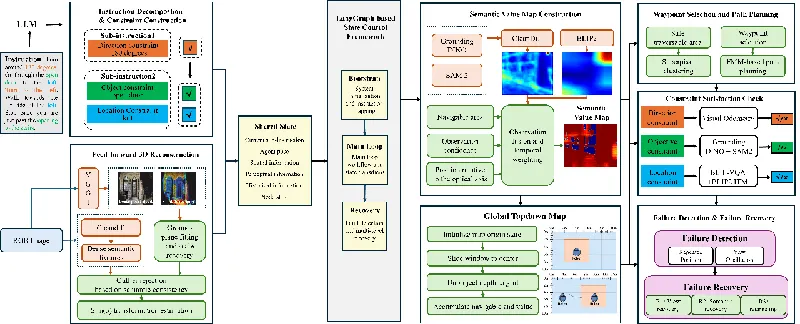
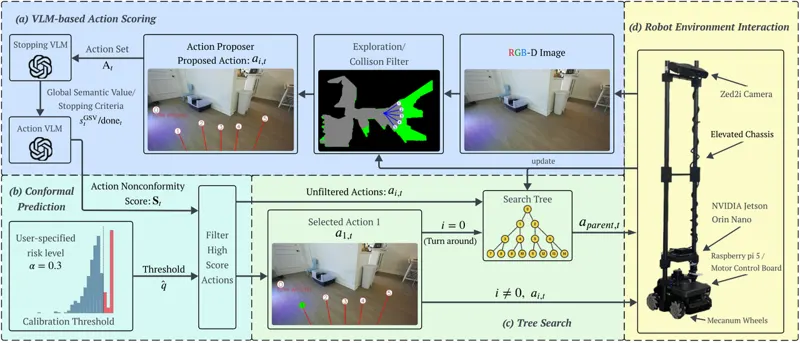
Directing a robot to locate a target object in unseen environments remains a central challenge in embodied AI. Vision-Language Model (VLM)-based methods provide rich semantic reasoning but often produce uncalibrated and overconfident action decisions. We introduce CPNav, a navigation framework that combines collision-aware planning with statistically calibrated VLM action scoring for map-free object-goal navigation. From RGB-D input, CPNav constructs a navigability map, generates collision-free motion primitives, and queries two VLMs for goal detection and action scoring. The resulting scores are calibrated offline via conformal prediction (CP) using oracle actions obtained through a tree-structured exploration procedure with backtracking, providing finite-sample guarantees at a user-specified risk level. The CP layer is model-agnostic and can wrap any VLM policy. Online, calibrated VLM scores guide action selection, while a tree-structured exploration history records alternative actions and allows backtracking. We evaluate CPNav in both simulation and real-world hardware settings. In AI Habitat simulation, compared with the uncalibrated baseline method, CPNav achieves relative SR and SPL improvements of 6.2% and 11.4% on HM3D v0.2, and 12.4% and 8.8% on MP3D, respectively. In real-world deployment on a modified Hiwonder MentorPi robot, the corresponding improvements in SR and SPL are 24.9% and 15.2%, respectively. Code is available at https://github.com/practice-lab-ucla/CPnav.

Vision-language navigationObject-Goal Navigation
Qizhao Chen, Yuanhong Zeng, Shoh Nishino · 124 views · Nov 7, 2026
HALO: A Unified Vision-Language-Action Model for Embodied Multimodal Chain-of-Thought Reasoning

HALO: A Unified Vision-Language-Action Model for Embodied Multimodal Chain-of-Thought Reasoning

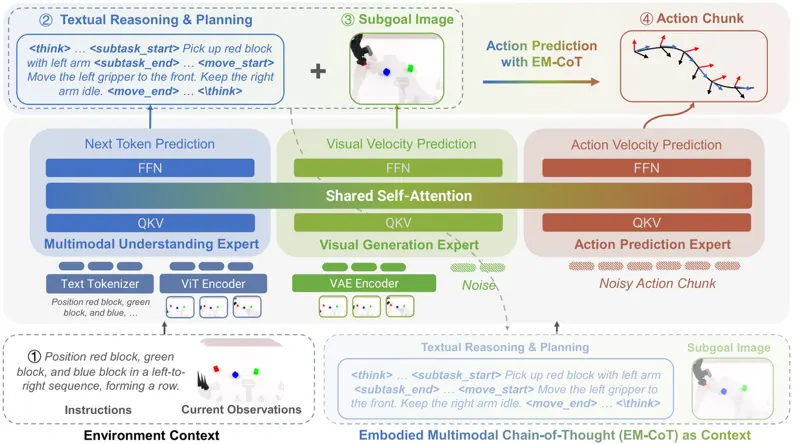
Vision-Language-Action (VLA) models have shown strong performance in robotic manipulation, but often struggle in long-horizon or out-of-distribution scenarios due to the lack of explicit mechanisms for multimodal reasoning and anticipating how the world will evolve under action. Recent works introduce textual chain-of-thought or visual subgoal prediction within VLA models to reason, but still fail to offer a unified human-like reasoning framework for joint textual reasoning, visual foresight, and action prediction. To this end, we propose HALO, a unified VLA model that enables embodied multimodal chain-of-thought (EM-CoT) reasoning through a sequential process of textual task reasoning, visual subgoal prediction for fine-grained guidance, and EM-CoT-augmented action prediction. We instantiate HALO with a Mixture-of-Transformers (MoT) architecture that decouples semantic reasoning, visual foresight, and action prediction into specialized experts while allowing seamless cross-expert collaboration. To enable HALO learning at scale, we introduce an automated pipeline to synthesize EM-CoT training data along with a carefully crafted training recipe. Extensive experiments demonstrate that: (1) HALO achieves superior performance in both simulated and real-world environments, surpassing baseline policy pi_0 by 34.1% on RoboTwin benchmark; (2) all proposed components of the training recipe and EM-CoT design help improve task success rate; and (3) HALO exhibits strong generalization capabilities under aggressive unseen environmental randomization with our proposed EM-CoT reasoning.

VLARobot Manipulation
Quanxin Shou, Fangqi Zhu, Shawn Chen · 182 views · Feb 24, 2026
Envisioning Agentic Robotics: A New Era of Robotic Systems

Envisioning Agentic Robotics: A New Era of Robotic Systems

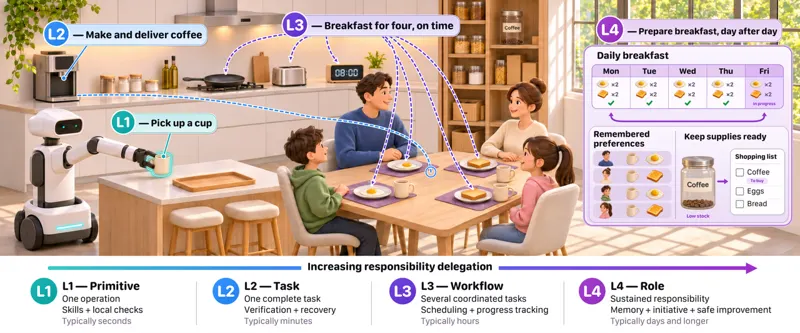
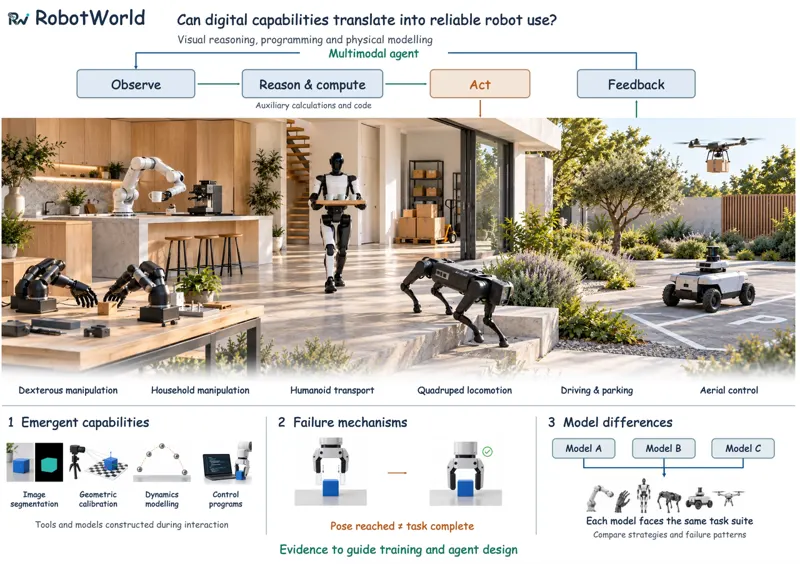
The release of GPT-6 Astra marks the emergence of a new paradigm in robotics: agentic robotics. Within weeks, frontier models with agentic harnesses matched or exceeded task-specific policies on many embodied benchmarks. Instead of training a dedicated policy for each family of tasks, an agentic robotic system applies a foundation model to open-world embodied tasks. It operates in a closed loop: observing the environment, interpreting user intent, reasoning about the task, invoking skills and tools, verifying outcomes, and adapting its strategy. Despite these advances, the community has yet to converge on a shared definition, a reliable evaluation framework, or a research roadmap. We argue that Embodied System 2, realized by a foundation model together with an embodied harness, forms the decision-making core of agentic robotics. Its central challenge is to translate general-purpose reasoning into effective and verifiable actions under physical constraints such as limited reaction time, mechanical limits, unpredictable environment changes, and irreversible consequences. Motivated by this perspective, we propose an evaluation framework that measures both model capabilities and closed-loop system performance. Furthermore, we identify the principles that carry over from digital to physical agents and the challenges that must be addressed to achieve reliable physical autonomy. On top of the Embodied System 2 and the evaluation framework, we envision a research roadmap toward sustained autonomy: the ability to perform work safely and reliably with progressively broader responsibility, from executing individual primitives to fulfilling standing roles.

Agentic RoboticsAI
Grid Robotics, Qingfeng Lan, Duo Li · 352 views · Nov 13, 2026
XBot-Omni: An Omni-Modal Model for Embodied Understanding and Interaction

XBot-Omni: An Omni-Modal Model for Embodied Understanding and Interaction

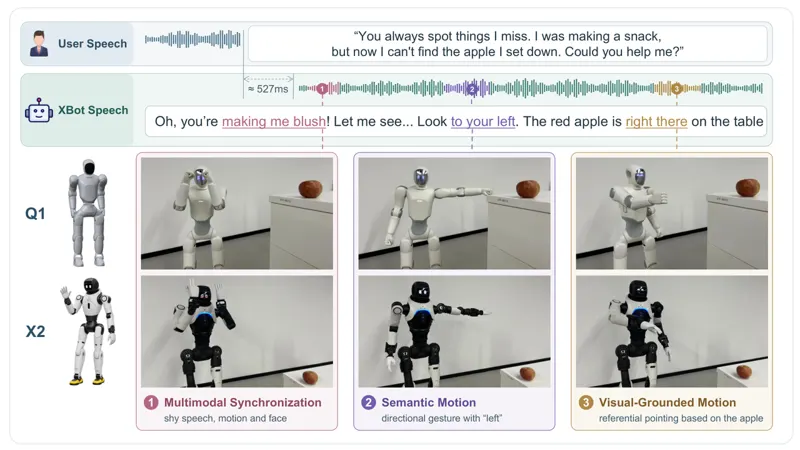
Embodied interaction requires an agent to integrate multimodal perception with verbal and nonverbal behaviors to effectively communicate its intentions, including speech, body motion, and facial expressions. We present XBot-Omni, a Thinker–Talker–Actor architecture that extends the Omni paradigm to robotic modalities, including body motion and facial expressions, with ``X'' representing the extensibility to robotic-specific modalities. The Thinker processes text, images, audio, and video to formulate contextually appropriate responses, which are then realized by the Talker and Actor through speech and coordinated bodily expressions, respectively. In this report, we innovatively introduce the concept of ``Actor'' as a dedicated component for embodied agents: a coordinated, streaming module that leverages the native representations of the Thinker and Talker within an end-to-end pipeline, introducing only modest latency overhead. This unified architecture enables multimodal generation conditioned on omni-modal inputs directly to prevent information loss in staged designs. We comprehensively evaluate XBot-Omni across seven benchmarks, demonstrating strong multimodal understanding capabilities on both general-domain and robot-centric videos, as well as high-quality, natural, and well-coordinated motion generation. Furthermore, our results validate its capability to generate embodied multimodal responses directly from omni inputs, meeting the diverse requirements of embodied interaction. XBot-Omni enables robots not only to perceive the omni world but also to express themselves through speech and bodily behaviors, extending Omni models from conversational interaction to embodied communication in physical environments.
Embodied AIOmni-Modal Model
Kerui Gu, Xing Fu, Shuoyang Sun · 310 views · Nov 12, 2026
OmniBrain-0: A Unified Agentic Model for Embodied Intelligence

OmniBrain-0: A Unified Agentic Model for Embodied Intelligence

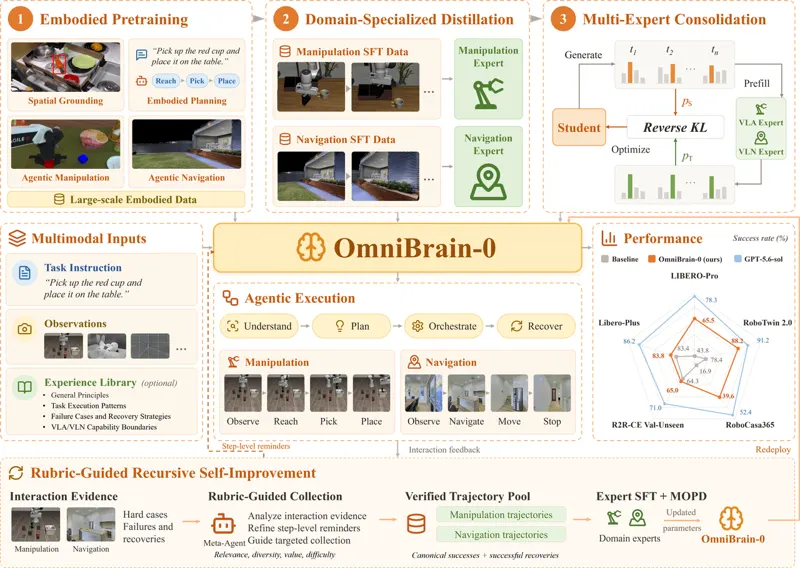
General-purpose embodied intelligence requires robots to coordinate diverse skills over long horizons, track task progress, and recover from failures. Specialist policies alone do not ensure task-level reliability, while powerful multimodal agents rely on costly reasoning and external experience that compact models struggle to reproduce. We introduce OmniBrain-0, a lightweight unified embodied agent that coordinates manipulation and navigation through a shared high-level decision model, integrating task understanding, planning, progress tracking, and feedback-driven recovery. Our progressive training framework combines embodied pretraining, domain-specialized agent distillation, and multi-teacher on-policy distillation (MOPD). It distills powerful teachers' interaction experience into manipulation and navigation experts, then consolidates their decision capabilities into OmniBrain-0. Unification therefore occurs within the learned decision model rather than only at the tool interface. We further introduce Rubric-Guided Recursive Self-Improvement (RSI), a data flywheel in which a Meta-Agent turns execution evidence into refined rubrics, step-level reminders, and verified trajectories for domain-expert updates before their reconsolidation into OmniBrain-0 through MOPD. We evaluate OmniBrain-0 on LIBERO-Pro, LIBERO-Plus, RoboCasa365, RoboTwin 2.0, and R2R-CE Val-Unseen, as well as multiple real-world manipulation tasks. OmniBrain-0 combines strong cross-domain task performance with substantially lower inference and execution overhead than its closed-source teacher, demonstrating efficient transfer and consolidation of embodied capabilities into a compact unified agent.

Embodied AIVLA
Xiaomi Embodied Intelligence Team, Yuechen Luo, Chong He · 510 views · Oct 26, 2026

As an Amazon Associate, we earn from qualifying purchases.