Skip to content
Learning Humanoid Locomotion with Perceptive Internal Model

Learning Humanoid Locomotion with Perceptive Internal Model

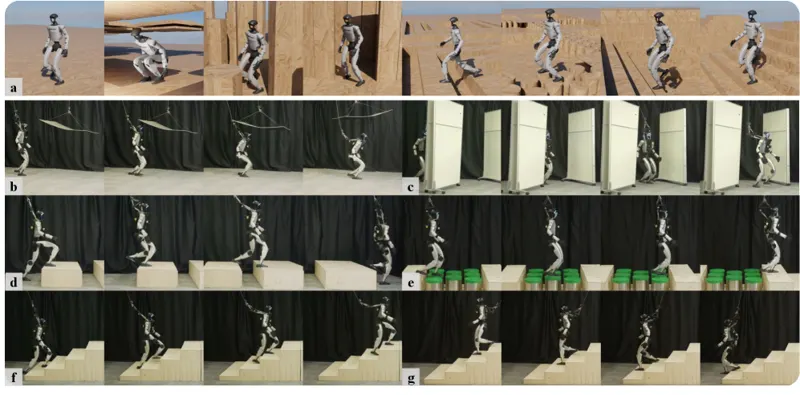
In contrast to quadruped robots that can navigate diverse terrains using a "blind" policy, humanoid robots require accurate perception for stable locomotion due to their high degrees of freedom and inherently unstable morphology. However, incorporating perceptual signals often introduces additional disturbances to the system, potentially reducing its robustness, generalizability, and efficiency. This paper presents the Perceptive Internal Model (PIM), which relies on onboard, continuously updated elevation maps centered around the robot to perceive its surroundings. We train the policy using ground-truth obstacle heights surrounding the robot in simulation, optimizing it based on the Hybrid Internal Model (HIM), and perform inference with heights sampled from the constructed elevation map. Unlike previous methods that directly encode depth maps or raw point clouds, our approach allows the robot to perceive the terrain beneath its feet clearly and is less affected by camera movement or noise. Furthermore, since depth map rendering is not required in simulation, our method introduces minimal additional computational costs and can train the policy in 3 hours on an RTX 4090 GPU. We verify the effectiveness of our method across various humanoid robots, various indoor and outdoor terrains, stairs, and various sensor configurations. Our method can enable a humanoid robot to continuously climb stairs and has the potential to serve as a foundational algorithm for the development of future humanoid control methods.

HumanoidInternal Perception ModelReinforcement LearningJunfeng Long, Junli Ren, Moji Shi·Nov 21, 2024
PRIOR: Perceptive Learning for Humanoid Locomotion with Reference Gait Priors

PRIOR: Perceptive Learning for Humanoid Locomotion with Reference Gait Priors

Training perceptive humanoid locomotion policies that traverse complex terrains with natural gaits remains an open challenge, typically demanding multi-stage training pipelines, adversarial objectives, or extensive real-world calibration. We present PRIOR, an efficient and reproducible framework built on Isaac Lab that achieves robust terrain traversal with human-like gaits through a simple yet effective design: (i) a parametric gait generator that supplies stable reference trajectories derived from motion capture without adversarial training, (ii) a GRU-based state estimator that infers terrain geometry directly from egocentric depth images via self-supervised heightmap reconstruction, and (iii) terrain-adaptive footstep rewards that guide foot placement toward traversable regions. Through systematic analysis of depth image resolution trade-offs, we identify configurations that maximize terrain fidelity under real-time constraints, substantially reducing perceptual overhead without degrading traversal performance. Comprehensive experiments across terrains of varying difficulty-including stairs, boxes, and gaps-demonstrate that each component yields complementary and essential performance gains, with the full framework achieving a 100% traversal success rate. We will open-source the complete PRIOR framework, including the training pipeline, parametric gait generator, and evaluation benchmarks, to serve as a reproducible foundation for humanoid locomotion research on Isaac Lab.

Isaac LabHumanoidReinforcement LearningChenxi Han, Shilu He, Yi Cheng·Mar 19, 2026
Omnidirectional Humanoid Locomotion on Stairs via Unsafe Stepping Penalty and Sparse LiDAR Elevation Mapping

Omnidirectional Humanoid Locomotion on Stairs via Unsafe Stepping Penalty and Sparse LiDAR Elevation Mapping

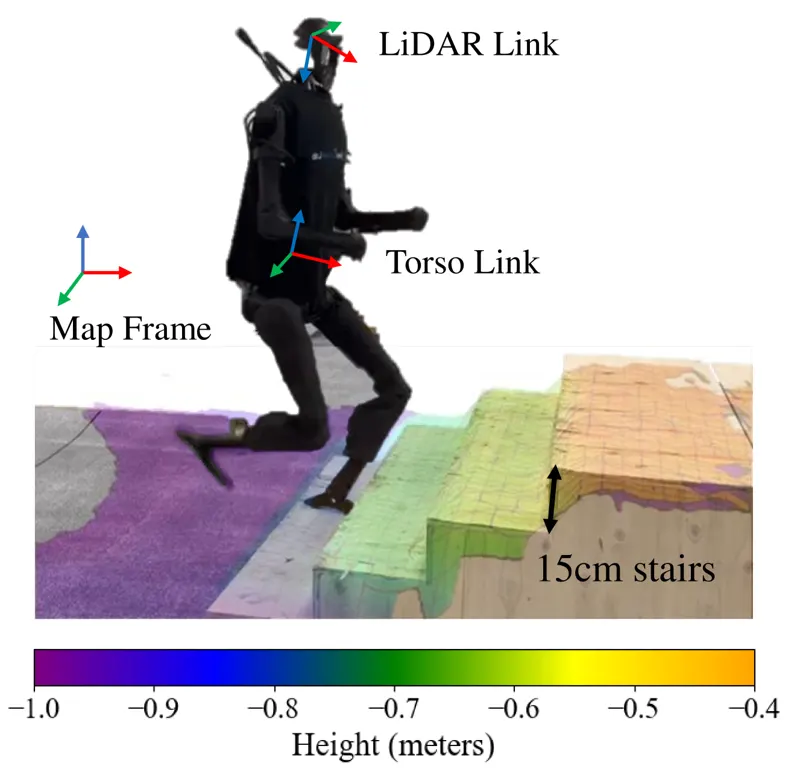
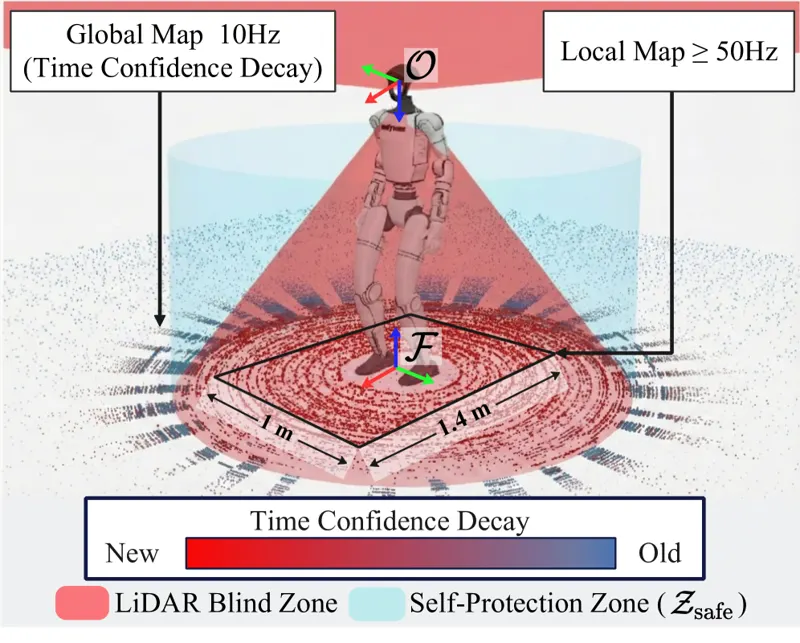
Humanoid robots, characterized by numerous degrees of freedom and a high center of gravity, are inherently unstable. Safe omnidirectional locomotion on stairs requires both omnidirectional terrain perception and reliable foothold selection. Existing methods often rely on forward-facing depth cameras, which create blind zones that restrict omnidirectional mobility. Furthermore, sparse post-contact unsafe stepping penalties lead to low learning efficiency and suboptimal strategies. To realize safe stair-traversal gaits, this paper introduces a single-stage training framework incorporating a dense unsafe stepping penalty that provides continuous feedback as the foot approaches a hazardous placement. To obtain stable and reliable elevation maps, we build a rolling point-cloud mapping system with spatiotemporal confidence decay and a self-protection zone mechanism, producing temporally consistent local maps. These maps are further refined by an Edge-Guided Asymmetric U-Net (EGAU), which mitigates reconstruction distortion caused by sparse LiDAR returns on stair risers. Simulation and real-robot experiments show that the proposed method achieves a near-100% safe stepping rate on stair terrains in simulation, while maintaining a remarkably high safe stepping rate in real-world deployments. Furthermore, it completes a continuous long-distance walking test on complex outdoor terrains, demonstrating reliable sim-to-real transfer and long-term stability.

LiDARHumanoidOmni-directional MotionYuzhi Jiang, Yujun Liang, Junhao Li·Mar 9, 2026
Gait-Adaptive Perceptive Humanoid Locomotion with Real-Time Under-Base Terrain Reconstruction

Gait-Adaptive Perceptive Humanoid Locomotion with Real-Time Under-Base Terrain Reconstruction

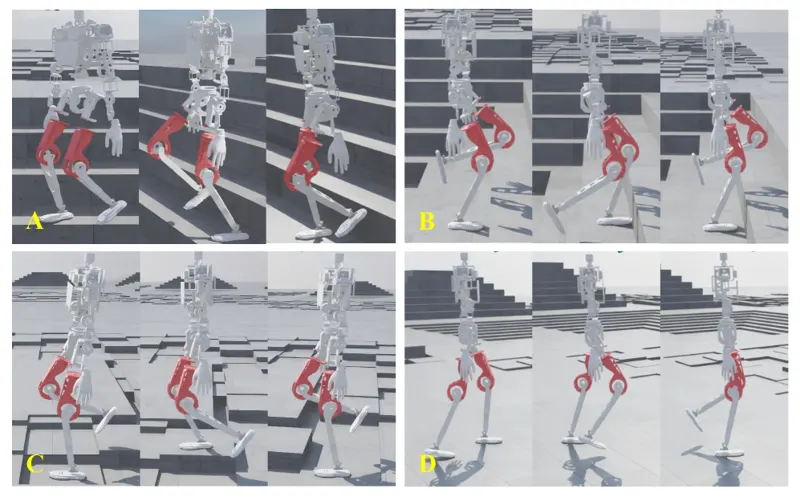
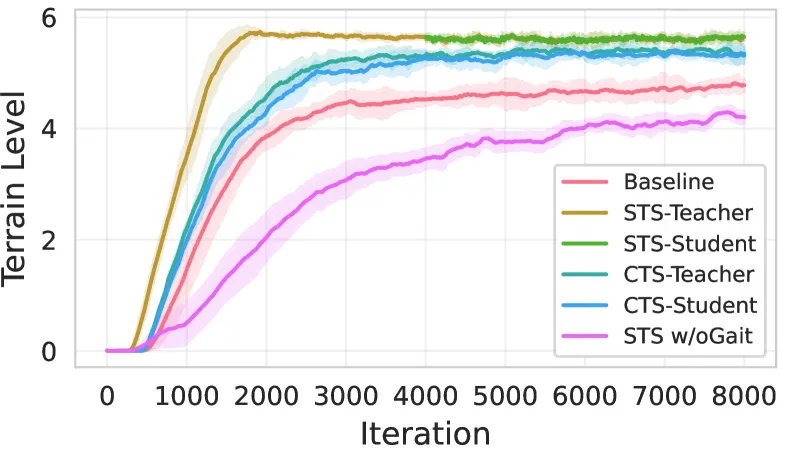
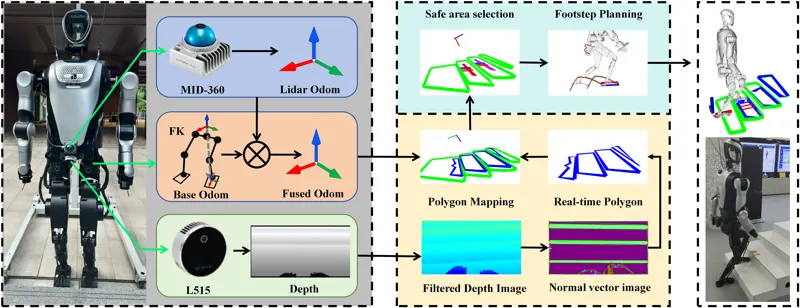
For full-size humanoid robots, even with recent advances in reinforcement learning-based control, achieving reliable locomotion on complex terrains, such as long staircases, remains challenging. In such settings, limited perception, ambiguous terrain cues, and insufficient adaptation of gait timing can cause even a single misplaced or mistimed step to result in rapid loss of balance. We introduce a perceptive locomotion framework that merges terrain sensing, gait regulation, and whole-body control into a single reinforcement learning policy. A downward-facing depth camera mounted under the base observes the support region around the feet, and a compact U-Net reconstructs a dense egocentric height map from each frame in real time, operating at the same frequency as the control loop. The perceptual height map, together with proprioceptive observations, is processed by a unified policy that produces joint commands and a global stepping-phase signal, allowing gait timing and whole-body posture to be adapted jointly to the commanded motion and local terrain geometry. We further adopt a single-stage successive teacher-student training scheme for efficient policy learning and knowledge transfer. Experiments conducted on a 31-DoF, 1.65 m humanoid robot demonstrate robust locomotion in both simulation and real-world settings, including forward and backward stair ascent and descent, as well as crossing a 46 cm gap. Project Page:https://ga-phl.github.io/

HumanoidGait AdaptationTerrain ReconstructionHaolin Song, Hongbo Zhu, Tao Yu·Dec 8, 2025
Explicit Stair Geometry Conditioning for Robust Humanoid Locomotion

Explicit Stair Geometry Conditioning for Robust Humanoid Locomotion

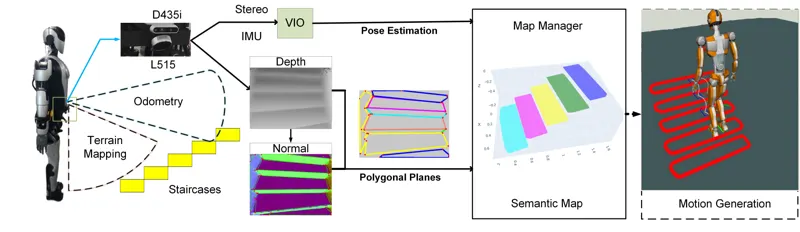
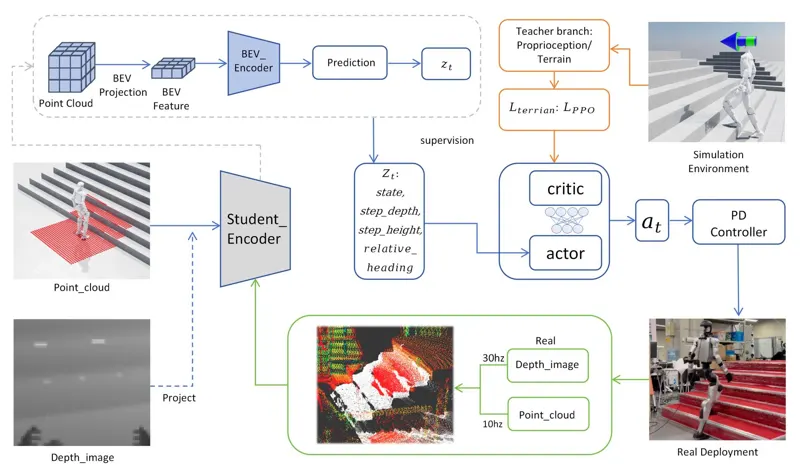
Robust humanoid stair climbing remains challenging due to geometric discontinuities, sensitivity to step height variations, and perception uncertainty in real-world environments. Existing learning-based locomotion policies often rely on implicit terrain representations or blind proprioceptive feedback, limiting their ability to generalize across varying stair geometries and to anticipate required gait adjustments. This paper proposes an explicit stair geometry conditioning framework for robust humanoid stair climbing. Instead of encoding terrain as high-dimensional latent features, we extract a compact set of interpretable geometric parameters, including step height, step depth, and current yaw angle relative to the robot heading. These explicit stair parameters directly condition a Proximal Policy Optimization (PPO)-based locomotion policy, enabling proactive modulation of swing-foot clearance and stride characteristics according to stair structure. Simulation experiments demonstrate improved generalization across unseen stair heights beyond the training distribution. Real-world experiments on the Unitree G1 humanoid validate reliable indoor and outdoor stair traversal. In challenging outdoor scenarios, the robot successfully ascends 33 consecutive steps without failure, demonstrating robustness and practical deployability.

HumanoidStair ClimbingReinforcement LearningJianguo Zhang, Wentai Xu, Shusheng Ye·May 11, 2026
NSL-SLAM: High-Fidelity Neural Structured-Light Depth for Practical SLAM and Reconstruction

NSL-SLAM: High-Fidelity Neural Structured-Light Depth for Practical SLAM and Reconstruction

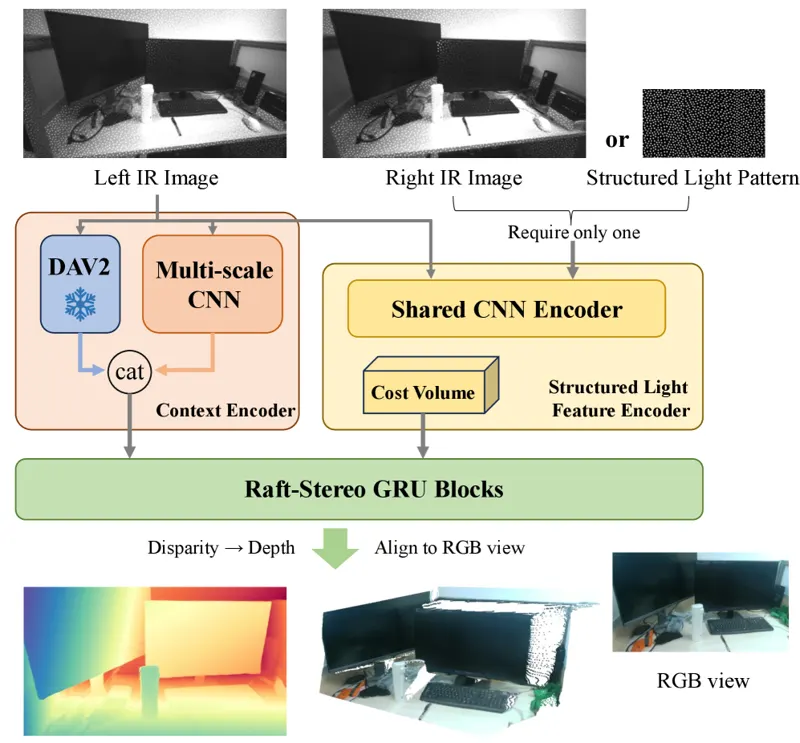
Structured-light (SL) cameras power depth sensing in millions of devices, and recent neural SL decoding methods have substantially improved their depth quality. SLAM systems can benefit greatly from such strong depth sensing, where reliable geometry enables stable tracking and faithful reconstruction. In this work, we present NSL-SLAM, a practical SLAM system tailored for high-fidelity structured-light depth. We first strengthen SL depth sensing: inspired by the neural structured-light (NSL) method, we further incorporate strong monocular depth priors into the SL stereo decoding, reducing depth RMSE by 35% on Replica-SL compared to NSL. We then build a depth-centric SLAM pipeline with this stronger depth: because structured-light geometry is dense and metrically accurate, we keep it as the primary tracking signal, and add only sparse visual correspondences for geometrically degenerate cases and lightweight bundle adjustment for long-range drift. Our depth estimator and SLAM design reinforce each other: stronger depth makes a simple SLAM pipeline effective, and the depth-centric pipeline ensures this advantage transfers to downstream reconstruction. Experimentally, on the synthetic Replica-SL benchmark, NSL-SLAM achieves the best tracking accuracy and improves reconstruction F-score by 1.6 points over the SOTA baseline under a shared-depth protocol. On a real benchmark of 8 challenging scenes, it is the only method that avoids catastrophic failure on all sequences while achieving 43.3% lower trajectory deviation than selected baselines. The SLAM system runs online at 20.9 FPS, demonstrating that stronger structured-light depth and depth-centric system design together enable practical, robust SLAM.

SLAMStructured Light DepthNeural Depth EstimationJiaheng Li, Binsheng Zhang, Xinhai Chang·Jul 27, 2026