Skip to content
A Nonlinear MPC Framework for Loco-Manipulation of Quadrupedal Robots with Non-Negligible Manipulator Dynamics

A Nonlinear MPC Framework for Loco-Manipulation of Quadrupedal Robots with Non-Negligible Manipulator Dynamics

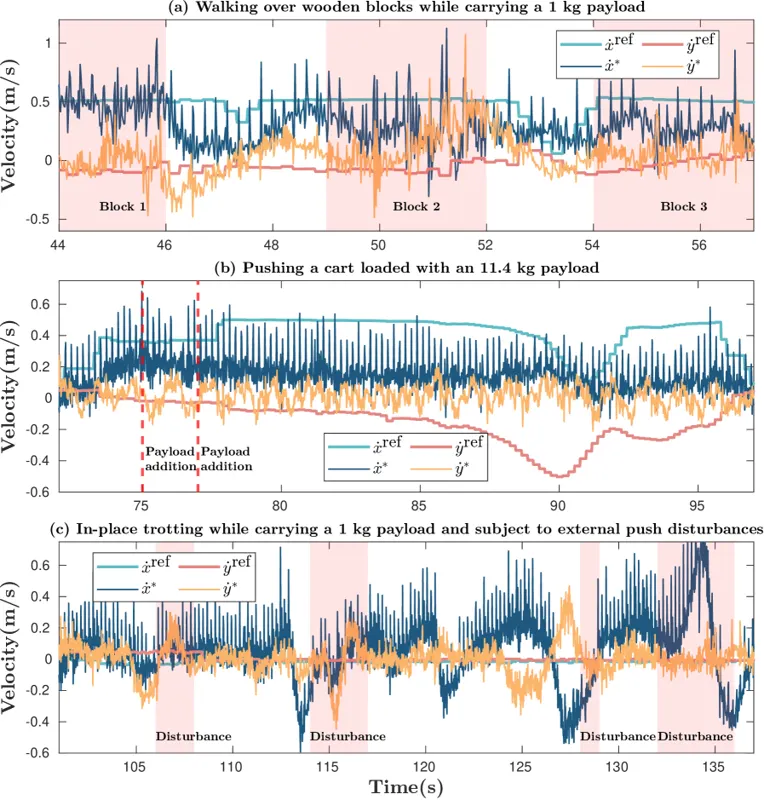
Model predictive control (MPC) combined with reduced-order template models has emerged as a powerful tool for trajectory optimization in dynamic legged locomotion. However, loco-manipulation tasks performed by legged robots introduce additional complexity, necessitating computationally efficient MPC algorithms capable of handling high-degree-of-freedom (DoF) models. This letter presents a computationally efficient nonlinear MPC (NMPC) framework tailored for loco-manipulation tasks of quadrupedal robots equipped with robotic manipulators whose dynamics are non-negligible relative to those of the quadruped. The proposed framework adopts a decomposition strategy that couples locomotion template models – such as the single rigid body (SRB) model – with a full-order dynamic model of the robotic manipulator for torque-level control. This decomposition enables efficient real-time solution of the NMPC problem in a receding horizon fashion at 60 Hz. The optimal state and input trajectories generated by the NMPC for locomotion are tracked by a low-level nonlinear whole-body controller (WBC) running at 500 Hz, while the optimal torque commands for the manipulator are directly applied. The layered control architecture is validated through extensive numerical simulations and hardware experiments on a 15-kg Unitree Go2 quadrupedal robot augmented with a 4.4-kg 4-DoF Kinova arm. Given that the Kinova arm dynamics are non-negligible relative to the Go2 base, the proposed NMPC framework demonstrates robust stability in performing diverse loco-manipulation tasks, effectively handling external disturbances, payload variations, and uneven terrain.

MPCMobile ManipulationQuadruped robotsRuturaj Sambhus, Kapi Ketan Mehta, Ali MirMohammad Sadeghi·Jul 29, 2025
MLM: Learning Multi-task Loco-Manipulation Whole-Body Control for Quadruped Robot with Arm

MLM: Learning Multi-task Loco-Manipulation Whole-Body Control for Quadruped Robot with Arm

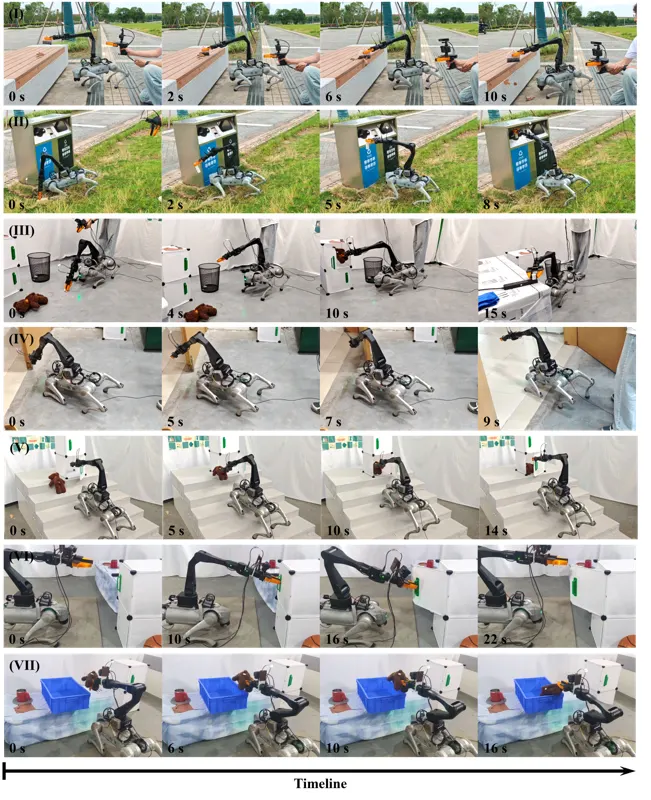
Whole-body loco-manipulation for quadruped robots with arms remains a challenging problem, particularly in achieving multi-task control. To address this, we propose MLM, a reinforcement learning framework driven by both real-world and simulation data. It enables a six-DoF robotic arm-equipped quadruped robot to perform whole-body loco-manipulation for multiple tasks autonomously or under human teleoperation. To address the problem of balancing multiple tasks during the learning of loco-manipulation, we introduce a trajectory library with an adaptive, curriculum-based sampling mechanism. This approach allows the policy to efficiently leverage real-world collected trajectories for learning multi-task loco-manipulation. To address deployment scenarios with only historical observations and to enhance the performance of policy execution across tasks with different spatial ranges, we propose a Trajectory-Velocity Prediction policy network. It predicts unobservable future trajectories and velocities. By leveraging extensive simulation data and curriculum-based rewards, our controller achieves whole-body behaviors in simulation and zero-shot transfer to real-world deployment. Ablation studies in simulation verify the necessity and effectiveness of our approach, while real-world experiments on a Go2 robot with an Airbot robotic arm demonstrate the policy's good performance in multi-task execution.

Reinforcement LearningMobile ManipulationQuadruped robotsXin Liu, Bida Ma, Chenkun Qi·Aug 14, 2025
Language-Guided Grasping under Partial Observation for Mobile Manipulation in Field Inspection and Maintenance

Language-Guided Grasping under Partial Observation for Mobile Manipulation in Field Inspection and Maintenance

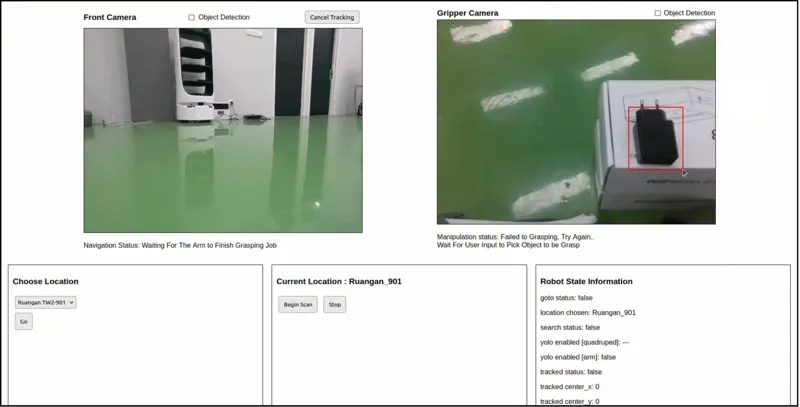
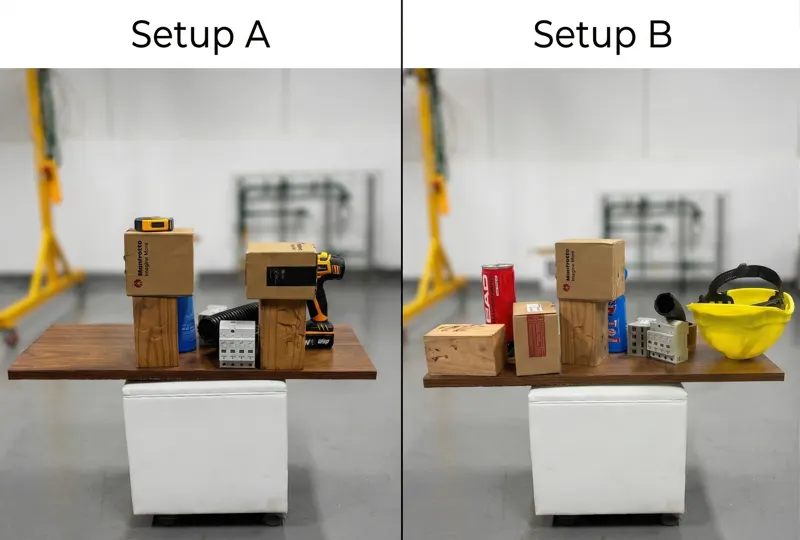
Offshore inspection and maintenance have increasingly been using legged robots for routine sensing, yet many useful interventions still require physical interaction with tools, containers, and task-relevant objects. Employing robots for these tasks can reduce operators' exposure in confined, elevated, or potentially explosive areas. This paper presents a language-guided grasping pipeline for a legged mobile manipulator operating under partial observation. An operator defines the target, the system grounds it in RGB with open-vocabulary detection and promptable segmentation, extracts an object-centric RGB-D point cloud, improves sparse geometry through depth compensation and point-cloud completion, and selects a 6-DoF grasp using collision, clearance, reachability, and approach constraints. The system is implemented on a quadruped robot with an arm and evaluated in two cluttered tabletop scenes motivated by small-object retrieval during inspection and maintenance. Across paired trials, the proposed pipeline achieved 9/10 successful grasps, compared with 3/10 for a view-dependent deployment baseline. In this controlled setting, object-centric completion and execution-aware selection reduced approach collisions and improved the reliability of language-guided grasping for supervised field manipulation.

Inspection RobotLanguage-Guided GraspingMobile ManipulationDilermando Almeida, Juliano Negri, Guilherme Lazzarini·Mar 9, 2026