Skip to content
GUARD: Stabilizing Recursive Self-Improvement with Regret Guidance

GUARD: Stabilizing Recursive Self-Improvement with Regret Guidance

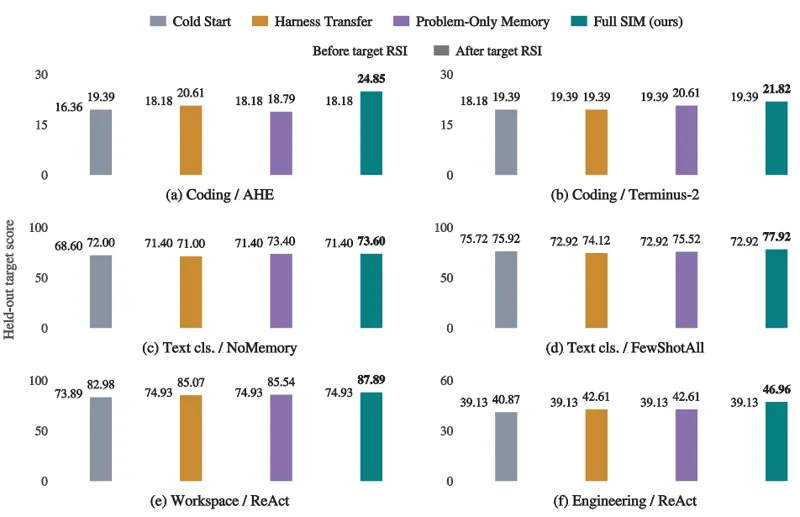
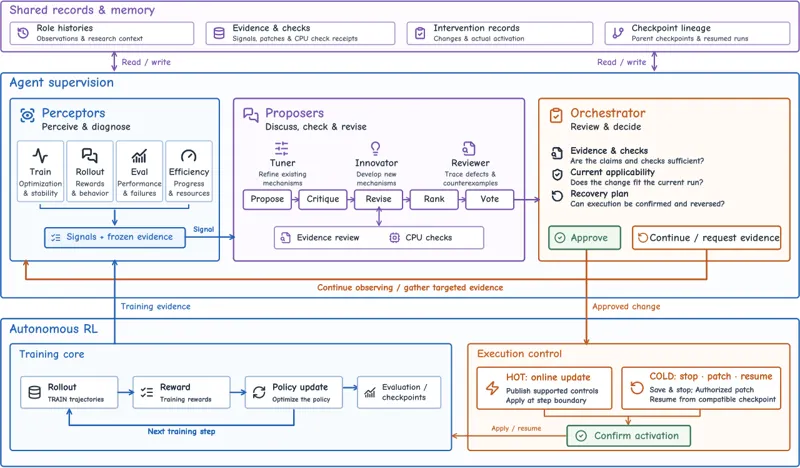
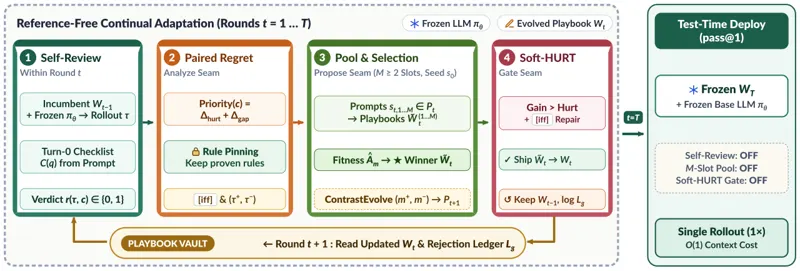
Autonomous AI agents pair a frozen base model with an editable harness of prompts, skills, tool rules, and memory. Recursive self-improvement (RSI) adapts this harness from experience without weight updates, yet self-editing without external graders often backfires: reflection and scalar scores conflate what an edit newly broke with what remains unsolved, causing local regressions, skill forgetting, and memory bloat. We introduce GUARD (Grader-free Unsupervised Environment Design [UED] with Adaptive Rule Distillation), a closed-loop framework for reference-free continual harness evolution. Our key insight is to decompose each task into pre-execution self-checks and guide harness updates via directional regret. Each round grades trajectories against these checks, pinning mastered rules while prioritizing newly broken behaviors, and selects among parallel candidate edits by critic-free group-relative fitness. A Soft-HURT gate then promotes an edit only when gains outweigh regressions, scoping specialized fixes to prevent over-triggering and guaranteeing non-regression on its gated buffer. At test time, one frozen harness runs in a single pass. Across benchmarks on memory, skill evolution, continual task streams, and domain reasoning, GUARD consistently improves performance without catastrophic forgetting or memory pollution while substantially cutting deployment token usage.

LLMAgent Harness
Minghe Zhang, Xuetao Kang, Yifei Ming · 290 views · Nov 17, 2026
Large Language Models Do Not Always Need Readable Language

Large Language Models Do Not Always Need Readable Language

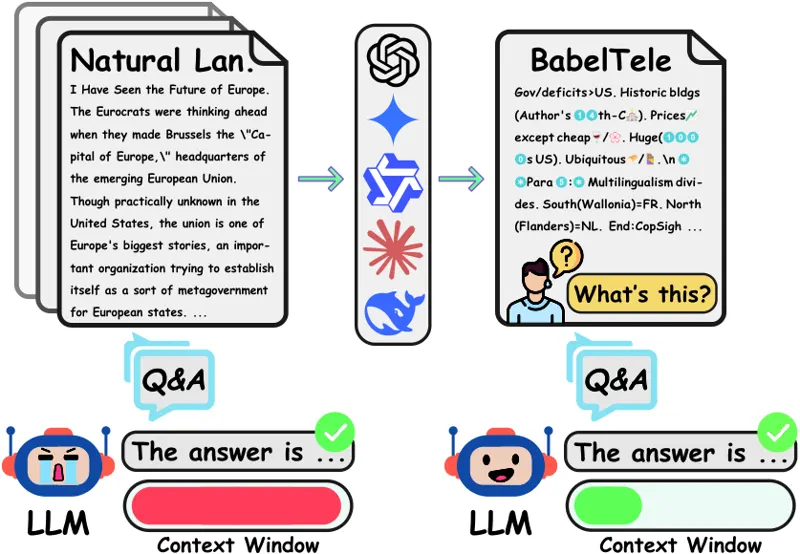
Large language models (LLMs) are commonly prompted and interfaced with human-readable natural language, even when the intended reader is another model. This paper investigates whether semantic information can be encoded in compact, non-standard textual forms that sacrifice human readability while remaining recoverable by LLMs. We refer to this class of model-centric textual representations as BabelTele, approached here not as a fixed protocol but as an empirical probe into LLMs' capacity to generate and interpret such representations. Through readability diagnostics, model likelihood measures, human questionnaires, and downstream task evaluations, we find that BabelTele can substantially depart from ordinary natural language while preserving core semantics for instruction-tuned LLMs. As a task-agnostic representational paradigm, BabelTele demonstrates high information density, maintaining 99.5% semantic fidelity even when the text volume is condensed to 27.9% of its original length. We further evaluate its semantic robustness in cross-model transfer, agent memory, and multi-agent communication. Results suggest that BabelTele can reduce context overhead while generally maintaining reliable downstream performance, although its effectiveness depends on the compressor-reader pair and task setting. These findings indicate that human readability, natural-language typicality, and model-side semantic recoverability can be partially decoupled, opening a path toward model-native representations in future exploration of LLM systems.

LLMContext Compression
Jiayi Zhu, Haoxuan Peng, Junxi Wang · 189 views · Jun 18, 2026
MIDAS Hand: Modular low-Impedance Direct-drive Anthropomorphic Sensing Hand

MIDAS Hand: Modular low-Impedance Direct-drive Anthropomorphic Sensing Hand

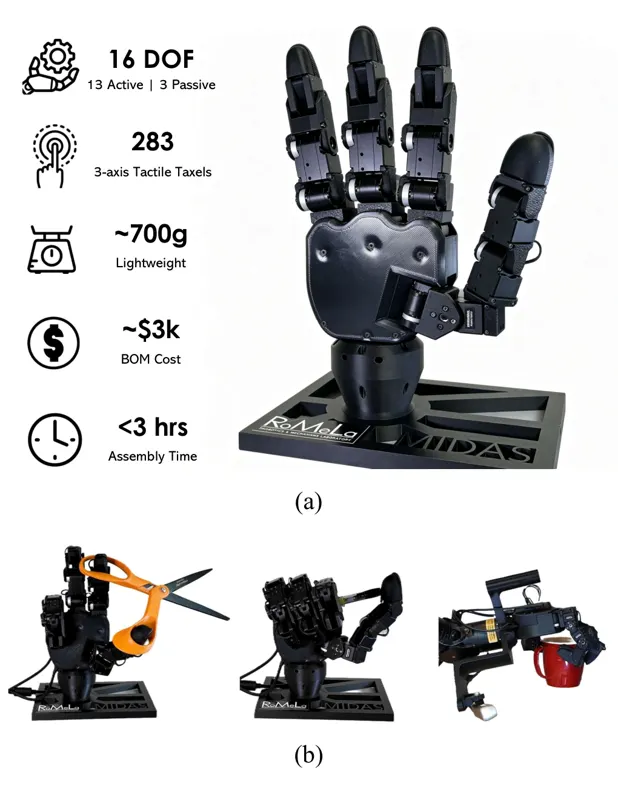
Dexterous manipulation is limited not only by algorithms but by a shortage of accessible hand hardware that combines human-scale morphology, ease of manufacturing or maintenance, tactile sensing, and practical cost. Existing dexterous hands tend to optimize some of these properties at the expense of others. We present MIDAS Hand, a low-cost, open-source, human-scale dexterous hand with integrated tactile sensing for manipulation research. MIDAS Hand provides 16 total degrees of freedom (DoF) with 13 active DoF, directly driven actuation with measurably low backdrive torque, and 283 three-axis tactile taxels in a compact 700 g package with a bill of materials under 3,000 USD. Built from 3D-printed components, it assembles in under three hours while providing the strength, repeatability, and maintainability needed for repeated real-world experiments. Alongside the hardware, we release a full stack: design files, build documentation, control and tactile Python APIs, simulation models, and retargeting and teleoperation pipelines. We characterize MIDAS Hand through workspace and grasp-taxonomy analysis, payload and reliability tests, backdrivability measurements, and teleoperation demonstrations with tactile sensing, showing that it offers a balanced, reproducible platform for tactile dexterous manipulation and human-to-robot data collection. Project page: https://midas-hand.com
Dexterous ManipulationTactile Sensing
Alvin Zhu, Mingzhang Zhu, Beom Jun Kim · 194 views · Jul 16, 2026
RoboAtom: Large-scale Atomic-Action Supervision for Robot Learning

RoboAtom: Large-scale Atomic-Action Supervision for Robot Learning

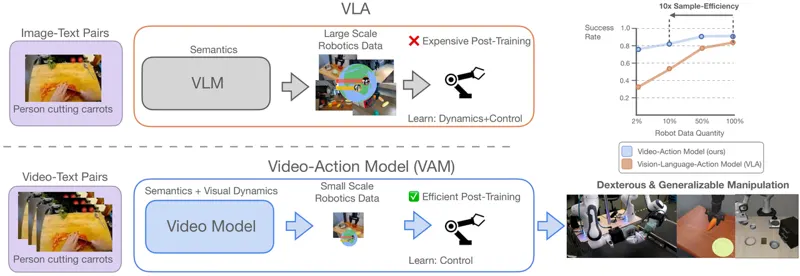
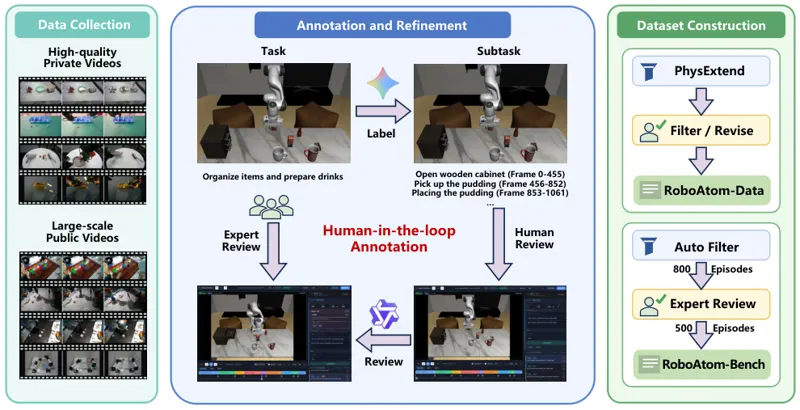
Fine-grained action annotations can support skill reuse and compositional generalization in robot policies. However, robot datasets typically provide task-level instructions without subtask annotations. Although some include subtask labels, inconsistent formats and conventions hinder cross-source joint training. We propose RoboAtom-Data, which adds unified, time-aligned atomic-action annotations to existing data from multiple sources, covering 1.45 million trajectories, 6.88 million skill-labeled segments, and 16,882.1 hours. Our pipeline combines a unified protocol, large-scale manual annotation, propagation across repeated executions with the same ordered skill sequence, and multi-stage quality control. We evaluate the dataset through automatic atomic-action annotation and robot control. We construct RoboAtom-Bench to standardize evaluation of skill recognition and temporal boundary localization. Trained on the annotated data, RoboAtom-Anno achieves better automatic annotation performance than all evaluated open- and closed-source models on both RoboAtom-Bench and the external WGO-Bench. For robot control, atomic-action supervision paired with hierarchical execution improves task success over task-level baselines on LIBERO-Long, LIBERO-Plus, and RoboTwin. We will release the data, benchmark, model, and construction pipeline to support further research on skill-level robot learning.

Robot LearningAtomic Actions
Xueyuan Wei, Xuanxu Wang, Xudong Li · 169 views · Oct 29, 2026
Envisioning Agentic Robotics: A New Era of Robotic Systems

Envisioning Agentic Robotics: A New Era of Robotic Systems

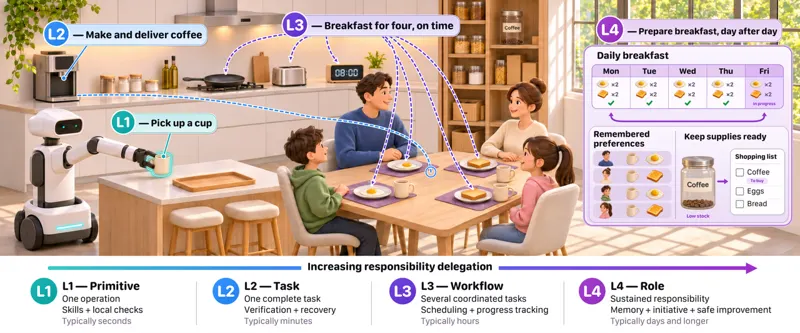
The release of GPT-6 Astra marks the emergence of a new paradigm in robotics: agentic robotics. Within weeks, frontier models with agentic harnesses matched or exceeded task-specific policies on many embodied benchmarks. Instead of training a dedicated policy for each family of tasks, an agentic robotic system applies a foundation model to open-world embodied tasks. It operates in a closed loop: observing the environment, interpreting user intent, reasoning about the task, invoking skills and tools, verifying outcomes, and adapting its strategy. Despite these advances, the community has yet to converge on a shared definition, a reliable evaluation framework, or a research roadmap. We argue that Embodied System 2, realized by a foundation model together with an embodied harness, forms the decision-making core of agentic robotics. Its central challenge is to translate general-purpose reasoning into effective and verifiable actions under physical constraints such as limited reaction time, mechanical limits, unpredictable environment changes, and irreversible consequences. Motivated by this perspective, we propose an evaluation framework that measures both model capabilities and closed-loop system performance. Furthermore, we identify the principles that carry over from digital to physical agents and the challenges that must be addressed to achieve reliable physical autonomy. On top of the Embodied System 2 and the evaluation framework, we envision a research roadmap toward sustained autonomy: the ability to perform work safely and reliably with progressively broader responsibility, from executing individual primitives to fulfilling standing roles.

Agentic RoboticsAI
Grid Robotics, Qingfeng Lan, Duo Li · 352 views · Nov 13, 2026

As an Amazon Associate, we earn from qualifying purchases.