Skip to content
Patch Policy: Efficient Embodied Control via Dense Visual Representations

Patch Policy: Efficient Embodied Control via Dense Visual Representations

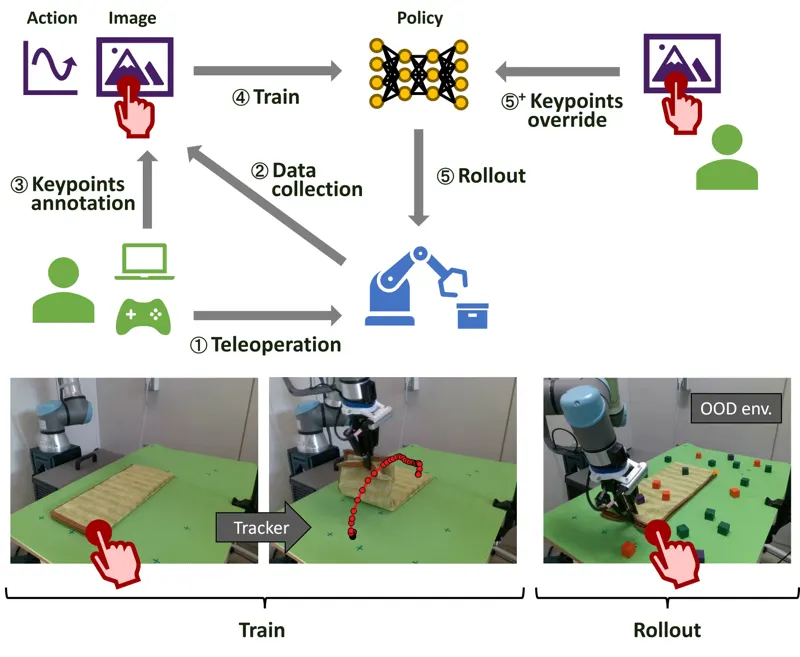
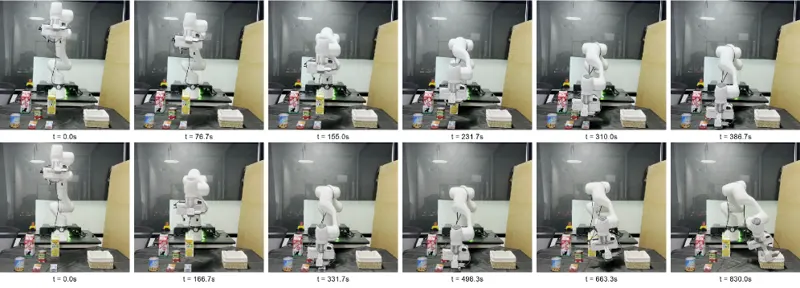
Pretrained dense visual features from Vision Transformers (ViTs) are powerful yet have been underutilized in robot learning. Modern robot policies either compress each observation into a single global token, or rely on visual backbones trained from scratch, sacrificing both fine-grained spatial detail and the benefits of large-scale visual pre-training. While there exist policies that do operate on dense patch features like large vision-language-action models (VLAs), they tend to be heavy and slow, inheriting the full cost of a billion-parameter vision-language model (VLM) backbone. We close this gap with Patch Policy, a minimal architectural extension that enables transformer-based policies to consume dense pre-trained patch tokens directly without the computational overhead of a full VLM. At its core is a block-causal attention mask that preserves the temporal causality of standard policies while letting the model attend over many patch tokens per observation, alongside other state information. Patch Policy is lightweight, fast, and highly effective. Across four simulated and three real-world environment suites, our method achieves a 40% relative improvement over policies using state-of-the-art global-pooled representations. Furthermore, it surpasses fine-tuned OpenVLA-OFT by 18% while using roughly 0.7% of the parameters. We believe Patch Policy provides a pipeline for the robotics community to readily leverage continuing progress in visual representation learning, without sacrificing the training efficiency or inference speed required for high-frequency, reactive control. Videos can be viewed at https://patch-policy.github.io

Patch PolicyDense Visual Representation
Gaoyue Zhou, Zichen Jeff Cui, Ada Langford · 620 views · Jul 20, 2026
PRISM: Polynomial Representations for Interaction-Structured Motor Control

PRISM: Polynomial Representations for Interaction-Structured Motor Control

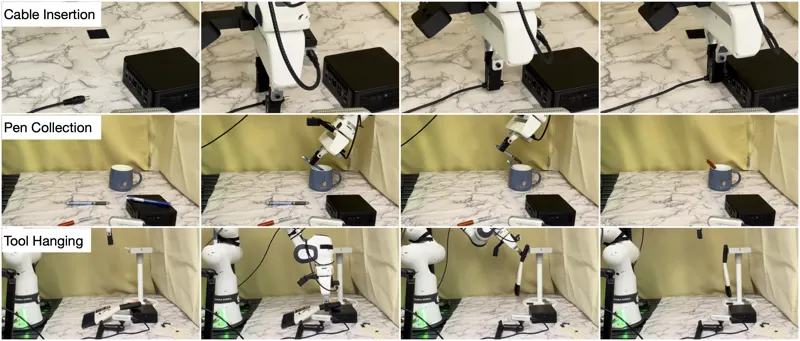
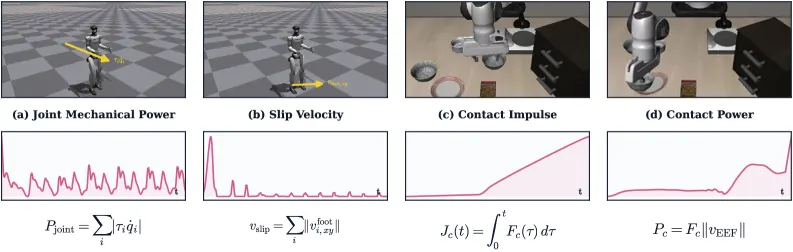
Robot policies are typically MLPs mapping observations to actions. Yet robot observations are physical variables, and many action-relevant cues arise not from individual variables but from their interactions; power, inertial effects, contact, slip, and compliance depend on products among observable signals. We introduce PRISM, a policy representation that makes polynomial interactions among observable physical variables explicit, learnable, and compact. Rather than listing all polynomial terms, PRISM uses a factorized polynomial module to expose higher-order interaction features efficiently. In reinforcement learning, it keeps the standard MLP backbone but applies a gradually activated element-wise polynomial function after it. In imitation learning, it replaces linear proprioceptive conditioning in Diffusion Policy with a polynomial layer trained end-to-end. Across humanoid locomotion and contact-rich manipulation, PRISM improves performance over standard MLP policies and larger MLPs with matched capacity, showing that interaction structure cannot be replaced by capacity alone. It also yields sensorless compliant behavior without force, wrench, tactile input, contact labels, or admittance control. These results suggest that polynomial representations should become a standard architectural choice for embodied motor control. The project page is available at https://lsh3163.github.io/prism/
PrismMotion Control
Seung Hyun Lee, Stella X. Yu · 600 views · Jul 26, 2026
Dynamics-Aware Meta-Imitation for Generalization to Unseen Robotic Manipulation

Dynamics-Aware Meta-Imitation for Generalization to Unseen Robotic Manipulation

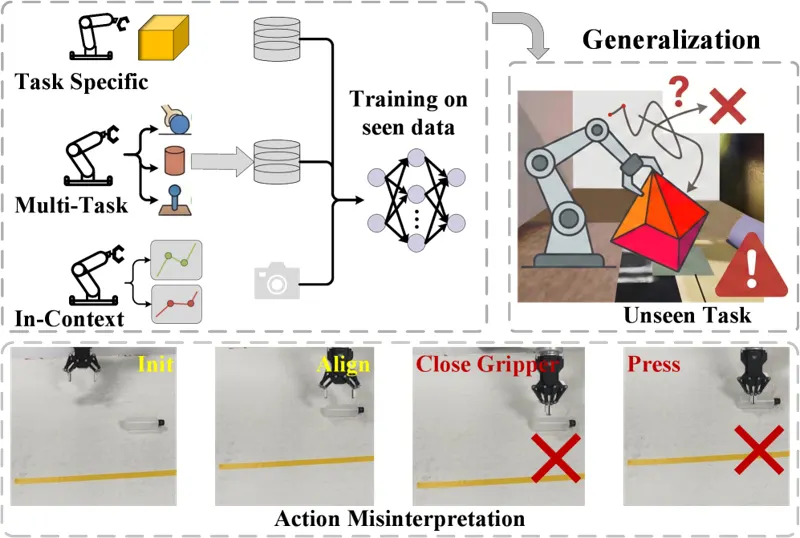
Imitation Learning aims to learn skills from extensive observations and demonstrations for robots, so it suffers from data scarcity and environment generalization. The existing methods predominantly focus on imitation from in-domain tasks and consequently struggle with generalization to unseen tasks. To bridge this generalization gap, we propose the Dynamics-Aware Meta-Imitation (DAMI) framework. By integrating meta-learning to construct a shared skill space, DAMI equips agents for rapid adaptation to novel tasks. We introduce the Visual-Motor Trajectory (VMT) module to capture complex spatio-temporal dynamics within the task latent space. Furthermore, we propose the Unpaired Unified Task (U2T) block to fuse unstructured multimodal observations. To coordinate these representations, we integrate a Task-Conditioned Feature Modulation (TCFM) mechanism customized for modulating low-level 3D features. By capturing intrinsic dynamics from a random complete reference demonstration, our framework learns the underlying task logic rather than memorizing static cues, ensuring effective generalization. Extensive experiments in both simulation and real-world settings demonstrate that our approach outperforms state-of-the-art baselines regarding direct inference on seen tasks and adaptation to unseen tasks via few-shot fine-tuning.

Imitation LearningMeta-learning
Zhenduo Shang, Xiyao Liu, Bohan Li · 530 views · Jul 17, 2026
Scalable Causal Imitation Learning

Scalable Causal Imitation Learning

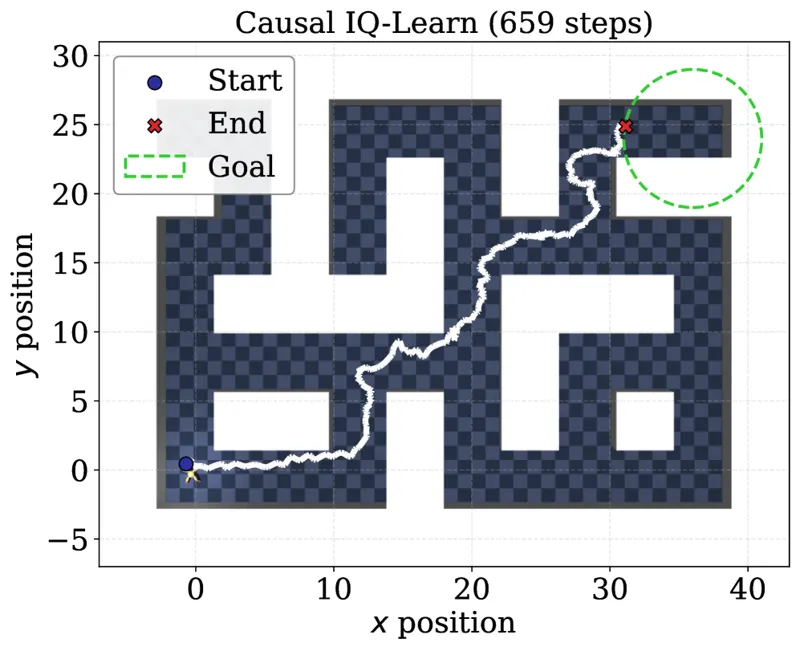
Imitation learning enables learning a policy in an unknown environment with a latent reward signal using expert demonstrations, but it struggles when the imitator's and expert's observations are mismatched and unobserved confounders are present in expert demonstrations. By identifying appropriate adjustment sets via the sequential π-backdoor criterion, causal imitation learning (CIL) provides a framework for approximating the expert's policy from confounded data. However, existing CIL methods, Causal Behavioral Cloning (Causal BC) and Causal Generative Adversarial Imitation Learning (Causal GAIL), are designed for short-horizon, low-dimensional settings. When applied to continuous control tasks with long horizons and high-dimensional state-action spaces, these methods exhibit poor performance: Causal BC suffers from compounding errors, Causal GAIL is unstable and sample-inefficient, and sequential π-backdoor adjustment becomes impractical. We introduce Causal Soft Q Imitation Learning (SQIL) and Causal Inverse soft-Q Learning (IQ-Learn), two off-policy causal imitation learning algorithms that combine the causal adjustment framework with state-of-the-art inverse reinforcement learning objectives. Both algorithms operate on causally-adjusted state representations produced by an efficient approximation of the sequential π-backdoor criterion, exploiting the causal structure of continuous control environments to reduce the full-horizon adjustment to a fixed-size sliding window. We evaluate all methods in a suite of confounded environments and find that Causal SQIL and Causal IQ-Learn substantially outperform prior CIL algorithms on long-horizon tasks, sometimes surpassing the expert, whereas all causally unaware imitation methods fail to learn meaningful behavior.

Imitation LearningCausal Inference
Eylam Tagor, Mingxuan Li, Elias Bareinboim · 469 views · Jul 18, 2026
MEVION: Low-Cost Open-Source Data Collection System for Powerful and High-Speed Dual-Arm Manipulation

MEVION: Low-Cost Open-Source Data Collection System for Powerful and High-Speed Dual-Arm Manipulation

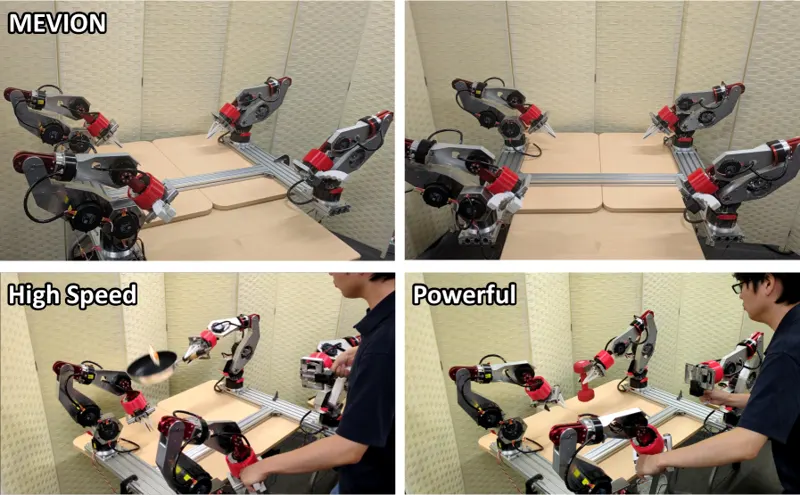
The global competition for developing robotic foundation models is intensifying. Among the data collection systems used for dual-arm robots, ALOHA is representative of being low-cost and open-source, and is widely adopted by researchers as a de facto standard. However, due to its limited ability to generate high forces and speeds, it is difficult to handle heavy objects or perform fast manipulations. To address this, we developed MEVION, a low-cost and open-source dual-arm robot data collection system capable of generating greater force and speed. All parts of this robot can be sourced through e-commerce, and by extensively utilizing sheet metal welding, its large body structure is constructed with a small number of components at low cost, while also simplifying assembly. MEVION is equipped with four 6-DoF arms with parallel grippers. Each arm weighs 7.0 kg and has a maximum torque of 60 Nm, and the entire system can be constructed for about USD 14,000. The elbow joint adopts a closed-link mechanism similar to those used in quadruped robots, which reduces the distal mass and enables higher force and speed output at the end-effector. We demonstrate that MEVION enables data collection for object manipulation tasks not previously possible and supports imitation learning-based motion generation. All hardware and software of this work are included in the Supplementary Materials or https://github.com/haraduka/mevion.

Data CollectionDual-Arm
Kento Kawaharazuka, Yoshiki Obinata, Hirokazu Ishida · 557 views · Jul 20, 2026

As an Amazon Associate, we earn from qualifying purchases.