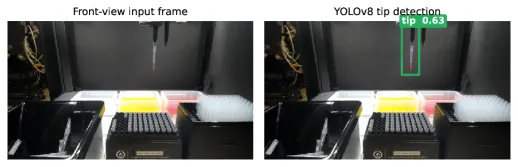
Self-driving laboratories increasingly rely on low-cost liquid handlers such as the Opentrons OT-2, which ship without the pressure-based aspiration monitoring of Hamilton or Tecan systems and are typically run open-loop. Two failure modes go undetected: protocols that are syntactically valid but violate assay-specific invariants (e.g., tip reuse between a PCR template and a no-template control), and physical execution failures (partial dispense, air bubbles, missing tips) at runtime. We present AEGIS, a two-layer guardian for both. Layer 1 pairs a curated machine-readable assay rule database with an LLM that reasons over OT-2 Python code, reaching an adjusted F1 of 0.97 on a 24-protocol benchmark across five assay families and beating rules-only and LLM-only ablations across five backends; a free open-weight model ties the best proprietary one, so no paid API is required. Layer 2 fits a PCA world model to YOLO-cropped four-frame pipette trajectories; under a leakage-free leave-one-plate-out evaluation it reaches average precision 0.89 and operating-point F1 0.71 (AUROC 0.80), a deployment-faithful number that matches the live demonstration, and we characterize the small-pipette (p20) resolution limit (F1 0.47). A live demonstration on a physical OT-2 (five replicates per condition) catches planted no-tip failures deterministically and partial dispense on coloured dyes, with an always-VLM self-vote gate lifting partial-dispense recall to 5/5; transparent water is a principled limit of any front-view-only monitor, which AEGIS surfaces as low-confidence VLM reasoning rather than a wrong verdict. Cascade triage holds VLM cost near $1.63 per plate versus $10.33 for an always-VLM baseline. AEGIS is open source and, to our knowledge, the first system to unify pre-flight assay-aware validation with runtime visual monitoring for an open-source liquid handler.
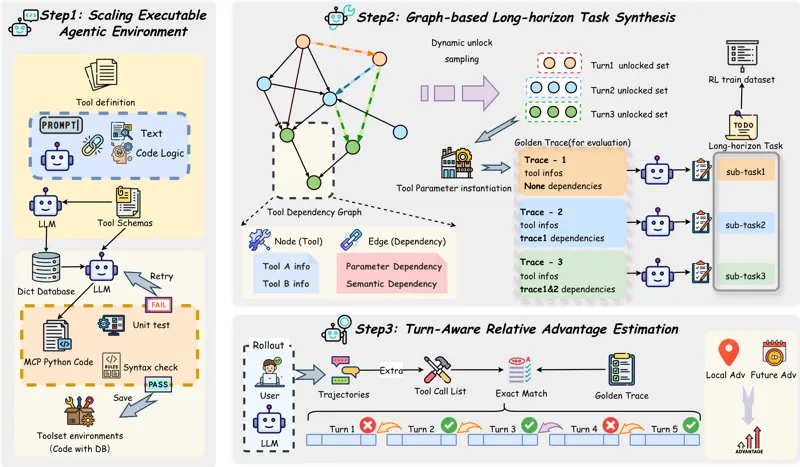
While LLM agents demonstrate strong reasoning abilities in compact and well-defined scenarios, they struggle to maintain robustness and effectiveness when faced with large-scale, diverse, and dynamic real-world environments that demand seamless tool integration. To address this gap, we introduce ToolVerse, a comprehensive framework that scales up agentic RL environments and enables agents to perform complex long-horizon reasoning in Tool-Integrated Reasoning (TIR) tasks. First, ToolVerse automatically builds the massive executable agent training environments from nearly 400 real-world Model Context Protocols (MCPs) that contain about 4500 tools. Second, we propose a task design strategy based on a tool dependency graph, utilizing Dynamic Unlocking Sampling Algorithm to generate long-horizon tasks, and produce GUST (Graph Unlocking Sampling Tasks) dataset. Third, to alleviate the credit assigment problem in long-horizon agentic RL, we propose a fine-grained Turn-Aware Relative Advantage algorithm. We conduct extensive Agentic RL training using ToolVerse and evaluate our framework on serveral agentic benchmarks. Experimental results demonstrate that our framework significantly strengthens LLMs' capabilities in long-horizon tool use, achieving a marked performance boost and showcasing robust reasoning within dynamic environments.
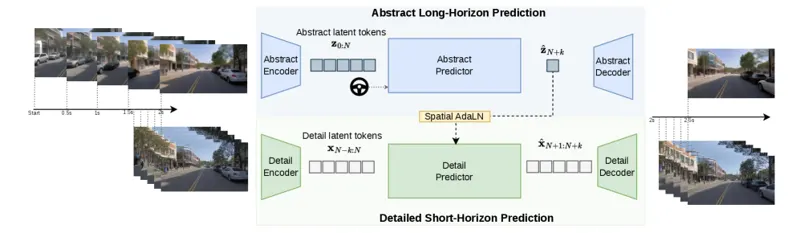
Current world models operate at a single level of abstraction, with most prioritizing perceptual fidelity while lacking the spatial reasoning and semantic understanding required for real-world downstream tasks. We present a hierarchical driving world model that factorizes future prediction across two levels operating at distinct temporal and abstraction scales: a high-level predictor that forecasts coarse scene structure over extended temporal horizons, and a low-level generator that produces detailed predictions conditioned on the high-level output. This decomposition yields high perceptual fidelity while also capturing strong spatial and semantic representations. We further show that pretraining with a diffusion forcing objective yields substantially richer internal representations than the standard teacher forcing objective, while teacher forcing – predicting only the next frame from clean context – produces more stable autoregressive rollouts. We therefore introduce a generic two-stage training paradigm that pretrains the model with diffusion forcing and fine-tunes with teacher forcing, combining the representational benefits of the former with the rollout stability of the latter. Our approach achieves state-of-the-art results across the standard suite of driving world model evaluations on established benchmarks, including long-horizon generation fidelity, steering responsiveness evaluated on counterfactual scenarios, and internal representation quality. Project page with code, demo, checkpoints and qualitative results: https://lmb-freiburg.github.io/orbis2.github.io/
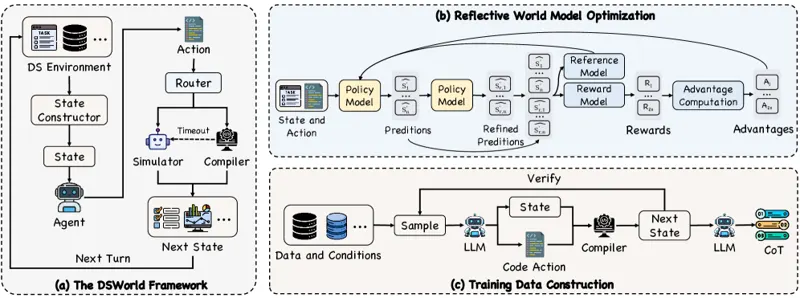
Despite strong capabilities in data understanding and decision-making, autonomous data science agents still heavily rely on trial-and-error workflows that involve expensive computation. This bottleneck motivates models that can anticipate the effects of data science operations before real execution. In this paper, we introduce the concept of Data Science World Model, which model the data science execution environment by predicting environment state transitions conditioned on current workflow states and candidate operations. We further propose DSWorld, a practical framework that combines structured state construction, cost-aware routing, lightweight real execution, and an LLM-based simulator for expensive operations. To support training, we construct an 8K-scale transition trajectory dataset and introduce Reflective World Model Optimization, an error-aware reinforcement learning strategy for improving transition prediction. Experiments show that DSWorld accelerates RL-based agent training by approximately 14× and search-based inference by approximately $3$-6× while maintaining competitive performance, and outperforms the strongest LLM baseline by 35.6% on transition prediction tasks. The code is available at https://anonymous.4open.science/r/DSWorld.