Skip to content
XBot-Omni: An Omni-Modal Model for Embodied Understanding and Interaction

XBot-Omni: An Omni-Modal Model for Embodied Understanding and Interaction

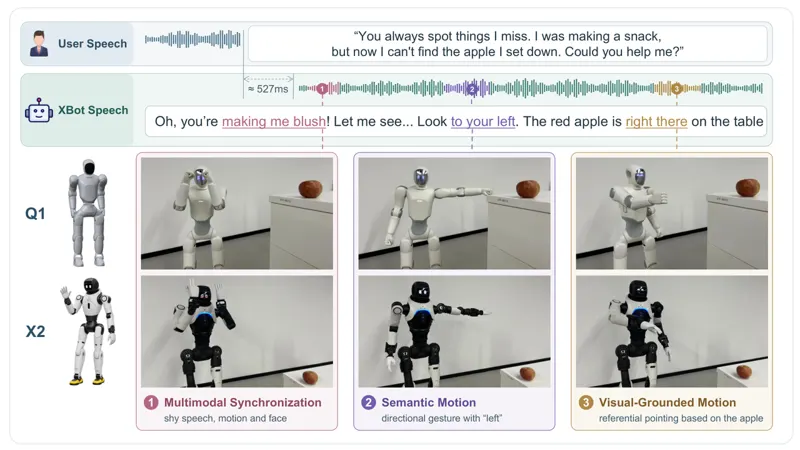
Embodied interaction requires an agent to integrate multimodal perception with verbal and nonverbal behaviors to effectively communicate its intentions, including speech, body motion, and facial expressions. We present XBot-Omni, a Thinker–Talker–Actor architecture that extends the Omni paradigm to robotic modalities, including body motion and facial expressions, with ``X'' representing the extensibility to robotic-specific modalities. The Thinker processes text, images, audio, and video to formulate contextually appropriate responses, which are then realized by the Talker and Actor through speech and coordinated bodily expressions, respectively. In this report, we innovatively introduce the concept of ``Actor'' as a dedicated component for embodied agents: a coordinated, streaming module that leverages the native representations of the Thinker and Talker within an end-to-end pipeline, introducing only modest latency overhead. This unified architecture enables multimodal generation conditioned on omni-modal inputs directly to prevent information loss in staged designs. We comprehensively evaluate XBot-Omni across seven benchmarks, demonstrating strong multimodal understanding capabilities on both general-domain and robot-centric videos, as well as high-quality, natural, and well-coordinated motion generation. Furthermore, our results validate its capability to generate embodied multimodal responses directly from omni inputs, meeting the diverse requirements of embodied interaction. XBot-Omni enables robots not only to perceive the omni world but also to express themselves through speech and bodily behaviors, extending Omni models from conversational interaction to embodied communication in physical environments.
Embodied AIOmni-Modal Model
Kerui Gu, Xing Fu, Shuoyang Sun · 309 views · Nov 12, 2026
DyCraft: An Agentic System for Long-Horizon 4D Scene Generation

DyCraft: An Agentic System for Long-Horizon 4D Scene Generation

While frontier coding agents can generate high-quality 3D scenes and articulated assets, they struggle to create coherent long-horizon animations. When equipped with general-purpose harnesses, they frequently produce physically implausible outputs, generating objects that interpenetrate, lack physical support, or move unnaturally. Such bare agents struggle to repair these errors because they default to scripting the full animation in one pass, making it difficult to verify their work and disentangle complex spatiotemporal constraints. Drawing on the practice of human animators, we introduce DyCraft, a system for animated 3D scene generation that breaks animation into steps that coding agents can more reliably solve. DyCraft first expands the user's prompt into a detailed plan and builds a static scene. It then creates a 3D storyboard of key animation poses, where each frame is a static 3D scene that the agent can build and debug in isolation. Storyboarding decomposes the problem into pairs of verified start and end states, allowing the agent to author local motion between them with a collection of motion authoring tools. We evaluate DyCraft on 24 long-horizon, multi-shot animation tasks covering humanoid robots, human and animal characters, and physical mechanisms. Compared with a native GPT-6 agent in Codex and prior agentic baselines, DyCraft substantially reduces physical violations and generates higher-quality animated 3D scenes that are more often preferred by human raters.

4D GenerationAgentic AI
Jeff Tan, Hang Dai, Zeqian Long · 290 views · Oct 29, 2026
RAVEN: A Unified Active SLAM System for Rapid Autonomous Visual Exploration with Aerial Robots under Localization Uncertainty

RAVEN: A Unified Active SLAM System for Rapid Autonomous Visual Exploration with Aerial Robots under Localization Uncertainty

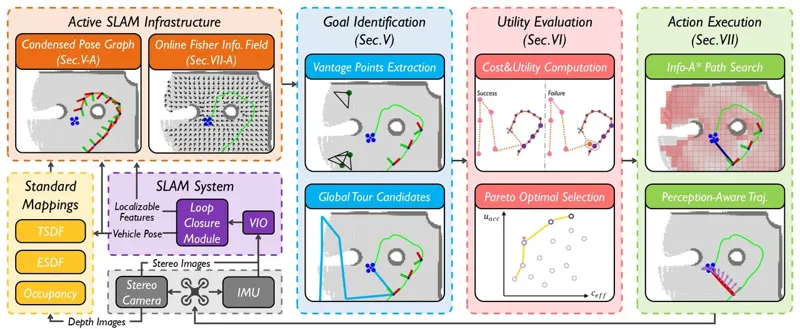
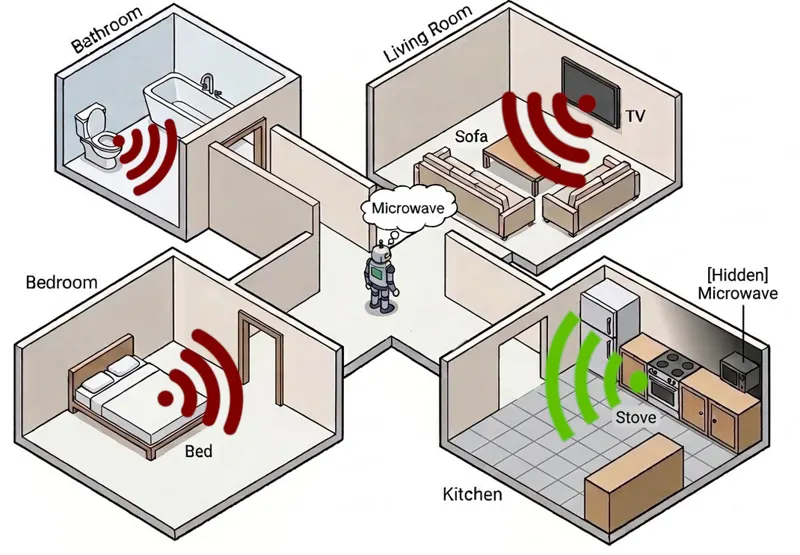
Active simultaneous localization and mapping (SLAM) addresses the problem of planning robot motion to build complete and accurate maps of unknown environments through efficient exploration while maintaining high localization accuracy. This raises a dilemma between exploring unknown spaces to expand coverage and exploiting visited regions to perform active loop closures. Despite numerous prior works on ground robots, aerial robots with high agility and constrained sensor suites face more significant localization drift and thereby demand dedicated active SLAM planning. Moreover, a unified strategy that adapts performance based on task-specific priorities remains an open question. In this article, we introduce RAVEN, a unified active SLAM framework for Rapid Autonomous Visual ExploratioN using quadrotors, which systematically accounts for localization uncertainty. The framework starts with identifying frontiers and active loop closure candidates, from which global tour candidates are generated. These candidates are evaluated using a utility vector that separately quantifies exploration efficiency and localization accuracy, and the final tour is selected according to a prioritization parameter ranging from [0,1]. Finally, a perception-aware navigation planner generates smooth execution trajectories that minimize visual state estimation error based on the online Fisher information field that provides visual localization information in real-time. Benchmark evaluations demonstrate that RAVEN outperforms state-of-the-art active SLAM methods, highlighting its advantages in producing a spectrum of performance across prioritizations. Fully onboard field experiments with a customized stereo-inertial quadrotor further validate its practical applicability in challenging environments. The source code will be released to benefit the community.

Aerial RoboticsActive SLAM
Xinyi Chen, Yichen Zhang, Chenxing Jiang · 196 views · Oct 27, 2026
GS3LAM: Gaussian Semantic Splatting SLAM

GS3LAM: Gaussian Semantic Splatting SLAM

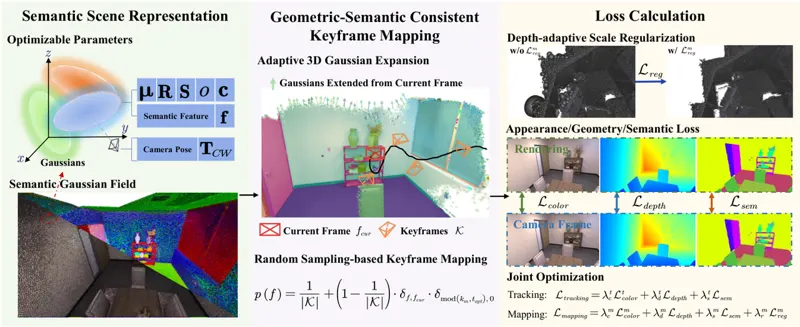
Recently, the multi-modal fusion of RGB, depth, and semantics has shown great potential in dense Simultaneous Localization and Mapping (SLAM). However, a prerequisite for generating consistent semantic maps is the availability of dense, efficient, and scalable scene representations. Existing semantic SLAM systems based on explicit representations are often limited by resolution and an inability to predict unknown areas. Conversely, implicit representations typically rely on time-consuming ray tracing, failing to meet real-time requirements. Fortunately, 3D Gaussian Splatting (3DGS) has emerged as a promising representation that combines the efficiency of point-based methods with the continuity of geometric structures. To this end, we propose GS3LAM, a Gaussian Semantic Splatting SLAM framework that processes multimodal data to render consistent, dense semantic maps in real-time. GS3LAM models the scene as a Semantic Gaussian Field (SG-Field) and jointly optimizes camera poses and the field via multimodal error constraints. Furthermore, a Depth-adaptive Scale Regularization (DSR) scheme is introduced to resolve misalignments between scale-invariant Gaussians and geometric surfaces. To mitigate catastrophic forgetting, we propose a Random Sampling-based Keyframe Mapping (RSKM) strategy, which demonstrates superior performance over common local covisibility optimization methods. Extensive experiments on benchmark datasets show that GS3LAM achieves increased tracking robustness, superior rendering quality, and enhanced semantic precision compared to state-of-the-art methods. Source code is available at https://github.com/lif314/GS3LAM.

Semantic SLAMGaussian Splatting
Linfei Li, Lin Zhang, Zhong Wang · 219 views · Mar 29, 2026

As an Amazon Associate, we earn from qualifying purchases.