Skip to content
UniWAM: Unified World-Action Model

UniWAM: Unified World-Action Model

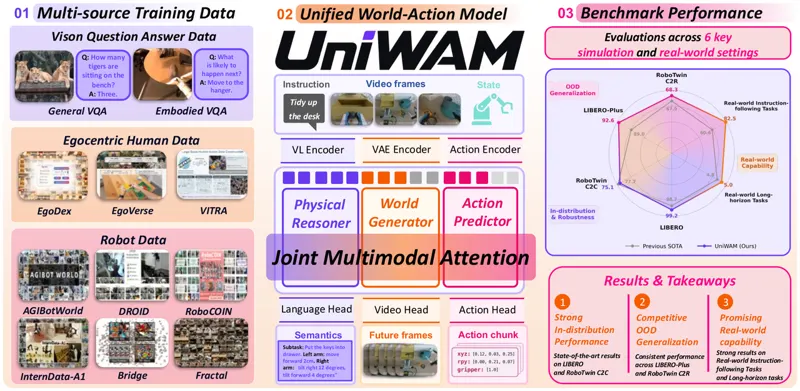
Vision-language-action models benefit from the understanding and reasoning capabilities of pretrained vision-language models, but action-only supervision provides limited grounding in world dynamics. Conversely, world-action models inherit spatiotemporal priors from video generation models, yet remain limited in semantic understanding and reasoning under distribution shifts. We introduce UniWAM, a unified architecture that integrates a physical reasoner, a world generator, and an action predictor to jointly learn semantic understanding of the physical world, visual generation, and action prediction. To ensure the quality of the training data, we developed a rigorous data cleaning and annotation pipeline for both human egocentric data and robot data. To adapt the vision-language component to embodied tasks while preserving its inherited language capabilities, we represent low-level actions in natural language and introduce a pre-training recipe that assigns complementary supervision from visual question answering (VQA) data, human egocentric data, and robot demonstrations to the appropriate model components. During post-training, future visual noise augmentation reduces reliance on precise future predictions, while history-conditioned flow matching uses encoded action history to initialize action generation. Together, these designs significantly reduce denoising steps while maintaining performance. UniWAM achieves state-of-the-art (SOTA) performance across multiple evaluations, including in-distribution performance, robustness, generalization, instruction following, and long-horizon task execution. Furthermore, we uncover a log-linear scaling law of unified human-robot co-training, demonstrating the effectiveness of large-scale pre-training on a mixture of human and robot data.
World-action modelsVision-language-action (VLA)
Wenxuan Song, Jiayi Chen, Jingbo Wang · 278 views · Oct 1, 2026
OmniBrain-0: A Unified Agentic Model for Embodied Intelligence

OmniBrain-0: A Unified Agentic Model for Embodied Intelligence

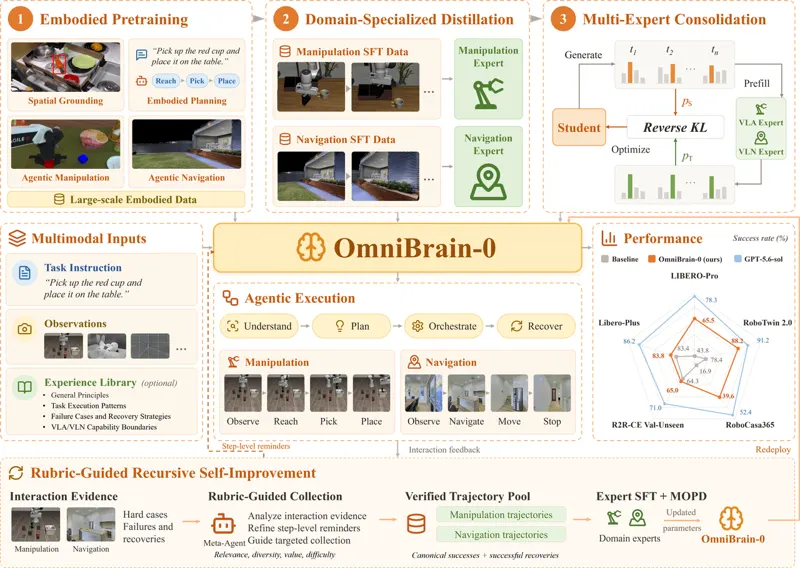
General-purpose embodied intelligence requires robots to coordinate diverse skills over long horizons, track task progress, and recover from failures. Specialist policies alone do not ensure task-level reliability, while powerful multimodal agents rely on costly reasoning and external experience that compact models struggle to reproduce. We introduce OmniBrain-0, a lightweight unified embodied agent that coordinates manipulation and navigation through a shared high-level decision model, integrating task understanding, planning, progress tracking, and feedback-driven recovery. Our progressive training framework combines embodied pretraining, domain-specialized agent distillation, and multi-teacher on-policy distillation (MOPD). It distills powerful teachers' interaction experience into manipulation and navigation experts, then consolidates their decision capabilities into OmniBrain-0. Unification therefore occurs within the learned decision model rather than only at the tool interface. We further introduce Rubric-Guided Recursive Self-Improvement (RSI), a data flywheel in which a Meta-Agent turns execution evidence into refined rubrics, step-level reminders, and verified trajectories for domain-expert updates before their reconsolidation into OmniBrain-0 through MOPD. We evaluate OmniBrain-0 on LIBERO-Pro, LIBERO-Plus, RoboCasa365, RoboTwin 2.0, and R2R-CE Val-Unseen, as well as multiple real-world manipulation tasks. OmniBrain-0 combines strong cross-domain task performance with substantially lower inference and execution overhead than its closed-source teacher, demonstrating efficient transfer and consolidation of embodied capabilities into a compact unified agent.

Embodied AIVLA
Xiaomi Embodied Intelligence Team, Yuechen Luo, Chong He · 510 views · Oct 26, 2026

As an Amazon Associate, we earn from qualifying purchases.