Skip to content
METATRON: A Promptable Whole-Body Execution Layer for Humanoids

METATRON: A Promptable Whole-Body Execution Layer for Humanoids

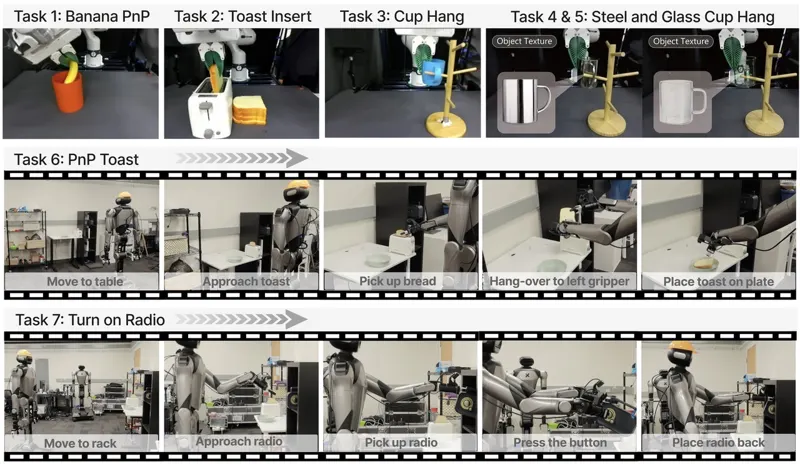
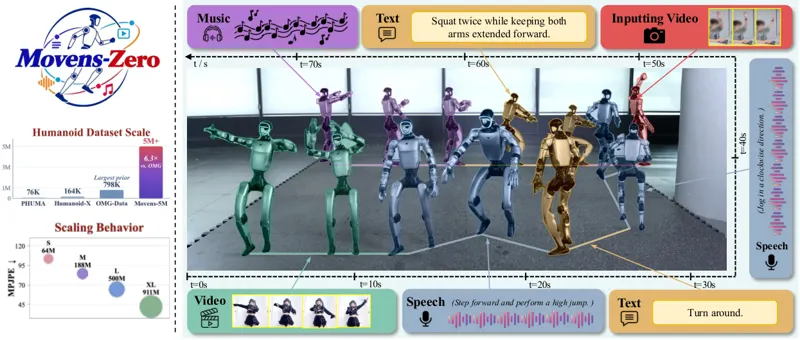
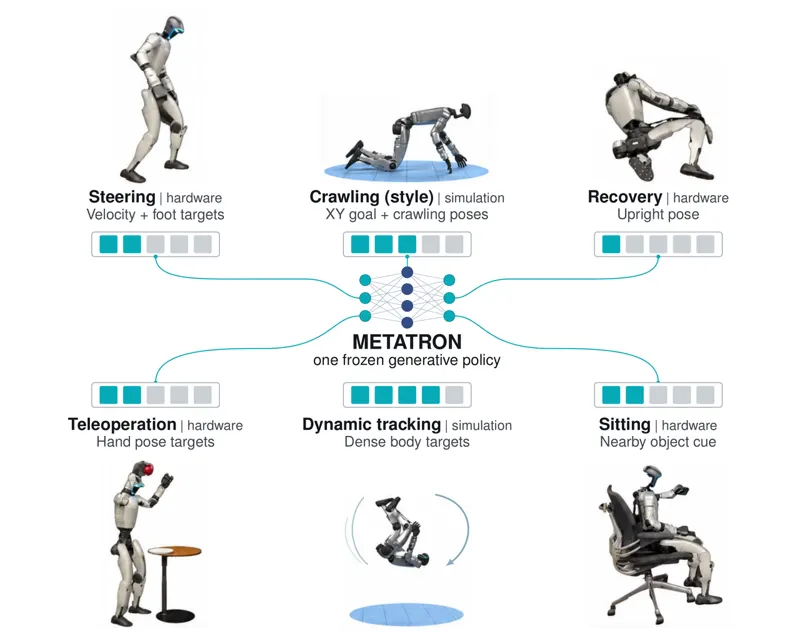
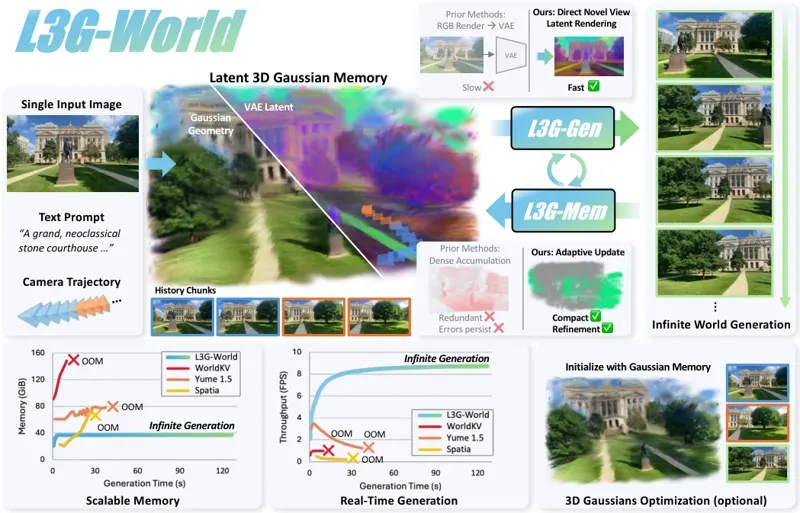
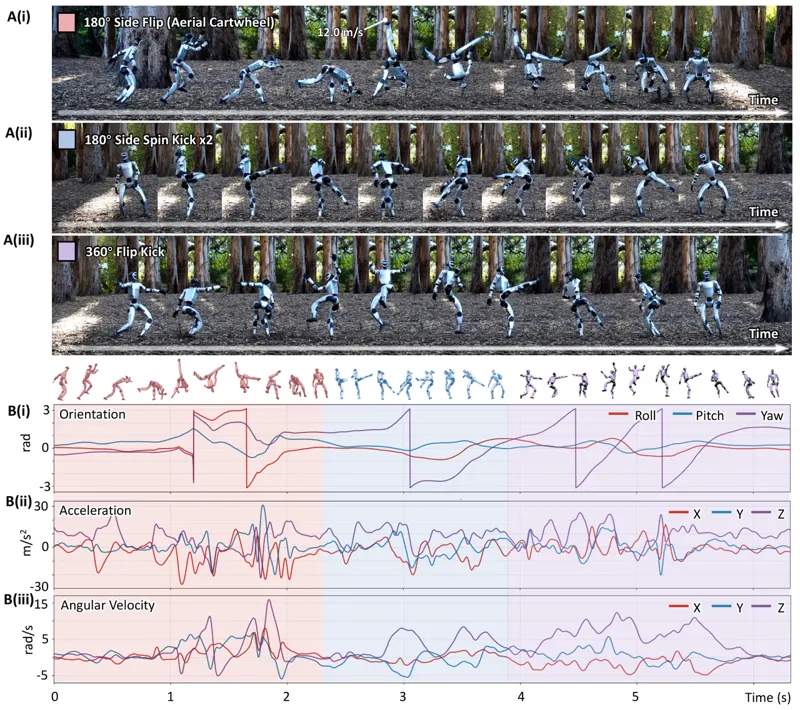
Humanoid controllers often require task-specific training despite sharing the need for balance and whole-body coordination. We present Metatron, a promptable whole-body execution layer combining a generative base policy with a programmable skill layer. The base policy receives partial goals, collectively called a prompt, that can combine timed body-part targets, velocity commands, and style cues. It produces diverse whole-body motions consistent with these goals. Training combines motion capture, synthetic recovery trajectories, and retargeted scene-interaction motions. After training, the policy is frozen. Stateful programs called skills express task intent as prompts at each control step, drawing rough geometric sketches that the policy turns into coordinated movement. Skills are ordinary code, refined by coding agents that analyze motion data and fit compact rules without task-specific policy training. On the physical Unitree G1, one frozen checkpoint supports walking, recovery, teleoperated object pickup, and sitting on furniture. Comparative evaluations show higher reaching success and push robustness than the tested reference-tracking pipelines. The same recipe produces climbing and acrobatics on a simulated character. Metatron enables coding agents to turn learned motor capabilities into new skills through code, without further policy training.

HumanoidWhole-Body Control
Chen Tessler, Yifeng Jiang, Alec Otto · 850 views · Oct 27, 2026
Memory Tax: Dissecting the Net Value of Agent Memory

Memory Tax: Dissecting the Net Value of Agent Memory

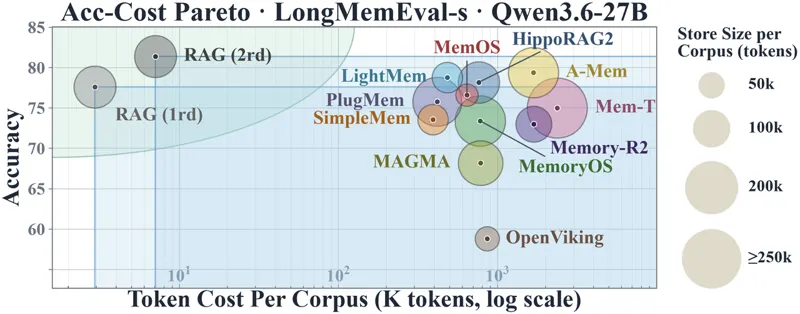
Memory is increasingly used in long-horizon agents, yet the net value of building memory over direct retrieval from raw history remains largely unclear. Through a large-scale evaluation across multiple benchmarks and model backbones, we find many dedicated memory systems underperform naive RAG in many cases, indicating a negative net value. Taking RAG as a reference, we dissect the net value of memory into the gains and losses over direct retrieval, termed memory benefit and memory tax. These gains and losses arise because memory process changes how the raw information is organized and accessed. We view such changes as the double-edged deviations from the raw history. They are originally designed and introduced to benefit the task, for example by reorganizing facts or distilling preferences, but some may also remove or obscure evidence, giving rise to memory tax. Since memory benefit reflects the expected gains of its design, we then focus more on the overlooked memory tax, study how it arises from the system and evaluation side, and generalize the concept to more application scenarios of memory. We hope the notion of memory tax can provide a new lens and shift more attention from standalone performance to the net value of memory, informing more reliable memory designs and evaluations. We will open-source the code and results to the community. Project Page: https://hexuan21.github.io/MemoryTax/

Agent MemoryLong-Term Memory
Xuan He, Sining Zhoubian, Ruozhen Yang · 584 views · Oct 25, 2026

As an Amazon Associate, we earn from qualifying purchases.