Skip to content
CPNav: Calibrated Vision-Language Navigation for Object-Goal Search in Unseen Environments

CPNav: Calibrated Vision-Language Navigation for Object-Goal Search in Unseen Environments

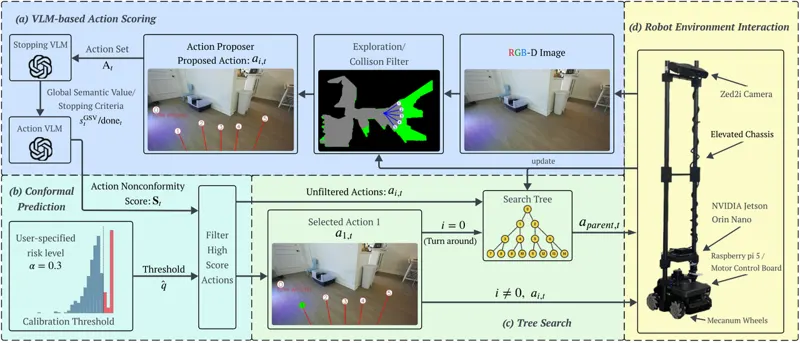
Directing a robot to locate a target object in unseen environments remains a central challenge in embodied AI. Vision-Language Model (VLM)-based methods provide rich semantic reasoning but often produce uncalibrated and overconfident action decisions. We introduce CPNav, a navigation framework that combines collision-aware planning with statistically calibrated VLM action scoring for map-free object-goal navigation. From RGB-D input, CPNav constructs a navigability map, generates collision-free motion primitives, and queries two VLMs for goal detection and action scoring. The resulting scores are calibrated offline via conformal prediction (CP) using oracle actions obtained through a tree-structured exploration procedure with backtracking, providing finite-sample guarantees at a user-specified risk level. The CP layer is model-agnostic and can wrap any VLM policy. Online, calibrated VLM scores guide action selection, while a tree-structured exploration history records alternative actions and allows backtracking. We evaluate CPNav in both simulation and real-world hardware settings. In AI Habitat simulation, compared with the uncalibrated baseline method, CPNav achieves relative SR and SPL improvements of 6.2% and 11.4% on HM3D v0.2, and 12.4% and 8.8% on MP3D, respectively. In real-world deployment on a modified Hiwonder MentorPi robot, the corresponding improvements in SR and SPL are 24.9% and 15.2%, respectively. Code is available at https://github.com/practice-lab-ucla/CPnav.

Vision-language navigationObject-Goal Navigation
Qizhao Chen, Yuanhong Zeng, Shoh Nishino · 123 views · Nov 7, 2026
OmniBrain-0: A Unified Agentic Model for Embodied Intelligence

OmniBrain-0: A Unified Agentic Model for Embodied Intelligence

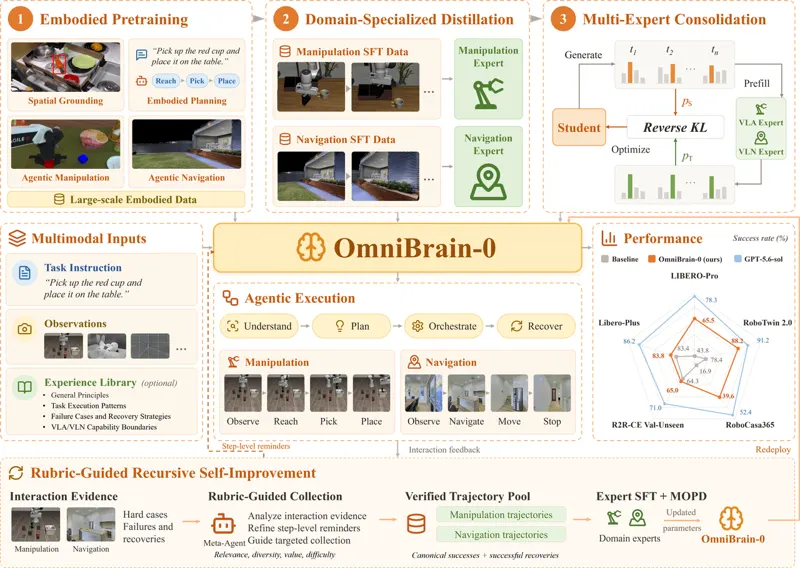
General-purpose embodied intelligence requires robots to coordinate diverse skills over long horizons, track task progress, and recover from failures. Specialist policies alone do not ensure task-level reliability, while powerful multimodal agents rely on costly reasoning and external experience that compact models struggle to reproduce. We introduce OmniBrain-0, a lightweight unified embodied agent that coordinates manipulation and navigation through a shared high-level decision model, integrating task understanding, planning, progress tracking, and feedback-driven recovery. Our progressive training framework combines embodied pretraining, domain-specialized agent distillation, and multi-teacher on-policy distillation (MOPD). It distills powerful teachers' interaction experience into manipulation and navigation experts, then consolidates their decision capabilities into OmniBrain-0. Unification therefore occurs within the learned decision model rather than only at the tool interface. We further introduce Rubric-Guided Recursive Self-Improvement (RSI), a data flywheel in which a Meta-Agent turns execution evidence into refined rubrics, step-level reminders, and verified trajectories for domain-expert updates before their reconsolidation into OmniBrain-0 through MOPD. We evaluate OmniBrain-0 on LIBERO-Pro, LIBERO-Plus, RoboCasa365, RoboTwin 2.0, and R2R-CE Val-Unseen, as well as multiple real-world manipulation tasks. OmniBrain-0 combines strong cross-domain task performance with substantially lower inference and execution overhead than its closed-source teacher, demonstrating efficient transfer and consolidation of embodied capabilities into a compact unified agent.
Embodied AIVLA
Xiaomi Embodied Intelligence Team, Yuechen Luo, Chong He · 510 views · Oct 26, 2026
NavJev: Efficient Vision-Language Navigation via Action-Centric Visual Compression and Discriminative Action-Semantic Memory

NavJev: Efficient Vision-Language Navigation via Action-Centric Visual Compression and Discriminative Action-Semantic Memory

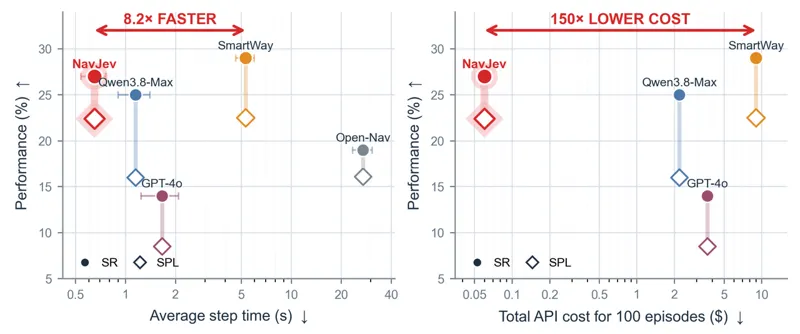
Recent zero-shot Vision-and-Language Navigation (VLN) methods increasingly rely on multimodal large language models (MLLMs) to reason over visual observations, navigation instructions, and candidate actions. Although effective, repeatedly invoking autoregressive multimodal reasoning at every navigation step introduces substantial inference latency, limiting the responsiveness of embodied agents. We propose NavJev, an efficient VLN framework that reformulates online navigation from repeated multimodal generation into compact visual compression followed by lightweight typed action selection. Specifically, Action-Centric Visual Compression (ACVC) integrates waypoint geometry, BLIP captions, and RAM semantic tags into compact representations of candidate actions, while Discriminative Action-Semantic Memory (DASM) filters shared semantics and maintains discriminative action-specific evidence across navigation steps. Based on these representations, Jev directly performs structured probabilistic decisions over the available action set. Experiments on R2R-CE show that NavJev achieves 27.0% SR and 22.4% SPL with only 0.65 s per navigation step, while substantially reducing inference latency and cost compared with MLLM-based VLN methods. The project page is available at https://kai-sheng-caesar.github.io/NavJev/.

Vision-language navigationZero-Shot
Kai Sheng, Liuyi Wang, Jinlong Li · 393 views · Sep 28, 2026
SimpleVLN: Towards Simple and Frontier Vision-Language Navigation

SimpleVLN: Towards Simple and Frontier Vision-Language Navigation

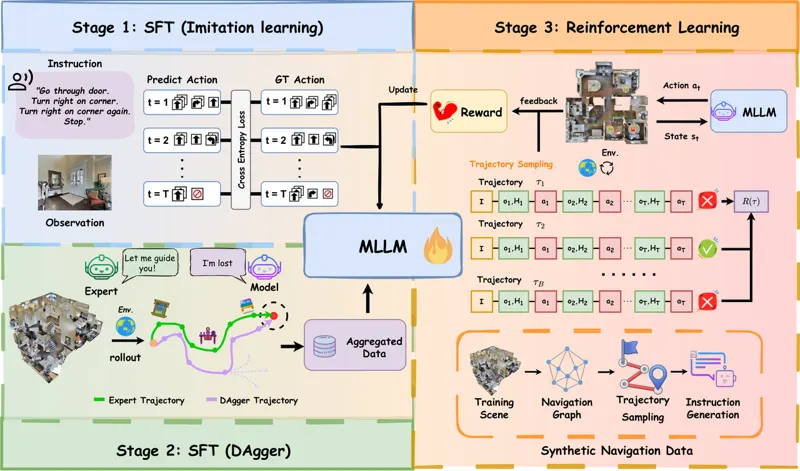
Vision-and-Language Navigation (VLN) requires embodied agents to ground language in visual observations and make long-horizon decisions. Existing methods often address these demands through task-specific architectures. As multimodal large language models (MLLMs) become increasingly capable, an important question remains: Have we truly unlocked the potential of native MLLMs for VLN before introducing task-specific architecture? We present SimpleVLN, an architecture-preserving framework developed through studies of navigation formulation, data construction, and optimization. At the formulation level, SimpleVLN combines single-turn decision inputs with fixed-budget global-local memory to efficiently use navigation history without unbounded context growth, while action chunks enable efficient output of multiple primitive actions per model invocation. For data construction, we combine expert demonstrations with policy-dependent DAgger experience and develop a scalable synthesis pipeline that generates large-scale tasks for reinforcement learning. At the optimization level, a progressive IL-DAgger-RL pipeline advances from action imitation to task-level outcome optimization. Comprehensive experiments validate the effectiveness of these three aspects. We instantiate SimpleVLN across multiple MLLM backbones and model sizes, demonstrating its generality. SimpleVLN achieves 76.7% and 80.1% success rates on the R2R-CE and RxR-CE splits, respectively, substantially outperforming existing methods. These results show that the navigation capabilities of native MLLMs can be effectively unlocked without task-specific architectural designs.

Vision-language navigationEmbodied AI
Lingyi Hong, Weiren Cai, Jiayu Chen · 554 views · Oct 16, 2026

As an Amazon Associate, we earn from qualifying purchases.