Skip to content
PAPERJul 21, 2026

Agentic Real2Sim: Physics-based World Modeling with Vision-Language Agents

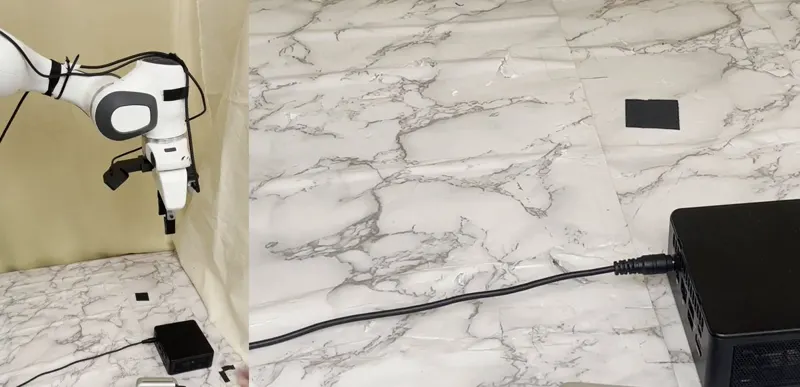
Real-to-sim conversion for robotic interaction with objects remains labor-intensive because it requires more than visual reconstruction: a streamlined real2sim process must recover scene geometries and object states, infer physical parameters, and assemble actors, objects, cameras, poses, and trajectories into a runnable physical simulation. Today this process still depends on manual tuning of visual foundation models, mesh cleanup, coordinate-frame alignment, and brittle workflow glue across visual perception tools and simulators. We introduce Agentic Real2Sim, a framework for generalized physical world modeling with vision-language agents, converting a real-world recording of object-robot interaction into a simulatable episodic twin which preserves observations, geometries, robot interactions, and object states. We evaluate Agentic Real2Sim on rigid-object manipulation, deformable-object interaction, and humanoid motion scenes, spanning domains that are usually handled by separate Real2Sim pipelines, marking a first step toward scalable conversion. The framework's agentic decisions can be driven by an open-weight VLM backend at a small fraction of the cost of frontier models, while attaining comparable conversion success rate. We aim to use the resulting real-world-aligned twins for downstream robotics tasks, specifically policy learning and evaluation. The project site is available at https://agentic-real2sim.github.io/.

Guanxiong Chen, Qianjun Xia, Jiawei Peng

Sim-to-RealWorld ModelsVision-language modelsPhysics simulation
PAPERJul 21, 2026

ZeroSplat: Generalized Referring Segmentation in 3D Gaussian Splatting

Recent advancements in 3D Gaussian Splatting (3DGS) have enabled language-guided scene understanding. However, existing Referring 3D Gaussian Splatting (R3DGS) methods are fundamentally restricted to single-target queries. To reflect the ambiguity of real-world instructions, we introduce the Generalized Referring 3D Gaussian Splatting Segmentation (GR3DGS) task, which requires dynamically segmenting an arbitrary number of targets (0, 1, or N). To facilitate comprehensive evaluation of this new task, we construct two new benchmarks: GR-LERF and GR-ScanNet. Crucially, existing R3DGS paradigms exhibit fundamental technical bottlenecks that severely limit their performance on the GR3DGS task: they lack intrinsic 3D point-level understanding by operating merely on 2D rendered pixels, and they incur prohibitive computational overhead by requiring per-scene optimization to embed heavy semantic features. To dismantle these bottlenecks, we propose ZeroSplat, a novel training-free and zero-feature framework. ZeroSplat lifts 2D Vision-Language Model (VLM) priors into 3D space through robust multi-view geometric constraints. This strategy enables intrinsic point-level understanding without incurring any additional feature storage. Extensive experiments demonstrate that ZeroSplat significantly outperforms state-of-the-art methods across generalized and single-target scenarios while maintaining exceptional efficiency. Project Page: https://inkmind-ai.github.io/ZeroSplat

Jiayu Ding, Meilu Song, Xiaoyi Zhang

3D Gaussian Splatting
PAPERJul 20, 2026

Patch Policy: Efficient Embodied Control via Dense Visual Representations

Pretrained dense visual features from Vision Transformers (ViTs) are powerful yet have been underutilized in robot learning. Modern robot policies either compress each observation into a single global token, or rely on visual backbones trained from scratch, sacrificing both fine-grained spatial detail and the benefits of large-scale visual pre-training. While there exist policies that do operate on dense patch features like large vision-language-action models (VLAs), they tend to be heavy and slow, inheriting the full cost of a billion-parameter vision-language model (VLM) backbone. We close this gap with Patch Policy, a minimal architectural extension that enables transformer-based policies to consume dense pre-trained patch tokens directly without the computational overhead of a full VLM. At its core is a block-causal attention mask that preserves the temporal causality of standard policies while letting the model attend over many patch tokens per observation, alongside other state information. Patch Policy is lightweight, fast, and highly effective. Across four simulated and three real-world environment suites, our method achieves a 40% relative improvement over policies using state-of-the-art global-pooled representations. Furthermore, it surpasses fine-tuned OpenVLA-OFT by 18% while using roughly 0.7% of the parameters. We believe Patch Policy provides a pipeline for the robotics community to readily leverage continuing progress in visual representation learning, without sacrificing the training efficiency or inference speed required for high-frequency, reactive control. Videos can be viewed at https://patch-policy.github.io

Gaoyue Zhou, Zichen Jeff Cui, Ada Langford

Patch PolicyDense Visual RepresentationDINOv2WebSSL
PAPERJul 20, 2026

World Translation: Minimizing Sim-to-Real Gap with Backward Dynamics Extraction and Unpaired Domain Translation

The gap between simulation and reality remains a fundamental challenge in deploying simulation-trained robotic policies in the real world. Real-to-sim methods narrow this gap from the real side, learning transition dynamics from real data to build a more realistic digital world. Learned dynamics models are their dominant instance. Such methods, however, face a partial observability problem: the same observation may branch to different transitions due to unobservable factors. Existing methods assume these factors can be recovered from observation history. However, this may fail whenever observation history is uninformative, such as a sudden contact event with no prior warning. To address this limitation, we propose World Translation, which exploits a complementary strength of simulators and learned dynamics. Simulators are deterministic but physically imperfect, while learned models are accurate but underdetermined under partial observability. Rather than predicting transitions forward from history, we extract the unobservable dynamics information backward from an observed transition, then translate this feature across simulation and reality as an unpaired domain-translation problem that preserves dynamics content while transferring domain style. Experiments across humanoid, quadruped, and manipulator platforms show that our method achieves more accurate dynamics modeling than baselines, with the largest gains when unobservable factors cannot be recovered from observation history. Real-robot deployment on Go2 quadruped confirms improved policy transfer.

Xinchen Yao, Leixin Chang, Hua Chen

Sim-to-RealDomain AdaptationWorld ModelsInverse Dynamics
PAPERJul 20, 2026

QIRF Quantum-Inspired Non-Orthogonal Function-Space Compression for 3D Gaussian Splatting

3D Gaussian Splatting (3DGS) achieves high-quality real-time rendering by representing a scene with a large collection of anisotropic Gaussian primitives. However, complex scenes often require millions of Gaussians, resulting in substantial storage and rendering costs. Existing compression methods mainly reduce redundancy through primitive-wise pruning, attribute quantization, clustering, or neural coding, while redundancy caused by strongly overlapping and non-orthogonal Gaussian basis functions remains largely unexplored. We present QIRF, a quantum-inspired non-orthogonal function-space compression method for 3D Gaussian Splatting. QIRF models neighboring Gaussian primitives as a local non-orthogonal basis and formulates primitive reduction as a subspace-aware selection problem. Specifically, an analytic Gaussian overlap matrix and a radiance-response density matrix are constructed to characterize functional redundancy and rendering relevance. Generalized eigendecomposition is then used to identify the dominant local subspace and select representative Gaussian primitives. An RRDM-based response model and detail-aware safeguarding further preserve visually important high-frequency structures under aggressive pruning. Experiments on 13 scenes from Mip-NeRF 360, Tanks and Temples, and Deep Blending show that QIRF reduces the Gaussian count and raw PLY storage by 71.7 percent on average, corresponding to approximately 3.54 times compression, while maintaining reconstruction quality comparable to 3DGS and achieving a marginal average PSNR improvement of 0.10 dB. QIRF also improves the average rendering speed over 3DGS by 34.3 percent. These results suggest that non-orthogonal function-space redundancy is an important yet underexplored source of representational redundancy in explicit Gaussian radiance fields.

Shizeng Jiang, Hao Zhang, Xuerui Ma

3D Gaussian Splatting
PAPERJul 20, 2026

Closing the Loop in Humanoid VLA: Persistent 3D Object Tokens for Verifiable Loco-Manipulation

Vision-language-action policies are a promising foundation for general robot control, but long-horizon humanoid loco-manipulation requires the robot to treat task objects as persistent physical entities across movement, contact, occlusion, and recovery. We study this problem as object-state divergence: the object state used to condition a whole-body action can differ from the state used to decide whether the action achieved the intended physical relation. We propose Persistent Object Tokenization (POT), which maintains role-indexed 3D object records from RGB-D observations and converts them into object tokens for a whole-body action expert. Instantiated as POT-VLA, the same object records condition action generation and support geometric predicate checks, yielding a closed-loop execution system in which object state is both actionable and verifiable. On a Unitree G1, POT-VLA improves a matched direct GR00T-N1.7 baseline from 39/80 to 71/80 successes over eight real-world task families. In an external Being-0-aligned reference, POT-VLA achieves 44/50 successes on aligned service tasks, compared with the 37/50 success reported by the Being-0 paper. The largest gains occur on tasks requiring maintained 3D relations, suggesting that persistent object-centered state is a useful abstraction for verifiable humanoid VLA execution.

Peng Ren, Haoyang Ge, Jiang Zhao

VLARGB-DUnitree G1NVIDIA GR00T

As an Amazon Associate, we earn from qualifying purchases.