Skip to content
PAPEROct 7, 2026

RoboPrompt: Intuitive Robot Policy Steering with Sparse Human Input

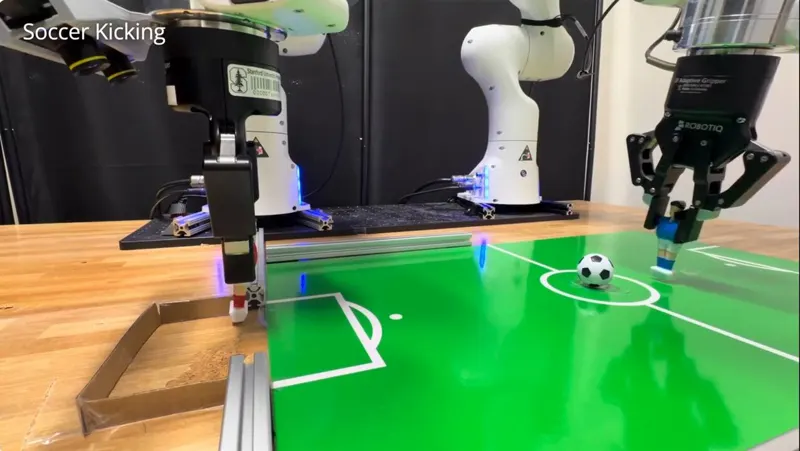
End-to-end robot policies trained through imitation learning remain constrained by limited data diversity, making reliable zero-shot deployment in real-world settings challenging. Shared-autonomy methods enable human correction through teleoperation, but specialized hardware and operator training hinder deployment at scale. Other approaches incorporate human guidance as additional policy inputs, often requiring architectural changes and dedicated training for steerability, which limits their applicability across policies. We present RoboPrompt, a general-purpose, lightweight robot policy steering system that enables users to guide policy behavior through intuitive, sparse inputs, including drawn traces, target points, and coarse directional instructions. RoboPrompt decouples human-intention translation from the underlying policy: a reusable module converts human guidance into action drafts, which are refined through the diffusion or flow-matching dynamics of the base policy. By controlling action generation in noise space, RoboPrompt balances human intent with the policy prior without modifying the base policy architecture or fine-tuning it for steerability. Experiments demonstrate effective steering across Diffusion Policy, π_0.5, and FastWAM. We further use steered rollouts for online policy improvement through DAgger. After 2-3 rounds of iteration, average success rates increase by 15.5% for π_0.5 across three tasks and by 21.3% across three policies(Diffusion Policy, π_0.5, FastWAM) on the Insert Bread task, while average human intervention counts decrease by 44.0% (2.86 to 1.60) and 81.9% (2.60 to 0.47), respectively.

Yanwen Zou, Chenyang Shi, Guoxuan Xu

ManipulationImitation LearningDiffusion policiesHuman-in-the-Loop
PAPEROct 7, 2026

HuMBLE: Human Motion-Driven Behavior Learning for Embodied Locomotion

Despite recent advances in humanoid locomotion, controllers optimized for command tracking and robustness tend to produce mechanical gaits, whereas controllers tied to human motion data often fail to generalize to commands outside the data distribution. This work introduces a learning framework that balances these competing objectives to synthesize real-time steerable, robust, and biomimetic locomotion policies from human data. Using an in-house curated locomotion dataset covering diverse speeds and directions, we first learn a natural locomotion prior policy through a teacher-student distillation process. Specifically, we train a full-body reference-conditioned policy with Reinforcement Learning (RL), then distill it into a lightweight prior policy conditioned solely on proprioception and a planar torso-velocity steering command. Next, we fine-tune the prior policy with multi-task RL to expand command coverage and robustness beyond the data distribution, pairing a goal-conditioned task that tracks arbitrary commands with a reference-guided task that tracks the human data as an explicit style regularizer. We validate our framework on three humanoid robots: the Boston Dynamics Atlas R1, Atlas D1, and Unitree G1. Experimental results demonstrate robust performance across real-world scenarios, including direct user-controlled locomotion in indoor and outdoor environments, and integration as the locomotion layer within hierarchical control stacks. Benchmarks against Tabula Rasa RL policies trained without human data and ablation studies confirm that our framework yields a lightweight, deployable policy that reconstructs coordinated whole-body behavior from a steering command, retaining the human gait characteristics while remaining robust and fully steerable.

Mike Zhang, Dongho Kang, Kevin Bergamin

Humanoid LocomotionMotion ImitationReinforcement LearningTeacher-Student Distillation

As an Amazon Associate, we earn from qualifying purchases.