Skip to content
← Tags
SuperNav: An Agentic Navigation System for Any Task in Any Scene

SuperNav: An Agentic Navigation System for Any Task in Any Scene

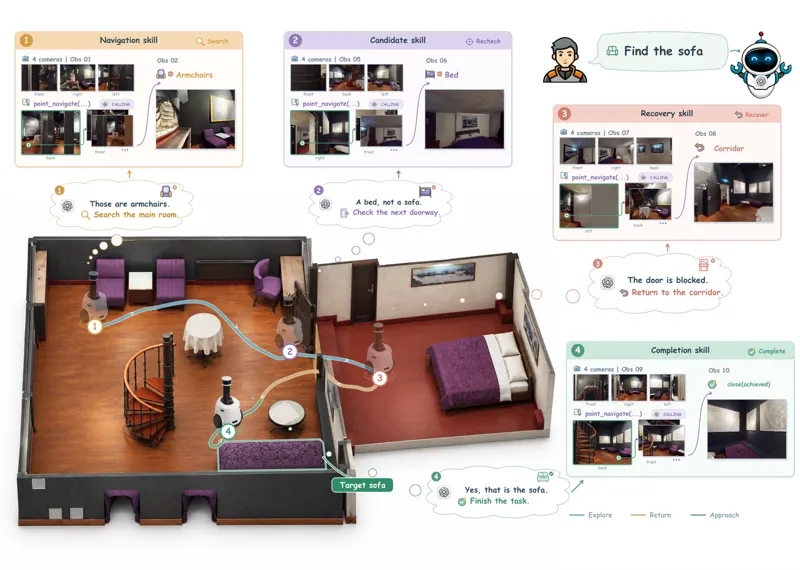
General-purpose service robots need navigation systems that can handle diverse human requests in unfamiliar environments, combining task generality with scene generality. Some existing methods fine-tune multimodal large language models (MLLMs) to predict navigation actions, making their behavior dependent on the coverage of navigation training data and potentially limiting generalization to new requests and environments. Our key insight is to let the MLLM focus on interpreting requests, understanding scenes, and making decisions while preserving its general-purpose capabilities and delegating motion execution to navigation tools. To realize this idea, we introduce SuperNav, which equips a pretrained MLLM with a specialized agent harness without navigation-specific fine-tuning of the MLLM. Our harness supports these decisions with Navigation Skills, agent-oriented Tools for physical interaction, and task-progress and context management. A unified visual-point interface connects decision-making to motion by allowing the model to specify destinations directly in images and revise its decisions from execution feedback. Together, these components support sustained navigation across different task requirements and environments. SuperNav outperforms four evaluated baselines on instance-level, multi-object, and demand-driven tasks. Category-level evaluation on HM3D and deployment on a real quadruped robot further demonstrate its applicability across environments. Project Page: https://zju3dv.github.io/SuperNav/
Jinkai Zhang, Jingyi Xu, Yuanhong Yu · 137 views · Oct 8, 2026
Object NavigationEmbodied AgentMultimodal LLMOct 8, 2026
LifelongCrossNav: Persistent 3D Semantic Memory for Cross-Floor Multi-Object Navigation

LifelongCrossNav: Persistent 3D Semantic Memory for Cross-Floor Multi-Object Navigation

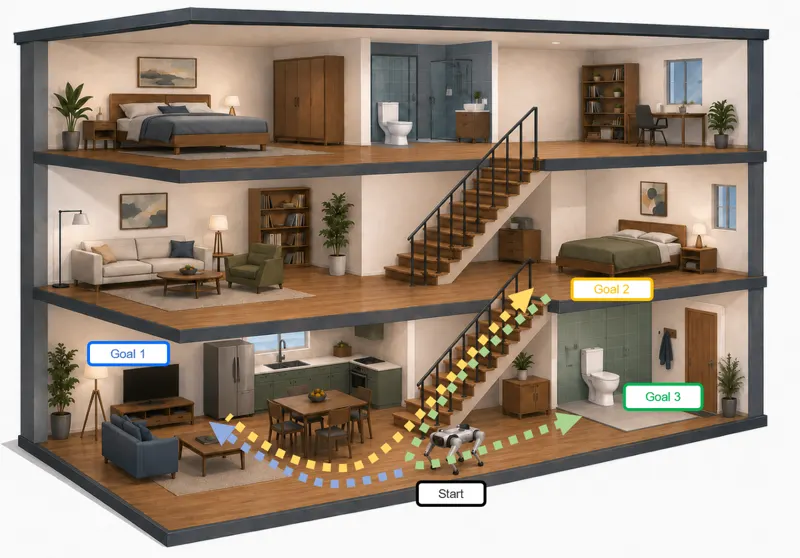
Object-goal navigation has made substantial progress in semantic perception and exploration, yet persistent memory for multi-object navigation and cross-floor navigation are still commonly addressed separately. We present LifelongCrossNav, a framework for sequential multi-object ObjectNav in unknown multi-floor indoor environments. Within each episode, the agent receives an ordered sequence of object-goal queries while continuously maintaining a shared sparse 3D semantic voxel memory. This memory incrementally accumulates geometric structure, traversability states, and vision-language features, allowing subsequent object-goal queries to retrieve previously acquired scene information without rebuilding the map. To support persistent search across floors, LifelongCrossNav combines support-aware 3D traversability mapping, stair-specific perception, and direction-aware stair traversal. A unified navigation policy coordinates same-floor frontier exploration, live and historical point-of-interest retrieval, stair navigation, and target-object search and approach. We further introduce HM3D-MFMON, a benchmark for sequential Multi-Floor Multi-Object Navigation built on HM3D scenes, including a dedicated subset in which completing the full sequence of object-goal subtasks requires at least one floor transition. Experimental results show that LifelongCrossNav consistently outperforms a representative planar persistent semantic-map baseline on HM3D-MFMON, demonstrating that persistent 3D semantic memory and cross-floor traversability modeling effectively support sequential multi-object navigation in multi-floor environments. Project page: https://flageval-baai.github.io/LifelongCrossNavPage.

Zehui Li, Zihao Sun, Jiawei Xu · 162 views · Aug 7, 2026
Object-Goal NavigationSemantic MemoryMulti-Floor NavigationAug 7, 2026

As an Amazon Associate, we earn from qualifying purchases.