Skip to content
← Tags
Post-Training Large Language Models via Reinforcement Learning from Self-Feedback

Post-Training Large Language Models via Reinforcement Learning from Self-Feedback

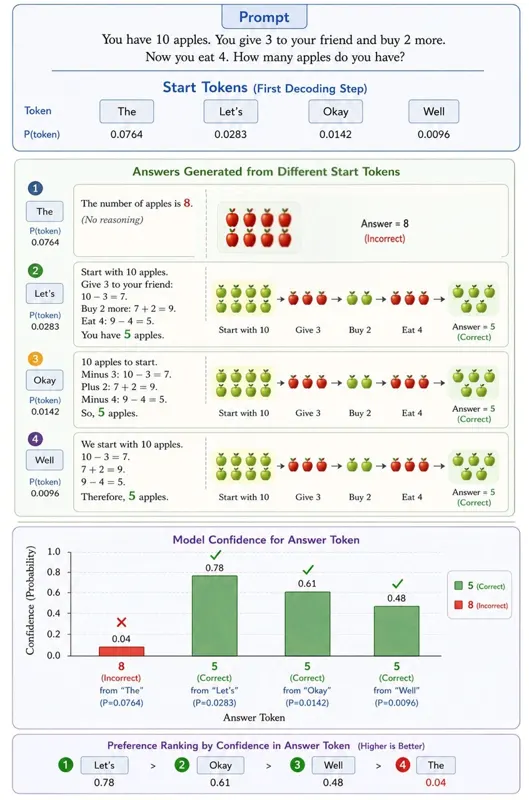
Large Language Models (LLMs) often produce plausible but poorly-calibrated answers, limiting their reliability on reasoning-intensive tasks. Recent research suggests that Chain-of-Thought (CoT) reasoning paths are inherent in pre-trained LLMs and can be elicited by simply altering the decoding process, where the presence of a CoT path correlates with higher answer confidence. Building on these insights, we present Reinforcement Learning from Self-Feedback (RLSF), a post-training stage that utilises the model's intrinsic confidence as a self-generated reward. By generating multiple CoT decoding beams from a frozen LLM, we compute the confidence of each final answer span and rank the resulting traces accordingly to create synthetic preferences. These preferences are subsequently utilised to fine-tune the policy through standard preference optimisation, requiring no human labels, gold answers, or externally curated rewards. RLSF simultaneously (i) refines the model's probability estimates–restoring well-behaved calibration–and (ii) strengthens step-by-step reasoning, yielding improved performance on arithmetic reasoning and multiple-choice question answering. By converting a model's own uncertainty into structured self-feedback, RLSF affirms reinforcement learning on intrinsic model behaviour as a principled and data-efficient component of the LLM post-training pipeline. Our results demonstrate that leveraging these inherent reasoning capabilities provides a robust path for enhancing model reliability without manual prompt engineering or external supervision.

Carel van Niekerk, Renato Vukovic, Benjamin Ruppik · 268 views · Jul 29, 2025
Large Language ModelsReinforcement Learning
Jul 29, 2025
DSpark: Confidence-Scheduled Speculative Decoding with Semi-Autoregressive Generation

DSpark: Confidence-Scheduled Speculative Decoding with Semi-Autoregressive Generation

Speculative decoding accelerates Large Language Model (LLM) inference by decoupling draft generation from target verification. While recent parallel drafters efficiently propose long token sequences in a single forward pass, they suffer from rapid acceptance decay due to a lack of inter-token dependencies. Furthermore, indiscriminately verifying these extended blocks wastes critical batch capacity on tokens with high rejection risks, severely degrading throughput in high-concurrency serving systems. We introduce DSpark, a speculative decoding framework that unifies high-throughput parallel generation with adaptive, load-aware verification. To maintain draft quality, DSpark utilizes a semi-autoregressive architecture, coupling a parallel backbone with a lightweight sequential module, to introduce intra-block dependency modeling and mitigate suffix decay. To optimize system efficiency, DSpark employs confidence-scheduled verification, dynamically tailoring the verification length for each request based on estimated prefix survival probabilities and engine-specific throughput profiles. On offline benchmarks across diverse domains, DSpark substantially improves the accepted length over state-of-the-art autoregressive and parallel drafters. When deployed within the DeepSeek-V4 serving system under live user traffic, DSpark successfully mitigates verification waste. Compared to the established production baseline (MTP-1), DSpark accelerates per-user generation speeds by 60 to 85 percent at matched throughput levels. More importantly, by preventing severe throughput degradation under strict interactivity constraints, it enables performance tiers that were previously unattainable, shifting the Pareto frontier of our serving system.

Xin Cheng, Xingkai Yu, Chenze Shao · 792 views · Jul 6, 2026
Speculative DecodingLLM Inference
Jul 6, 2026

As an Amazon Associate, we earn from qualifying purchases.