Skip to content
← Tags
Social-WM: Safety-Aware Latent World Models for Robot Social Navigation

Social-WM: Safety-Aware Latent World Models for Robot Social Navigation

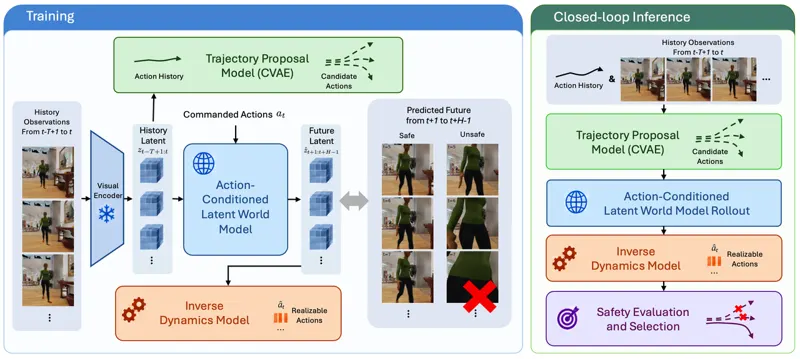
Safe social navigation requires a robot to anticipate not only the future consequences of its actions, but also whether a nominal action can actually be executed under surrounding physical and social constraints. We present Social-WM, an efficient latent world-model planning framework trained from egocentric RGB video sequences. Our key observation is that social-navigation experience contains a systematic discrepancy between the nominal action and the realizable action: a nominal forward action may be fully executed in free space, but needs to be constrained when heading towards a pedestrian or obstacle. Social-WM learns these safety-relevant consequences directly through action-conditioned future prediction, where the target is the actual observed future following each command. We further introduce a realizable inverse-dynamics objective that associates observed latent transitions with the action actually realized rather than the nominal one. At deployment, candidate actions are imagined through the latent world model, and the inverse dynamics model estimates their realizability; nominal–realizable discrepancy then provides a safety signal before execution. The learned dynamics and realizability model remain goal-independent and support both position- and image-goal navigation. On Social-HM3D, Social-WM achieves 63.77% success while reducing human collisions to 21.67%, and maintains strong performance under zero-shot transfer to Social-MP3D, without explicit pedestrian tracking, privileged human state, or online reinforcement learning.

Zhihao Zheng, Mooi Choo Chuah · 32 views · Sep 30, 2026
Social NavigationWorld Models
Sep 30, 2026
From reactive to cognitive: brain-inspired spatial intelligence for embodied agents

From reactive to cognitive: brain-inspired spatial intelligence for embodied agents

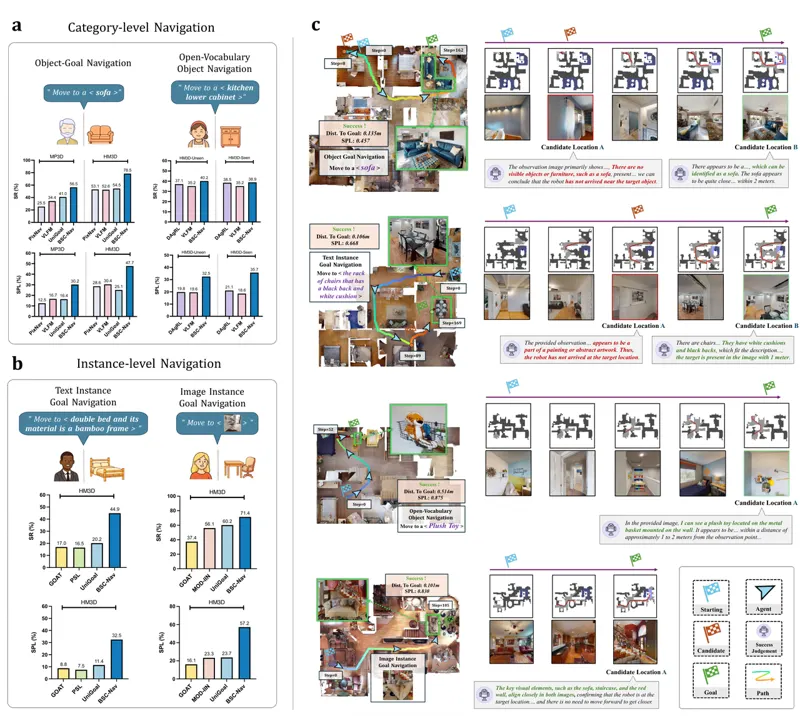
Tsinghua University and Beihang University present BSC-Nav (Brain-inspired Spatial Cognition for Navigation). The paper argues that existing embodied agents — whether end-to-end RL or "MLLM plus modular pipeline" — are fundamentally reactive and stateless: they process an observation and discard it, lacking any durable internal model of space, which yields fragmented knowledge, short-sighted planning and poor generalization. The authors borrow the answer from neuroscience, where spatial knowledge consolidates into three interconnected forms: landmarks, route knowledge, and survey knowledge. BSC-Nav instantiates these computationally in three modules. Landmark memory stores 4-tuples (world coordinates, open-vocabulary category, detection confidence, GPT-4o contextual description) with a spatial-overlap set plus confidence-weighted fusion for deduplication. The cognitive map extracts DINO-v2 patch features, projects them through inverse perspective projection and cascaded coordinate transforms into a voxel grid, and adopts a free-energy-principle-inspired surprise-driven update: a new feature is written when its mean distance to features in the n-hop neighborhood exceeds a threshold, replacing the lowest-surprise entry when the buffer is full, preserving cross-viewpoint diversity while bounding storage. Working memory retrieves hierarchically by instruction complexity — simple targets use text-only GPT-4 reasoning over landmark memory (even inferring unrecorded targets from co-located landmarks), while complex targets first have descriptions refined by GPT-4o, then "imagine" the appearance via Stable Diffusion 3.5, encoded by DINO-v2 and center-distance weighted pooled to query the cognitive map (imagine-then-localize), with similarity-weighted DBSCAN yielding candidate coordinates. Rather than greedily taking the highest confidence, candidates are ordered by H_i = lambda*p_i + (1-lambda)(1 - d_i/d_max). Across 62 MP3D/HM3D scenes and 8,195 episodes: OGN reaches 78.5% SR on HM3D (24.0 points above SOTA UniGoal), OVON zero-shot beats supervised DAgRL, IIN reaches 71.4%; SPL gains are even more consistent (IIN 57.2% vs 23.7%). On A-EQA it achieves the highest LLM-Match of 54.6, still trailing humans by 27.5. Real-world deployment on a custom platform (AgileX Ranger-mini-3.0 chassis, Franka Research 3 arm, RealSense D435i) ran 75 episodes in a ~200 m² two-floor space, with IIN reaching 100% SR on 4 of 5 targets and reliable localization to semantically plausible regions even on failure, plus long-horizon navigation-plus-manipulation demos such as "make breakfast" over three open-vocabulary objects. The paper proposes an embodied Turing test for spatial cognition probing three dimensions: real-time construction of reusable spatial representations, abstraction from sparse partial observations, and translation of high-level goals into actionable spatial plans.

Ruan, Shouwei, Wang, Liyuan, Kang, Caixin · 932 views · Aug 24, 2025
BSC-NavEmbodied AI
Aug 24, 2025
Patch Policy: Efficient Embodied Control via Dense Visual Representations

Patch Policy: Efficient Embodied Control via Dense Visual Representations

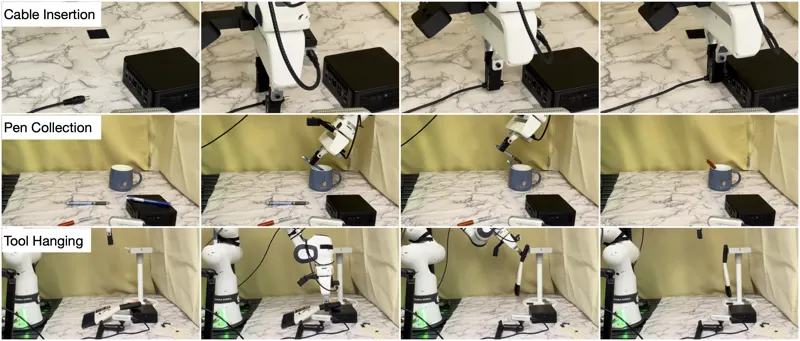
Pretrained dense visual features from Vision Transformers (ViTs) are powerful yet have been underutilized in robot learning. Modern robot policies either compress each observation into a single global token, or rely on visual backbones trained from scratch, sacrificing both fine-grained spatial detail and the benefits of large-scale visual pre-training. While there exist policies that do operate on dense patch features like large vision-language-action models (VLAs), they tend to be heavy and slow, inheriting the full cost of a billion-parameter vision-language model (VLM) backbone. We close this gap with Patch Policy, a minimal architectural extension that enables transformer-based policies to consume dense pre-trained patch tokens directly without the computational overhead of a full VLM. At its core is a block-causal attention mask that preserves the temporal causality of standard policies while letting the model attend over many patch tokens per observation, alongside other state information. Patch Policy is lightweight, fast, and highly effective. Across four simulated and three real-world environment suites, our method achieves a 40% relative improvement over policies using state-of-the-art global-pooled representations. Furthermore, it surpasses fine-tuned OpenVLA-OFT by 18% while using roughly 0.7% of the parameters. We believe Patch Policy provides a pipeline for the robotics community to readily leverage continuing progress in visual representation learning, without sacrificing the training efficiency or inference speed required for high-frequency, reactive control. Videos can be viewed at https://patch-policy.github.io

Gaoyue Zhou, Zichen Jeff Cui, Ada Langford · 447 views · Jul 20, 2026
Patch PolicyDense Visual Representation
Jul 20, 2026

As an Amazon Associate, we earn from qualifying purchases.