Skip to content
← Tags

#Evolutionary Search (3)

MathResearchTopB

AlphaEvolve: pointing a model at problems that come with an objective scoring function

Google DeepMind's coding-agent-driven evolutionary search: Gemini Flash proposes candidates in volume and Gemini Pro in quality, automatic evaluators score them, and high scorers stay in the population as next-round context, i.e. evolutionary search with an LLM as the mutation operator; it applies only where an automatic evaluator exists, hence the math and agents filing. An evolved scheduling heuristic has run in production in Google data centres (Borg) for over a year, recovering 0.7% of Google's global compute (Google's compute, not all compute on earth), the card reading and the only result validated by long-running production. An evolved matmul kernel is 23% faster at specific sizes, and about 20% of 50+ open maths problems improved, including 4x4 complex matrix multiplication in 48 multiplications against Strassen's 1969 record of 49. Verification differs from the prover line: a Lean check is mathematical correctness, "23% faster" is an empirical reading on specific hardware. No public weights, Early Access is a waitlist, and the precondition is an evaluator you write yourself. Graded B (contested): a year of production behind the Borg result, nothing reproduced.
0.7%Google global compute recovered (production-verified)Contested · 2025-05
ProductionGoogle DeepMindSite
AlphaEvolve: pointing a model at problems that come with an objective scoring function
DiscoveryRSI: Recursively Learning to Discover Valuable Hypotheses

DiscoveryRSI: Recursively Learning to Discover Valuable Hypotheses

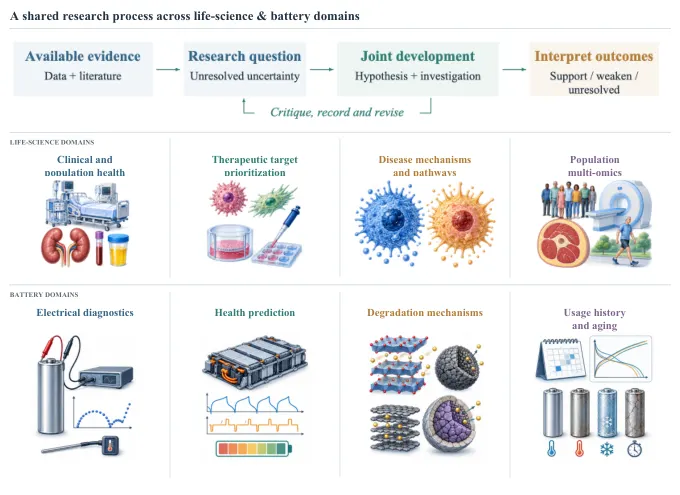
Scientific discovery requires developing worthwhile hypotheses into practical investigations, yet learning from this evolving research process remains challenging. We introduce an operational definition of valuable and testable research hypotheses: evidence-grounded claims about consequential uncertainties, coupled with feasible investigations, explicit decision criteria, and alternative explanations. Our DiscoveryRSI framework develops hypothesis trees through multi-agent evolutionary search, compiles selected investigations into executable Harbor tasks, and recursively learns through three mechanisms: hypothesis credit optimization attributes scientific assessments to documented research contributions; harness replay identifies productive strategies and recurring failures to refine research workflows; and rediscovery applies accepted improvements to new investigations, generating further experience for subsequent learning. We also introduce DFM-Bench, which provides comprehensive assessment of hypothesis quality and cumulative research progress at the levels of hypotheses, revisions, development paths and research runs. Across four life-science domains, automated evaluation shows that hypothesis quality rises from 4.86 for the base model to 5.39 after two rounds of self-improvement, with the large gains in falsifiability and data resolvability. We further validate hypothesis quality through expert review, comparing our DiscoveryRSI-27B with other research agents. Preliminary human assessments show that DiscoveryRSI-27B scores higher than GPT-6 Luna on hypothesis importance and whether claims are plausible and evidence-bounded. DiscoveryRSI-27B achieved a 6.3% rate of hypothesis correspondence with research published after the model cutoff, largely outperform GPT-6 with 2.5% and Claude Opus 5 with 2.3%, while delivering greater human-rated improvement along research paths.

Jianyuan Zhong, Chenwei Wu, Zhaochen Yu · 314 views · Oct 16, 2026
Scientific DiscoveryMulti-Agent Systems
Oct 16, 2026

As an Amazon Associate, we earn from qualifying purchases.