Skip to content
← Tags

#Impedance Control (4)

VT-Bridge: Bridging Pretrained Foundation VLAs to VTLAs via Lightweight Residual Adaptation

VT-Bridge: Bridging Pretrained Foundation VLAs to VTLAs via Lightweight Residual Adaptation

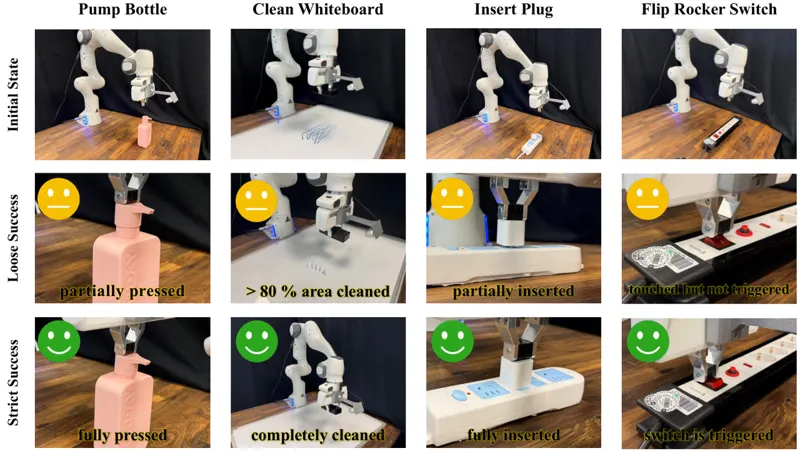
Vision-Tactile-Language-Action (VTLA) models have demonstrated clear advantages over Vision-Language-Action (VLA) models in contact-rich manipulation. However, developing VTLA models is severely constrained by the massive amounts of vision-tactile data and computational resources required. To address this bottleneck, we propose VT-Bridge, a lightweight residual adaptation strategy that bridges pretrained foundation VLAs to VTLAs. Rather than training a VTLA model from scratch or modifying the original architecture of a pretrained VLA, VT-Bridge employs an identical lightweight residual-adapter architecture across VLA backbones and uses backbone-specific weights to refine actions at the robot execution frequency. This design substantially lowers the data and training barriers. Specifically, it requires up to 50 vision-tactile demonstrations per task to fine-tune a VLA backbone and train a 0.98M-parameter residual adapter. Experiments with three representative VLA backbones (π₀, π_0.5, and SmolVLA) across four contact-rich manipulation tasks further demonstrate its consistent effectiveness across VLA architectures. On average, VT-Bridge raises the task completion rate from 11.7% with task-level VLA fine-tuning alone to 62.9%. Together, these findings demonstrate the broad applicability, effectiveness, and accessibility of VT-Bridge for contact-rich manipulation. The project page is available at https://hoxnocha.github.io/vt-bridge-web/.

Yansong Wu, Tuo Yang, Rongping Zhao · 42 views · Sep 18, 2026
Tactile SensingVLAContact-Rich ManipulationSep 18, 2026
Plug, Play, and Comply: A Modular Framework for Online Variable Impedance with Arbitrarily Oriented Compliance Axes

Plug, Play, and Comply: A Modular Framework for Online Variable Impedance with Arbitrarily Oriented Compliance Axes

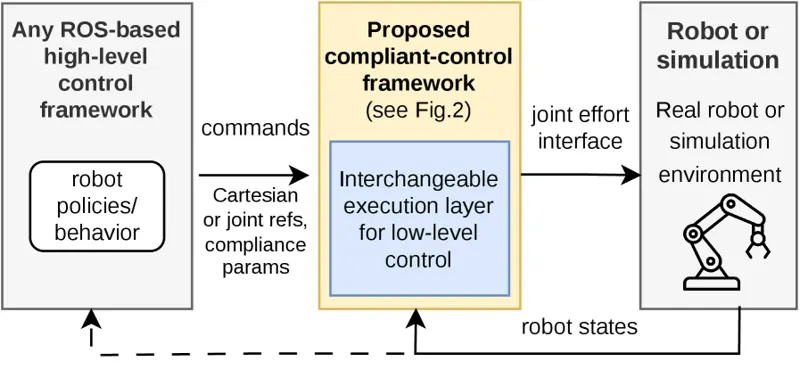
The paper proposes a robot-agnostic compliant-control framework that extends the ROS control ecosystem with standardized joint and Cartesian command interfaces. It addresses a key limitation of existing control software: no reusable infrastructure for implementing compliant-control algorithms across different manipulators while preserving a common interface to higher-level applications. A plugin-based architecture separates controller infrastructure from control-law implementation. Generic wrappers use existing hardware abstractions to interface with different manipulators, while runtime-loaded plugins implement only the control law. Command interfaces support joint- and Cartesian-space references, stiffness and damping gains, nullspace targets, and feedforward terms, enabling variable impedance and diverse compliant-control formulations. Robot kinematics and dynamics are computed from URDF models using Pinocchio. The architecture facilitates the development of compliant-control strategies and enables the same implementation to be deployed across platforms unchanged. The complete framework, including reference controllers, high-level task interfaces, and example configurations for various manipulators, is open-sourced. The reference Cartesian impedance controller supports task-dependent compliance by rotating translational and rotational stiffness and damping, allowing the principal compliance directions to be updated online according to local task geometry rather than remaining fixed in the robot base or TCP frame. This is particularly important in contact-rich manipulation, where the desired directions of motion, constraints, and compliance directions may vary throughout task execution. Real-robot experiments demonstrate task-dependent compliance in contact-rich manipulation, while simulations show portability across manipulators with distinct kinematic and dynamic characteristics.

Mihael Simonič, Xiaocong Li · 288 views · Jul 24, 2026
Variable ImpedanceComplianceModularJul 24, 2026

As an Amazon Associate, we earn from qualifying purchases.