Skip to content
Tags

#Legged robots (9)

Optimizing Grasping in Legged Robots: A Deep Learning Approach to Loco-Manipulation

Optimizing Grasping in Legged Robots: A Deep Learning Approach to Loco-Manipulation

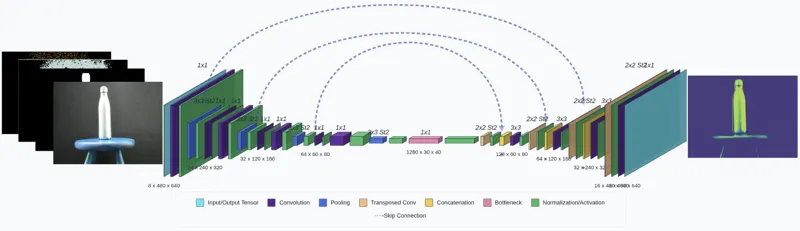
This paper presents a deep learning framework designed to enhance the grasping capabilities of quadrupeds equipped with arms, with a focus on improving precision and adaptability. Our approach centers on a sim-to-real methodology that minimizes reliance on physical data collection. We developed a pipeline within the Genesis simulation environment to generate a synthetic dataset of grasp attempts on common objects. By simulating thousands of interactions from various perspectives, we created pixel-wise annotated grasp-quality maps to serve as the ground truth for our model. This dataset was used to train a custom CNN with a U-Net-like architecture that processes multi-modal input from an onboard RGB and depth cameras, including RGB images, depth maps, segmentation masks, and surface normal maps. The trained model outputs a grasp-quality heatmap to identify the optimal grasp point. We validated the complete framework on a four-legged robot. The system successfully executed a full loco-manipulation task: autonomously navigating to a target object, perceiving it with its sensors, predicting the optimal grasp pose using our model, and performing a precise grasp. This work proves that leveraging simulated training with advanced sensing offers a scalable and effective solution for object handling.

Dilermando Almeida, Guilherme Lazzarini, Juliano NegriAug 24, 2025
Legged robotsDeep LearningGraspingAug 24, 2025
Autonomous Legged Mobile Manipulation for Lunar Surface Operations via Constrained Reinforcement Learning

Autonomous Legged Mobile Manipulation for Lunar Surface Operations via Constrained Reinforcement Learning

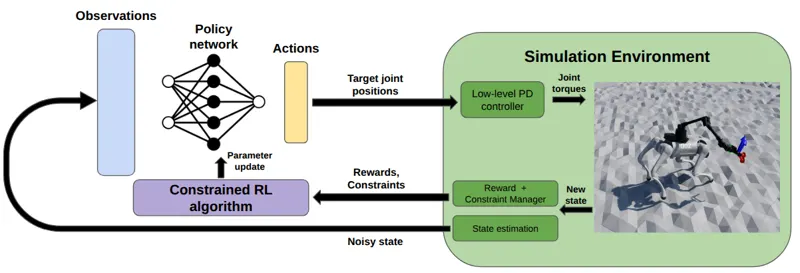
Robotics plays a pivotal role in planetary science and exploration, where autonomous and reliable systems are crucial due to the risks and challenges inherent to space environments. The establishment of permanent lunar bases demands robotic platforms capable of navigating and manipulating in the harsh lunar terrain. While wheeled rovers have been the mainstay for planetary exploration, their limitations in unstructured and steep terrains motivate the adoption of legged robots, which offer superior mobility and adaptability. This paper introduces a constrained reinforcement learning framework designed for autonomous quadrupedal mobile manipulators operating in lunar environments. The proposed framework integrates whole-body locomotion and manipulation capabilities while explicitly addressing critical safety constraints, including collision avoidance, dynamic stability, and power efficiency, in order to ensure robust performance under lunar-specific conditions, such as reduced gravity and irregular terrain. Experimental results demonstrate the framework's effectiveness in achieving precise 6D task-space end-effector pose tracking, achieving an average positional accuracy of 4 cm and orientation accuracy of 8.1 degrees. The system consistently respects both soft and hard constraints, exhibiting adaptive behaviors optimized for lunar gravity conditions. This work effectively bridges adaptive learning with essential mission-critical safety requirements, paving the way for advanced autonomous robotic explorers for future lunar missions.

Alvaro Belmonte-Baeza, Miguel Cazorla, Gabriel J. GarcíaOct 14, 2025
Lunar Surface OperationConstraint Reinforcement LearningLegged robotsOct 14, 2025
Language-Guided Grasping under Partial Observation for Mobile Manipulation in Field Inspection and Maintenance

Language-Guided Grasping under Partial Observation for Mobile Manipulation in Field Inspection and Maintenance

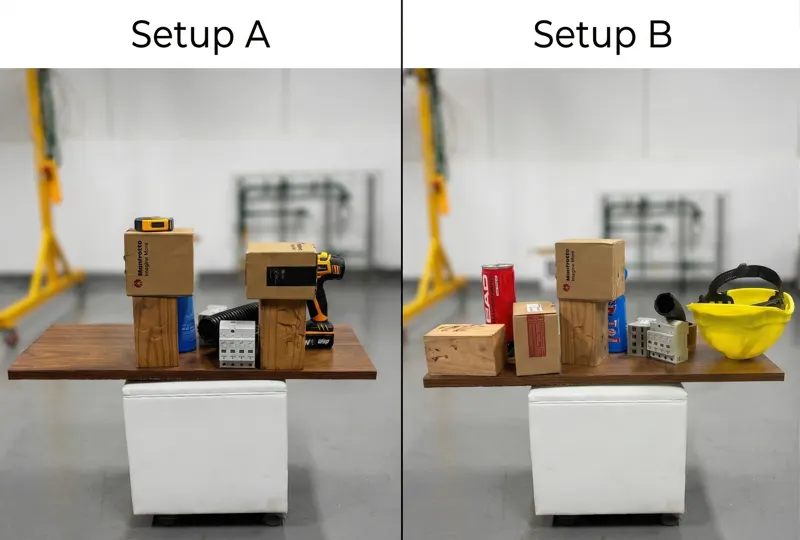
Offshore inspection and maintenance have increasingly been using legged robots for routine sensing, yet many useful interventions still require physical interaction with tools, containers, and task-relevant objects. Employing robots for these tasks can reduce operators' exposure in confined, elevated, or potentially explosive areas. This paper presents a language-guided grasping pipeline for a legged mobile manipulator operating under partial observation. An operator defines the target, the system grounds it in RGB with open-vocabulary detection and promptable segmentation, extracts an object-centric RGB-D point cloud, improves sparse geometry through depth compensation and point-cloud completion, and selects a 6-DoF grasp using collision, clearance, reachability, and approach constraints. The system is implemented on a quadruped robot with an arm and evaluated in two cluttered tabletop scenes motivated by small-object retrieval during inspection and maintenance. Across paired trials, the proposed pipeline achieved 9/10 successful grasps, compared with 3/10 for a view-dependent deployment baseline. In this controlled setting, object-centric completion and execution-aware selection reduced approach collisions and improved the reliability of language-guided grasping for supervised field manipulation.

Dilermando Almeida, Juliano Negri, Guilherme LazzariniMar 9, 2026
Inspection RobotLanguage-Guided GraspingMobile ManipulationMar 9, 2026
X-Morph: Human Motion Priors for Scalable Robot Learning Across Morphologies

X-Morph: Human Motion Priors for Scalable Robot Learning Across Morphologies

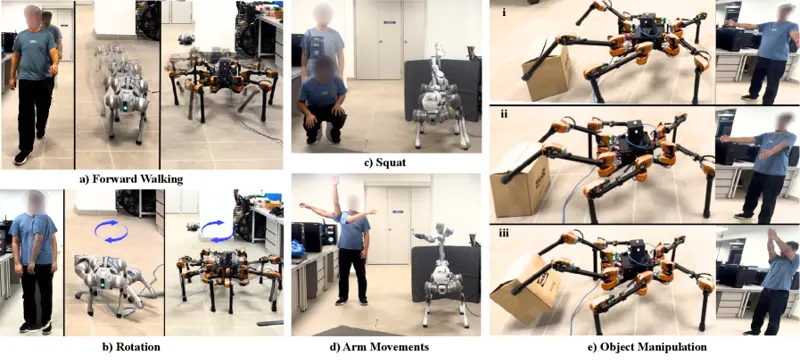
Recent progress in humanoid behavior models has been driven in large part by abundant human motion data, but comparable motion data is scarce for non-humanoid legged robots such as quadrupeds, hexapods, and quadruped manipulators. A promising alternative is to repurpose human motion across embodiments; however, direct retargeting often produces motions that are visually plausible yet physically inconsistent or difficult to track under robot dynamics. We present X-Morph, a human-motion-to-robot-behavior pipeline that converts human motion into deployable locomotion and loco-manipulation policies for diverse non-humanoid legged morphologies. A cross-morphology retargeting stage converts human motions into kinematically plausible, intent-preserving robot references, which are then tracked by a privileged RL policy and distilled into a causal student policy. We evaluate X-Morph on three morphologically distinct platforms: a quadruped, a hexapod, and a quadruped equipped with a manipulator. The resulting policies track diverse retargeted motions, generalize to unseen human motions, and support downstream use cases including video-based teleoperation, behavior-prior control, and text-conditioned motion generation. These results suggest that large-scale human motion can serve as a substrate for learning broad, reusable behavior priors beyond humanoid robots. Project page: https://maker-rat.github.io/morph/

Ritwik Sharma, Shivam Sood, Arhaan JainJun 29, 2026
RetargetingLegged robotsGait optimizationJun 29, 2026
Safe Execution of RL Policies Via Acceleration-Based CBF-QP Constraint Enforcement for Real-World Robotic Deployments

Safe Execution of RL Policies Via Acceleration-Based CBF-QP Constraint Enforcement for Real-World Robotic Deployments

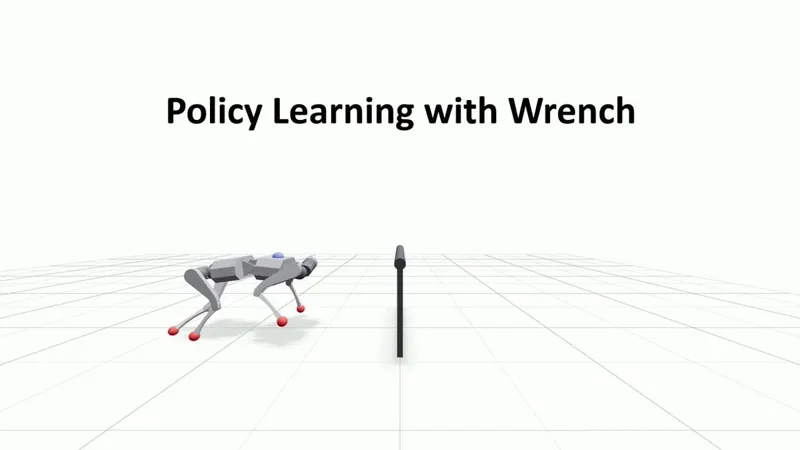
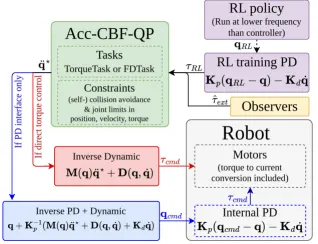
Reinforcement Learning (RL) has demonstrated remarkable capabilities for solving complex robotic control problems, but its lack of safety guarantees severely limits deployment on hardware. In particular, as legged robots and manipulators often operate near safety-critical boundaries, out-of-distribution states can lead to failure upon deployment. To address this, we introduce Acc-CBF-QP, an acceleration-based Quadratic Program (QP) safety filter using Control Barrier Functions (CBFs) that constrains any RL policy onto a safe set at runtime without modifying training. The method applies to unconstrained and Safe-RL policies, and enforces joint position, velocity, torque, and collision constraints within a unified optimization framework. A key contribution is the formulation of RL+QP tasks that regulate deviation from the RL command when constraints would otherwise be violated. We introduce a TorqueTask, minimizing torque deviation, and a Forward Dynamics Task, minimizing induced acceleration deviation, thus providing principled control over safety-performance trade-offs. Experiments on a 7-DoF Kinova Gen3 manipulator and a 19-DoF Unitree H1 humanoid, both in simulation and on hardware, highlight substantial reductions in constraint violations. On the real H1 hardware, a Safe-RL policy alone yielded 10.04 violations/s, which were reduced by 92% to 0.80 violations/s when augmented with Acc-CBF-QP. On the Kinova Gen3, Acc-CBF-QP fully eliminated violations. Nominal task performance of the RL objective is preserved in violation-free regimes. Under aggressive velocity commands on H1, Acc-CBF-QP improves execution by preventing constraint-induced shutdowns, yielding longer survival times. The full pipeline is open-source.

Bastien Muraccioli, Alice Cariou, Pierre-Alexandre LeziartJul 16, 2026
RLSafetyCBF-QPJul 16, 2026