Skip to content
← Tags
Design & FrontendLeonxlnx/taste-skillFeatured

Taste Skill: 13 anti-slop frontend skills that turn AI tells into countable rules

Editor's takeThe lesson worth stealing is rules expressed as countable mechanical tests: eyebrow count ≤ ceil(sections/3), bento cells equal to content items, zero em-dashes on the page, palette families rotated across projects. Each one aims straight at the model repeating itself instead of stopping at an adjective. The repo is equally honest about its edges: v2 self-declares experimental and is still moving, §13 explicitly excludes dashboards, data tables, multi-step wizards, code editors and native mobile, and the only test in the repo guards the source-invocation semantics of the skill.sh shell helper rather than the design rules.

One MIT repo holding 13 skills: ten that output code and three that output reference images only, all installed into Claude Code / Codex / Cursor with a single npx skills add. The default design-taste-frontend v2 (experimental) is a 1,228-line SKILL.md: first the model must emit a one-line "design read", then it sets three dials (DESIGN_VARIANCE / MOTION_INTENSITY / VISUAL_DENSITY), then it implements against 14 chapters of hard rules - install the official package for corporate briefs, label aesthetic borrowings in comments, zero em-dashes anywhere on the page, eyebrow quota computed from section count, bento cells equal to content items, and finally a 50-plus box pre-flight check. The repo also ships research/laziness, a literature directory using controlled studies to explain why models cut output short.

Claude CodeCodexCursor
npx skills add https://github.com/Leonxlnx/taste-skill

JavaScriptLeonxlnx94.8k
Taste Skill: 13 anti-slop frontend skills that turn AI tells into countable rules
Vision-Language-Motion Maps: An Open-Vocabulary, Uncertainty-Aware, Queryable Motion Attribute for 3D Scene Maps

Vision-Language-Motion Maps: An Open-Vocabulary, Uncertainty-Aware, Queryable Motion Attribute for 3D Scene Maps

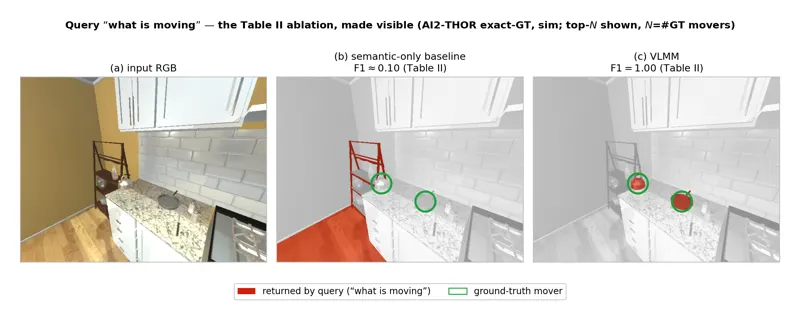
Open-vocabulary 3D maps let robots answer language queries about what and where, but they assume a static world and cannot answer queries about how scene elements behave. We introduce Vision-Language-Motion Maps (VLMM), an open-vocabulary, natural-language-queryable 3D map in which each element carries a fused motion attribute: a VLM/LLM semantic movability prior combined with geometrically observed cross-frame motion, together with a per-element uncertainty. Queries reduce to attribute filters that distinguish what has been seen to move, what could move but has not, and what stays still. On a controlled simulator benchmark with exact ground truth (AI2-THOR, three scene types) we show through ablation that the schema fields are non-substitutable: a semantic-only baseline fails motion queries even with strong features, and neither motion field substitutes for the other (the prior cannot answer "what is moving," observed motion cannot answer "what could move"). On real dynamic RGB-D (TUM and Bonn, six sequences) we show the uncertainty channel-our key difference from prior fused-motion work-consistently improves moving-vs-static average precision and reduces false motion flags, and is robust to estimated (noisy) poses. The raw confidence is not calibrated, but post-hoc isotonic calibration reaches an expected calibration error of 0.10. VLMM is a representation contribution: the closest prior maps each lack at least one of the four properties-open-vocabulary, language-queryable, fused prior-and-observed motion, and per-element uncertainty-that our combination provides.

Dibyendu Ghosh, Ayushi Shakya · 327 views · Jul 17, 2026
VLMMOpen-vocabularyMotionJul 17, 2026

As an Amazon Associate, we earn from qualifying purchases.