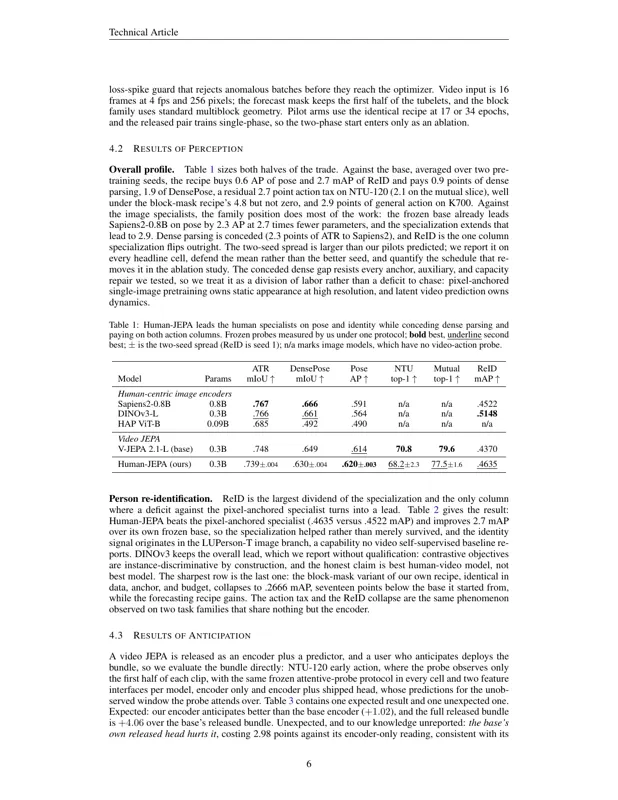
Human-JEPA: A Human-Centric Vision Model that Perceives and AnticipatesMachines that understand humans should perceive the present and anticipate the future. Existing human-centric vision model are pretrained on human images, set the state of the art in static dense perception, so motion and anticipation are out of reach. Here we present Human-JEPA, a human-centric vision model trained on video by anchored forecasting: dense targets are pinned to a frozen copy of the initialization, preventing a silent collapse of dense perception, and block masks are replaced by a pure past-to-future split, avoiding a five-point action tax and a seventeen-point re-identification collapse. Under frozen probes, Human-JEPA leads the pixel-anchored specialists on pose and person re-identification at 2.7 times fewer parameters, conceding high-resolution dense parsing, and its released predictor head is the first that does not degrade anticipation. A single safely adapted model thus serves both halves of understanding humans.Hui Wei, Licai Sun, Guoying Zhao·Aug 21, 2026human-centric visionvideo forecastingPose estimationAug 21, 2026
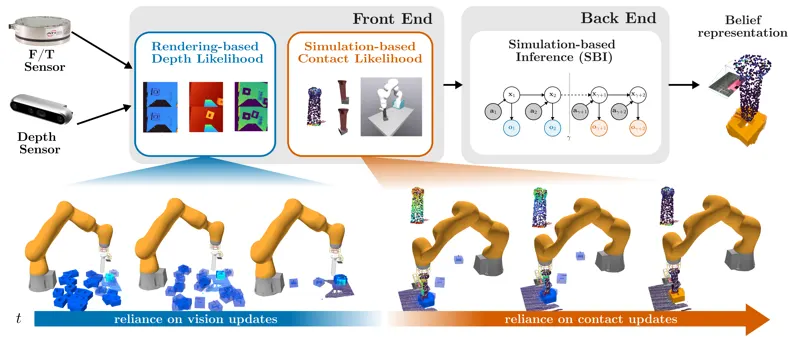
BayesContact: Uncertain Pose Estimation via Visuo-Tactile Proposals and Simulation-based InferenceContact-rich manipulation requires pose estimates that are often more accurate than what depth-only sensing provides. Existing methods, relying on vision and contact, employ costly offline training procedures that need to be retrained for new environments and geometries. We propose BayesContact, a Simulation-Based Inference framework for visuo-tactile pose estimation in peg-in-hole insertion. BayesContact maintains a particle belief over object pose and fuses depth observations with force/torque-derived contact evidence. We employ simulation based forward models to approximate these observation likelihoods. For each pose hypothesis, a renderer predicts depth measurements and a physics simulator predicts contact outcomes under guarded probing actions; both are scored against real observations to update the belief. The resulting multimodal belief also enables information-gain-based probing for active disambiguation. Across simulated geometries and real-robot experiments, BayesContact improves pose observability and insertion success over vision-only inference by 30%Aditya Kamireddypalli, Matias Mattamala, Joao Moura·Jul 17, 2026TactilePose estimationSBIJul 17, 2026
 0:54
0:54