Skip to content
← Tags

#Self-Improvement (5)

RLSR: Reinforcement Learning from Self Reward

RLSR: Reinforcement Learning from Self Reward

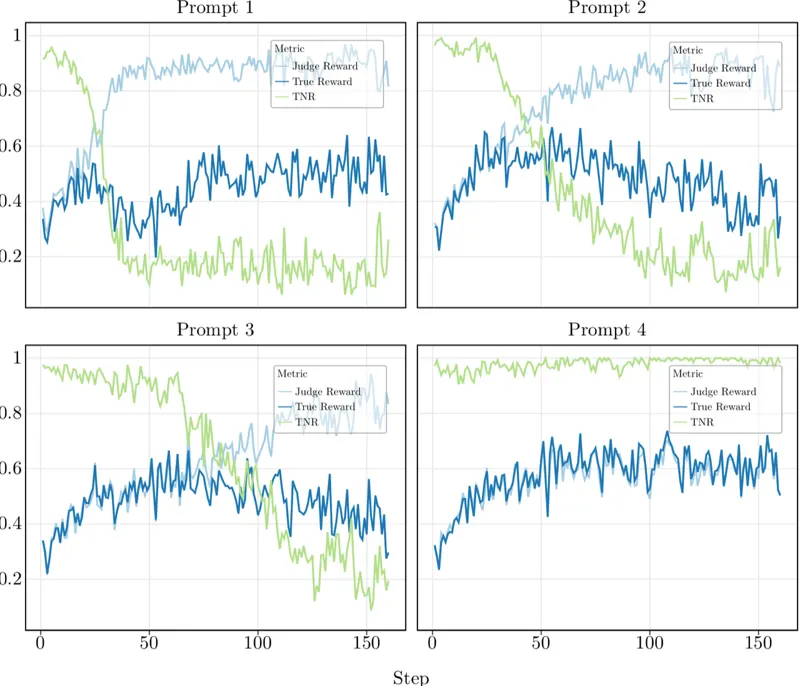
Large language models can generate solutions to complex problems, but training them with reinforcement learning typically requires verifiable rewards that are expensive to create and not possible for all domains. We demonstrate that LLMs can effectively self-improve through self-judging without reference solutions, leveraging the inherent asymmetry between generating and verifying solutions. Our experiments show that models can provide reliable reward signals without ground truth answers, enabling reinforcement learning in domains where verifiable rewards are impractical. By implementing self-judging across Countdown puzzles and integration problems, we achieve performance comparable to formal verification without ground truth solutions. Most notably, Qwen 2.5 7B DeepSeek Distilled trained with self-rewards qualifies for the prestigious MIT Integration Bee competition, performance through self-supervised improvement. When combined with synthetic question generation, we establish a complete self-improvement loop where models generate practice problems, solve them, and evaluate their own performance without any external validation. Our findings demonstrate that LLM judges can provide effective reward signals for training, unlocking reinforcement learning in countless domains previously limited by reward engineering challenges. This work represents a significant step toward autonomous AI systems that continuously improve through self-directed learning rather than human-guided training, potentially accelerating progress across domains where training data is scarce or evaluation is complex.
Toby Simonds, Kevin Lopez, Akira Yoshiyama · 108 views · May 12, 2025
Reinforcement LearningLarge Language Models
May 12, 2025
LoopWAM: Closed-Loop Generalist Policy Improvement from Deployment Rollouts

LoopWAM: Closed-Loop Generalist Policy Improvement from Deployment Rollouts

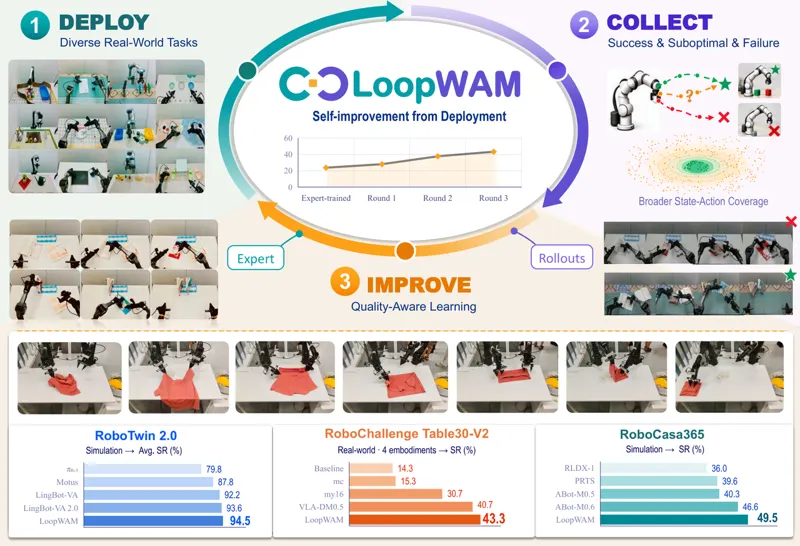
Scaling expert demonstrations alone does not enable generalist robot policies to improve from deployment. Real-world rollouts contain successes, suboptimal behavior, and failures: imitating every recorded action can reinforce poor behavior, while filtering out failures discards evidence of physical interactions and their consequences. We introduce LoopWAM, a closed-loop world-action model that learns directly from this full quality spectrum, using rollouts from both itself and other deployed policies. Source-dependent noise sampling unifies behavior learning and action-conditioned world modeling, while quality steering and quality-weighted supervision retain full video supervision across qualities and regulate action imitation. Video and action tokens interact throughout parallel denoising, allowing learned consequences to inform action generation directly. On RoboChallenge Table30-V2, three deployment-and-training rounds raise success from 23.67% to 43.33%, a 19.7-percentage-point gain, with a final score of 56.80. LoopWAM also achieves 94.5% average success on RoboTwin 2.0 and 49.5% overall success on RoboCasa365 without additional embodied pretraining, obtaining the best overall results among the compared methods across all three benchmarks. On challenging shirt folding task, two rounds of deployment-driven improvement after single-task post-training raise success from 13.20% to 55.56%. These results demonstrate closed-loop improvement from mixed-quality experience under both multi-task learning and single-task post-training. Project page: https://loop-wam.github.io/

Wenxuan Guo, Yingping Liang, Zhaoguo Wang · 334 views · Oct 13, 2026
World-action modelsSelf-Improvement
Oct 13, 2026
ASENA: Self-evolving Agents for Embodied Navigation

ASENA: Self-evolving Agents for Embodied Navigation

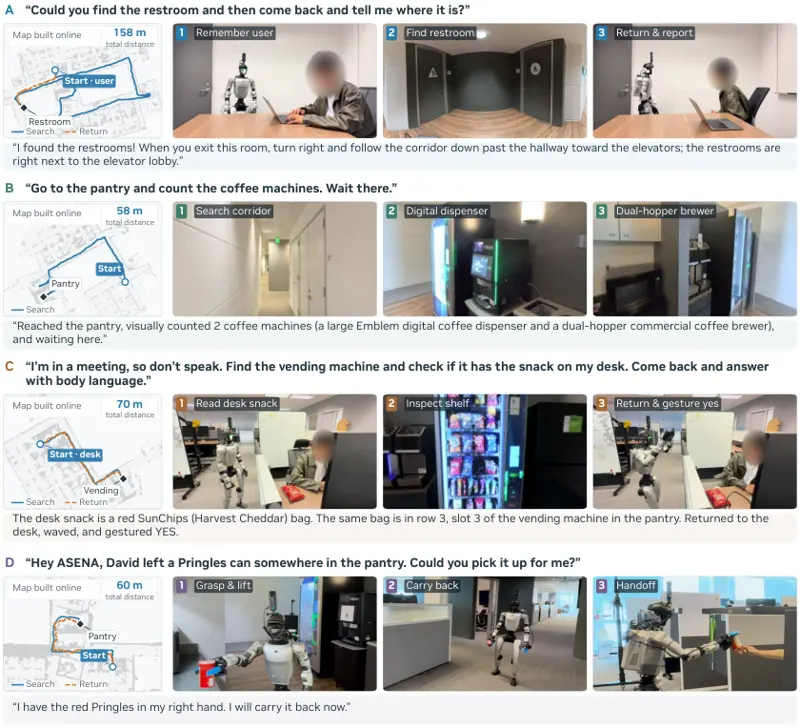
We present ASENA, an embodied agent system that enables general-purpose coding agents to program humanoid navigation, manipulation, and interaction. Through a unified robot harness, agents read sensor data, write and execute programs, inspect recorded outcomes, repair failures, and reuse notes and executable skills while keeping their model weights fixed. We also introduce ASENA-VLN, a 4B monocular navigation policy that serves as an optional tool within this programmable system. ASENA-VLN predicts body-frame trajectories for both extended routes and short-horizon behaviors. Its shared vision-language decoder is trained on route instructions, visual question answering, and a newly curated dataset of geometry-derived atomic navigation tasks. As a standalone policy, ASENA-VLN achieves state-of-the-art success rates of 68.7% on R2R and 70.2% on RxR. When integrated with a coding agent, learned navigation improves ASENA's success rate by 11 percentage points on both agentic benchmarks and reduces execution time. Persistent workspace evolution uses simulator feedback to improve success over ten passes through recurring 100-task subsets. Success increases from 72% to 98% on R2R and from 65% to 89% on RxR. On embodied question answering, ASENA achieves state-of-the-art accuracy with fewer interaction steps. On a Unitree G1, we demonstrate search, visual inspection, spatial reasoning, synthesized gestures, and mobile manipulation combining object pickup, carrying, and handoff without a pre-built map. These demonstrations illustrate how online programming extends robot behavior beyond route following and predefined skills.

An-Chieh Cheng, Isabella Liu, Edmund Bu · 351 views · Sep 30, 2026
Vision-language navigationEmbodied AI
Sep 30, 2026

As an Amazon Associate, we earn from qualifying purchases.