Skip to content
Tags

#Social Navigation (2)

Token-Wise Latent Streaming from Slow Reasoners to Fast Planners for Dynamic Vision Language Navigation

Token-Wise Latent Streaming from Slow Reasoners to Fast Planners for Dynamic Vision Language Navigation

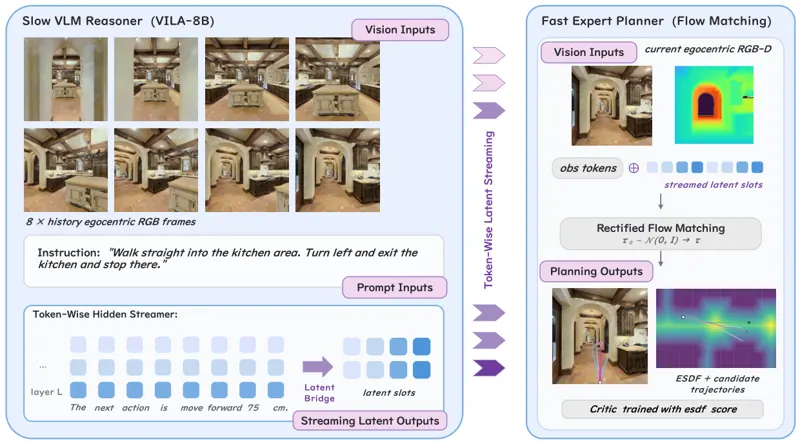
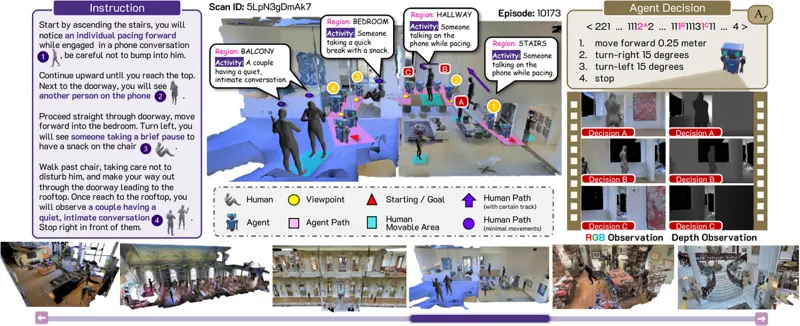
Vision-Language Navigation in dynamic, human-centric environments exposes a fundamental tension: linguistic reasoning is slow and deliberative, whereas safe, socially compliant planning should be instant and reactive. The resulting observation staleness is safety-critical: a maneuver chosen during inference can already be unsafe by the time it executes. We observe that, long before a VLM finishes its inference, its intermediate hidden states already encode action-relevant intent. We propose SPARK-VLN, a dual-system framework for dynamic social VLN that streams the slow VLM reasoner's knowledge to a fast flow-matching expert planner throughout token generation, providing fresh and evolving guidance during inference. This design is realized by three modules: a Token-Wise Hidden Streamer that extracts intermediate hidden states along the token generation process, a Sequence-to-Slot Latent Bridge that projects them into fixed-size latent slots, and an Evolving Latent Conditioner that infuses them into the expert planner. We also introduce a human-centric benchmark suite for dynamic social vision-language navigation that keeps pedestrians and the robot active throughout inference and reports navigation success, social compliance, human collisions, and explicit staleness statistics. Across these settings, SPARK-VLN mproves navigation success and social compliance while sustaining inference efficiency. Webpage: https://hutslib.github.io/SPARK-VLN/.

Tianshuai Hu, Yangyi Zhong, Zeying GongJul 18, 2026
Vision-language navigationSocial NavigationDual-SystemJul 18, 2026
Navigating the Crowd: Non-linear MPC with Social Forces Dynamics for Human-Aware Robot Navigation

Navigating the Crowd: Non-linear MPC with Social Forces Dynamics for Human-Aware Robot Navigation

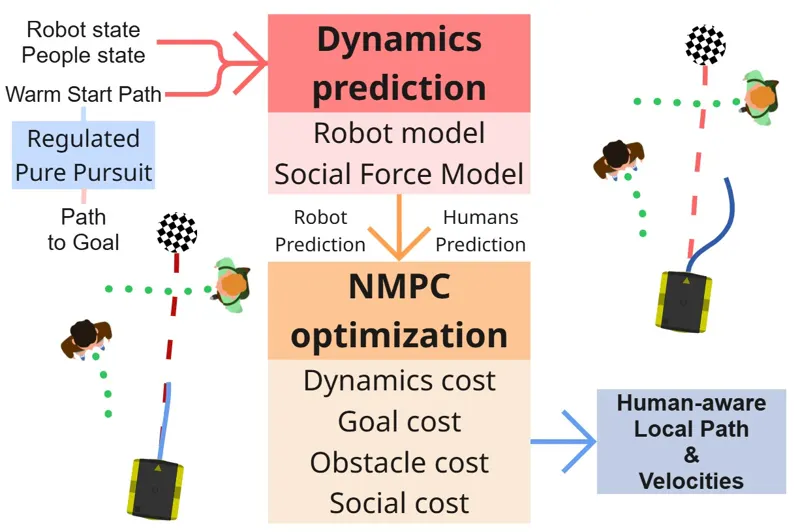
Safe and socially compliant navigation remains a fundamental challenge for autonomous robots operating in human-populated environments. Beyond collision avoidance, robots must anticipate human motion and respect personal space to ensure human comfort. Model Predictive Control (MPC) offers a robust alternative to classical and data-driven methods, although its effectiveness strongly depends on accurate human motion prediction and efficient computation. This paper introduces SFM-NMPC, a Social Force Model-based Non-linear Model Predictive Control framework that embeds human motion prediction directly within the optimization loop. By incorporating the Social Force Model into the dynamic model of surrounding agents, the controller jointly predicts the trajectories of humans and robots over the prediction horizon, thereby enabling socially-aware planning. A tailored set of social cost functions guides the optimization toward human-compliant behaviors. Despite the increased model complexity, the proposed formulation runs in real time at 20 Hz. Extensive simulated testing in crowded environments demonstrates that SFM-NMPC outperforms state-of-the-art baselines in social compliance metrics while maintaining efficient and smooth navigation. Visual trajectory analysis and an ablation study further highlight the contribution of the embedded SFM dynamics and social cost terms, confirming the effectiveness of the proposed approach for real-world social navigation.

Stefano Trepella, Andrea Ostuni, Mauro MartiniJul 11, 2026
Robot navigationSocial Navigationmodel predictive controlJul 11, 2026