Skip to content
← Tags

#Spatial reasoning (10)

StageVLN: Spatial and Trajectory Auxiliary Guidance for Efficient Vision-Language Navigation

StageVLN: Spatial and Trajectory Auxiliary Guidance for Efficient Vision-Language Navigation

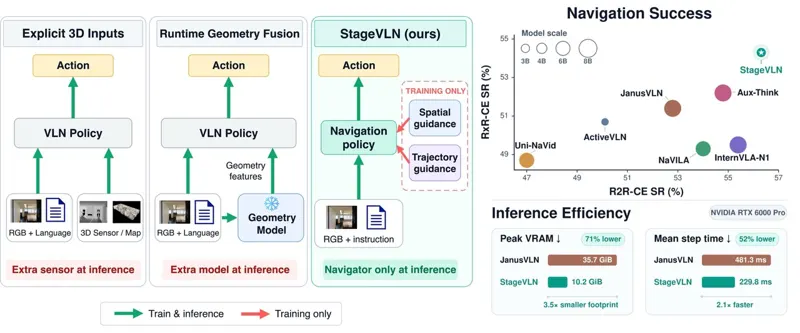
Vision-and-Language Navigation (VLN) policies increasingly benefit from strong semantic priors provided by large vision-language models (VLMs). However, standard action supervision does not explicitly encourage intermediate representations to preserve scene geometry, relative orientation, or global episode progress. Incorporating depth estimators, explicit maps, point clouds, or geometry foundation models at inference can provide such structure but introduces additional computation, memory overhead, and architectural dependence during deployment. We introduce StageVLN, a training framework that shapes navigation representations through privileged spatial and trajectory guidance while preserving the original inference pathway. A frozen geometry foundation model provides multi-level spatial guidance to hierarchical navigator states, while relative-heading and expert-route progress objectives provide complementary trajectory-state supervision. All auxiliary components are used only during training and removed at deployment. On R2R-CE validation-unseen, StageVLN achieves 56.3% SR and 51.4% SPL with a 4B-parameter backbone, without an additional geometry encoder at inference. On RxR-CE, it achieves 54.3% SR without additional navigation training data or a geometry encoder at inference.
Anh Dao, Quan-Dung Pham, Le Danh Vinh · 98 views · Oct 5, 2026
Vision-language navigationEmbodied AI
Oct 5, 2026
Reinforcing Egocentric Spatial Perception in Multimodal Large Language Models via Ego Scene Augmentation

Reinforcing Egocentric Spatial Perception in Multimodal Large Language Models via Ego Scene Augmentation

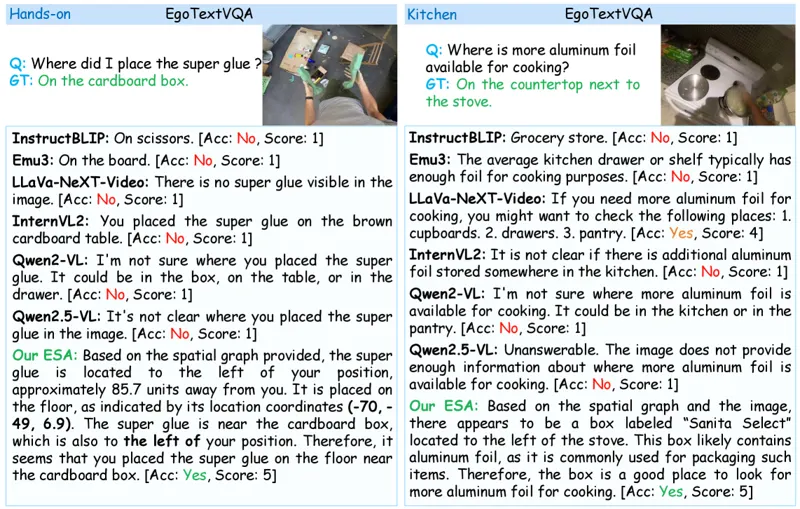
Egocentric Visual Question Answering (VQA) has attracted widespread attention as an important task for enabling Multimodal Large Language Models (MLLMs) to interact with the real world. However, existing MLLMs struggle to perform effective spatial reasoning in complex egocentric scenes due to their limited spatial perception capabilities. To this end, we introduce Ego Scene Augmentation (ESA), an egocentric spatial perception framework, which actively enhances the spatial perception capabilities from the egocentric perspective, powered by the proposed Ego-element Graph. Our core insight is leveraging the Ego-element Graph as an intermediary representation to augment the egocentric spatial perception of MLLMs via visual foundational models. Specifically, we 1) construct the Ego-element Graph, which encapsulates and integrates egocentric spatial features enabled by visual foundational models; 2) enhance the spatial perception capabilities of MLLMs via the Ego-element Graph for ego-perspective scenes. Our proposed ESA framework presents significant performance improvement on the EgoTextVQA benchmark. We achieve an 8.14% gain on the indoor setting and an 8.72% gain on the outdoor setting. Furthermore, our ESA shows the most impressive performance improvement in the shopping subset of the indoor setting. The project code is publicly available.

Chi Kit Wong, Ye Pan, Yuanhuiyi Lyu · 464 views · Jul 16, 2026
MLLMFirst-person
Jul 16, 2026

As an Amazon Associate, we earn from qualifying purchases.