Skip to content
← Tags
See-and-Reach: Precise Vision-Language Navigation for UAVs within the Field of View

See-and-Reach: Precise Vision-Language Navigation for UAVs within the Field of View

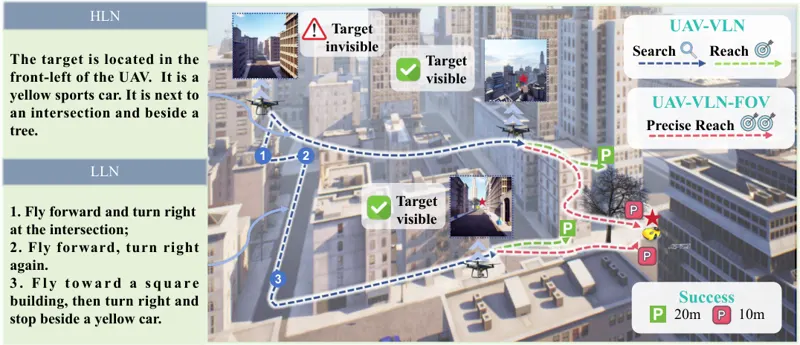
UAV Vision-Language Navigation (UAV-VLN) is typically formulated as a holistic search-and-reach problem, where long-range target discovery and final target approach are optimized and evaluated jointly. This formulation makes it difficult to assess a critical capability of aerial embodied agents, namely whether a UAV can accurately ground a visible target and translate vision-language evidence into precise 3D motion once the target enters its field of view. To address this limitation, we introduce UAV-VLN-FOV, a target-visible navigation task that isolates the see-and-reach stage and enables a more diagnostic evaluation of terminal reaching ability. We further propose 3DG-VLN, a vision-language waypoint prediction framework guided by dynamic 3D direction cues to enhance fine-grained visual grounding and spatial direction alignment for precise target reaching. Specifically, 3DG-VLN adaptively processes high-resolution front-view and downward-view observations to preserve fine-grained visual and geometric details for target grounding. It also updates the target-relative direction online during closed-loop navigation, allowing the agent to maintain spatial alignment with the target and reduce accumulated direction drift. To support this task, we construct a dedicated high-resolution benchmark which contains 2,717 trajectories with target-oriented high-level instructions, high-resolution front-view and downward-view egocentric observations, and continuous 3D waypoint annotations. Experiments show that 3DG-VLN outperforms competitive UAV-VLN baselines, achieving a 13.82% improvement in success rate. Real-world trials further demonstrate the potential of 3DG-VLN for practical see-and-reach navigation. The source code and benchmark are available at https://github.com/xuefanfu/3DG-VLN.
Fanfu Xue, En Yu, Yantian Shen · 109 views · Jun 18, 2026
Vision-language navigationUAVEmbodied AIJun 18, 2026
CosFly-VLA: A Spatially Aware Vision-Language-Action Model for UAV Tracking

CosFly-VLA: A Spatially Aware Vision-Language-Action Model for UAV Tracking

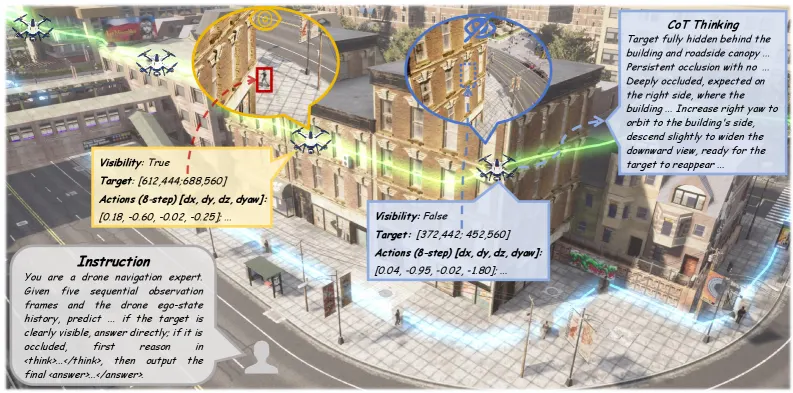
Dynamic target tracking is essential for Unmanned Aerial Vehicles (UAVs) operating in complex urban environments, where both the target and the camera viewpoint change continuously. Existing Vision-Language-Action (VLA) policies can track visible targets effectively, but their performance often degrades when buildings, vegetation, or roadside objects block the line of sight. During sustained occlusion, a policy may lose the target state, execute actions toward an incorrect region, and amplify this error through subsequent observations until re-acquisition becomes impossible. To this end, we present CosFly-VLA, a spatially aware VLA model that jointly grounds the target, estimates its visibility, and generates continuous flight actions through a structured prediction interface. To train this policy, we use a large-scale recipe over diverse data sources. Spatially Grounded Continued Pretraining (CPT) on a 500k mixed pool injects UAV-view depth, distance, and 3-D spatial reasoning. A three-stage Curriculum-based Supervised Fine-Tuning (SFT) process then specializes the tracker through multi-head warm-up followed by two-stage curriculum learning over natural and hard / long-occlusion data. Chain-of-Thought (CoT) training subsequently teaches recovery-oriented reasoning traces before structured answers. Finally, a closed-loop Reinforcement Learning (RL) stage optimizes tracking behavior with a multi-component reward covering stand-off tracking, grounding quality, collision avoidance, and task success. Relative to OpenVLA, CosFly-VLA-0.8B reduces open-loop Average Displacement Error (ADE) by 34.1% on seen-test and 35.3% on unseen-test. Closed-loop optimization improves Success Rate (SR) by 29.8% and 2.5%, respectively. These results demonstrate progress from visible-frame imitation toward spatially grounded action-closed-loop control, evaluated under a shared oracle state history.

Ruilong Ren, Songsheng Cheng, Yunpeng Zhou · 512 views · Jul 16, 2026
UAVVLATrackingJul 16, 2026
AeroAct: Action-Centered World-Action Models for Language-Conditioned Quadrotor Flight

AeroAct: Action-Centered World-Action Models for Language-Conditioned Quadrotor Flight

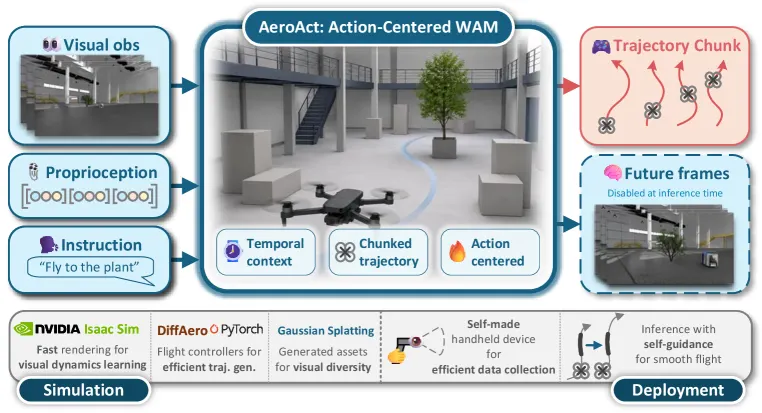
Language-conditioned quadrotor flight requires a policy to ground semantic goals, anticipate the visual consequences of ego-motion, and output control references that remain smooth and dynamically executable under rapidly changing first-person views. Existing aerial vision-language navigation and vision-language-action methods commonly use discrete actions, high-level waypoints, or instantaneous velocity commands, which provide limited supervision about how flight actions change future observations. We present AeroAct, an action-centered world-action model (WAM) for quadrotor navigation. To the best of our knowledge, AeroAct is the first WAM instantiated and demonstrated for real-world aerial flight. The model adapts a pretrained video diffusion Transformer to predict local trajectory-action chunks from egocentric visual history, proprioception, and language. Future first-person frames are used during training as dense consequence supervision, while deployment directly decodes actions without generating future video. To obtain aligned visual, state, language, and dynamically feasible action data, we build a DiffAero-based pipeline with complementary Isaac Lab and 3D Gaussian splatting renderers. We further introduce a low-cost handheld collection device that couples camera observations with motion estimates to recreate flight-like egocentric trajectories, and a self-guidance procedure that improves temporal consistency across overlapping trajectory chunks. Closed-loop simulation and real-world experiments show that temporal visual context improves target tracking and object-search performance, and that WAM-based policies can be executed on a physical quadrotor.

Xinhong Zhang, Qiyuan Zhu, Yubo Huang · 462 views · Jul 16, 2026
UAVQuadrotorWorld ModelsJul 16, 2026

As an Amazon Associate, we earn from qualifying purchases.