What Visual Representations Do World Action Models Need?
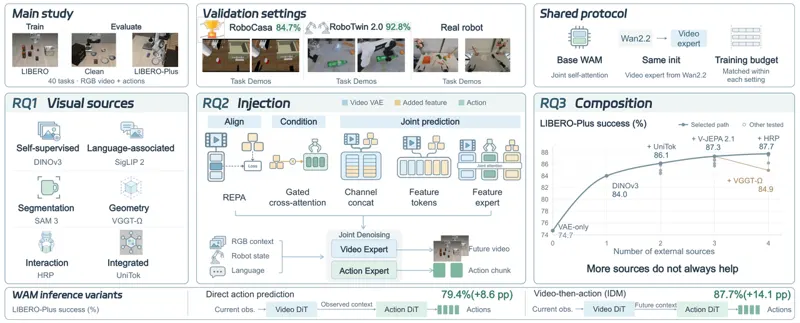
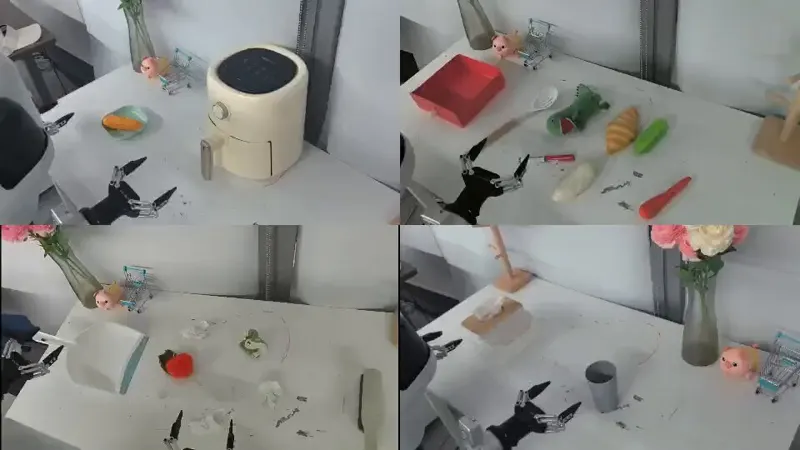
World Action Models inherit their visual foundation from video-generation VAEs trained for pixel reconstruction, which leaves manipulation-relevant information underrepresented. This study holds one Wan2.2 dual-expert backbone and one training protocol fixed and compares 13 frozen visual representations, 5 feature-integration mechanisms and multiple feature compositions on LIBERO-Plus. Three findings emerge. First, general-purpose representations beat specialized ones on average (82.2 vs 80.0 overall success), and every perturbation family is topped by a general source. Second, channel-wise joint prediction is the strongest mechanism (81.5 mean over 13 sources, 5.1 points ahead of the runner-up), and its gain comes mainly from predicting future features rather than from conditioning on the current frame. Third, extra sources help only when complementary: the largest additional gain is 3.7 points, and pairing a distilled encoder with its own teacher (C-RADIOv4 + DINOv3) drops success to 78.6. The resulting recipe R²-WAM (DINOv3 + UniTok + V-JEPA 2.1, channel-wise) reaches 84.7% on RoboCasa GR1 Tabletop (+5.9) and 92.8% on RoboTwin 2.0 (+2.2), and improves all four Galbot G1 real-robot tasks by roughly 10 points.
Kai Liu, Jiangran Lyu, Tingyu Deng · 34 views · Oct 9, 2026
World-action modelsVisual RepresentationRobot ManipulationOct 9, 2026
 1:34
1:34