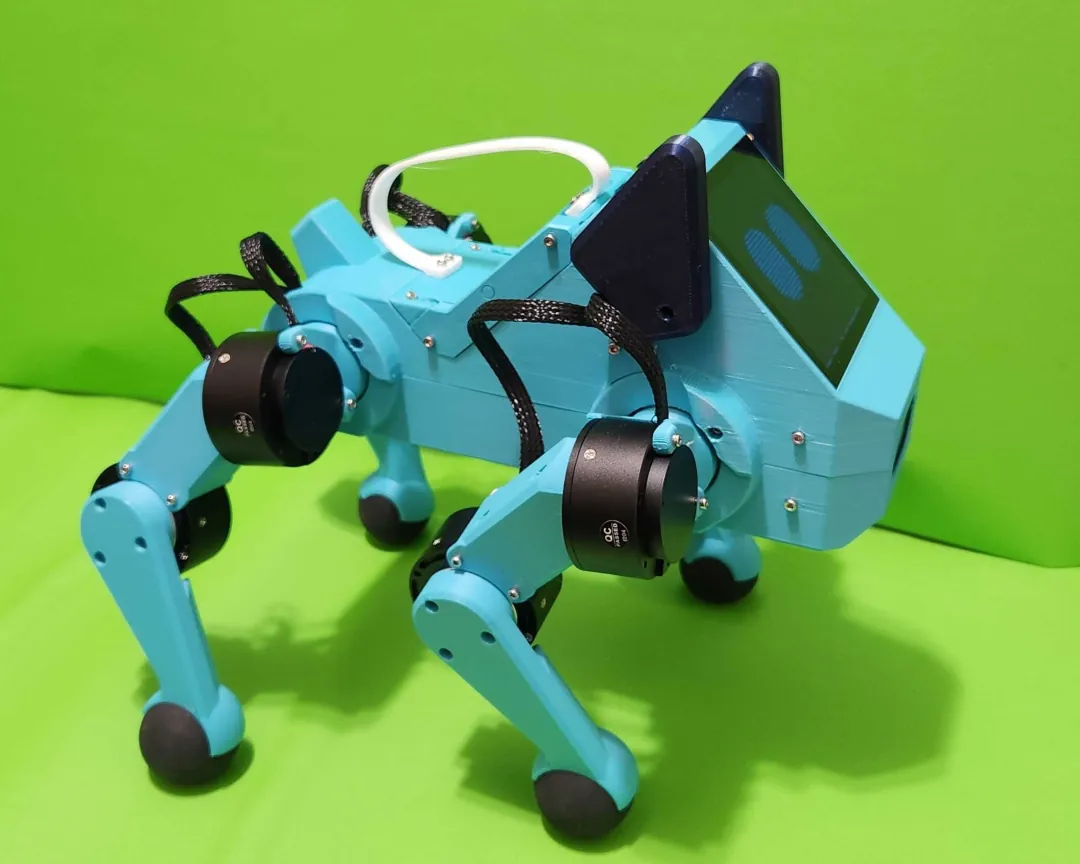
The Open-Source Quadruped Robotics Map: From Kinematics and MPC to RL and Research Hardware
A project-by-project guide to open-source quadruped robotics, spanning kinematics, ROS stacks, MPC/WBC, reinforcement learning, wheel-legged designs, and research-grade actuators.
Core thesis: open-source quadruped robotics is no longer a collection of isolated demonstrations that merely manage to walk. It is a full technical map that reaches from microcontrollers and ROS integration to optimization-based control, reinforcement learning, actuators, and mechanical design. Many projects appear to solve the same four-legged locomotion problem, but their real differences lie in how they divide state estimation, gait scheduling, foot trajectories, force allocation, simulation training, and hardware constraints.
This article is a complete English adaptation of “Embodied AI | A Deep Analysis of Open-Source Quadruped Projects: A Technology Map from Beginner to Research Grade,” published by Gan Gan AUTOHUB. The original surveyed more than twenty mainstream quadruped repositories on GitHub and grouped them into five families: kinematic control, ROS-based full-stack systems, optimization control, reinforcement learning, and research-grade hardware. We preserve that organizing structure while making the inheritance paths, operating boundaries, and engineering costs explicit, so readers can move from bookmarking repositories to understanding complete systems.
GitHub stars and forks below are snapshots reported by the source article, not live metrics. When evaluating a repository, code completeness, maintenance, documentation, hardware dependencies, and reproducibility matter more than a star count.
1. Why quadrupeds are a useful entry point into open robotics
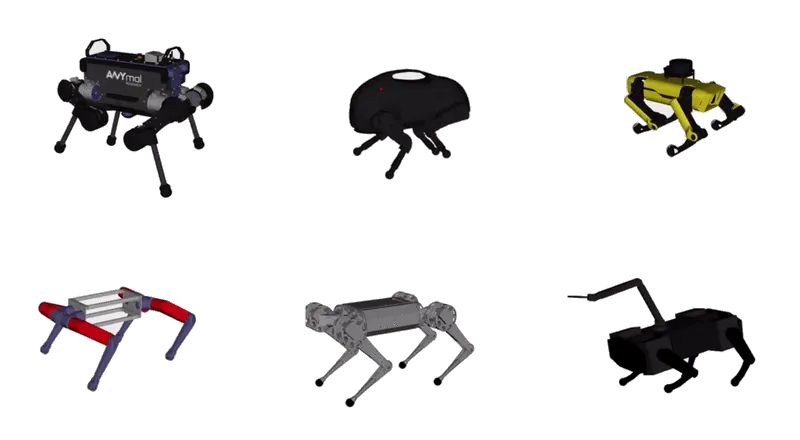
Boston Dynamics Spot and the MIT Cheetah once represented capabilities available only to well-resourced laboratories. Today, learners can reproduce many of their core ideas through open code, 3D-printable structures, actuator designs, and simulation. The real value of these projects is not that they eliminate development work. It is that they expose the engineering tradeoffs normally hidden inside papers and labs: when analytic inverse kinematics is enough, when dynamics optimization starts to pay off, why reinforcement learning depends on domain randomization, and whether a high-performance joint is difficult because of its motor, reducer, encoder, or all three.
The projects can be understood along two axes. The first is control complexity, from fixed gaits and inverse kinematics to MPC and whole-body control, then to neural policies. The second is system scope: some repositories provide only a controller, while others include ROS navigation, mechanical parts, PCBs, firmware, and simulation. Only by considering both axes can one avoid comparing a low-cost servo platform directly with a research machine built around high-performance actuators.
| Technical family | Typical methods | Strengths | Main limitations |
|---|---|---|---|
| Minimal kinematic control | IK, phase state machines, scripted foot trajectories | Low cost, good real-time behavior, easy to understand from source | Limited disturbance rejection and rough-terrain adaptation; hand-tuned gait parameters |
| ROS full stack | URDF, TF, node communication, Navigation2 | Modular, extensible, connects perception and navigation | System complexity; communication and real-time behavior require careful design |
| Optimization control | MPC, WBC, quadratic programming, contact constraints | Dynamics-aware and able to represent friction and torque constraints | Complex models and solvers; high deployment and tuning cost |
| Reinforcement learning | PPO, domain randomization, teacher-student distillation, curricula | Can discover complex gaits with less explicit trajectory design | Sample hungry; a significant sim-to-real gap remains |
| Research-grade hardware | Quasi-direct drive, dual encoders, FOC, open mechanics | Reproducible force control and a complete hardware-software loop | Expensive and difficult to manufacture, assemble, and operate safely |
2. Minimalism: use kinematics and state machines to get moving first
2.1 Less computation can mean more controllability
Minimalist projects commonly run on microcontrollers or small single-board computers. Instead of solving full multibody dynamics, they divide locomotion into layers that are easy to inspect: decide which legs are in swing or stance, generate a periodic foot trajectory, and use inverse kinematics to map each foot target into joint angles. In a Trot, diagonal legs share a phase while the other diagonal pair supports the body. With sensible phase offsets, step height, and footholds, even a small platform can walk convincingly.
The strength of this approach is explainability. At any instant, the developer can identify the gait phase, the intended foot position, and the joint command that follows from it. Its limits are equally visible. Without contact-force or dynamics constraints, the robot has limited ability to reject a lateral push. Soft soil, slopes, or changing payloads usually force another round of phase and PD tuning.
2.2 Stanford Pupper: a teaching example of layered control
Stanford Pupper comes from the Stanford Robotics Club. The source recorded roughly 1,676 stars and 653 forks, but its structure matters more than the count. Gait scheduling, foot-trajectory generation, and inverse kinematics are separated: TrotGait controls the diagonal phase, a trajectory generator defines each swing, and an IK solver maps target foot positions to twelve joint angles.
The project demonstrates an important engineering fact: with accurate kinematic calibration and consistent structure and servos, a simple PD controller can support dynamic trotting without necessarily requiring advanced force control. The sensible learning sequence is to validate single-leg IK, then the body frame and foot paths, and only then tune phase and PD gains. Skipping the first two steps often turns mechanical error into what looks like a controller problem.
2.3 Petoi OpenCat: actions as embedded skills
Petoi OpenCat follows a more product-oriented path. The source recorded roughly 4,713 stars. The platform supports bodies such as Nybble and Bittle and organizes sitting, walking, rolling, and special movements as Skills. Each skill is effectively a preset sequence of joint angles or a set of oscillator parameters with particular frequencies and amplitudes.
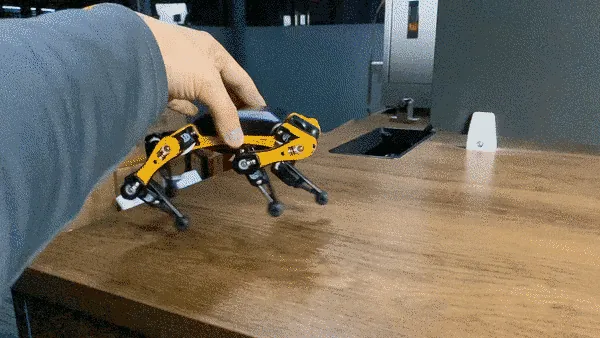
This organization fits an Arduino-class environment because executing a behavior does not require an online optimization solve. The modularity extends to mechanics: changing the body mainly means updating link lengths, joint directions, and zero positions rather than rewriting the behavior framework. The tradeoff is dependence on manually authored skills, which limits adaptation to unexpected disturbances and continuously changing velocity commands.
3. ROS ecosystems: from a control node to a complete robot
3.1 ROS supplies system boundaries, not automatic intelligence
ROS divides drivers, state estimation, locomotion control, perception, mapping, and planning into nodes connected through topics, services, parameters, and the TF tree. Quadrupeds benefit from this decomposition because the world frame, body frame, leg-base frames, and foot frames must remain consistent; URDF defines the mechanism, and launch files coordinate processes with different responsibilities and update rates.
Node boundaries introduce latency and debugging costs as well. Navigation can run at a lower rate, while joint control needs a stable low-latency loop. A usable ROS quadruped has to decide which information may traverse message queues and which control loops should remain local, rather than placing every computation behind the same scheduler and transport layer.
3.2 SpotMicro: connecting velocity commands and gaits through ROS
SpotMicro is one of the best-known DIY projects inspired by Spot Mini. The source reported roughly 2,043 stars and 484 forks. Its main control node subscribes to /cmd_vel, converts linear and angular velocity into gait parameters and foot trajectories, calculates joint targets through IK, and sends commands to the motor interface.
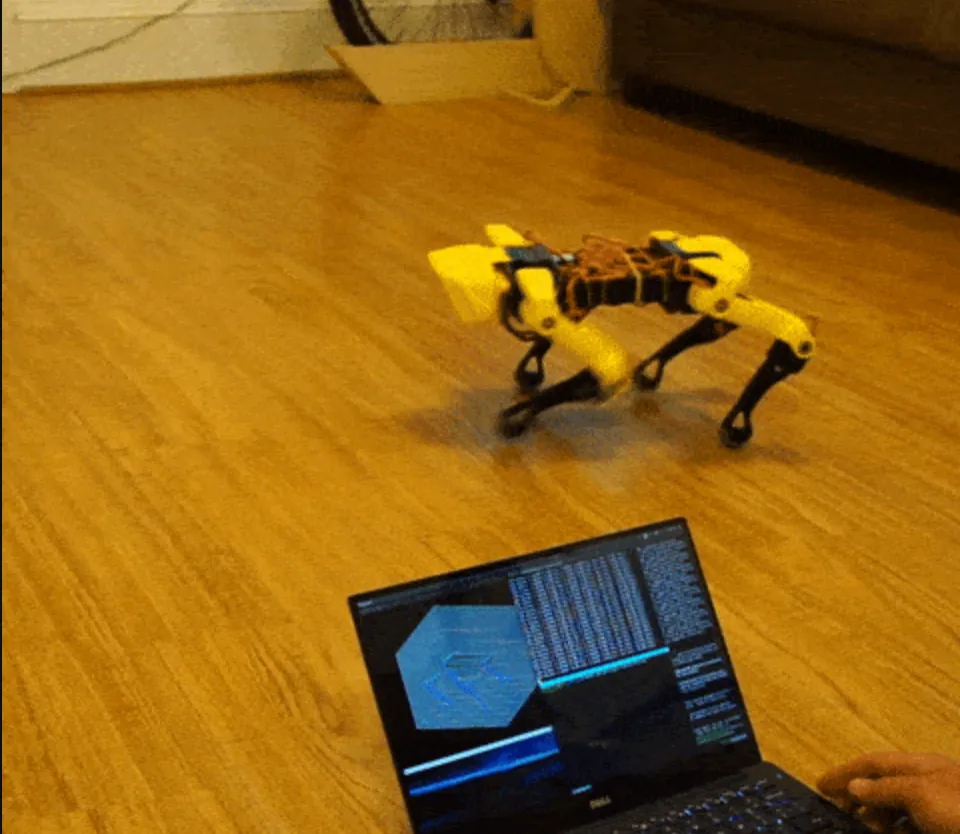
SpotMicro is also useful as a TF reference. Transforms among the world, body, leg-base, and foot frames provide the coordinate foundation for body-pose control, step-height adjustment, and terrain adaptation. Readers who study only IK equations may miss the question of which frame contains the foot target. Running SpotMicro's URDF and TF layout layer by layer usually builds better system intuition than reading the controller in isolation.
3.3 Mini Pupper: putting quadruped control inside ROS 2 and a navigation stack
Mini Pupper extends the Stanford Pupper idea into a product-oriented ROS 2 platform. It connects visual SLAM, Navigation2, global and local planning, and locomotion control so the robot can do more than follow a velocity command: it can map an environment, plan routes, and avoid obstacles.
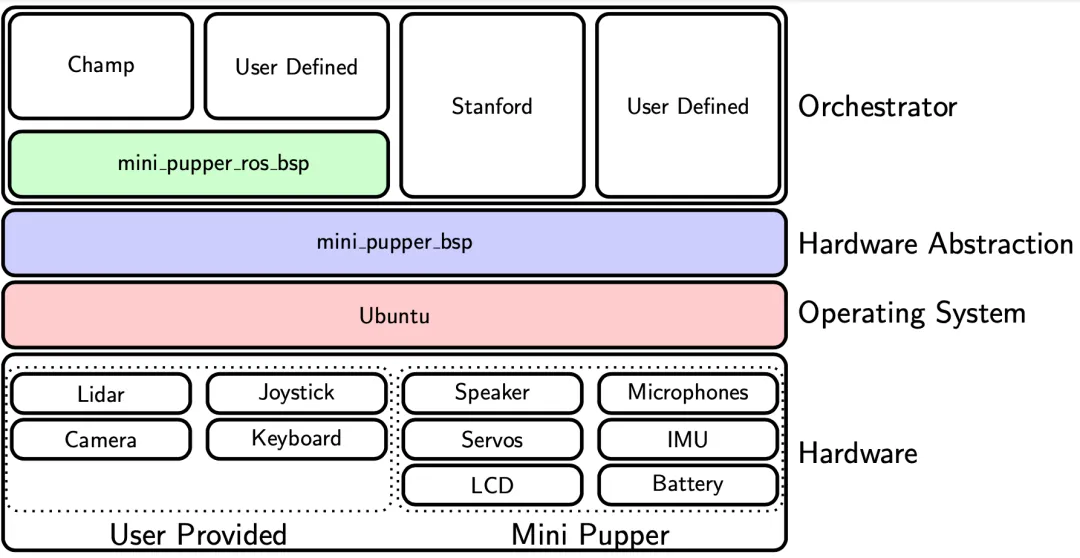
ROS 2 uses DDS as its communication middleware, allowing nodes to span processes and machines. Mapping and planning can run on a remote computer while the real-time controller remains on the robot. This creates new engineering constraints: timing, network jitter, discovery, and QoS settings all affect navigation and control. ROS 1 launch files and transport assumptions cannot simply be copied into this architecture.
4. Optimization control: bring contact force into the model
4.1 From moving feet to constrained optimization
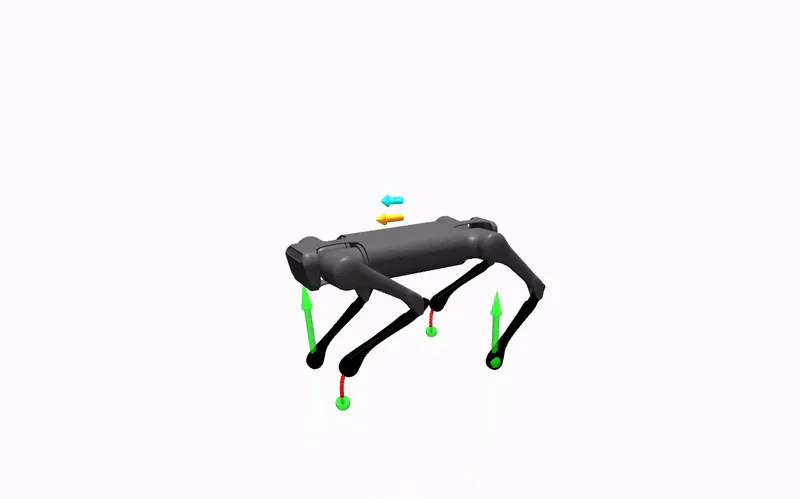
Kinematic control asks where the foot should go. Optimization control also asks how much force the ground can support. The controller must reconcile dynamics, friction cones, joint limits, and torque limits while tracking body velocity and orientation. Model Predictive Control repeatedly optimizes over a finite horizon and executes only the first command. Whole-Body Control assigns priorities to tasks such as balance, foot tracking, posture, and torque minimization.
A typical MPC objective can be expressed conceptually as:
$$\min_{x_{0:N},u_{0:N}}\sum_{k=0}^{N-1}\left(\|x_k-x_k^{ref}\|_Q^2+\|u_k\|_R^2\right)$$
subject to discrete dynamics, contact schedules, joint limits, and friction constraints. The equation is rarely the hardest part. Model fidelity, solver time, contact sequencing, state-estimation error, and parameter mismatch after hardware deployment are what determine whether the controller works.
4.2 legged_control: switched-system control with OCS2
legged_control connects OCS2 and ros-control to show how an academic optimization library enters a ROS control loop. A quadruped is a switched system: stance and swing assignments change over time, and the contact dynamics change with them. Its state estimator combines IMU, joint encoders, and contact information; MPC allocates foot forces using a single-rigid-body model; WBC maps those forces to joint torques; and a gait scheduler supplies future contact phases.
The repository is best suited to readers who already know ROS 1 and optimization control. The source explicitly notes its ROS 1 Noetic and Ubuntu 20.04 dependency, which can make installation difficult on newer systems. New projects may therefore use it as an architectural reference while porting the concepts to a current ROS 2 and solver stack.
4.3 CHAMP: turning MIT Cheetah ideas into a configurable framework
CHAMP combines foot trajectories, body-pose control, ROS interfaces, and multiple robot models. The source reported roughly 2,196 stars and 428 forks and highlighted its single-rigid-body assumption: leg mass and inertia are ignored, treating the machine as one rigid body. This trades some model fidelity for tractable contact-force optimization.
Its convex_mpc path formulates force allocation as a quadratic program and includes a linearized friction cone. The resulting tangential-force limit is tied to normal force, making the solution more physically plausible than unconstrained force distribution. CHAMP also provides a setup assistant that can generate a ROS package from a URDF and basic parameters, significantly reducing the work needed to bring up a new quadruped.
4.4 WBC and Quadruped-PyMPC: handling conflicting tasks by priority
When body pose, foot tracking, joint speed, and torque limits are all active, a simple weighted objective can sacrifice one task to improve another. WBC uses task priorities and null-space projection: balance or another high-priority objective is satisfied first, and lower-priority targets are optimized only in the remaining feasible space. Hierarchical quadratic programming provides a formal way to solve this sequence.
The source notes that the TopHillRobotics WBC implementation has low activity and points readers toward Quadruped-PyMPC instead. That project organizes MPC and WBC in Python and uses acados for real-time optimization, offering a readable path through models, constraints, objective terms, and controller interfaces.
5. Reinforcement learning: learn complex locomotion in parallel simulation
5.1 Less hand-authored gait, no escape from engineering
Reinforcement learning represents control as a trainable network and optimizes cumulative reward through interaction. It can discover gait details that are difficult to specify by hand, but it requires enormous amounts of data. A physical robot cannot tolerate millions of exploratory trials, so mainstream pipelines train in parallel simulators such as Isaac Gym, Isaac Lab, or PyBullet and then improve transfer with domain randomization, observation history, action smoothing, and actuator-delay models.
Walking in simulation is only the beginning. Sensor noise, motor response, contact models, communication delay, and structural compliance all alter the world seen at deployment. A credible sim-to-real pipeline must cover plausible hardware variation during training and retain safety limits, state monitoring, and fallback behavior on the real system.
5.2 Spot Mini Mini: domain randomization as part of the workflow
Spot Mini Mini is a PyBullet project focused on learned quadruped locomotion. The source reported roughly 919 stars and 191 forks. Its central contribution is not one specific network but a systematic lesson in randomizing mass, center of mass, link lengths, friction, motor delay, joint damping, IMU noise, and terrain variation.
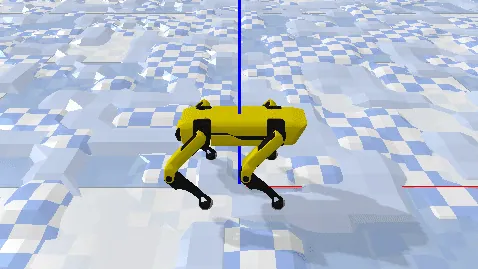
The method deliberately makes training messy. When the real robot's mass distribution differs from the simulator, or floor friction changes, the policy can still use feedback and history to maintain stability. The ranges are not automatically better when wider: too narrow and transfer fails, too broad and the task may become impossible to learn. They should reflect the real uncertainty of the target hardware.
5.3 REX-Gym: reward design determines what the robot learns
REX-Gym provides several quadruped tasks behind a Gym-style interface. The source recorded roughly 1,089 stars. A basic walking reward often combines forward-speed tracking with penalties for energy use, foot impact, body-orientation error, and joint velocity. Changing those weights changes the resulting gait style.
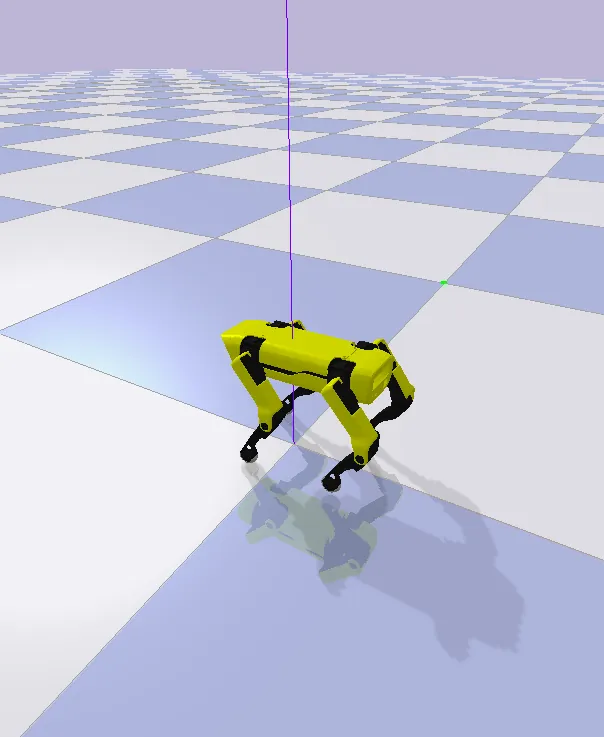
The project also demonstrates curriculum learning. Early training uses simpler terrain, lower target speeds, and easier commands; difficulty increases only as the policy stabilizes. Compared with starting at maximum difficulty, a curriculum is often more stable and less likely to reward high-frequency jitter or bizarre postures that exploit the simulator.
5.4 Isaac Gym, Isaac Lab, and Legged Gym: parallelization changes scale
NVIDIA's Isaac Lab puts physics simulation, environment replication, and policy training on a GPU pipeline. The source describes thousands of parallel robot instances on a single high-end GPU, reducing some training jobs from days to minutes or tens of minutes. Actual throughput still depends on the GPU, environment, and policy.
ETH Zurich's Legged Gym is a representative academic framework built on Isaac Gym. It combines massively parallel environments, terrain curricula, observation history, and PPO. A teacher can use privileged information during training and then distill its behavior into a student that relies on proprioception. Deployment-oriented details include observation noise, action smoothing, actuator modeling, latency simulation, and curriculum control.
The shared benefit of these frameworks is that environment count becomes a tunable resource. Parallelism does not by itself create real-world robustness. Training distribution, state design, action scaling, and the hardware interface still determine whether a policy is safe to deploy.
5.5 rl-mpc-locomotion: a layered combination of learning and optimization
rl-mpc-locomotion provides a teaching-oriented path through kinematics, single-rigid-body dynamics, MPC, WBC, and reinforcement learning. The source recorded roughly 946 stars and highlighted its explanatory material as a systematic introduction.
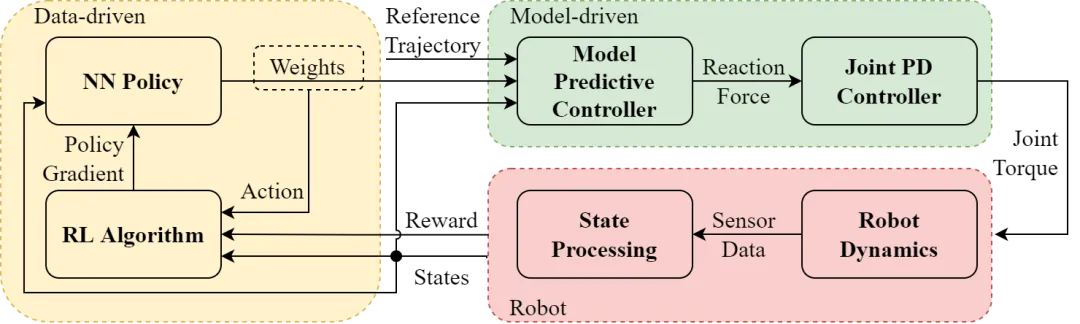
Its most instructive idea is the division of responsibility. MPC continues to allocate forces under dynamic constraints; RL does not need to output joint torques directly and can instead learn high-level control parameters or decisions. This preserves interpretability while using data to adapt the controller. The cost is a more complicated training architecture, and the interface between learner and controller must be stable so the policy cannot exploit simulator-only shortcuts.
5.6 ABS: high speed must still include obstacle awareness
ABS, or Agile But Safe, was developed with participation from CMU, ETH Zurich, and other collaborators. It combines fast running, target tracking, and collision avoidance. The source describes a layered pipeline involving a depth camera, local occupancy map, MPPI trajectory sampling, and a learned low-level locomotion controller.
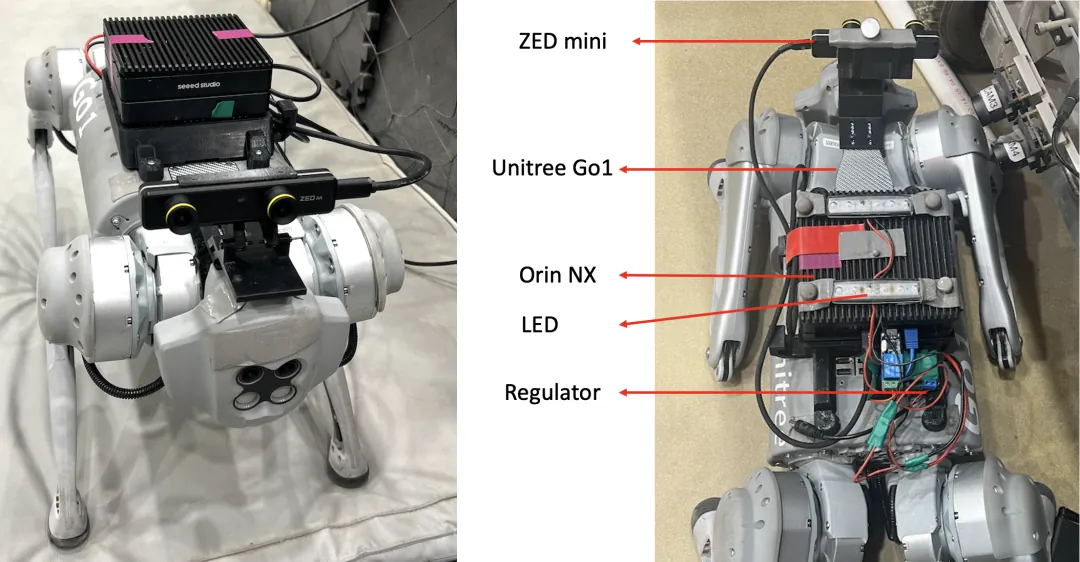
MPPI samples candidate trajectories, evaluates target progress and safety under dynamic constraints, and selects an executable path. The low-level policy converts desired speed and steering into joint action and is trained with frameworks such as legged_gym and rsl_rl. The system shows that higher autonomy is not a navigation stack bolted onto a quadruped; perception latency, planning rate, and whole-body control must share a carefully designed timing budget.
6. Wheel-legged robots: trading wheel speed against terrain capability
6.1 Wheel-legged is not simply “quadruped plus four wheels”
The hard part is coordinating leg posture with wheel speed. On flat ground, driven wheels can reduce step and landing losses for better efficiency. On stairs, rubble, and slopes, legs provide obstacle clearance. The controller must decide when to rely more on rolling, when to lift a leg over an obstacle, and how to preserve stable contact during mode transitions.
6.2 rl_sar: one training pipeline for several wheel-legged platforms
rl_sar targets platforms including Unitree Go2, B2, and Aliengo and provides a path from simulated training to physical deployment. The source reported roughly 1,230 stars. A high-level policy consumes IMU, joint state, and target velocity and outputs leg posture and wheel speed; a low-level PD loop tracks the command. The reward combines velocity tracking, pose stability, energy use, and smoothness.
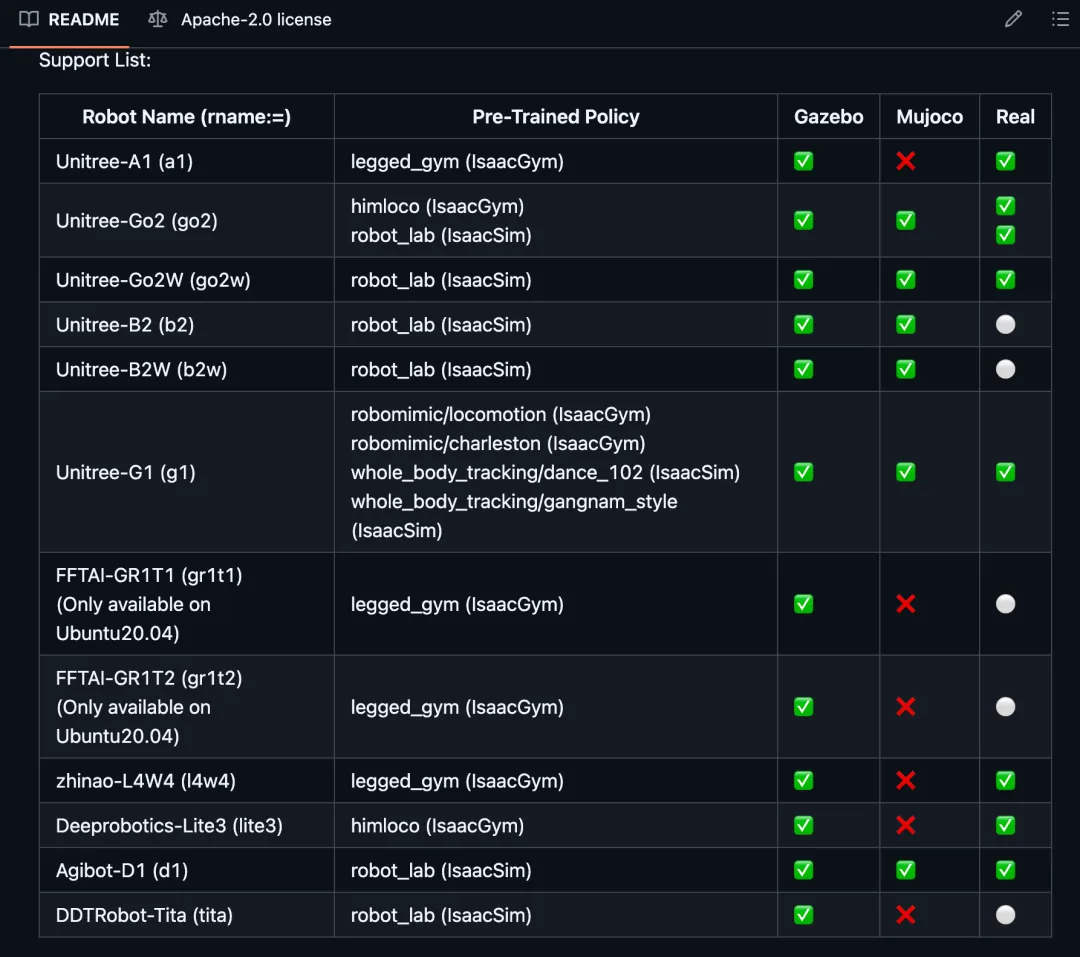
Randomizing mass, friction, and motor parameters reduces dependence on an exact model. Zero-shot transfer should still never be assumed. Wheel-ground contact, encoder direction, joint limits, torque saturation, and emergency-stop behavior must be checked on every physical platform.
6.3 Wheel-Legged-Gym and B2W mobile manipulation
Wheel-Legged-Gym from SUSTech builds on legged_gym and rsl_rl. Its value is a clear and approachable structure for moving from flat-ground velocity tracking toward more difficult terrain and more complex policies.
legged-robots-manipulation places manipulation on the Unitree B2W wheel-legged platform. It points toward a broader role for wheel-legged bases: not only moving a body, but acting as a stable mobile base for an arm. Legs, wheels, arm motion, and task strategy need a shared observation and reward space.
6.4 Other wheel-legged repositories
- Micro-Wheeled_leg-Robot: a miniature desktop platform for teaching and fast experiments.
- Ascend Quadruped: a low-cost wheel-legged platform with open mechanical and electrical design.
- Wheeled Biped: a two-legged wheeled form for studying another combination of balance and wheel drive.
7. Research-grade hardware: the actuator is part of the control problem
7.1 Why quasi-direct drive fits dynamic robots
A traditional high-ratio joint can produce high torque, but friction, backlash, and reflected inertia make force control and collision detection harder. Direct drive provides a more transparent motor-to-output relationship, but the motor becomes large and heavy. Quasi-direct drive usually balances the two around a low gear ratio, often in the 6:1 to 9:1 range, preserving torque density while keeping output force easier to estimate and control.
7.2 Solo and open actuators: motor, mechanics, electronics, and firmware
The Open Dynamic Robot Initiative actuator hardware from the Max Planck Institute for Intelligent Systems exposes motor, planetary reducer, dual-encoder, and FOC driver-board designs. The source recorded roughly 1,371 stars for the repository.
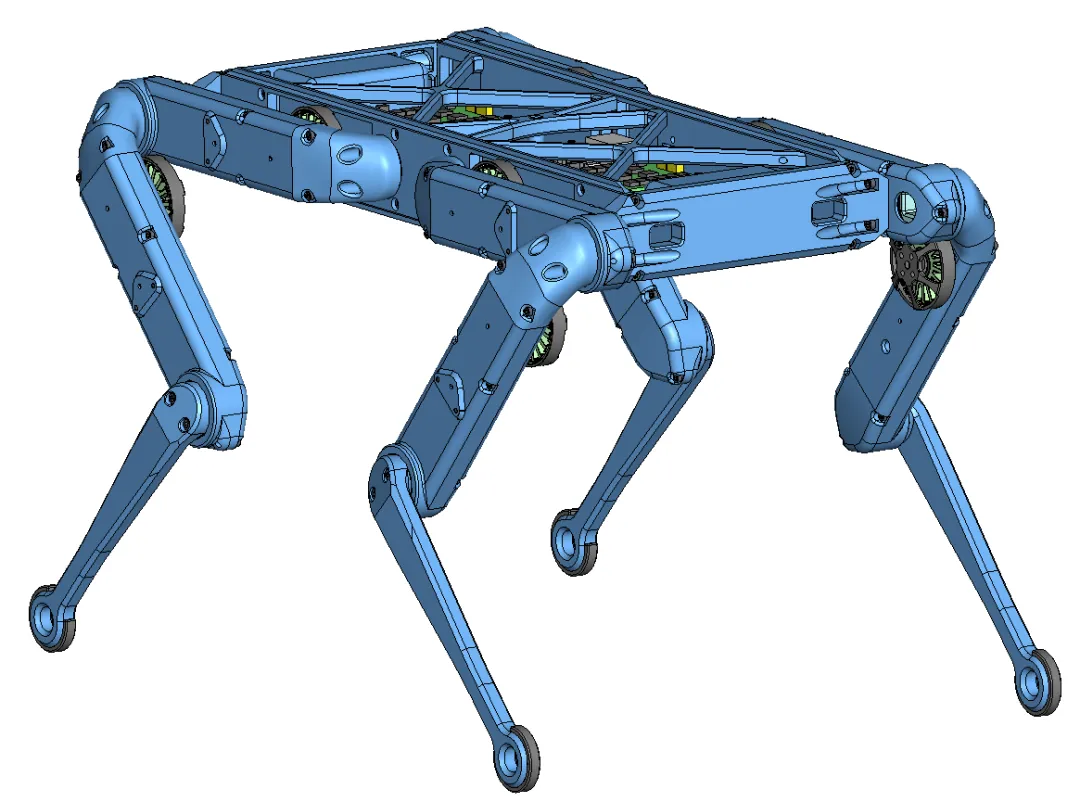
One encoder measures the motor side and another measures the output side. Their difference reflects compliance in the reducer and linkage and can be used to estimate output torque. This is not a conventional large joint-torque sensor, but it is a practical low-cost route to force-aware control. Open CAD, PCB, and firmware files also help researchers determine whether a failure belongs to the motor, driver, encoder, or higher-level controller.
7.3 OpenQuadruped: lowering the barrier with 3D printing
OpenQuadruped uses FDM-printable parts and common servos. The source reported roughly 462 stars. Its links add ribs for stiffness, bearings reduce joint friction, and the structure is designed for ordinary desktop printing. Its performance cannot match a quasi-direct-drive machine, but it compresses the path from CAD to a complete walking robot into a project an individual can attempt.
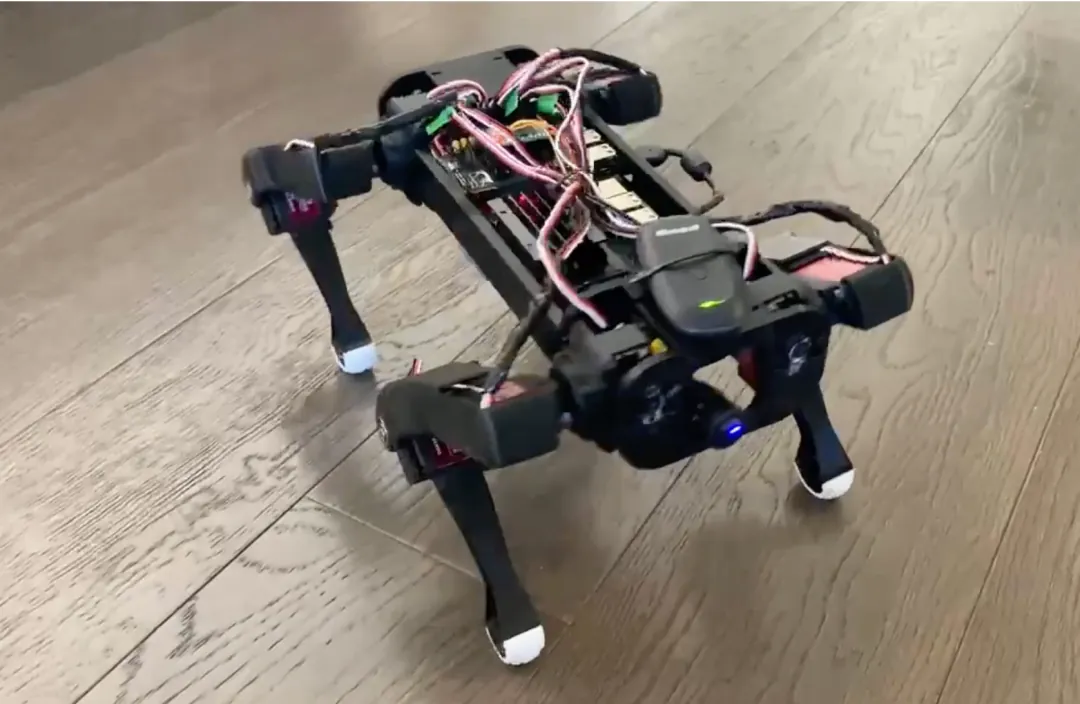
The project uses Bezier curves for foot paths, letting a developer adjust lifting height, stride, and landing shape through control points. Compared with editing a table of joint angles, this representation makes the relationship between trajectory shape and mechanical limits easier to reason about.
8. Trends: fusion, reproducibility, and new morphologies
8.1 Four recurring problems
Documentation depth is uneven. Installation instructions are common, but state estimation, contact scheduling, reward weighting, and controller interfaces are often under-explained. Hardware dependence is strong: moving an algorithm from servos to quasi-direct-drive joints can require new calibration, saturation logic, control rates, and actuator models. The simulation gap remains visible in contact, friction, latency, and structural compliance. Finally, safety engineering is often incomplete; emergency stop, fall protection, torque bounds, and communication-loss behavior should be designed with the controller, not added afterward.
8.2 Optimization and learning are converging through layered control
A practical direction is not to replace MPC with reinforcement learning completely, but to give each a different role. A learner can handle terrain interpretation, parameter adaptation, and high-level decisions; MPC or WBC can enforce dynamic, contact, and torque constraints. The optimizer provides a safety and feasibility layer while the learned component contributes adaptation and pattern recognition.
Google DeepMind's Barkour is a prominent end-to-end agility case. The source recorded roughly 336 stars and noted that the complete training code is not open. Its parkour, jumping, and precise landing results show that learned policies can exceed a hand-authored gait library, but reproducing such results requires specialized hardware, training infrastructure, and rigorous safety evaluation in addition to the algorithm.
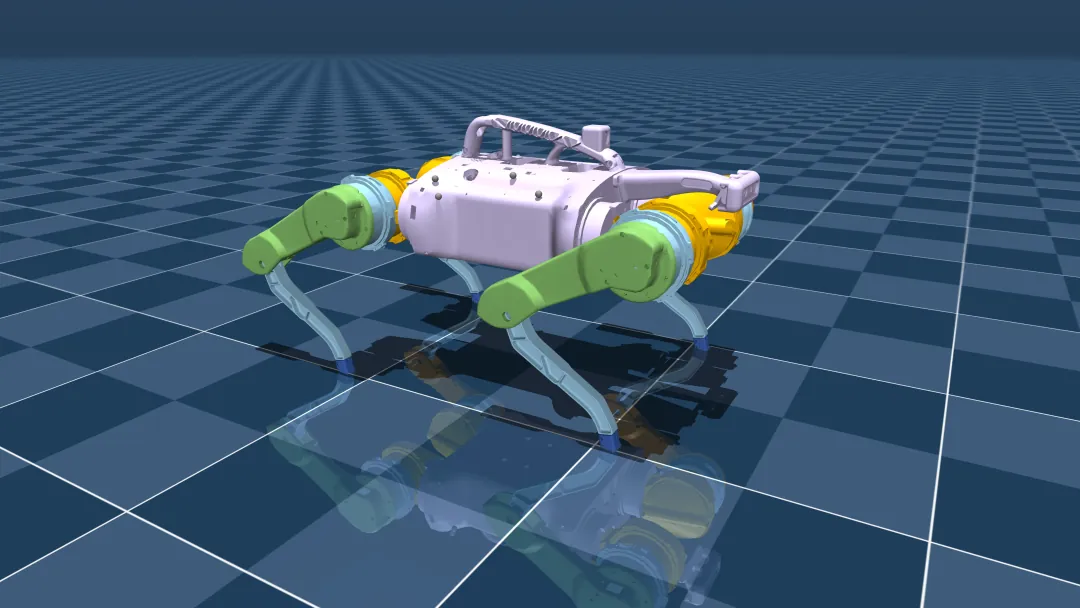
8.3 FLORES and FOC wheel-legs: mechanics redefine efficiency
FLORES explores a reconfigurable wheel-leg mechanism. Rather than attaching a wheel to a fixed lower leg, it changes joint configuration and steering capability so the machine can operate differently during wheeled travel and legged manipulation.
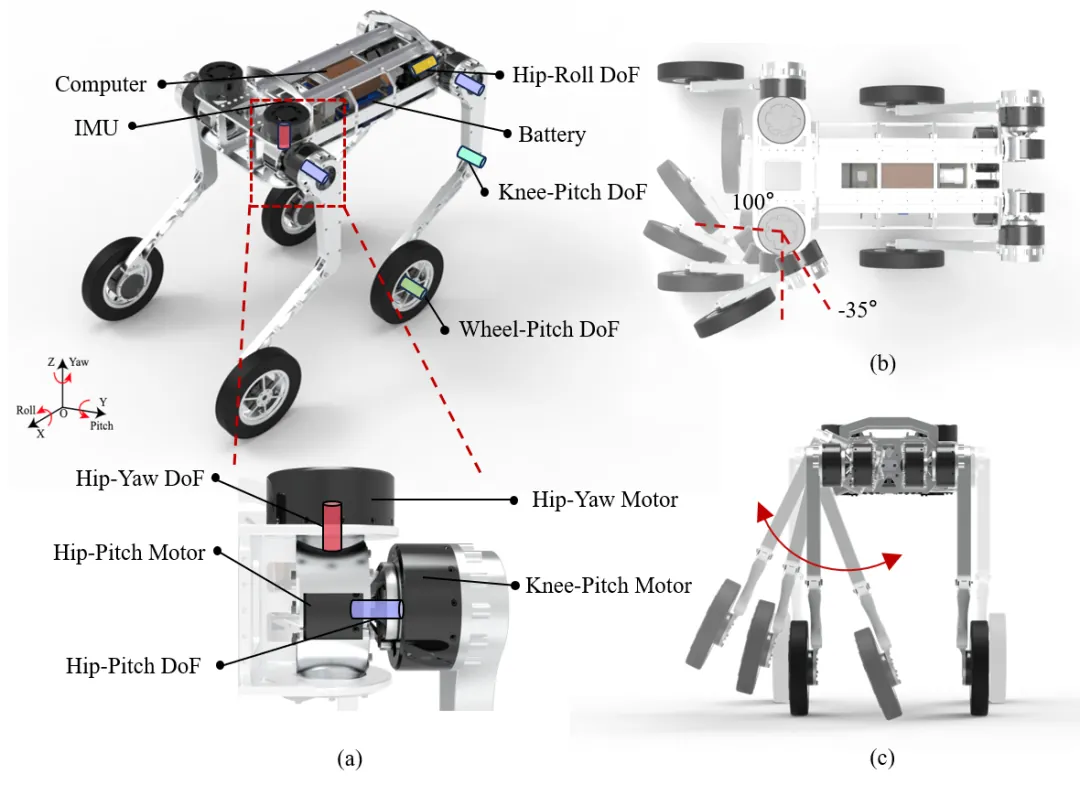
The FOC wheel-legged robot combines a five-bar linkage, STM32-based FOC drive, mechanics, electronics, and control in one open project. The source reported roughly 1,557 stars. The linkage offers a larger workspace, while FOC provides finer torque and speed control at the wheel, which matters for wheel-leg coordination and flat-ground force control.
8.4 Two-wheel-legged robots: harder balance, different mobility
Wheel Legged Genesis uses the Genesis physics engine and a staged curriculum. The source reported roughly 340 stars and described progression from balance and straight-line motion to steering and complex terrain. Two to three hours was the article's reported training result, not a fixed expectation across hardware and settings.
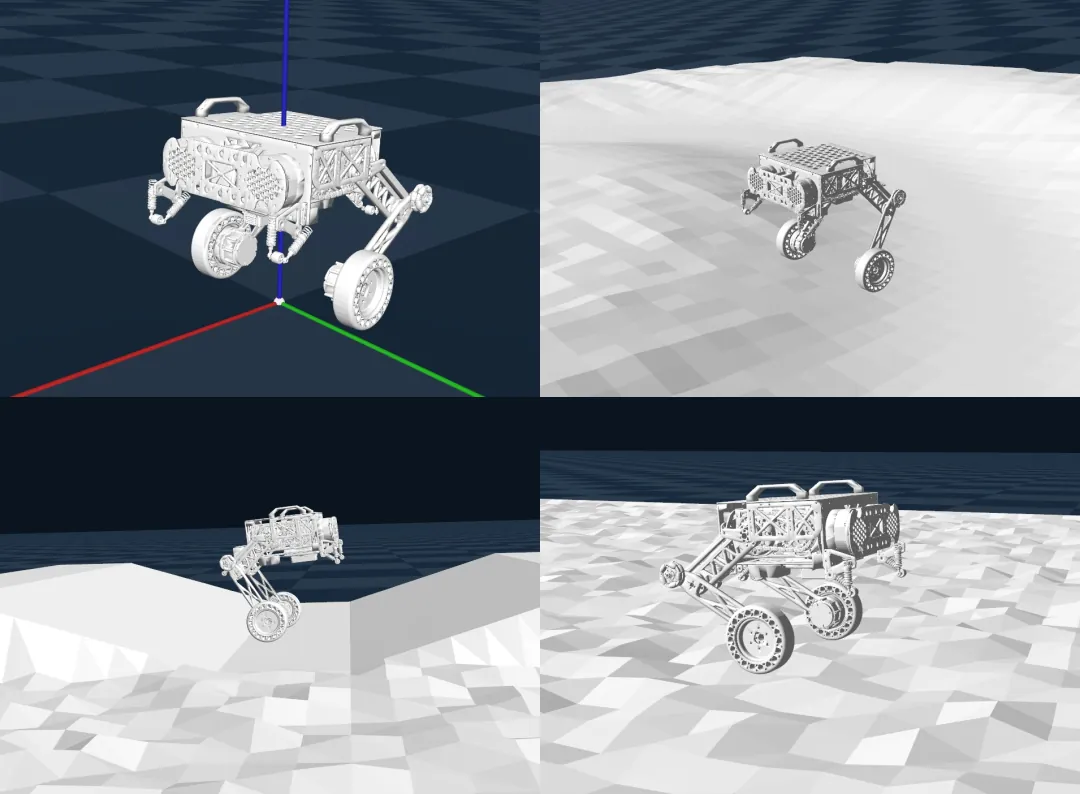
Isaac-RL-Two-wheel-Legged-Bot studies a robot with two legs and a driven wheel at each foot. It must solve dynamic balance and travel together and may offer advantages in tight spaces and at speed. Random pushes, slopes, and mass changes are used during training.
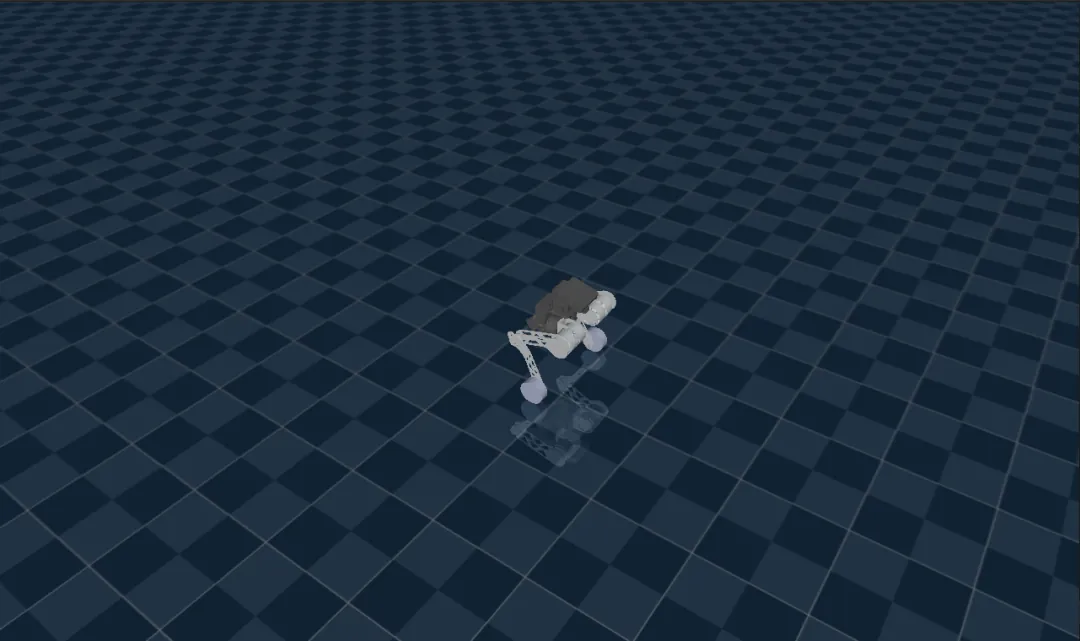
Additional wheel-legged resources include LocoLeggedWheel, WheelLeggedRobotSimulation, Venus-1 Four-link, and awesome-wheeled-legged. They focus, respectively, on Isaac Lab deployment, simulation assets, complete mechanical open source, and a curated project index.
9. Choosing a first route
To understand the fundamental locomotion loop, start with a project such as Stanford Pupper or OpenCat. Get single-leg IK, the URDF, and stand-to-sit behavior working before attempting a Trot; there is no need to begin with an optimizer.
To build a complete robot with perception and navigation, use SpotMicro or Mini Pupper as a ROS reference. At this stage, sensor timestamps, transforms, control rates, and communication should receive as much attention as the gait algorithm.
For dynamic locomotion and rough terrain, study the models in Quadruped-PyMPC, CHAMP, and legged_control before moving deeper into contact schedules and solvers. A reinforcement learning route can begin with Spot Mini Mini, REX-Gym, and Legged Gym, focusing on environment design, rewards, randomization, and deployment instead of copying only the training script.
For hardware or highly dynamic experiments, actuators, structural stiffness, encoders, and drivers matter as much as the algorithm. Solo-class platforms provide a research reference, while OpenQuadruped offers a lower-cost complete machine. Applying a high-dynamic force-control algorithm directly to a low-cost servo platform rarely reproduces a paper demonstration.
10. Conclusion: open source lowers the entry point, not the engineering difficulty
The open-source community has turned quadruped robotics from a specialized laboratory capability into a system that can be studied, modified, and reproduced. A developer can now print a small robot at modest cost or train thousands of simulated environments in Isaac Lab. A genuinely usable robot still depends on coordinated mechanical, electrical, control, estimation, perception, learning, and safety engineering.
Kinematic control is simple but bounded, optimization control is capable but complex to deploy, and reinforcement learning is flexible but expensive to train and transfer. The most useful question is not which framework is strongest. It is which layer of capability a task requires, which constraints cannot be relaxed, and which part of the system a repository actually opens. Verifying source, documentation, simulation, and hardware layer by layer is the dependable path from an open repository to real technical capability.
Appendix: project index
The following star counts are snapshots reported by the original article and are retained only as a rough measure of community attention at that time.
| Family | Project | Repository | Source snapshot |
|---|---|---|---|
| Minimal kinematics | Stanford Pupper | stanfordroboticsclub/StanfordQuadruped | 1,676 stars |
| Minimal kinematics | OpenCat | PetoiCamp/OpenCat-Quadruped-Robot | 4,713 stars |
| Minimal kinematics | Stanford Doggo | Nate711/StanfordDoggoProject | 2,508 stars |
| ROS full stack | SpotMicro | mike4192/spotMicro | 2,043 stars |
| ROS full stack | Mini Pupper | mangdangroboticsclub/mini_pupper | 36 stars |
| ROS full stack | QuadrupedRobot | mangdangroboticsclub/QuadrupedRobot | 1,088 stars |
| Optimization control | CHAMP | chvmp/champ | 2,196 stars |
| Optimization control | Quadruped-PyMPC | iit-DLSLab/Quadruped-PyMPC | 446 stars |
| Optimization control | TOWR | ethz-adrl/towr | 1,049 stars |
| Optimization control | DIAL-MPC | LeCAR-Lab/dial-mpc | 952 stars |
| Reinforcement learning | Spot Mini Mini | OpenQuadruped/spot_mini_mini | 919 stars |
| Reinforcement learning | REX-Gym | nicrusso7/rex-gym | 1,089 stars |
| Reinforcement learning | rl_sar | fan-ziqi/rl_sar | 1,230 stars |
| Reinforcement learning | rl-mpc-locomotion | silvery107/rl-mpc-locomotion | 946 stars |
| Research hardware | Solo actuator hardware | open_robot_actuator_hardware | 1,371 stars |
| Research hardware | OpenQuadruped | adham-elarabawy/open-quadruped | 462 stars |
| Research hardware | moteus | mjbots/moteus | 1,137 stars |
| Other | Barkour | google-deepmind/barkour_robot | 336 stars |
| Other | Sesame Robot | dorianborian/sesame-robot | 1,309 stars |
| Other | py-apple-quadruped | ToanTech/py-apple-quadruped-robot | 1,224 stars |
Source: “Embodied AI | A Deep Analysis of Open-Source Quadruped Projects: A Technology Map from Beginner to Research Grade” by Gan Gan AUTOHUB, author “Gan Gan Does Not Want to Write Bugs,” published October 12, 2026. This is a complete bilingual adaptation. The original's closing follow and previous-article promotions were removed. Project descriptions and community counts follow the source; selection guidance and engineering analysis were organized by RobotWorld.
Source:敢敢 AUTOHUBhttps://mp.weixin.qq.com/s/sHRTJTnHr5RNlFT2oWwHug