Zetta ζ: Closed-Loop Self-Evolution for a Frozen VLA Policy
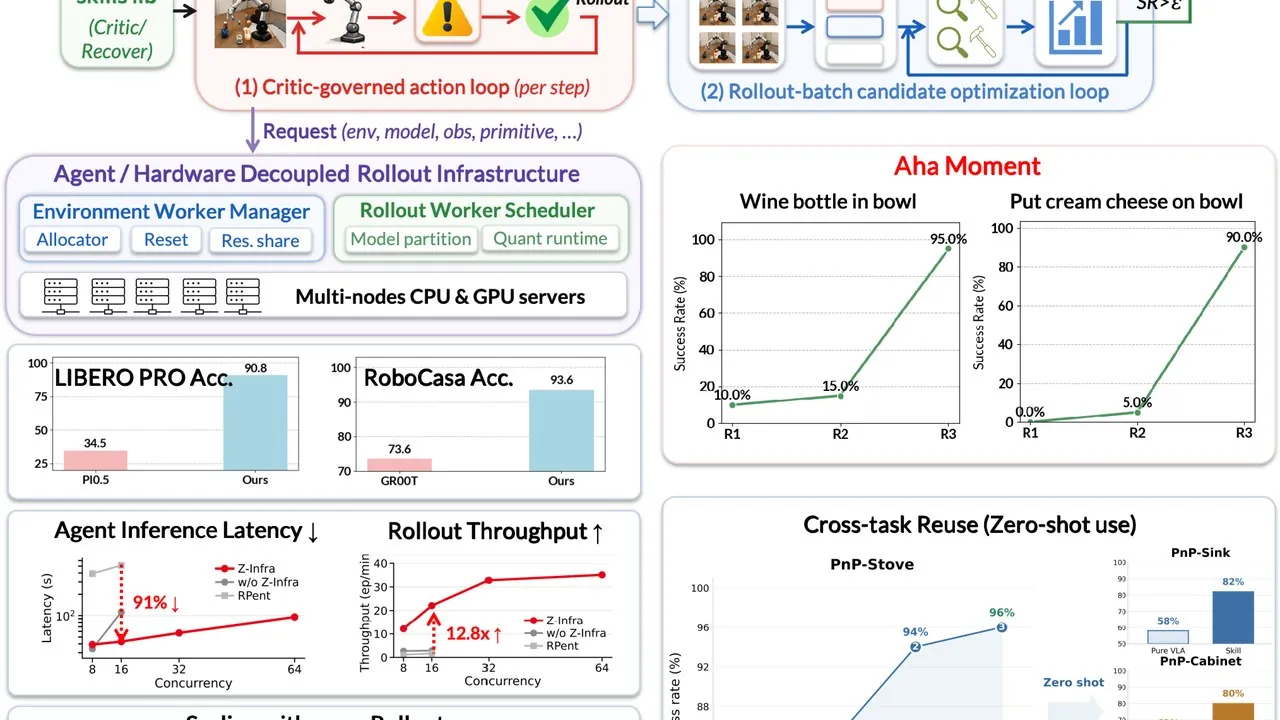
Tsinghua AIR and Z-Trans AI present Zetta ζ, a closed-loop embodied harness that improves a frozen VLA policy without a single gradient update. Instead of fine-tuning, it evolves the execution harness around the policy: code-based runtime critics watch every action, recovery skills take over on deviation, and a validation gate admits only skills that generalize. The frozen baseline scores 31.0% on LIBERO-Pro; the same policy under Zetta ζ reaches 92.5% (+56.3 absolute points), with a +20-point gain to 93.6% across 18 RoboCasa tasks. Z-Infra scales valid rollout throughput 20.6× and speeds inference 11.1×. Skills transfer zero-shot, and clear robotic "aha moments" emerge.
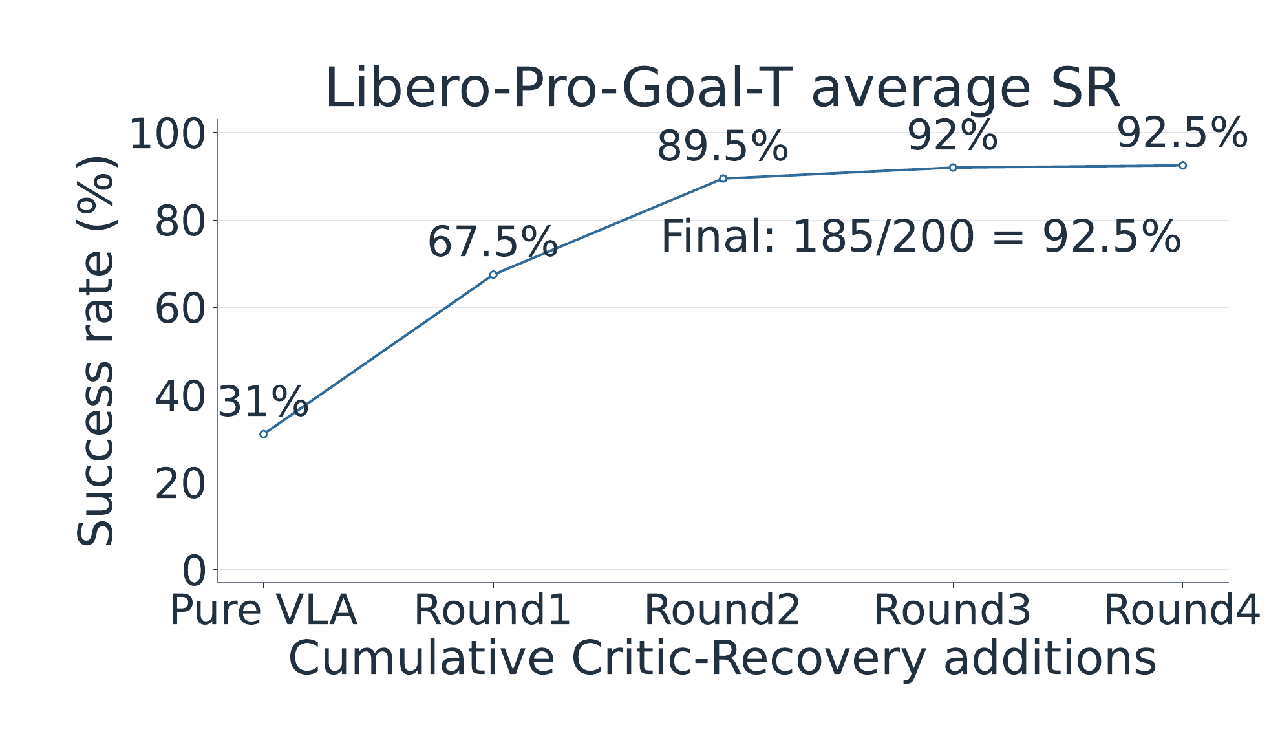
A research team from the Institute for AI Industry Research (AIR) at Tsinghua University, together with Z-Trans AI, has released Zetta ζ — a closed-loop embodied harness that lets a frozen VLA policy keep getting better at physical tasks without a single gradient update to its weights. Instead of fine-tuning the policy, Zetta ζ evolves the execution harness around it: code-based runtime critics that watch every action, recovery skills that take over the moment something goes wrong, and a validation gate that only admits skills proven to generalize. On LIBERO-Pro the frozen baseline succeeds 31.0% of the time; the same policy under Zetta ζ reaches 92.5%.
The headline numbers, straight from the project page:
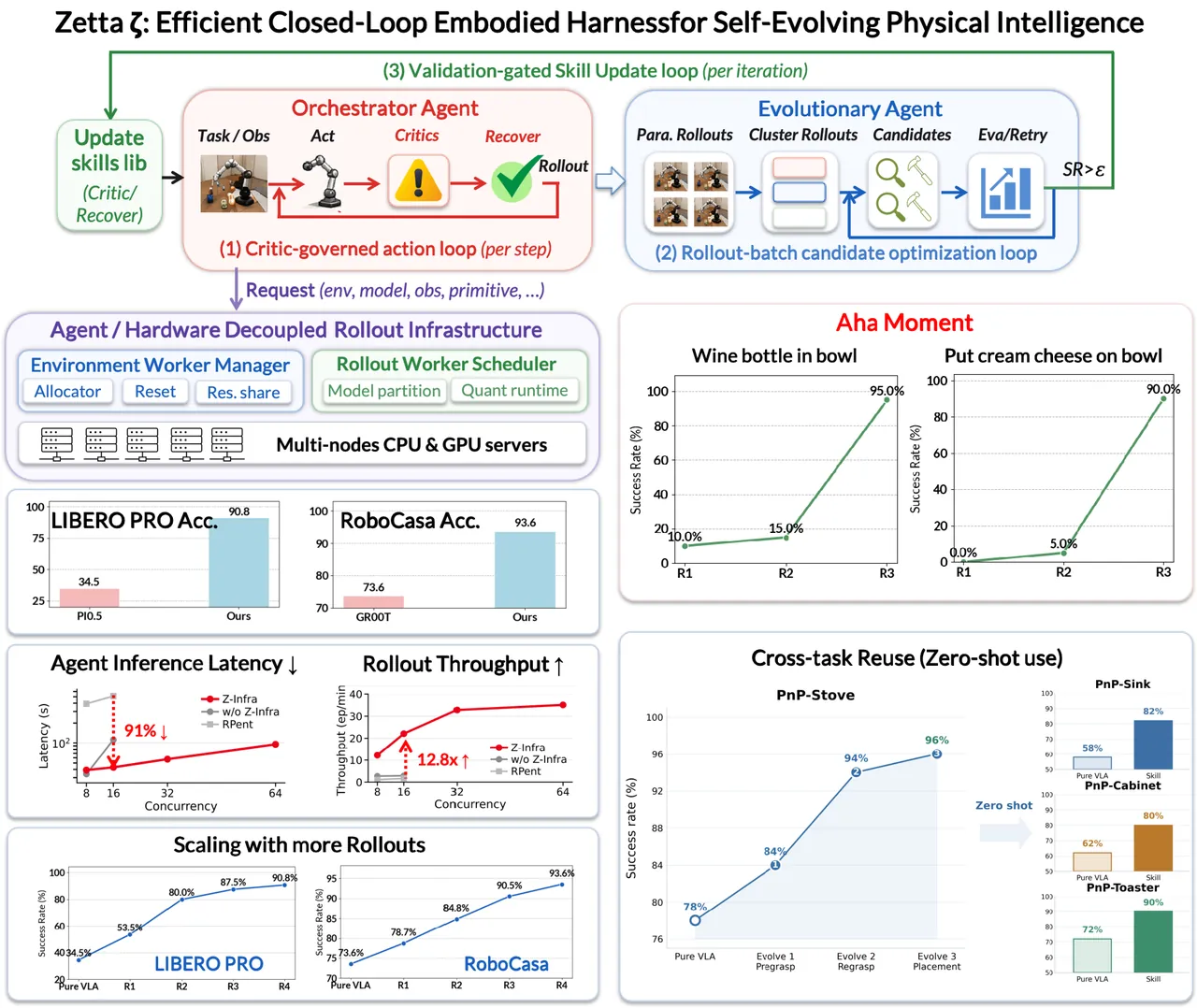
- 90.8% average task success on LIBERO-Pro Goal (vs. a 31.0% frozen baseline — a +56.3 point absolute gain)
- 93.6% average success across 18 RoboCasa tasks (+20 points over the frozen VLA)
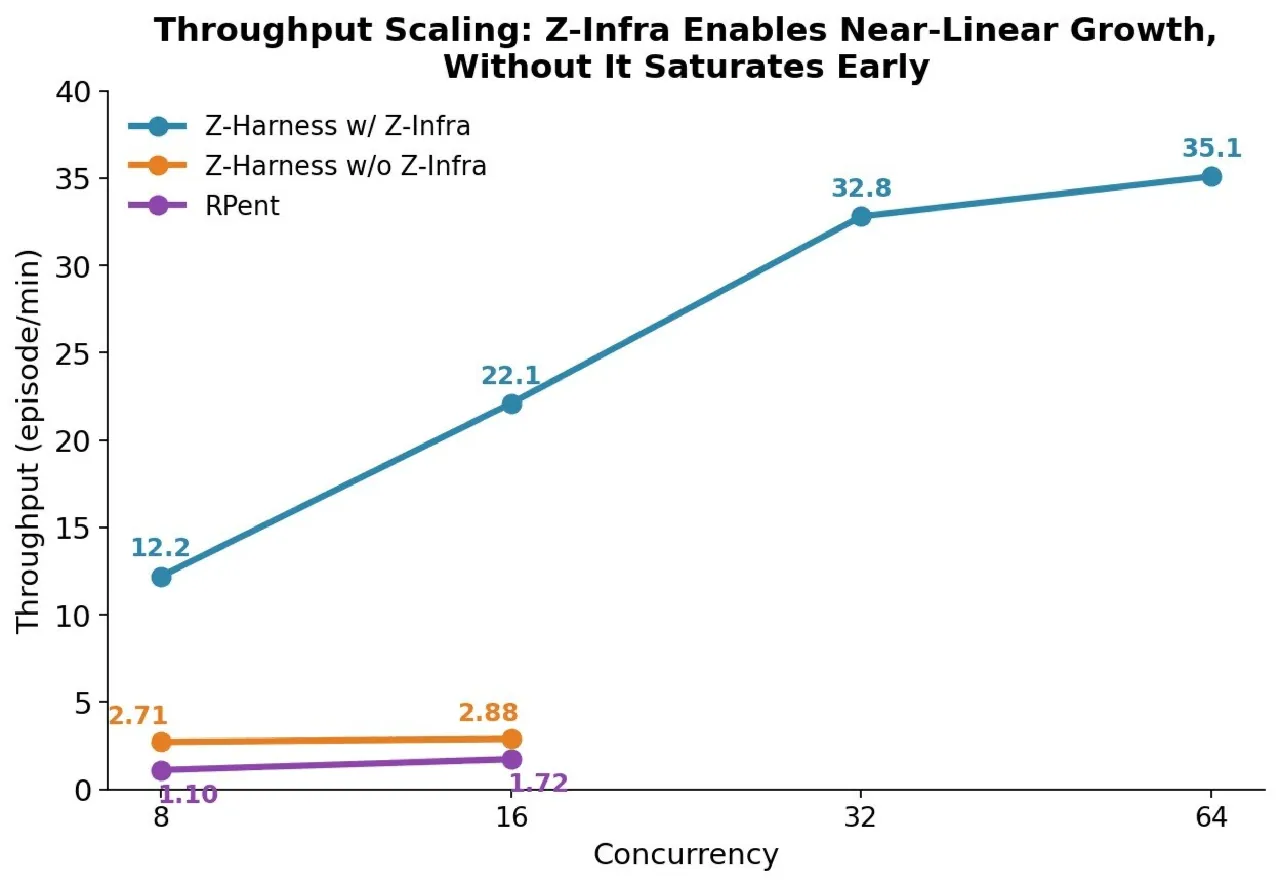
- 20.6× valid rollout throughput with the Z-Infra rollout layer
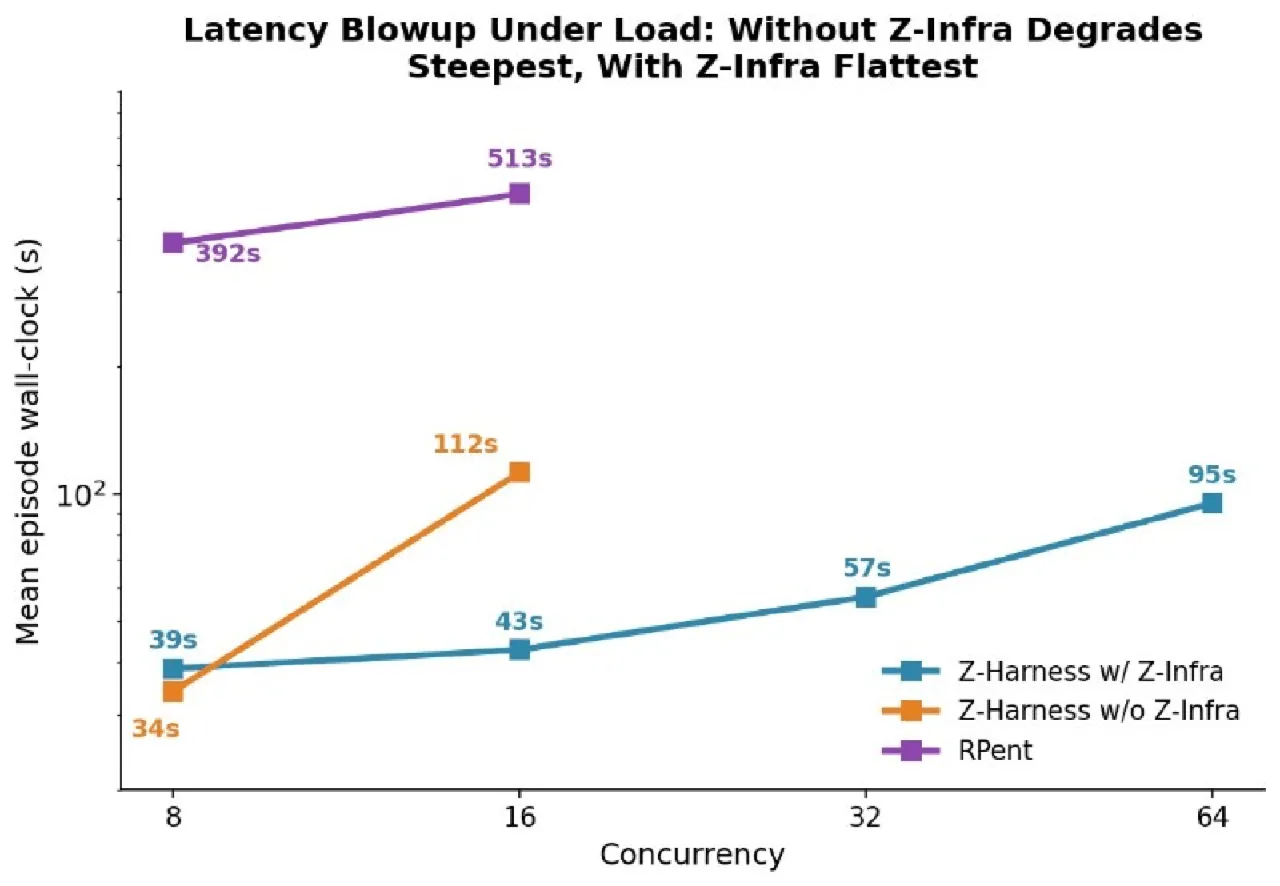
- 11.1× inference speedup for the harness itself
The problem: open-loop harnesses cannot govern physical execution
Embodied agents are increasingly used to close the gap left by end-to-end policy models — but the agentic path has not yet achieved closed-loop learning during physical execution. Existing harnesses remain largely open-loop: they follow fixed skills during a rollout and only reflect after the episode completes. The authors argue this post-hoc reflection fundamentally cannot govern execution as it unfolds, because physical interaction demands decisions that track rapidly changing robot–environment states at a frequency beyond today's large agentic models. By the time an episode-level reflection finishes analyzing, the mug is already on the floor.
Zetta ζ's answer is to separate governance from reflection by timescale, and to evolve code instead of weights: no VLA fine-tuning, no gradient updates on policy weights — only the code-based execution harness evolves.
Three timescale-separated loops
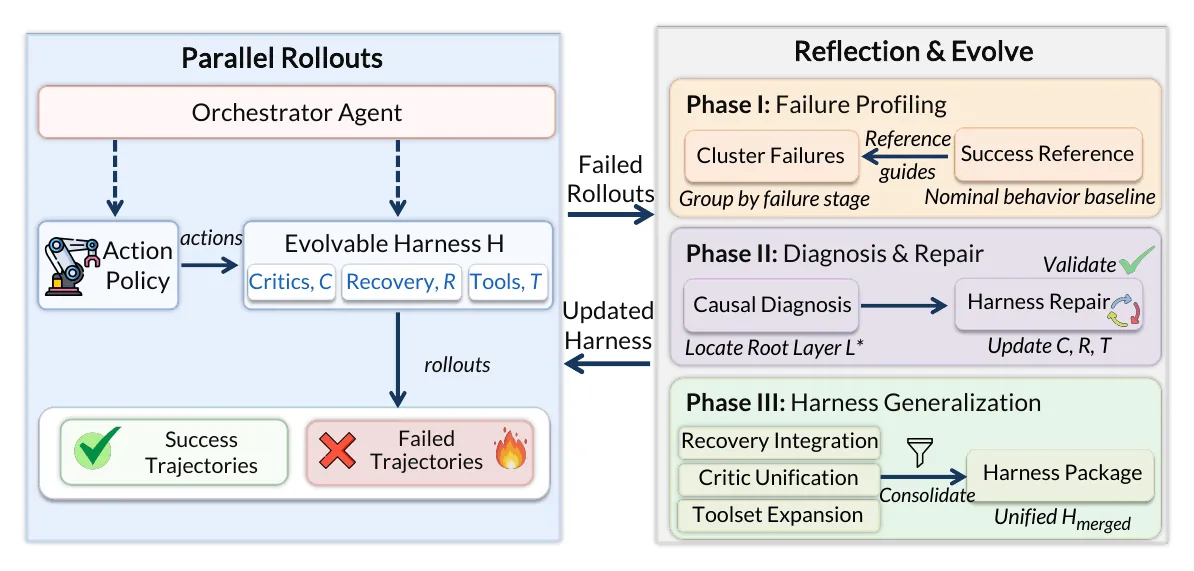
The harness self-evolves through three loops operating at different speeds:
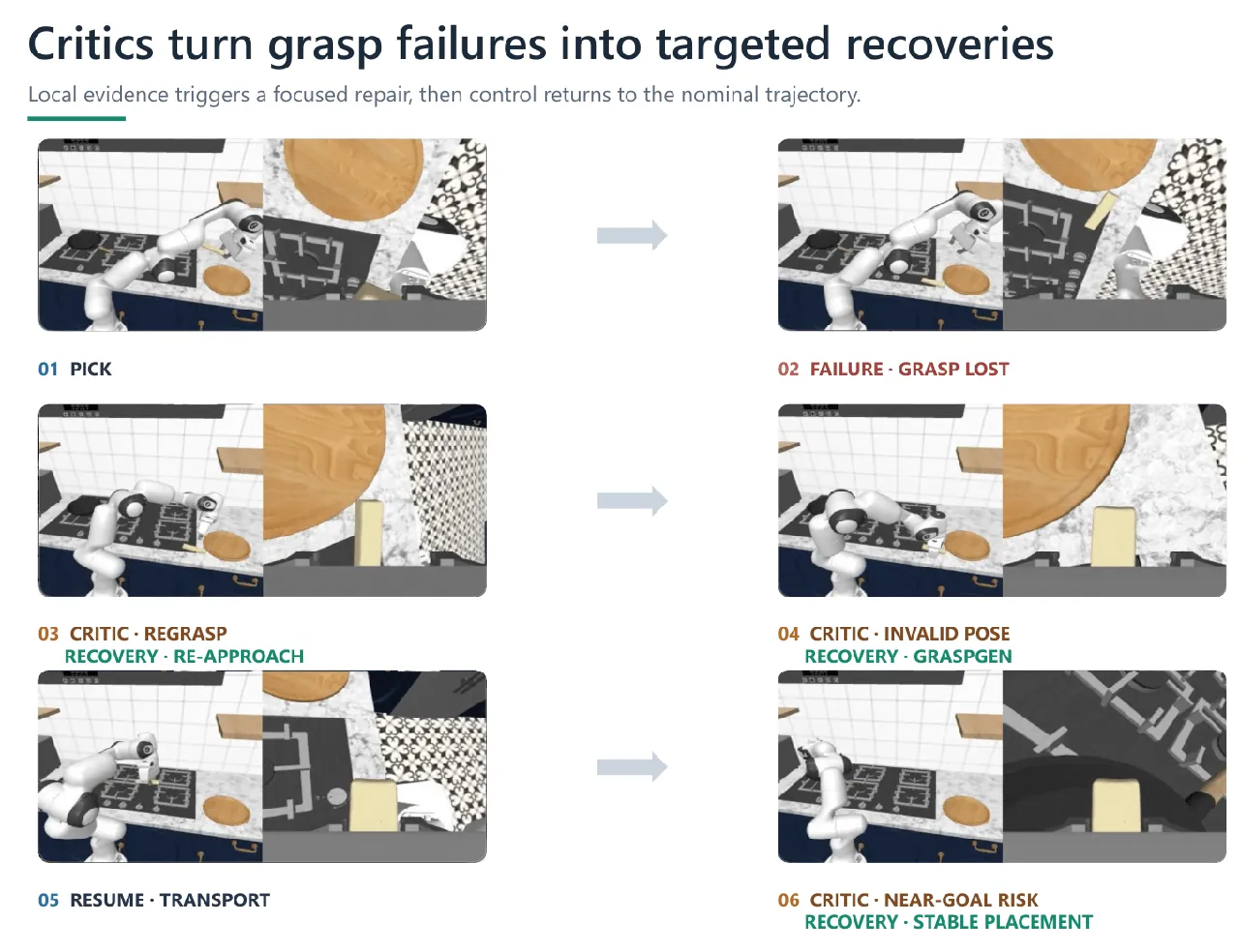
- Loop 1 · Action — Critic-governed action loop. Learned runtime critics execute at action frequency, monitor physical state, and trigger recovery skills the moment execution deviates from the nominal distribution. This is what makes governance online rather than post-hoc.
- Loop 2 · Rollout batch — Candidate optimization loop. Failed rollouts are clustered by their earliest observable divergence, causally diagnosed, and converted into candidate critic and recovery updates written in code space.
- Loop 3 · Iteration — Validation-gated skill update loop. Only candidates that pass historical regression tests and strict held-out generalization checks are admitted into the versioned skill memory. Skills that fix one task but break others never make it in.
Robotic "Aha moments": success is not a smooth curve
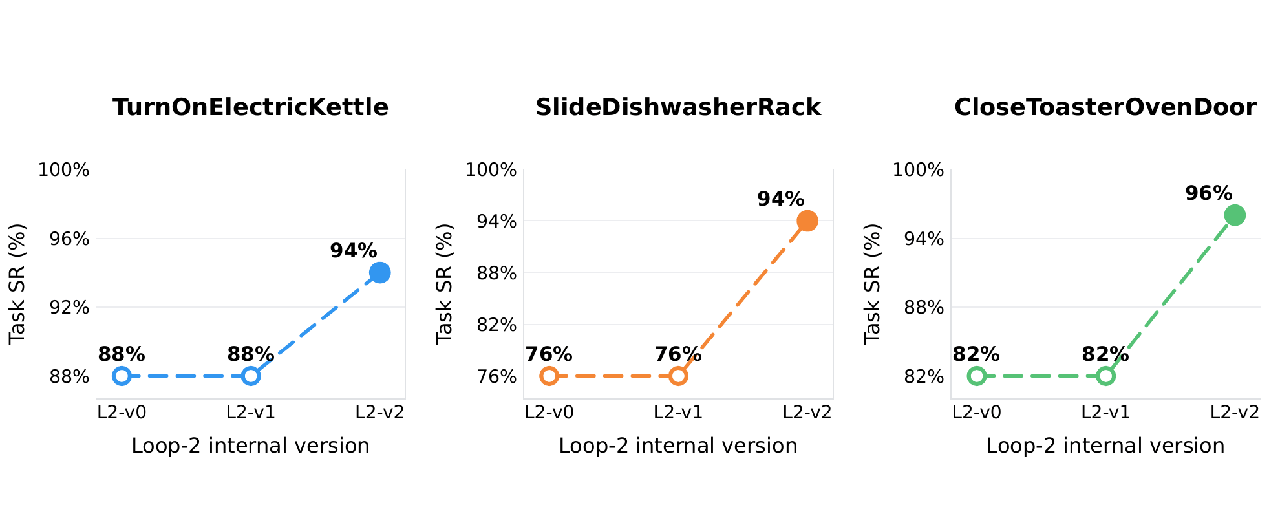
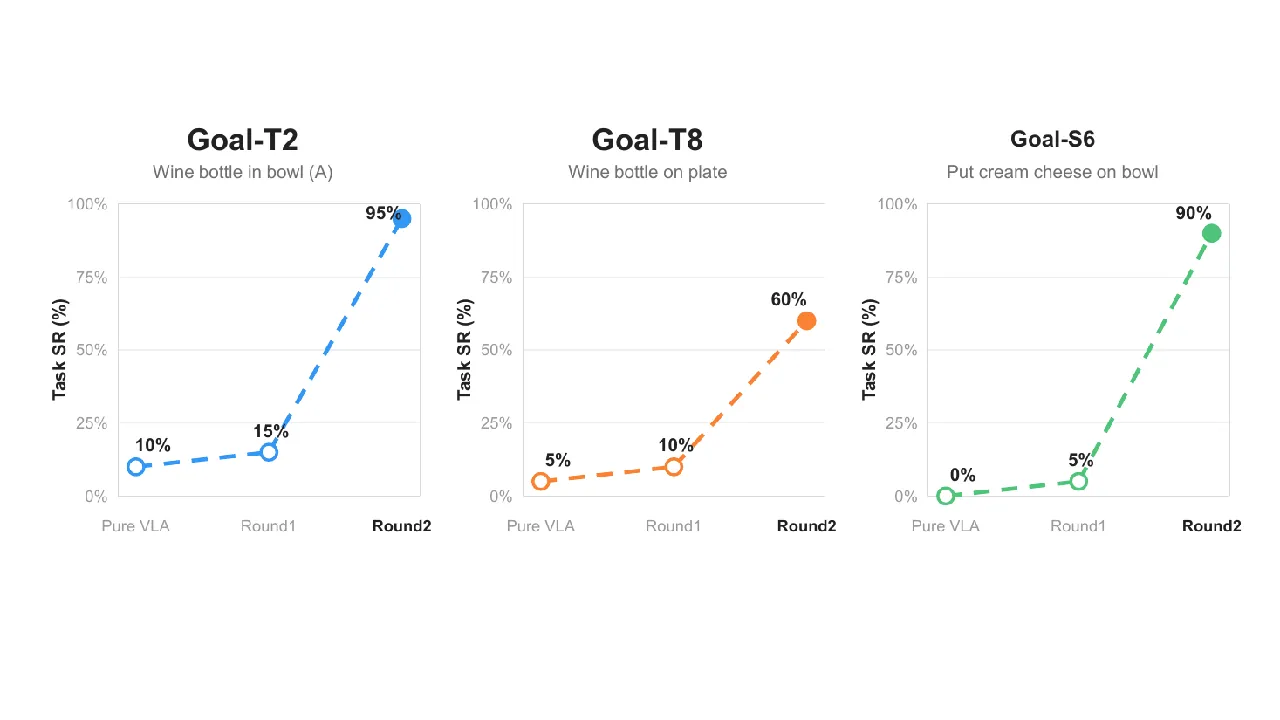
One of the most striking observations in the project: improvement is not gradual. Zetta ζ often discovers the key physical bottleneck and unlocks a sharp, discontinuous jump in success — what the team calls robotic "Aha moments".
Case study: CoffeeSetupMug on RoboCasa
Round-by-round improvements emerge on RoboCasa tasks such as turning on an electric kettle, sliding a dishwasher rack, closing a toaster-oven door, and placing a coffee pot. The CoffeeSetupMug task is representative:
Case study: push the plate to the front of the stove (LIBERO-Pro)
A harder example from LIBERO-Pro, where the frozen policy starts at 0% and needs two rounds of evolved skills:
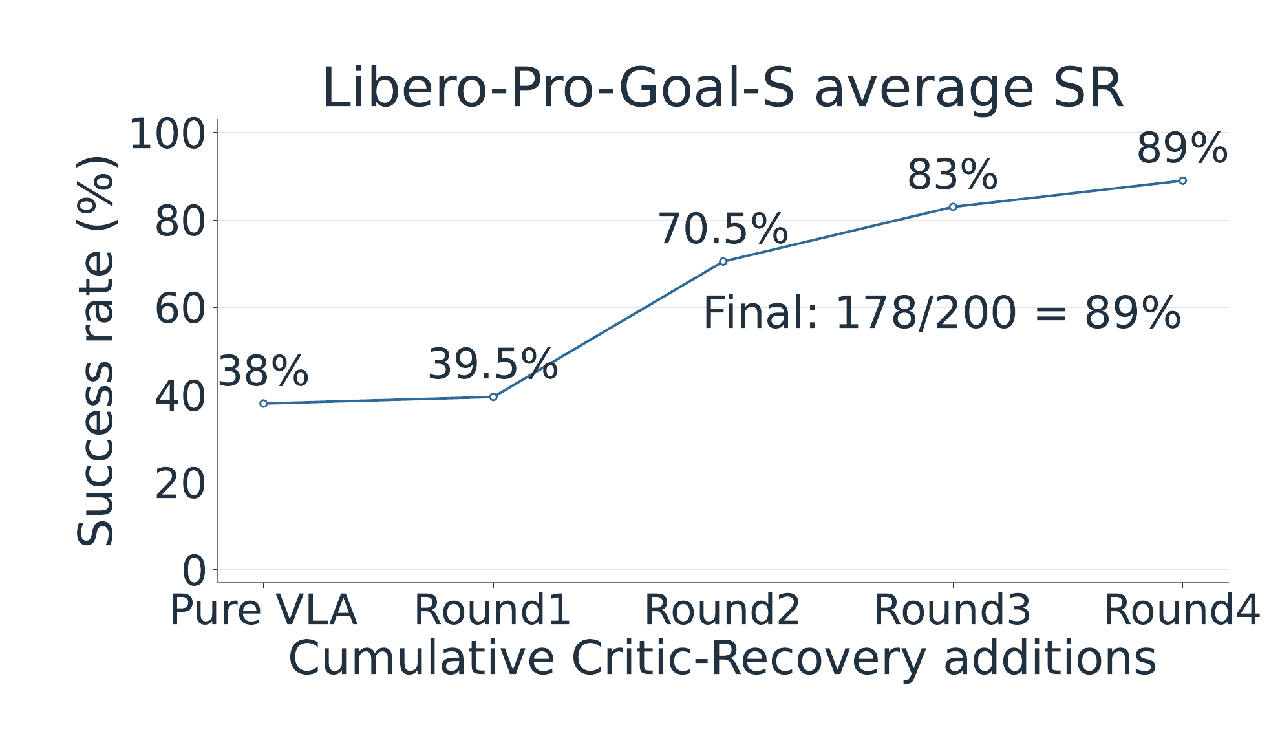
Success scales with evolution iterations
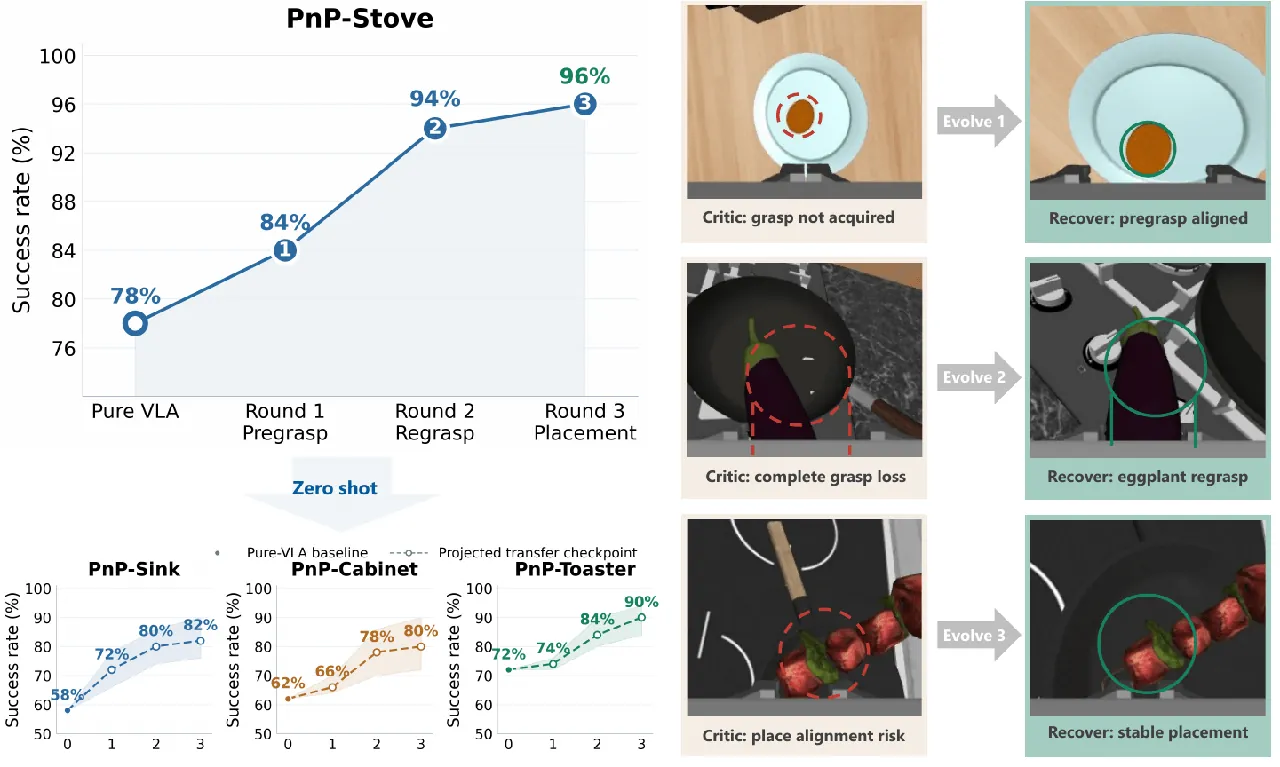
As cumulative critic–recovery mechanisms are added, task success steadily approaches the measured capability ceiling of the frozen policy:
Learned skills transfer zero-shot across tasks
The skills evolved by Zetta ζ are not task-specific trajectories. They are defined by object-relative geometry, contact, grasp retention, and progress predicates — physical invariants that transfer across related tasks without any additional evolution loop:
- PnP skills (pick-and-place transfer). Pregrasp, regrasp, and stable-placement skills learned on PnP-Stove improve PnP-Sink, PnP-Cabinet, and PnP-Toaster from a 64% macro-average to 84%.
- Articulated skills (contact-rich interaction transfer). Target localization, collision-aware approach, and stable-contact skills learned on TurnOffStove improve faucet, cabinet, and microwave tasks from a 64% macro-average to 80%.
Z-Infra: rollout infrastructure for self-evolving embodied agents
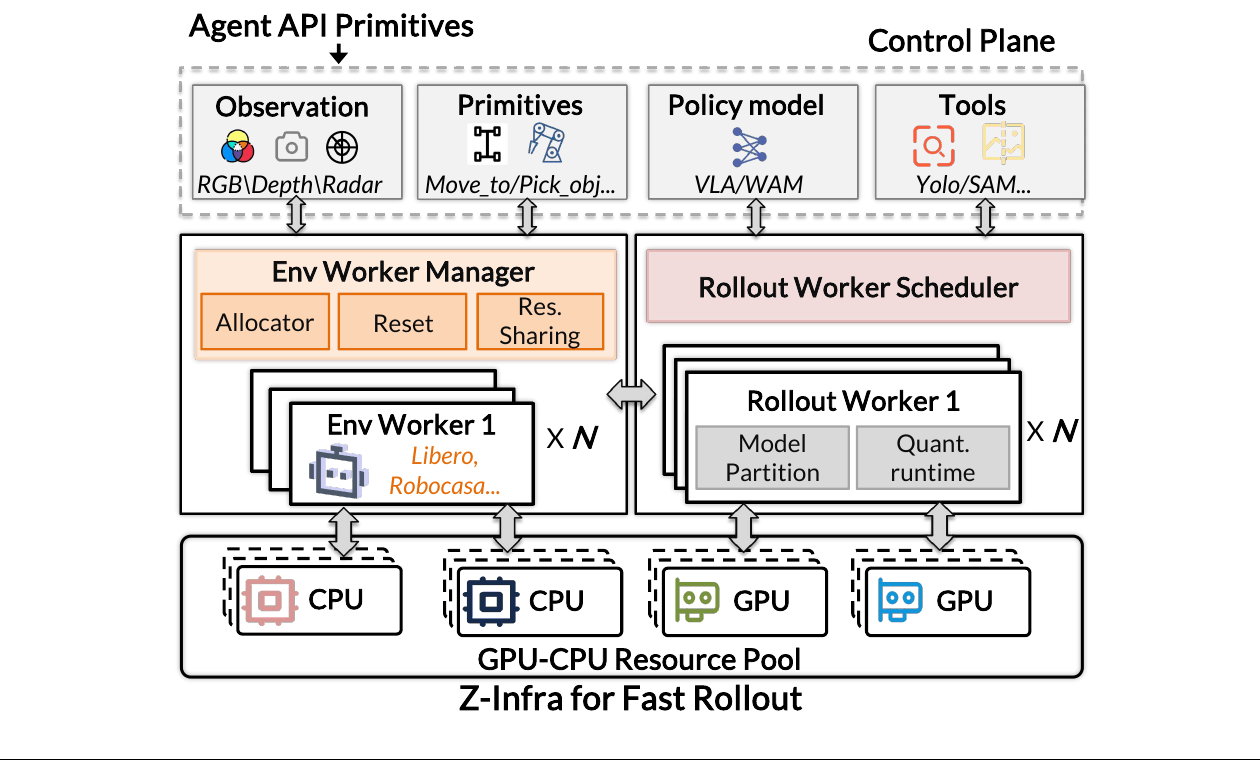
Self-exploration in the environment is the source of learning data, so faster rollouts produce faster evolution. Z-Infra is the rollout infrastructure layer that decouples agent logic from heterogeneous execution resources: a control plane routes agent requests to specialized environment workers and rollout workers, so the same agent logic runs across heterogeneous hardware without modification.
Benchmark results
All improvements come from evolving the harness, not from changing the frozen VLA weights. LIBERO-Pro Goal (T/S) and LIBERO-10 (T/S) are averaged over ten tasks each; RoboCasa is the macro-average over 18 Atomic-Seen tasks.
| Benchmark | Setting | Frozen VLA | Zetta ζ |
|---|---|---|---|
| LIBERO-Pro | Goal (T) | 31.0 | 92.5 |
| Goal (S) | 38.0 | 89.0 | |
| LIBERO-Pro | LIBERO-10 (T) | 50.0 | 63.0 |
| LIBERO-10 (S) | 9.0 | 40.0 | |
| RoboCasa | 18 Atomic-Seen | 73.56 | 93.56 |
Why it matters
The result the authors want readers to take away: closed-loop harness self-evolution opens a scaling path for reliable physical intelligence. Success continues to scale with self-exploration experience, learned skills transfer zero-shot, and clear robotic "Aha moments" emerge — all while the base policy stays frozen. If reproducible at wider scale, this is a compelling alternative to the fine-tuning-centric paradigm: improve the harness, not the weights.
Paper: Zetta ζ: An Efficient Closed-Loop Embodied Harness for Self-Evolving Physical Intelligence (arXiv:2608.16590) · Code: air-embodied-brain/Zetta-Embodiment
Source: Zetta ζ project page — AIR, Tsinghua University & Z-Trans AI. Xin Ding, Liang Mi, Mingzhe Huang, Zixuan Wang, Chao Zhang, Zixu Hao, Fu Chen, Xiangyu Li, Yikai Zheng, Yaoyu Guo, Weijun Wang, Kun Li, Hao Wu, Yunxin Liu, Ting Cao.
Source:Zetta ζ Project Pagehttps://air-embodied-brain.github.io/zetta/