OPEN SOURCE DEEP DIVE
Dexbotic: A One-Stop VLA Toolbox for Pretraining, Fine-Tuning, Inference, and Evaluation
A one-stop VLA toolbox from Dexmal: the unified DexData format spans pretraining, fine-tuning (full/LoRA/RL), inference, and evaluation, supporting mainstream models (π0, CogACT, OFT, MemVLA, GR00T N1) plus the in-house dual-expert DM0; DB-pretraining brings consistent gains across five simulation benchmarks, with 62% average success on RoboChallenge Table30 real-robot evaluation.
One Toolbox for the Entire VLA Pipeline
Dexbotic is a one-stop vision-language-action (VLA) toolbox open-sourced by the Dexmal team. Officially released in October 2025 with an accompanying technical report (arXiv:2510.23511), it has been updated at a high pace ever since. Instead of stitching together separate scripts for each stage, it consolidates the full VLA workflow — data preparation, pre-training, fine-tuning (full-parameter / LoRA / reinforcement learning), inference serving, simulation benchmarking, and real-robot deployment — into a single PyTorch codebase.
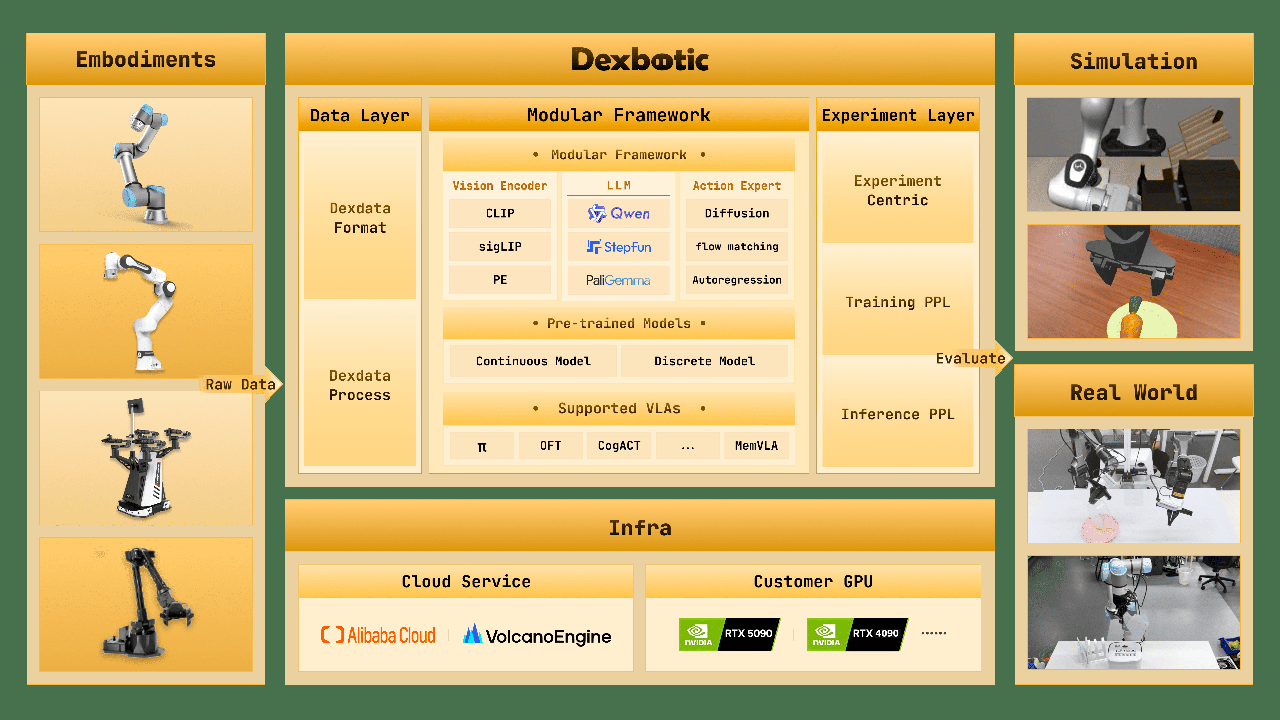
Three design threads run through the framework:
- Unified model interface: mainstream manipulation models (π0, π0.5, CogACT, OFT, MemVLA, GR00T N1) and navigation models (Uni-NaVid, NaVILA) share the same training, inference, and evaluation stack — switching models only requires swapping an experiment config file;
- DexData, a unified data format: official conversion scripts turn RLDS and LeRobot datasets into DexData, after which they plug directly into the training pipeline;
- Modular architecture: hierarchical configs, factory registration, and entry-point dispatch mean a new model or robot embodiment only needs to register its components — no changes to the core code.
Engineering Support for Training, Inference, and Deployment
On the training side, Dexbotic supports the FSDP2 distributed backend and ships co-training configurations for CogACT, Pi05, and DM0, letting the action expert and the language-model backbone be jointly optimized. Training is recommended from 8×A100/H100; on 8×RTX 4090 a ZeRO-3 offload config keeps memory in check. For fine-tuning, four LIBERO LoRA SFT recipes (π0, π0.5, DM0, CogACT) run even on a single consumer GPU.
On the inference side, a unified v1 inference API erases wrapper differences across models: once training finishes, the model can be served directly. With DM0, for example, you launch the inference server and send one curl request with an image and an instruction to /process_frame to get actions back. Docker is the recommended path for both development and deployment — the dexmal/dexbotic image works out of the box, and Blackwell GPUs (e.g., RTX 5090) have a dedicated c130t28 image. The minimal path:
docker pull dexmal/dexbotic
git clone https://github.com/dexmal/dexbotic && cd dexbotic
pip install -e .
torchrun --nproc_per_node=8 playground/benchmarks/libero/libero_dm0.py
DB-Pretrained Models: Consistent Gains Across Five Benchmarks
The team trained enhanced pretrained models (prefixed DB-) on their own large-scale dataset, then compared the original models against "DB-pretrained, then fine-tuned" versions on five mainstream simulation benchmarks. The gains are positive almost across the board and largest on transfer-style benchmarks like SimplerEnv and ManiSkill2 — CogACT rises from 51.25 to 69.45 and OFT from 30.23 to 76.39 — evidence that large-scale pretraining contributes far more to cross-environment generalization than in-distribution tuning.
| Benchmark | Model | Original | DB-Pretrained |
|---|---|---|---|
| LIBERO (avg) | CogACT | 93.6 | 94.9 |
| LIBERO (avg) | MemVLA | 96.7 | 97.0 |
| LIBERO (avg) | GR00T N1 | — | 94.8 |
| CALVIN (avg length) | CogACT | 3.246 | 4.063 |
| SimplerEnv (avg) | CogACT | 51.25 | 69.45 |
| SimplerEnv (avg) | OFT | 30.23 | 76.39 |
| SimplerEnv (avg) | MemVLA | 71.9 | 84.4 |
| ManiSkill2 (avg) | CogACT | 40 | 58 |
| ManiSkill2 (avg) | OFT | 21 | 63 |
| RoboTwin 2.0 (avg) | CogACT | 43.8 | 58.5 |
DM0: A Dual-Expert VLA with Flow Matching
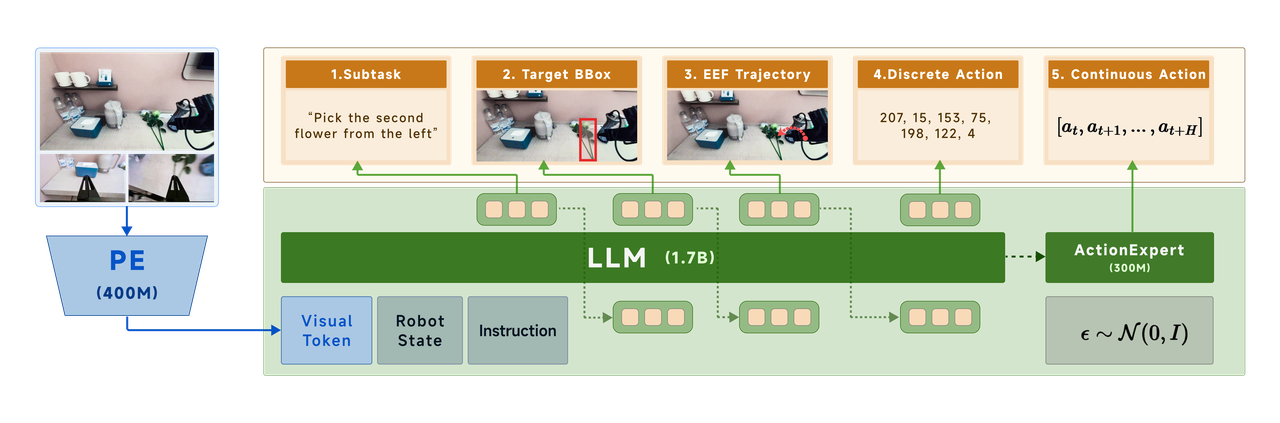
DM0 is the team's in-house VLA (released 2026-02-10 with its own technical report): a dual-expert structure pairing a vision-language backbone with an action expert, bridged by merged attention. Instead of discrete action tokens, the action head uses diffusion-style continuous generation via Flow Matching, producing a full chunk of future actions in a single forward pass. The open DM0-base weighs 2.4B parameters, supports 32-D actions, and accepts up to 3 camera views.
Results: DM0 averages 94.1 across the four LIBERO suites (Spatial 98.2 / Object 98.8 / Goal 96.6 / Long 82.6). On the RoboChallenge platform's Table30 real-robot evaluation, DM0 reaches a 62% average success rate and 72.25 average score, well ahead of π0 (28%) and π0.5 (43%). On the navigation front, DM0 achieves a 73.5 object-navigation success rate on HM3D and 45.3 on MP3D, on par with the navigation-specialized Uni-NaVid. On the engineering side, a Triton-backed realtime inference backend delivers roughly a 5x speedup on core inference, supporting closed-loop control on real robots.
RL Post-Training and the Real-Robot Ecosystem
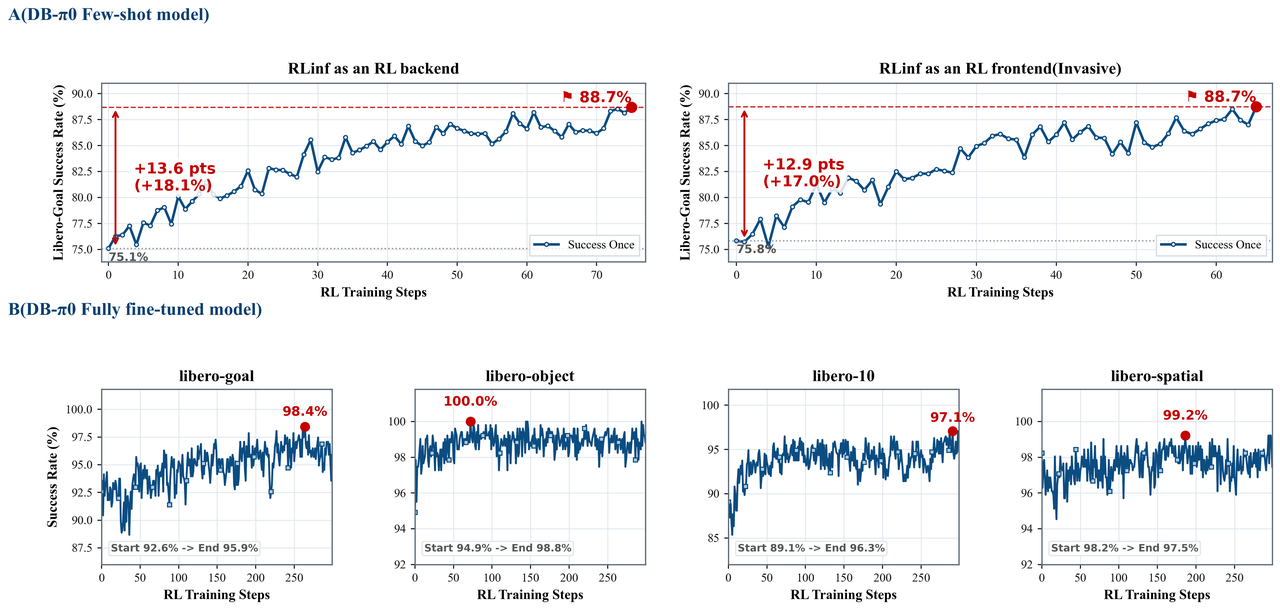
On 2026-02-10, Dexbotic and the RLinf team announced a strategic partnership to jointly advance VLA + RL research. The framework has GRPO built in, and RLinf can also be used as an external RL backend for post-training, sharing the same data and model interfaces as SFT/LoRA fine-tuning.
The real-robot ecosystem already covers UR5, Franka, ALOHA, the dual-arm DOS-W1, SO-101, XLeRobot, and the Unitree G1 (including a SONIC whole-body control example), each with an inference integration tutorial. For evaluation, a separate dexbotic-benchmark repository runs the full LIBERO suite in Docker with one command, and remote real-robot evaluation can be submitted through the RoboChallenge platform. The project is MIT-licensed, model weights are hosted on Hugging Face (Dexmal), and full documentation lives at dexbotic.com.